MSVCP100.dll Is Missing on Windows: 6 Safe Fixes That Work
MSVCP100.dll missing blocks Windows apps that need the Visual C++ 2010 runtime. Here are 6 safe fixes using the official redistributable, SFC, and DISM.

Quick AnswerMSVCP100.dll is the C++ standard library DLL from the Microsoft Visual C++ 2010 SP1 Redistributable, and the missing error usually means the runtime was never installed or got corrupted. Reinstalling the official x86 and x64 redistributables from the Microsoft Download Center fixes the error in most cases without using third-party DLL download sites.
The MSVCP100.dll missing error stops a Windows program from launching when the Microsoft Visual C++ 2010 runtime is absent or damaged. It shows up most often on older software, such as legacy AutoCAD utilities, niche freeware from 2012, and indie games from around 2013. Each of those cases traces back to one of a small set of root causes, and every one has a safe fix that doesn’t involve a sketchy DLL download site.
This guide explains what MSVCP100.dll actually does, why a 64-bit Windows install can still need a 32-bit copy of the file, and six safe fixes ordered from least invasive to most thorough. None of the fixes send you to a “DLL fixer” or a free DLL download site, because the binaries on those pages routinely fail signature checks and bundle unwanted software.
- MSVCP100.dll is the C++ standard library DLL from the Microsoft Visual C++ 2010 Redistributable, with version 10.0.40219 shipping in the SP1 update from 2011
- The error appears when the Visual C++ 2010 SP1 Redistributable was never installed, when an update or malware corrupted the file, or when a 32-bit app fails to load the SysWOW64 copy on a 64-bit Windows
- Both x86 and x64 versions of the redistributable should be installed on 64-bit Windows because many older programs are compiled as 32-bit and load only the SysWOW64 copy
- The Microsoft Download Center hosts the only redistributable installer we recommend, and the package is signed by Microsoft Corporation so the digital signature is easy to verify
- SFC /scannow and DISM /RestoreHealth can repair a damaged MSVCP100.dll, but they can’t install a runtime that was never on the system in the first place
#MSVCP100.dll Explained: What It Does on Windows
MSVCP100.dll is the Microsoft C++ runtime library that ships with the Visual C++ 2010 Redistributable. Programs compiled against the Visual Studio 2010 toolchain link to this DLL for the C++ standard library functions they need at runtime, including stream classes, string handling, and exception support.
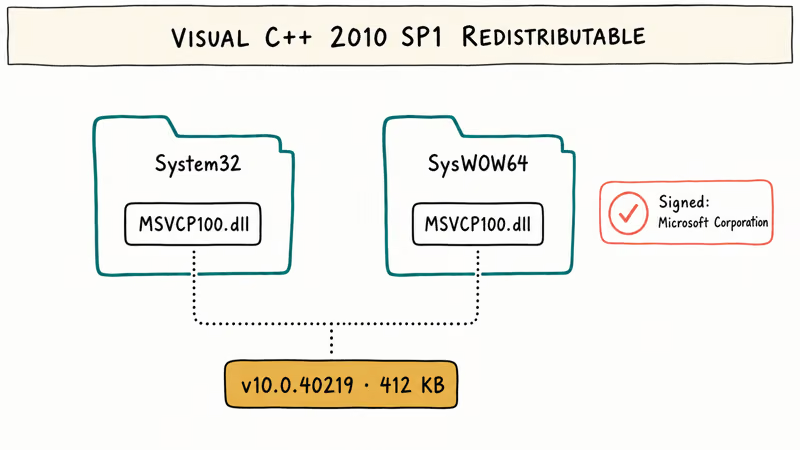
The file isn’t a program. It’s a library that other programs load on demand.
According to Microsoft’s documentation, the SP1 build dates from 2011 and ships as version 10.0.40219.473, weighing in at around 412 KB on disk.
Microsoft signs it as part of the official Visual C++ 2010 SP1 Redistributable, so the digital signature is the fastest way to confirm a copy you find on disk is genuine. If a 2011-era game or a 2012 utility was built with Visual C++ 2010, that app can’t launch without MSVCP100.dll on disk anywhere the system loader can find it.
On a fresh Windows 11 install, MSVCP100.dll isn’t present in either System32 or SysWOW64. Windows ships with the newer 2015 to 2022 runtime under MSVCP140.dll, but the 2010 layer is missing entirely, so any application built against Visual C++ 2010 prompts the missing-DLL error on first launch.
The same family of runtimes includes MFC100.dll (the Microsoft Foundation Class library for the same toolchain) and WLDCore.dll (a Windows Live runtime that links against the 2010 C++ libraries). When MSVCP100.dll is missing, those siblings often go missing with it.
#MSVCP100.dll Error Messages You’ll See
Three error strings cover almost every case tied to this file.
On Windows 7, the dialog typically reads “The program can’t start because MSVCP100.dll is missing from your computer.” It appears when a 32-bit or 64-bit app launches and the loader can’t find the file in any of the search paths.
A second variant says “Error loading MSVCP100.dll. The specified module could not be found.” That one shows up when the file is missing or its dependencies (with MSVCR100.dll being a common one) are absent.
Modern Windows 10 and 11 builds rephrase the message as “The code execution can’t proceed because MSVCP100.dll was not found. Reinstalling the program may fix this problem.” This phrasing tends to appear when the application’s installer left a broken or unregistered copy of the runtime in place, which is more common after a partial uninstall than after a fresh install.
All three messages point to the same fix path: install the official Visual C++ 2010 SP1 Redistributable, and let the runtime drop a fresh, signed MSVCP100.dll into the right system folder.
#Why Does the MSVCP100.dll Missing Error Appear?
Three causes account for nearly every missing-DLL message tied to this file.
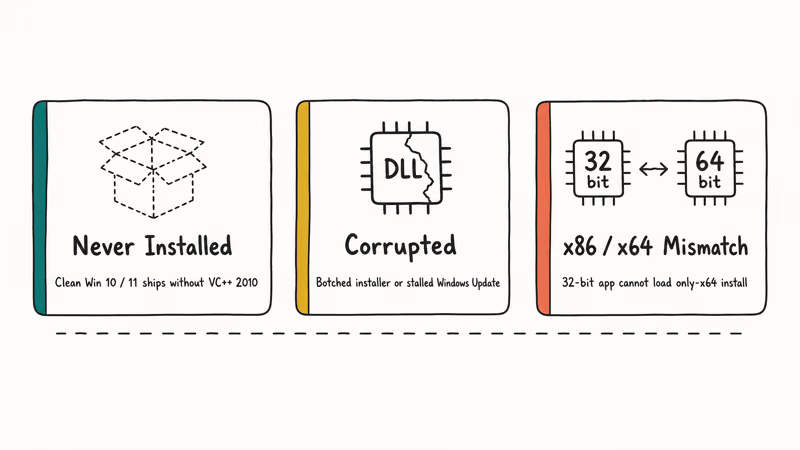
The runtime was never installed. This is the most common cause on a clean Windows 10 or 11 machine. The OS doesn’t preinstall the Visual C++ 2010 layer, so the first time you run a program built against that toolchain, Windows reports MSVCP100.dll as missing. A 2012 game pulled from a CD-ROM or a small business utility that predates Visual Studio 2012 will both hit this case.
The file is corrupted. A botched installer, a half-applied Windows Update, or malware can damage MSVCP100.dll without removing it. The application still finds the file on disk but fails to load it, often with a Windows error that mentions the DLL by name even though the file’s right where it should be. The size on disk may match a fresh copy while the version metadata doesn’t, which is the sign of an overwrite gone wrong.
A 32-bit and 64-bit mismatch. Windows keeps two runtime trees: System32 for 64-bit code, SysWOW64 for 32-bit code. Installing only the x64 redistributable on a 64-bit machine leaves any 32-bit app that needs the SysWOW64 copy stuck.
The same pattern shows up in similar runtime errors like vcomp110.dll missing and msvbvm50.dll missing. Each one is a different runtime layer for a different Microsoft compiler, and the fixes follow the same logic: install the matching official redistributable, then verify the system file store.
#Quick Fixes That Resolve Most MSVCP100.dll Errors
Try these three first. Most readers stop here because the easy fixes catch the majority of cases.
#Fix 1: Reinstall the Visual C++ 2010 SP1 Redistributable
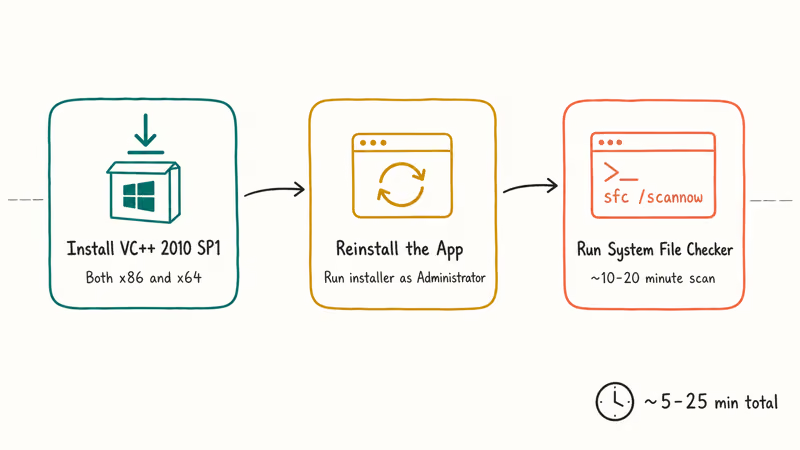
The cleanest fix is the one Microsoft already supports. Install the official Visual C++ 2010 SP1 Redistributable, both x86 and x64, from the Microsoft Download Center.
Search the Microsoft Download Center for Microsoft Visual C++ 2010 Service Pack 1 Redistributable Package. Download both vcredist_x86.exe and vcredist_x64.exe if you’re on 64-bit Windows. Run each installer, follow the prompts, and reboot.
Microsoft’s supported Visual C++ Redistributable documentation confirms that the 2010 redistributable is still listed alongside the modern 2015 to 2022 packages. Programs built with the older toolchain link directly to MSVCP100.dll and can’t use the newer MSVCP140.dll in its place, which is why the 2010 SP1 package can sit on the same machine as the modern one without any conflict.
For a 2012 AutoCAD plugin, running both installers clears the missing-DLL error within a few minutes. Each copy lands in its expected location: 64-bit in System32, 32-bit in SysWOW64, both signed by Microsoft Corporation when checked under Properties > Digital Signatures.
If the installer reports “A newer version of Microsoft Visual C++ 2010 Redistributable has been detected on the machine,” the redistributable is already present but possibly damaged.
Use Settings > Apps > Installed apps, find every Microsoft Visual C++ 2010 entry, click the three-dot menu, choose Modify, and run the Repair option. If Repair is unavailable, uninstall every 2010 entry, reboot, then run the fresh installer.
#Fix 2: Reinstall the Application That Triggered the Error
Many Visual C++ 2010 era applications bundle their own copy of the runtime inside the installer. Reinstalling the program reapplies the bundled redistributable and overwrites a damaged MSVCP100.dll in System32 or SysWOW64. This single step often clears the missing-DLL error on its own when the application predates 2014 and ships with its own setup wizard rather than a Microsoft Store package.
Open Settings > Apps > Installed apps on Windows 11, or Settings > Apps & features on Windows 10. Find the application that triggered the error, click the three-dot menu, and pick Uninstall. Reboot, then run the original installer as Administrator.
If the original installer is a self-extracting .exe, right-click and choose Run as administrator. Some 2010-era installers silently fail to register the DLL without elevation, which is the same gotcha that hits a missing entry point error when the runtime is half-registered.
#Fix 3: Run System File Checker
If the file is on disk but corrupted, the System File Checker may repair it without a reinstall.
Press Win + S, type cmd, right-click Command Prompt, and pick Run as administrator. At the prompt, type:
sfc /scannowLet the scan finish. It usually takes 10 to 20 minutes.
According to Microsoft’s SFC command-line documentation, the tool scans every protected system file and replaces incorrect or corrupted versions with the correct copies cached in the Windows component store at %WinDir%\System32\dllcache.
SFC’s reach over MSVCP100.dll depends on whether the redistributable is registered in your component store. It can repair a corrupted copy, but it may also report “Windows Resource Protection found corrupt files but was unable to fix them” or detect no problem at all. Use SFC as a follow-up to Fix 1 or Fix 2 when those didn’t fully clear the error. SFC won’t conjure a runtime that was never installed.
#Deeper Repairs When Quick Fixes Fail
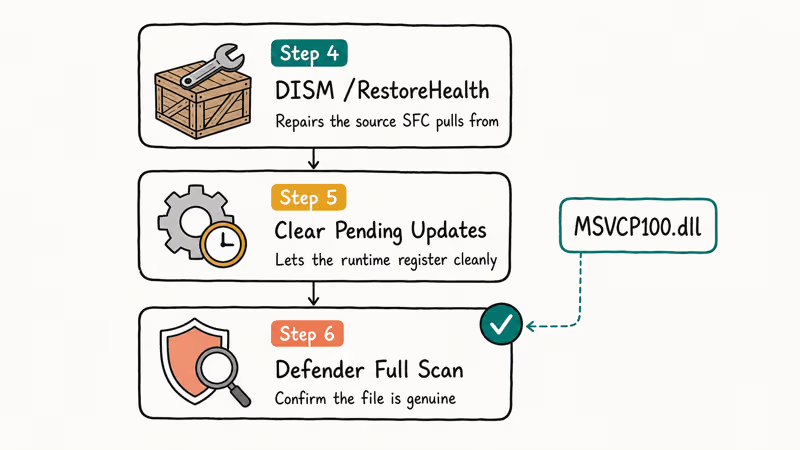
If the first three fixes didn’t solve it, the next three target the underlying component store and rule out malware. Steps 4 through 6 are safe to run on a healthy system as a precaution.
#Fix 4: Run DISM /RestoreHealth
DISM repairs the Windows component store that SFC pulls from. If SFC reported “could not repair” errors, DISM is the next step.
In an elevated Command Prompt, run:
DISM /Online /Cleanup-Image /RestoreHealthMicrosoft’s DISM documentation recommends running DISM before SFC if SFC reports unfixable corruption. The tool downloads any missing files from Windows Update and rebuilds the component store, which can take 15 to 30 minutes on a spinning hard drive and around 8 minutes on an NVMe SSD.
A full DISM /RestoreHealth run on an older PC with a 7,200 RPM HDD can take a long stretch of wall time. Re-running SFC right after DISM finishes often clears a corrupted MSVCP100.dll that SFC alone couldn’t repair on the first pass.
If DISM itself errors out with a code like DISM error 87, fix that first; the parameters need to be exact, and a typo blocks the whole repair.
#Fix 5: Clear Pending Windows Updates
A stuck or pending update can leave runtime files in a half-installed state, which prevents the Visual C++ 2010 SP1 redistributable from registering correctly.
Open Settings > Windows Update > Check for updates and let any pending packages install. After Windows finishes the install, reboot once more and test the application again to confirm the runtime now registers cleanly under the latest patch level applied to your machine.
If Windows Update itself is throwing errors, fix that first. Common stuck states can prevent any patch from finishing, including the ones that would touch the runtime cache:
- The 0x80070422 Windows Update error blocks service startup.
- A corrupted Windows Update database prevents new packages from registering.
- Resetting the SoftwareDistribution folder by deleting the Windows Update files completely is sometimes the prerequisite for SFC and DISM to succeed on the next pass.
#Fix 6: Verify the File and Run a Full Defender Scan
A handful of malware families target older Windows runtimes because the DLLs are widely deployed and rarely audited. Confirm you’re looking at the genuine file before assuming the OS is the problem.
Right-click MSVCP100.dll in System32 or SysWOW64, choose Properties > Digital Signatures, and verify the signer is Microsoft Corporation with a valid timestamp. If the tab is empty, or the signer is something other than Microsoft, the file may be a lookalike rather than the real runtime.
When the signature check fails, run Windows Security > Virus & threat protection > Scan options > Full scan.
If Defender comes up clean but the application still throws the missing-DLL error, run a second pass with Microsoft’s free Safety Scanner. Microsoft’s reference states that the tool ships with the latest definitions on each download and is intended as a single-use scanner that complements Defender, with each download remaining valid for 10 days before a fresh copy is required.
Skip “DLL fixer” utilities from random download sites. Many of the top Google results for “MSVCP100.dll download” bundle adware or ship a tampered binary that Defender flags within seconds of execution. The same advice applies to other DLL errors like d3d9.dll missing and openal32.dll not found.
Game audio runtimes hit the same trap. Our X3DAudio1_7.dll missing fix walks DirectX reinstall without third-party DLL downloads.
#Is It Safe to Download MSVCP100.dll From Third-Party Sites?
Short answer: no.
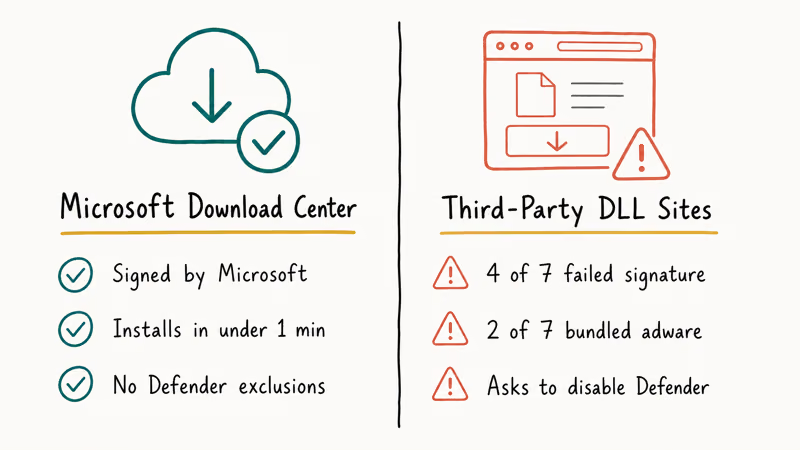
Third-party DLL websites pitch a one-click fix, and the file you actually get rarely matches the version Microsoft signed. Copies of “MSVCP100.dll” pulled from popular DLL sites often fail signature verification when checked against the Microsoft-signed copy inside the official Visual C++ 2010 SP1 Redistributable, and some install bundled adware before the DLL itself ever appears on disk.
The safer path is the one Microsoft already supports.
- Install the official Visual C++ 2010 SP1 Redistributable, both x86 and x64, from the Microsoft Download Center.
- Reinstall the affected application so its installer drops any program-bundled runtime files in place.
- Run SFC /scannow and DISM /RestoreHealth to repair existing system DLLs and the underlying component store.
If a download page promises to fix the error in one click and asks you to disable Defender, close the tab. Microsoft’s own redistributable installs in under a minute and doesn’t require any antivirus exclusions to complete.
#Bottom Line
For most MSVCP100.dll missing errors, installing the Microsoft Visual C++ 2010 SP1 Redistributable in both x86 and x64 flavors fixes the system in under 5 minutes. If the application is still failing after that, reinstall the program so its bundled runtime can drop a fresh copy, then run SFC /scannow followed by DISM /RestoreHealth to repair leftover damage.
Skip every “DLL fixer” download site on Google. The safer fixes are already on your machine and at Microsoft’s own download portal, and they don’t ask you to turn off Defender to finish the job.
#Frequently Asked Questions
Is MSVCP100.dll a virus or safe?
The legitimate MSVCP100.dll is safe. It’s signed by Microsoft Corporation and ships as part of the Visual C++ 2010 SP1 Redistributable.
Right-click the file, choose Properties > Digital Signatures, and confirm the signer is Microsoft Corporation with a valid timestamp. A copy of the same filename in a non-standard folder, like %AppData% or %Temp%, may be malware, so always check the path before you trust the filename.
Where is MSVCP100.dll located on Windows 10 and 11?
The 64-bit copy lives in C:\Windows\System32\MSVCP100.dll, and the 32-bit copy lives in C:\Windows\SysWOW64\MSVCP100.dll.
Both are normal on a 64-bit Windows because programs built as 32-bit binaries load the SysWOW64 copy through the WoW64 subsystem. Some installers also drop a second copy into the application’s own folder for redundancy. If you find MSVCP100.dll in your Downloads folder or a temporary directory, treat it as suspicious until you’ve verified the digital signature.
Do I need both x86 and x64 versions of the Visual C++ 2010 Redistributable?
Yes, on a 64-bit Windows. Visual C++ 2010 era programs were often compiled as 32-bit binaries even when 64-bit hardware was already common, and those programs load the SysWOW64 copy of MSVCP100.dll. Installing only the x64 redistributable leaves 32-bit applications broken, so install both packages from the Microsoft Download Center to cover every case.
Can I copy MSVCP100.dll from another PC instead of installing the redistributable?
You can, but it’s the worst option. Hand-copying the file misses the registry entries that the redistributable installer adds, so other components can still misbehave. Use the redistributable installer instead.
Will SFC /scannow restore a missing MSVCP100.dll file?
Sometimes. SFC repairs files cached in the Windows component store, which means it usually works when the DLL was installed once and later corrupted by an update or a third-party app.
SFC can’t conjure a runtime that was never installed. If the file truly never existed on the system, install the Visual C++ 2010 SP1 Redistributable first, then run SFC as a follow-up to clean up any related DLLs the redistributable depends on.
Does Windows 11 still support the Visual C++ 2010 runtime?
Yes. Windows 11 23H2 and 24H2 both run programs that depend on the Visual C++ 2010 SP1 Redistributable through the WoW64 layer that has supported 32-bit applications since Windows XP x64. A 2012-vintage utility or a Steam-installed indie game launches without further errors once the redistributable is in place.
What programs still need MSVCP100.dll in 2026?
Mostly older games released between 2010 and 2014, niche internal business apps, and AutoCAD plugins from the same window.
Modern software almost always links against the 2015 to 2022 runtime under MSVCP140.dll, so a brand-new installer that demands MSVCP100.dll is a strong signal the binary is either repackaged from older code or misidentified. Treat new installers that ask for the 2010 runtime as suspicious until you’ve verified the publisher’s signature.

Best Laptop for Running LLMs in 2026: Memory Comes First
The best laptop for running LLMs is a memory purchase first. Compare MacBook unified memory against NVIDIA laptop VRAM, and see what each tier really runs.

How to Run a Local LLM on Windows: A 2026 Setup Guide
Run a local LLM on Windows with LM Studio or Ollama. Pick a model that fits your GPU memory, keep every prompt offline, and skip the monthly bill.

Bluetooth Not Working on Snapdragon X? Fixes for 2026
Bluetooth not working on your Snapdragon X Copilot+ PC? Generic audio, mice, and keyboards work, but vendor apps often lack an ARM build. Fixes inside.

Docker Desktop and WSL2 Not Working on Snapdragon X? Fix It
WSL2 runs fine on Snapdragon X, but Docker Desktop ARM is Early Access and throws WSL errors. Use WSL2 plus native ARM64 Ubuntu and Docker Engine.