Pokémon Go Teleporting in 2026: Risks and Safer Choices
Pokémon Go teleporting can violate Niantic's terms and risk soft, temporary, or permanent bans. See the real consequences and safer ways to play in 2026.
Quick AnswerTeleporting in Pokémon Go usually means GPS spoofing, which violates Niantic's Terms of Service and can trigger a soft ban, a 30-day suspension, or permanent account loss under the Three-Strike Policy. A VPN can't teleport you because it only changes your IP, not your GPS coordinates.
Teleporting in Pokémon Go is shorthand for GPS spoofing: making your phone report a fake location so the avatar moves without you walking. It’s also one of the fastest ways to lose an account you’ve spent years building.
This guide covers the consequences and the workarounds on both iPhone and Android.
The honest answer: no method is “safe” for Pokémon Go itself. Only less risky. And the truly legitimate uses for GPS simulation tools sit almost entirely outside trainer accounts.
- Spoofing GPS in Pokémon Go violates Niantic’s Player Guidelines, and the published Three-Strike Policy can escalate the violation from warning to suspension to permanent termination
- A VPN can’t teleport you because it only routes IP traffic, while Pokémon Go reads GPS coordinates from the device’s location services API
- Soft bans typically last several hours and trigger after teleport distances exceed Niantic’s cooldown thresholds, but cooldowns are not a guaranteed shield
- Legitimate GPS simulation belongs to app QA, accessibility planning, and privacy testing on devices and accounts you actually own
- The safest expansion of Pokémon Go reach stays inside the game: Adventure Sync, remote raid passes, gift trading, and Pokémon GO Plus accessories
#The Real Risk: How Niantic Handles Spoofing
Pokémon Go’s Terms of Service and Player Guidelines aren’t vague on this point. According to Niantic’s Player Guidelines, falsifying location data, using emulators, modified clients, or third-party software to access the Services counts as cheating. The same document states that cheating can result in temporary suspension or permanent termination of the account.
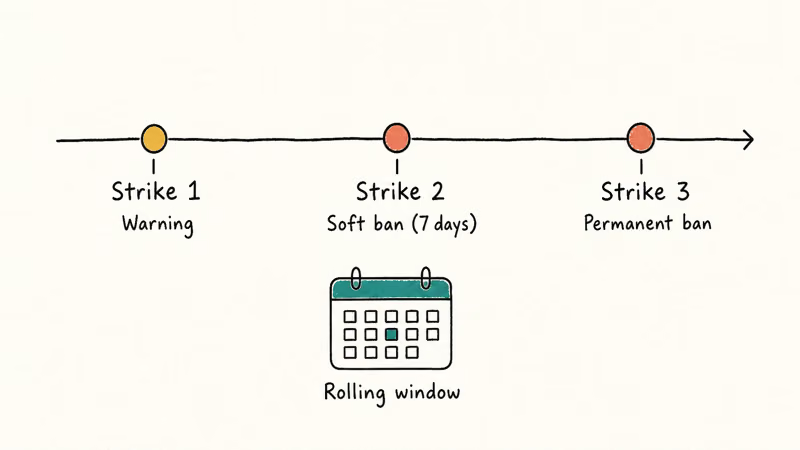
That cost is concrete: every Pokémon, every Stardust balance, every Premium item the account ever earned, gone in a single enforcement decision.
Niantic’s Three-Strike Policy states that 3 cumulative strikes lead to permanent account termination. The first strike issues a warning that limits gameplay features for around 7 days. The second escalates to a 30-day suspension. The third terminates the account across Pokémon Go, Pokémon Go Plus, and the Niantic ID itself.
Strikes carry across Niantic titles. A teleport offense in Pokémon Go can affect a clean account in another Niantic game.
Before any of that, there’s the soft ban.
A soft ban in Pokémon Go doesn’t kick you out. It stops Pokémon from being caught, PokéStops from giving items, and gyms from accepting battles. It usually triggers right after a large location jump followed by an in-game action before the cooldown clears.
During a soft ban, PokéStops return no items and wild encounters flee on the first throw for several hours. The cooldown isn’t a published number, but community-tracked thresholds line up with Niantic’s distance-based logic.
#Why You Might Get Banned in Pokémon Go
The avatar isn’t the only thing Niantic watches. The detection surface includes the GPS feed, the device sensors, the IP geolocation, the rate of in-game actions, the integrity of the app binary, and the cross-device fingerprint of the trainer ID, and a mismatch in any one of those streams can flag an account for review during the next sweep, regardless of how clean the account’s history looks otherwise.
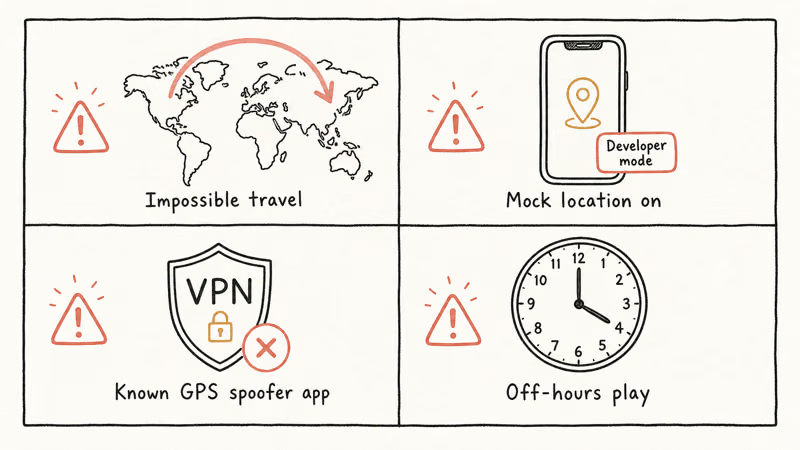
Mock-location toggles on Android leave a flag in the Android API that Pokémon Go reads directly. Modified Pokémon Go clients on jailbroken iOS, including the Pokémon Go joystick builds and discontinued tools like iSpoofer, inject fake coordinates through hooks the app actively scans for. According to community-monitored Niantic enforcement waves, banned account counts spike after every major version of the app shipped throughout 2023 and 2024, with each wave targeting a specific signature.
Rapid travel without sensor data is the second tell.
A real walk produces accelerometer noise, step counts, and GPS jitter. A teleport produces a clean coordinate jump with no motion telemetry. Niantic’s anti-cheat correlates these streams, which is why simply changing location in Pokémon Go without respecting the cooldown almost always trips a soft ban first and a strike second.
The third detection vector is account behavior over time. Multiple region jumps in a day, repeated rare-spawn captures across continents, and login patterns from impossible IP locations all build a profile. Players running multiple Pokémon Go accounts on the same device add another signal Niantic looks for.
#Does a VPN Actually Change Your GPS?
No.
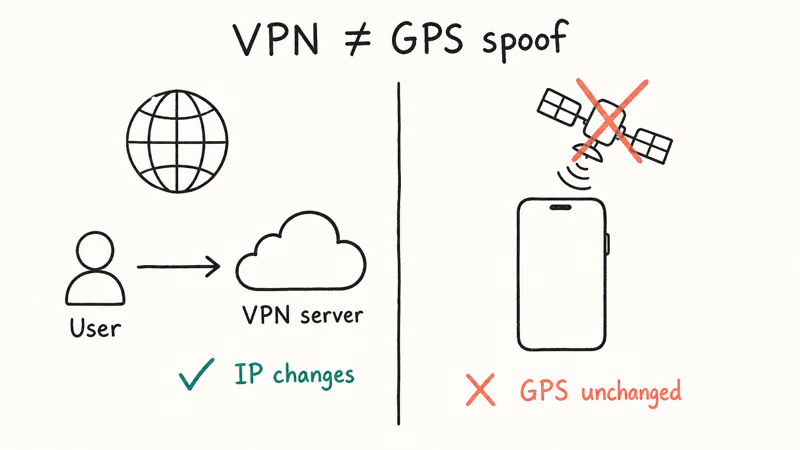
A VPN routes your internet traffic through a server somewhere else and changes the IP address that web services see. Pokémon Go reads location from the operating system’s GPS API, not from your IP. With a VPN active, the in-game coordinates stay put even while IP geolocation reports a server in another country, because the two systems read from completely different sources.
The “VPN to teleport in Pokémon Go” guides that float around forums are a historical artifact. Some old client versions were tricked by IP-only geo lookups, but Niantic patched that gap years ago.
According to Apple’s CoreLocation documentation, iOS apps that request precise location pull from the GPS, GLONASS, and Galileo radios on the device, not from the network layer. A VPN sitting on top of the network stack has no path to reach those radios.
This is also why we removed the old VPN affiliate suggestion from this page. Pointing readers at NordVPN as a “Pokémon Go teleport” tool would mislead them. A VPN is excellent for privacy, public Wi-Fi safety, and bypassing region locks on streaming services. It won’t teleport your trainer.
#What Are Legitimate Uses for GPS Simulation?
GPS simulation tools exist for real, lawful reasons that have nothing to do with Pokémon Go.
Apple ships built-in GPS simulation in Xcode for app developers, and Google ships the same capability in Android Studio. Both vendors document the workflows openly because every location-aware app must be testable somehow, and on-device fakes are the only practical way to verify behavior at coordinates the developer can’t physically visit during QA.
Apple’s built-in location simulation in Xcode routes through developer entitlements only, so it can’t be pointed at an arbitrary third-party app.
According to Apple’s Xcode location simulation documentation, developers can simulate routes and waypoints during automated UI tests for apps they build. That’s the authorized pattern: your own app, your own device, your own developer account.
Three legitimate use cases cover most non-developer needs:
- App and location QA testing. A small business owner verifying that a delivery app calculates correct distances across cities they serve. Tools like Tenorshare iAnyGo handle this on personal accounts and personal devices, and the product page explicitly limits use to your own equipment.
- Privacy testing on your own accounts. Confirming that a social app is leaking your real location, or that a dating app is exposing distance data you don’t want exposed. The test runs against accounts you own.
- Accessibility and travel pre-planning. A user with mobility limits previewing how a navigation app behaves at a destination they’ll travel to next week, on their own phone, before the trip.
Some links on this page are affiliate links, which means fone.tips may earn a commission at no extra cost to you.
What is not in scope: spoofing your work-tracking app to fake attendance, faking your location in a game whose Terms of Service forbid it, or simulating coordinates on a device or account that isn’t yours.
Three quick failures in that list:
The first violates your employer’s authorized-use policy. The second violates Niantic’s terms. The third can cross into computer-misuse statutes depending on jurisdiction. Violating a service’s terms isn’t always illegal, but it can be unlawful when combined with deception or financial gain.
#Safer Alternatives Within Niantic’s Rules
The frustrating reality is that Pokémon Go’s design assumes you can walk. The good news is that Niantic has built several legitimate features that extend reach without violating terms.
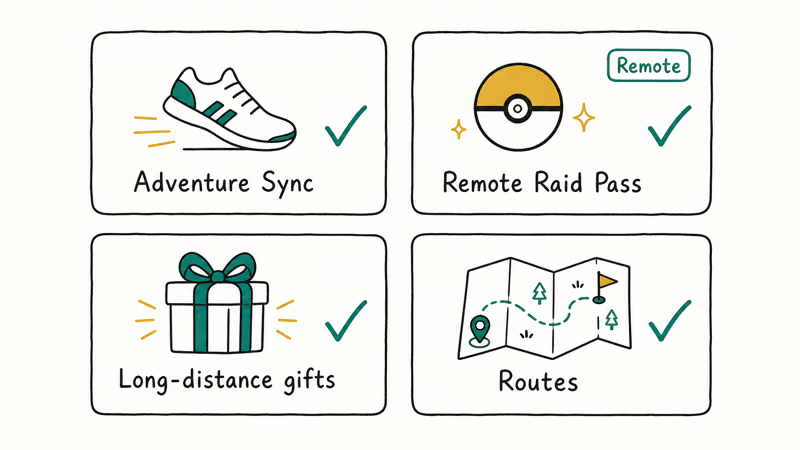
Adventure Sync credits steps that your phone counts in the background. It credits real walking distance via Google Fit on Android and Apple Health on iPhone, without any GPS modification. It hatches eggs and earns Buddy candy while your phone sits in your pocket on a normal commute.
Remote raid passes let you join raid battles at any gym, anywhere, as long as a friend shares a raid invite. They cost PokéCoins but remove the geographic constraint with zero rule violation. Niantic capped daily remote-raid participation in 2023 to push in-person play, but the system still works for distant five-star raids and Mega evolutions when the local community can’t muster the trainer count, especially in rural areas.
Gift trading and friend codes are how regional Pokémon move legally. Trade a Tauros from Chicago for a Kangaskhan from Sydney through a friend you actually have at level Great or higher. The Pokémon counts toward your Pokédex, and Niantic explicitly designed the system for this.
Pokémon Go Plus and Pokémon Go Plus + are official accessories. According to Pokémon Go’s official accessory page, the device catches Pokémon and spins PokéStops with a button press. No spoofing required. On a normal walk it racks up catches and PokéStop spins without you ever opening the app.
These options stay inside the rules.
They also build the friend graph and Adventure Sync history that contribute to a clean account profile. That matters: flagged accounts get reviewed harder during enforcement waves, and a long history of legitimate play shifts the burden of evidence in your favor when an appeal is reviewed.
#If You Still Choose to Spoof: Honest Risk Reduction
This site doesn’t recommend GPS spoofing in Pokémon Go. If you’ve read everything above and still plan to do it on your own account, here’s what reduces (but doesn’t eliminate) the chance of a strike. None of this is a guarantee.
Respect the cooldown distance. Community-maintained tables map distance to required wait time before any in-game action: a 1 to 5 km jump suggests roughly a 2-minute wait, a 100 to 250 km jump suggests 10 to 30 minutes, and a 900 to 1,300 km jump suggests around 90 minutes. Acting before the timer expires is the most reliable way to earn a soft ban.
Don’t mix spoofed and real sessions.
Switching back to your real location mid-day with an active spoof session is a guaranteed mismatch. If you spoof, finish the session, log out cleanly, and only return after the cooldown.
Use a secondary “burner” account, not your main. The risk is the same, but the loss is bounded. Linking a fake GPS for iOS tool or any location spoofer to your main 10-year Mystic account is the worst trade in the game.
Treat any account with sentimental Pokémon as untouchable.
Don’t use jailbroken or modified clients. Tools like PokeGo++ are explicitly named in Niantic’s banned-software list, and a single login from a modded client can flag the account permanently regardless of your other behavior.
The bigger picture remains the same: each strike compounds, and the third strike is permanent. Long-time players have lost level-50 accounts over a single weekend of spoofing during a community-day event.
#Bottom Line
Spoofing your location in Pokémon Go violates Niantic’s Terms of Service and can cost you the account. The Three-Strike Policy is documented, enforced in waves, and applies across every Niantic title tied to your trainer ID. A VPN can’t help because it doesn’t change GPS coordinates.
The path that protects your investment stays inside the rules: Adventure Sync, remote raids, gift trades, and the Pokémon Go Plus accessory line all extend your reach without lighting up the anti-cheat.
If you actually need GPS simulation for app QA, accessibility planning, or privacy testing on your own devices and accounts, tools like Tenorshare iAnyGo handle that lane safely.
Just don’t aim them at a trainer account you’d hate to lose.
Pokémon GO Guide
#Frequently Asked Questions
Does spoofing in Pokémon Go always result in a ban?
Not on the first attempt every time. Eventually, yes.
Niantic enforces in detection waves. An account can spoof for weeks and then receive a 7-day warning when the next sweep runs. Repeat violations escalate to a 30-day suspension and then permanent termination under the Three-Strike Policy. The waves typically follow major version releases, so the longer an account spoofs across versions, the higher the cumulative odds of being flagged in one of them.
Can a VPN teleport me in Pokémon Go?
No. VPNs change your IP address only, and Pokémon Go reads GPS coordinates from device location services that a VPN never touches.
What’s the difference between a soft ban and a strike?
A soft ban is a temporary cooldown, usually several hours, where Pokémon flee, PokéStops give nothing, and gyms reject you. It doesn’t add a strike to your account.
A strike, by contrast, is a formal warning, suspension, or termination logged against your trainer ID and counted under Niantic’s Three-Strike Policy. Soft bans can stack repeatedly without ever escalating to a strike if the underlying behavior is mild, but the cooldown timer is also a hint to Niantic’s anti-cheat that something on the account is off, and continued cooldown hits frequently precede a manual review.
Are there any legitimate uses for GPS simulation tools?
Yes. App developers, accessibility planners, and privacy researchers all use GPS simulation for testing on their own devices and accounts.
Can I get unbanned after a permanent termination?
Niantic’s appeal process exists, but reversal is rare. Successful appeals typically involve mistaken identity, account compromise, or detection false positives, not players asking for leniency after admitted spoofing. The Three-Strike Policy page confirms termination decisions are final after appeal review.
Will Adventure Sync get me flagged?
No.
Adventure Sync is an official Niantic feature that integrates with Apple Health and Google Fit. According to Niantic’s Adventure Sync support article, it credits real-world walking distance, and using it strengthens rather than weakens an account’s clean-history profile during enforcement reviews.
What about Pokémon Go fake GPS apps for Android?
They work mechanically but carry the same Terms-of-Service risk as any other spoofing method. Niantic specifically watches for the Android mock-location flag, so apps that toggle it route the account directly into the detection pipeline. The same is true for Pokémon Go spoofing frameworks across both platforms, and the popular “joystick” overlays bundled with rooted Android builds are flagged by the same fingerprint.
Is there any “100% safe” way to spoof Pokémon Go?
No. Every marketed method has documented ban cases.
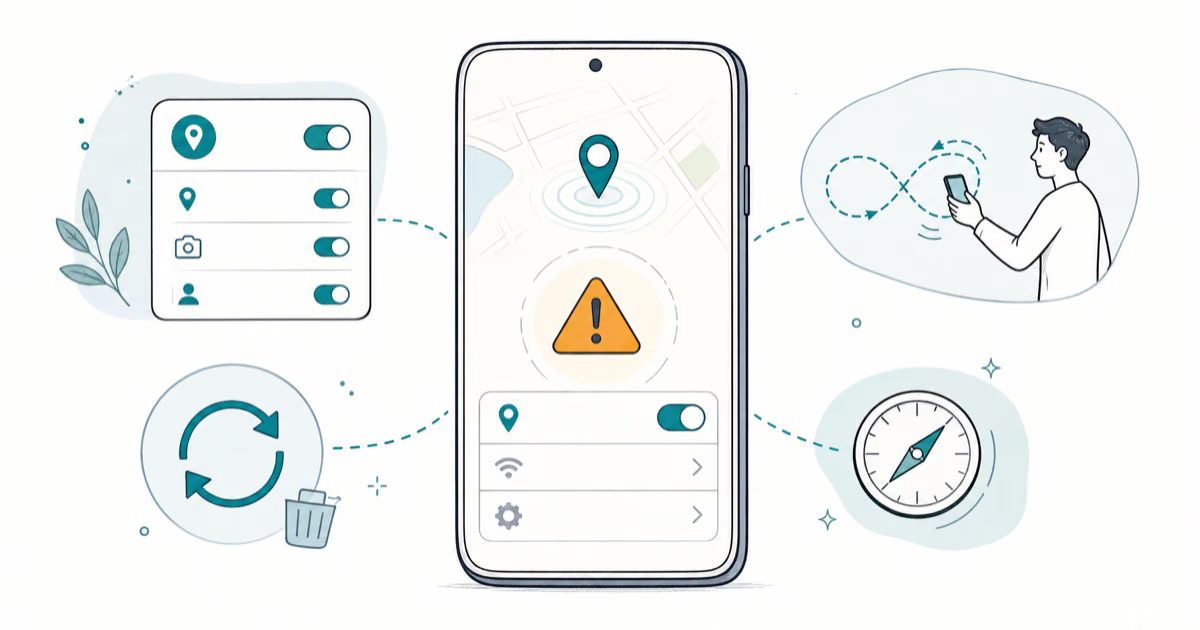
Pokemon GO GPS Signal Not Found: 7 Proven Fixes (2026)
Pokemon GO GPS signal not found? Seven ordered fixes for Android and iPhone covering precise location, permissions, mock-location, and more.
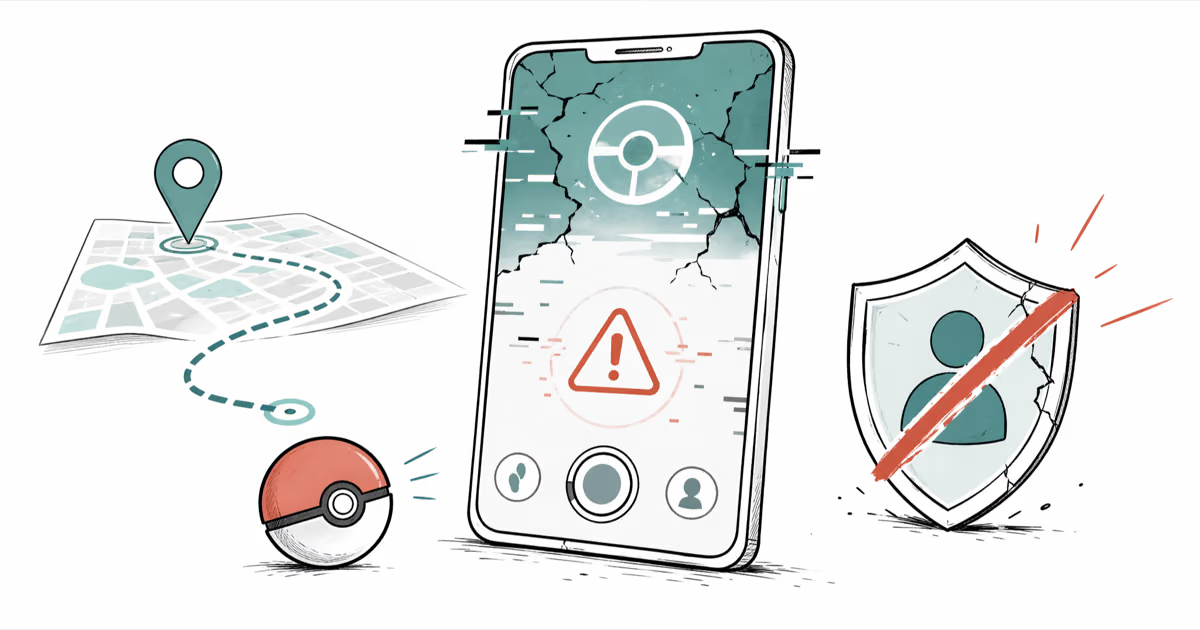
TweakBox Pokemon GO Review: Does It Still Work in 2026?
TweakBox Pokemon GO usually fails. Learn why, what Niantic's ban policy means for your account, and which official alternatives to use instead.
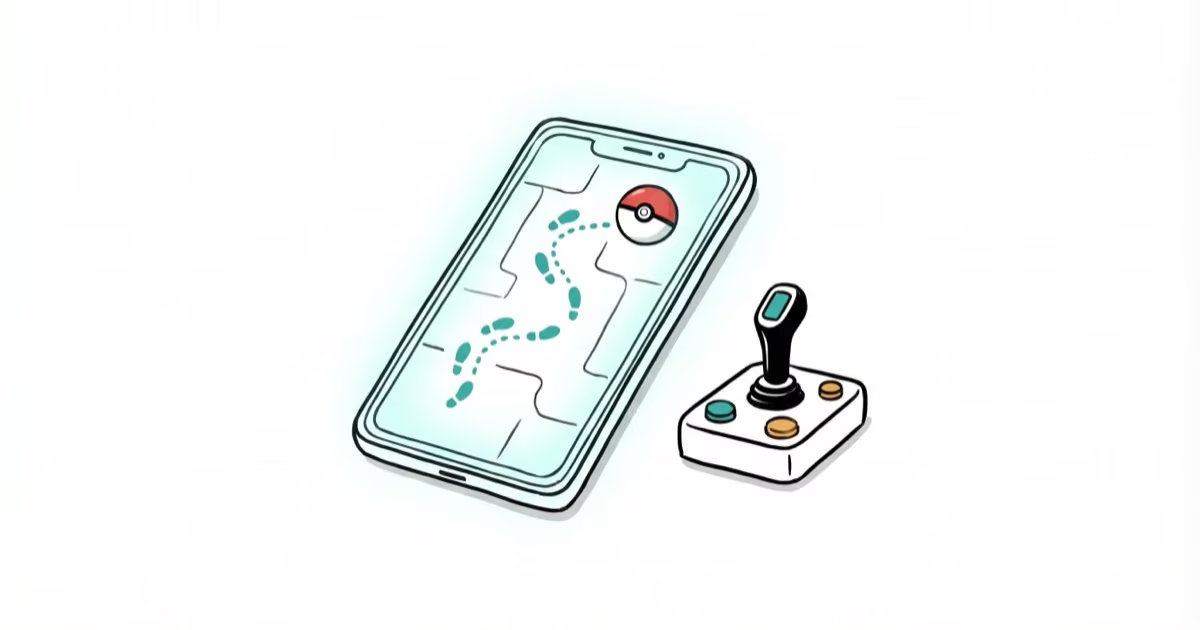
How to Auto Walk in Pokemon GO: Safe and Risky Methods
Learn how Pokemon GO Adventure Sync credits real activity, why fake-step and GPS tools risk account strikes, and which official options to use.
How to Find Magikarp Nests in Pokemon GO (2026 Guide)
Find Magikarp nests in Pokemon GO using community maps, water biomes, and rainy weather boosts. Plus candy farming tips to evolve Gyarados fast.