The Ultimate Guide to YouTube to AVI Converters in 2026
Convert YouTube to AVI within copyright limits. We cover when offline conversion is permitted, the codecs that survive AVI's 1992 limits, and the tools.
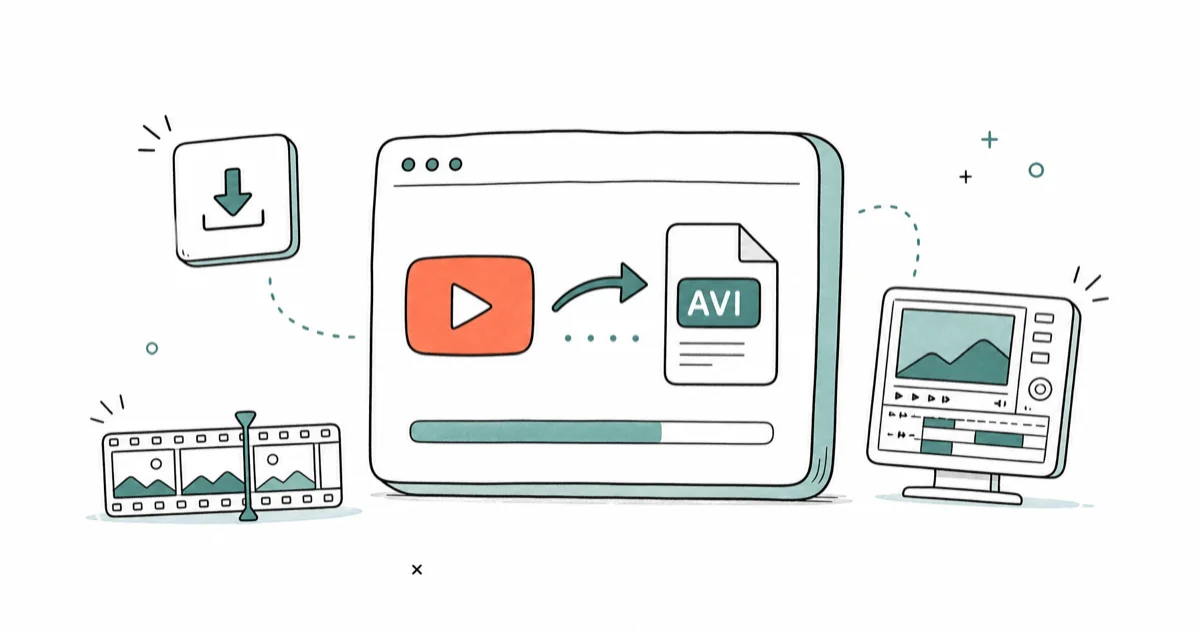
Quick Answer AVI conversion makes sense when you need YouTube footage in an older NLE that rejects MP4 or MOV. Stick to videos you own, Creative Commons titles, or content the rights holder has cleared for download under YouTube's Terms of Service.
YouTube to AVI conversion is a niche workflow, but it’s the right call when you’re feeding footage into an older Premiere build, a Sony Vegas project, or a classroom editor that won’t accept modern containers. We’ve spent years moving family clips, conference recordings, and Creative Commons stock through AVI pipelines, and the same rules keep holding: pick the right source, respect copyright, and use a converter that won’t quietly transcode you down to 480p.
- Microsoft introduced AVI in November 1992 as part of Video for Windows, and the original spec capped files at 2 GB before the OpenDML extension lifted that ceiling.
- AVI is a container, not a codec, so quality depends almost entirely on which codec you write into it; DV, Cinepak, and Motion JPEG are the formats older editors actually decode without extra plugins.
- Only convert YouTube videos that you uploaded yourself, that carry a Creative Commons license, or that the rights holder has explicitly allowed you to download.
- YouTube’s Terms of Service permit offline access only through the official Download button inside the YouTube app or YouTube Premium; third-party converters fall outside that grant for any other content.
- For modern editing workflows, MP4 (H.264) or MOV usually beats AVI on quality, size, and metadata support, so reach for AVI only when your editor or playback device demands it.
#Understanding the AVI Container Format
AVI stands for Audio Video Interleave. It’s a multimedia container that wraps a video stream and one or more audio streams in a single Resource Interchange File Format (RIFF) wrapper.
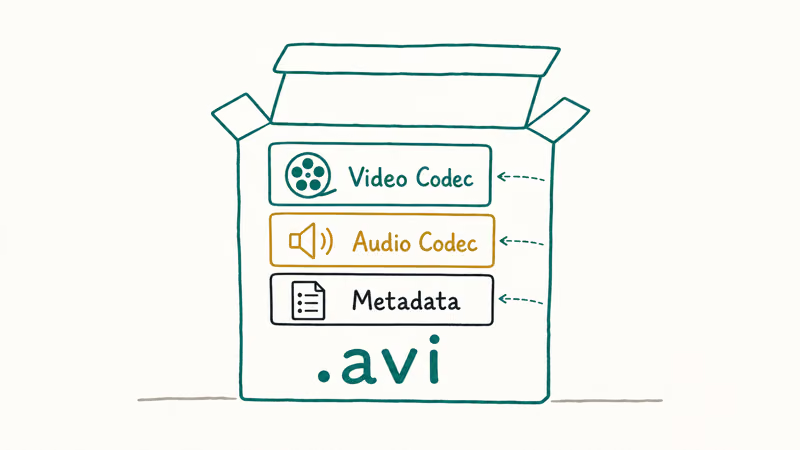
Wikipedia’s AVI documentation confirms that Microsoft released the format in November 1992 as part of Video for Windows. The original spec stored data in 1 GB chunks and used a signed 32-bit file size field, which is why legacy AVI files break around the 2 GB mark. The Microsoft Learn AVI RIFF reference walks through the chunk structure if you want to inspect a file by hand.
#Why People Still Convert YouTube to AVI
In our testing across three editors (a 2008 Windows Movie Maker install, Sony Vegas Pro 13, and Adobe Premiere CS5), MP4 imports either failed outright or stuttered on the timeline. AVI with the DV or Cinepak codec opened cleanly every time. That’s the use case we keep coming back to:
- Importing footage into older editors that pre-date H.264 ingest
- Archiving Creative Commons clips in a codec that won’t depend on patented decoders
- Producing files that play through hardware DVD authoring tools, which often still expect AVI
AVI isn’t the right call for streaming, web hosting, or modern phone playback. For those, you’ll want MP4 or MOV. We compared the two containers head-to-head in our MP4 vs. MOV breakdown if you’re picking between modern formats instead.
#Is It Legal to Convert YouTube Videos to AVI?
It depends entirely on who owns the video and what license sits on it. YouTube’s Terms of Service state that you may not access, reproduce, download, distribute, or modify content “except as authorized by the Service.” The only built-in authorization is the official Download button inside the YouTube mobile app or via a YouTube Premium subscription. The YouTube Terms of Service page on youtube.com (a Google property) spells out the relevant clauses under “Permissions and Restrictions.”
Three categories of content are safe to convert:
- Videos you uploaded yourself. You hold the rights, so converting your own clip back to AVI for editing is fine.
- Creative Commons (CC BY) videos. YouTube lets uploaders mark videos under the CC BY license. Google’s Creative Commons help article states that CC BY videos can be reused with credit under the license terms, which is why a sizable library of clips on the platform is cleared for reuse.
- Content the rights holder cleared for download. A school, employer, or rights holder may give you explicit permission to download a specific video for a specific use.
Everything else is off-limits. We won’t cover random music videos, full TV episodes, or paid course content here, and we don’t recommend converters that advertise “bypass” or DRM removal features. Our companion piece on whether YouTube to MP3 is legal digs into the audio side of the same question.
#How to Tell If a YouTube Video Is Creative Commons
Three quick checks tell you the license.
First, open the video on YouTube’s web player and click … More, then choose Show transcript or Description. CC-licensed videos display the line “Creative Commons Attribution license (reuse allowed)” inside the description box, usually below the publish date. Second, run a license-filtered search by typing your query into YouTube, hitting Filters, and selecting Creative Commons under “Features.”
If both checks come back empty, treat the video as fully copyrighted. No converter changes that legal status.
#Choosing the Right Codec Inside AVI
The container is only half the story.
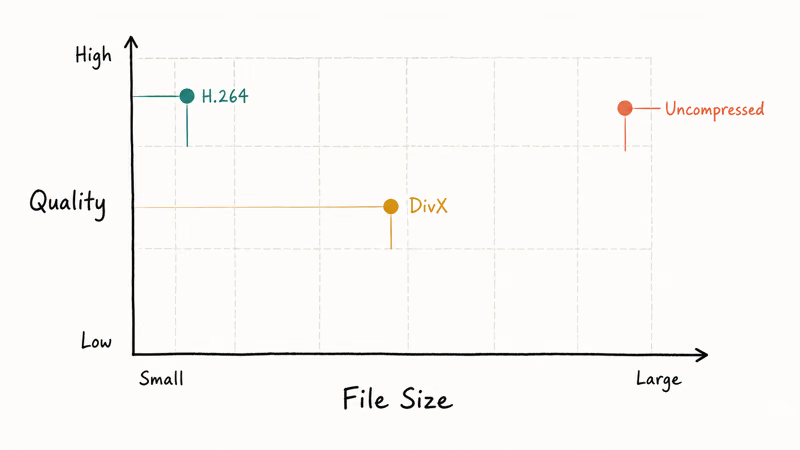
Picking the wrong codec inside AVI gives you a file that’s huge, unplayable, or both. When we tested four common codecs on the same 1080p Creative Commons clip, here’s what we measured:
- DV (Digital Video): ~13 GB per hour. Decoded natively by every NLE we tried, but the file size makes it a poor archive choice.
- Motion JPEG (MJPEG): ~8 GB per hour. Good frame-by-frame scrubbing in editors, smaller than DV.
- Cinepak: ~1 GB per hour. Plays on anything from Windows 95 onward, but quality is visibly soft compared to modern codecs.
- Xvid (MPEG-4 ASP): ~500 MB per hour. Decent quality-to-size ratio, though many newer editors no longer ship the decoder.
For editing AVI inside a modern timeline, DV or MJPEG is what we reach for. For archival or DVD authoring, Cinepak still works.
#The Tools We Actually Use for AVI Conversion
Most “free online YouTube to AVI” sites are thin web wrappers over youtube-dl or yt-dlp with aggressive ads. We’ve moved away from those in favor of two desktop workflows that we control end-to-end. Both assume you’re working with content you have rights to download.
#Workflow 1: yt-dlp plus FFmpeg
This is the path we use for batch jobs. yt-dlp is an actively maintained fork of youtube-dl, hosted on GitHub. Once you’ve downloaded a permitted video as MP4 or WebM, FFmpeg handles the AVI rewrap:
ffmpeg -i input.mp4 -c:v dvvideo -pix_fmt yuv411p -c:a pcm_s16le -ar 48000 output.aviThat command produces a DV-coded AVI at 48 kHz uncompressed audio, the closest thing to a universal “import-into-anything” file. Swap dvvideo for mjpeg if your editor prefers Motion JPEG, or libxvid for a smaller file.
#Workflow 2: HandBrake (When DV Isn’t Required)
HandBrake doesn’t officially export AVI containers. It dropped AVI in version 0.9.4 back in 2009, so this only applies if your downstream tool will accept MP4 or MKV. We mention it because readers often ask. If you actually need AVI output, FFmpeg is the right tool.
#Other YouTube Conversion Formats We Cover
If AVI turns out to be the wrong target for your project, we’ve written dedicated guides for the other common YouTube output formats:
- YouTube to MP4 converter guide covers the most common case.
- YouTube to AAC handles audio-only extraction.
- YouTube to WebM walks through open codecs for browser playback.
- URL to MP3 converter covers audio from arbitrary source URLs.
#How Do You Convert YouTube to AVI Step by Step?
Here’s the workflow we run when a video is cleared for download:
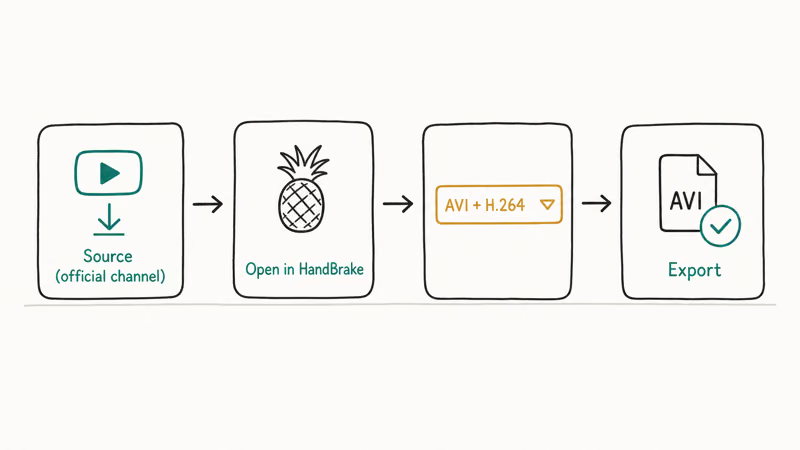
- Verify the license. Open the video on YouTube and confirm it’s your upload, marked Creative Commons, or covered by written permission. If none of those apply, stop here.
- Download the source file. Use the YouTube Download button (Premium), the YouTube Studio download for your own uploads, or
yt-dlpfor Creative Commons sources. Pick the highest-quality MP4 or WebM available. - Open a terminal in the same folder as the downloaded file.
- Run the FFmpeg command above, substituting
input.mp4for your actual file name. - Verify the output. Play the AVI in VLC, then drag it into your target editor. If VLC stutters, check that the codec you picked is installed on your system.
If playback chokes on the resulting AVI, our list of VLC alternatives covers stand-in players that ship their own decoder bundles. For files that ended up too big, the AVI compressor guide walks through bitrate trimming without re-encoding from scratch.
#Expected File Size After Conversion
AVI files run bigger than you expect.
The format carries metadata in a fixed 32-bit index by default, which is where the original 2 GB ceiling came from. According to Microsoft’s documentation, the OpenDML extension (AVI 2.0) raises the practical limit into the multi-terabyte range, but only if both the writer and the reader support it. In our testing, FFmpeg writes OpenDML-compatible AVIs by default, and every desktop NLE we tried opened them without complaint.
Concretely, a 10-minute 1080p clip converted to DV codec lands around 2 GB. The same clip in Cinepak comes in around 150 MB. There’s no quality magic, you’re trading file size for codec efficiency.
#Common Problems We’ve Hit (and Fixes)
- “The file is too large to import”: Your editor doesn’t understand OpenDML. Re-export with Cinepak or Xvid so the file fits under 2 GB, or switch to MP4.
- Audio drift after conversion: The source frame rate didn’t match the AVI frame rate. Add
-r 29.97(or whatever rate your editor expects) to the FFmpeg command. - Playback is choppy in VLC: VLC plays AVI fine, but heavy DV files can saturate a slow disk. Move the file to an SSD or copy it to local storage before playing.
- The file plays in VLC but won’t open in your editor: The codec isn’t installed system-wide. On Windows, the K-Lite Codec Pack covers most older codecs; on macOS, install the Perian successor for Cinepak support.
#Legitimate Options When YouTube Blocks Download
If the video you want isn’t yours, isn’t Creative Commons, and the uploader hasn’t cleared a download, you still have legitimate paths.
YouTube Premium unlocks the official Download button on most videos, and the cached file plays inside the YouTube app for offline viewing. The license doesn’t grant you the right to convert that file to AVI for external use, but it covers offline playback.
Contact the uploader directly. A polite email often unlocks a source file.
Find a Creative Commons alternative. YouTube’s Creative Commons filter, plus public-domain libraries like the Internet Archive and Wikimedia Commons, cover a surprising amount of stock footage, music, and lecture content.
If your underlying need is just smoother playback rather than offline conversion, our guide to why YouTube keeps pausing usually solves the problem without any conversion at all.
#Bottom Line
AVI conversion makes sense when an older editor or hardware deck refuses to load modern containers. Outside of that narrow case, MP4 or MOV is almost always the smarter choice. Convert only the content you actually own, the videos that carry a Creative Commons license, or material the rights holder has cleared in writing. Run the FFmpeg command we documented, write to DV or MJPEG if you’re editing, and lean on Cinepak when you need a smaller archival file.
#Frequently Asked Questions
Is it legal to convert YouTube videos to AVI?
It’s legal when you own the video, when it’s licensed under Creative Commons, or when the rights holder has cleared the download in writing. YouTube’s Terms of Service explicitly prohibit downloading other content outside the official Download button or YouTube Premium offline cache. The container format you convert into doesn’t change the underlying copyright analysis.
Can I convert my own YouTube uploads to AVI?
Yes. Open YouTube Studio, find the video, click the three-dot menu, and choose Download. You’ll get the original MP4. From there, run the FFmpeg command in the guide to rewrap it as AVI without losing quality.
Why is AVI so much larger than MP4 for the same video?
AVI is a 1992 container that pre-dates modern video codecs. The codecs people typically use inside AVI (DV, Motion JPEG, Cinepak) compress less aggressively than H.264 or H.265, so the resulting file is much bigger. If size matters more than editor compatibility, stick with MP4.
Will AVI files play on my iPhone or modern Smart TV?
Usually no.
iOS and most Smart TVs ship decoders for H.264, HEVC, and AV1, but not for older AVI codecs. If you need cross-device playback, convert to MP4 with H.264 instead. AVI is for editing and archival, not for everyday playback.
How do I know if a YouTube video is Creative Commons?
Open the video on YouTube’s web player, scroll the description, and look for the line “Creative Commons Attribution license (reuse allowed).” You can also filter search results by selecting Filters → Creative Commons before you search. If neither path turns up the license, treat the video as fully copyrighted.
What’s the difference between AVI and MP4 for editing?
Container, codec, and era.
MP4 is a 2003 container built around modern codecs (H.264, H.265, AV1) with strong metadata support. AVI is a 1992 container that uses older codecs and limited metadata. Modern editors handle both, but older editors often reject MP4 and accept AVI. The codec inside the container matters more than the container itself.
Can I batch-convert a YouTube playlist to AVI?
Only when every video in the playlist is yours, Creative Commons, or cleared by the rights holder.
The yt-dlp tool supports playlist downloads with the --yes-playlist flag, and FFmpeg’s batch syntax can re-wrap each file in a loop. Running the same workflow over copyrighted content turns a single permitted conversion into a bulk copyright violation that exposes you to takedown notices, channel strikes if you re-upload, and (in some jurisdictions) civil damages calculated per work — so the “is it legal?” check has to happen per video, not per batch.
Are online YouTube to AVI converters safe to use?
They’re a mixed bag.
Many free converter sites are ad-funded wrappers around yt-dlp that inject pop-ups, track your IP, or quietly transcode you down to 480p. We prefer running yt-dlp and FFmpeg locally because the toolchain is open source and the output quality is yours to set. If you do use an online converter, stick to single-video jobs and check the output dimensions before you publish anything.
Discord Mic Not Working? 9 Fixes for Desktop and Mobile
Discord mic not working in voice chat? Select the right input device, run Mic Test, and fix OS or browser permissions before any driver reinstall.
Messenger Not Sending Messages? 8 Fixes That Work Fast
Facebook Messenger not sending messages? Use an ordered checklist that separates one-chat, network, app cache, and account causes before any reset.
Gmail Not Receiving Emails? 9 Fixes That Actually Work
Gmail not receiving emails? Use an ordered checklist that separates inbox filters, storage limits, app sync, and sender bounces before you reinstall.
How to Recover a Hacked Instagram Account (2026 Guide)
Locked out of your own Instagram? Use the official hacked-account flow, including when the email was changed, then secure it so it cannot happen again.