MP4 Video Repair: 6 Methods to Fix Corrupted Video Files
Fix corrupted MP4 video files with VLC transcoding, FFmpeg stream copy, and dedicated repair tools. Step-by-step methods that recover playable files.
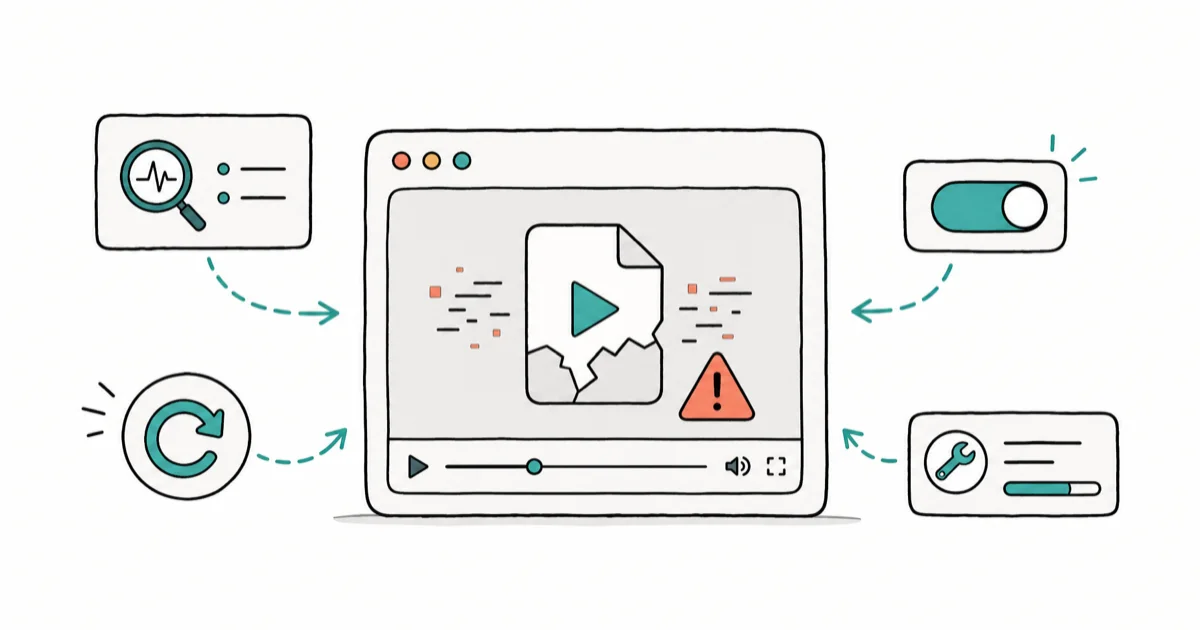
Quick AnswerRepair a corrupted MP4 by transcoding it through VLC, running an FFmpeg stream copy to rebuild the container index, or using dedicated software like Stellar Video Repair when free tools fail. Always work on a duplicate so the original stays intact.
MP4 video repair sits between data recovery and re-encoding. The file usually still exists on disk, but its container header, index, or stream metadata has been damaged so players refuse to open it.
The good news: most consumer corruption responds to free tools.
This guide walks through six common methods for broken MP4 files, starting with free tools and escalating to paid repair only when the free tools give up.
- VLC’s Convert/Save workflow rebuilds playback for header-level glitches by transcoding through its internal encoder pipeline.
- FFmpeg’s
-c copyflag rewrites the MP4 container index without re-encoding video, preserving the original quality. - Stellar Video Repair and Wondershare Repairit accept a reference video from the same camera to rebuild streams missing critical metadata.
- Online repair tools require uploading your footage to third-party servers and impose file-size caps that vary by provider.
- Safe-ejecting SD cards and keeping camera firmware current prevent the majority of recording-side corruption events.
#What Causes MP4 Files to Become Corrupted?
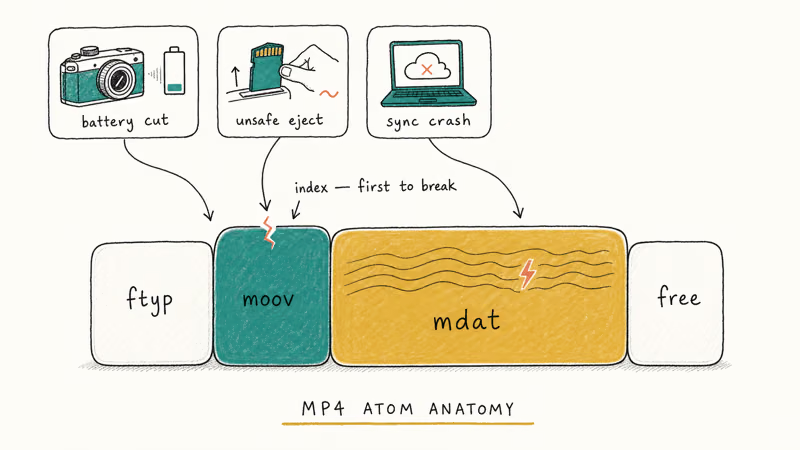
Corruption shows up after a few common events. Recording stops mid-write because a battery dies or a card is pulled, leaving the moov atom (the container’s index) unwritten. Transfers fail because USB cables disconnect or a sync app crashes mid-copy. Storage degrades on aging SD cards or USB sticks, flipping bits inside the codec data.
Editing software is another vector. When a machine crashes during a render, you end up with a half-flushed export that no player will demux. We cover one of the most common offenders in our iMovie video rendering error guide for Mac users.
According to Wikipedia’s MPEG-4 Part 14 entry, MP4 follows ISO/IEC 14496-14, which means every player expects the same atom structure. When even 1 atom goes missing, decoders bail.
Symptoms vary with where the damage lands. A truncated moov atom usually means the file refuses to open at all, since the player can’t find the offset table. Damage inside the mdat (media data) section produces playback that starts but stutters, freezes, or shows green-block frames.
Audio-video desync points to a damaged track index. Recognizing the pattern tells you which tool to reach for first.
#How to Repair an MP4 With VLC Media Player
VLC’s Convert/Save pipeline is the cheapest first attempt. According to VideoLAN’s project documentation, Convert/Save runs the source through VLC’s transcoding engine, which can reconstruct playable frames when the original header is malformed but the codec data is mostly intact.
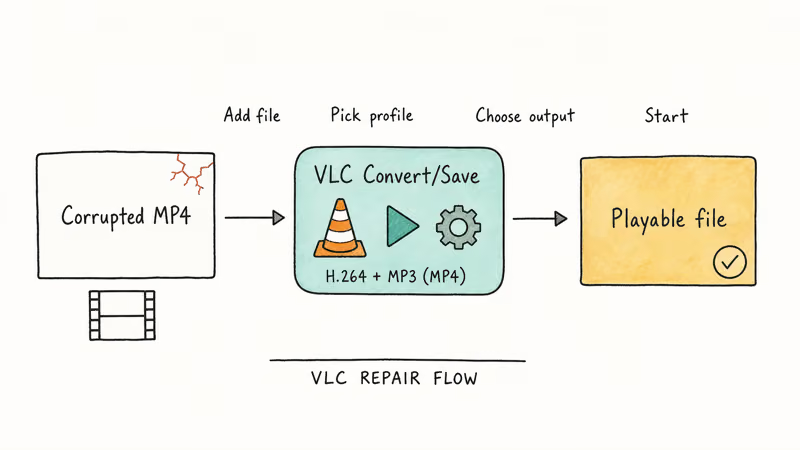
The trade-off is a re-encode: you lose a small amount of quality and the file size changes.
Steps:
- Install VLC Media Player (free for Windows, macOS, and Linux).
- Open VLC and choose
Media>Convert/ Save (or press Ctrl + R on Windows, Cmd + Shift + S on Mac). - Click Add, select the corrupted MP4, then click Convert / Save.
- Pick Video - H.264 + MP3 (MP4) from the profile list.
- Click Browse to choose an output path with a different filename.
- Click Start and wait for the progress bar.
VLC can produce a watchable file when the moov atom was truncated mid-write and the underlying video stream is still present. Expect possible freezes or missing segments where the source data is damaged.
When the file is too damaged for transcoding, VLC throws a “could not demux stream” error within the first 10 seconds. That’s your signal to move to FFmpeg or paid software. For everyday playback issues unrelated to corruption, our roundup of the best video players covers alternatives that handle weird codec combinations.
#Can FFmpeg Fix a Broken MP4 Header?
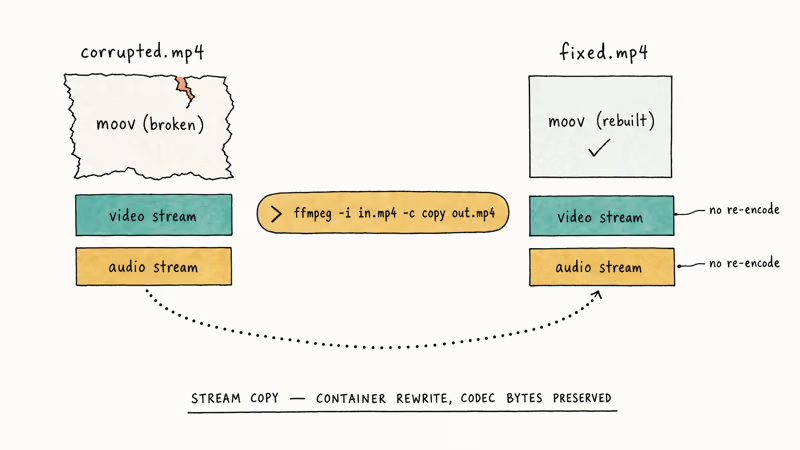
Yes, in many cases. FFmpeg’s documentation confirms that the -c copy option remuxes streams from the input container into a fresh output container without touching the codec data. This rebuilds the MP4 atom structure (including the moov index) while keeping the original video and audio bytes untouched, so there is no quality loss.
The basic command:
ffmpeg -i corrupted.mp4 -c copy fixed.mp4If that fails with an “Invalid data found when processing input” error, try:
ffmpeg -err_detect ignore_err -i corrupted.mp4 -c copy fixed.mp4FFmpeg stream copy works best when the index is damaged but the audio and video streams are still readable. If the tail of the recording is missing, FFmpeg may recover only the surviving tracks.
FFmpeg shines on container-level damage. It can’t reconstruct missing or scrambled codec frames.
For severely damaged moov atoms, the open-source untrunc tool (built on FFmpeg’s libraries) can match a reference file from the same camera to rebuild the index, similar to how paid tools work.
#Dedicated MP4 Repair Software for Severe Corruption
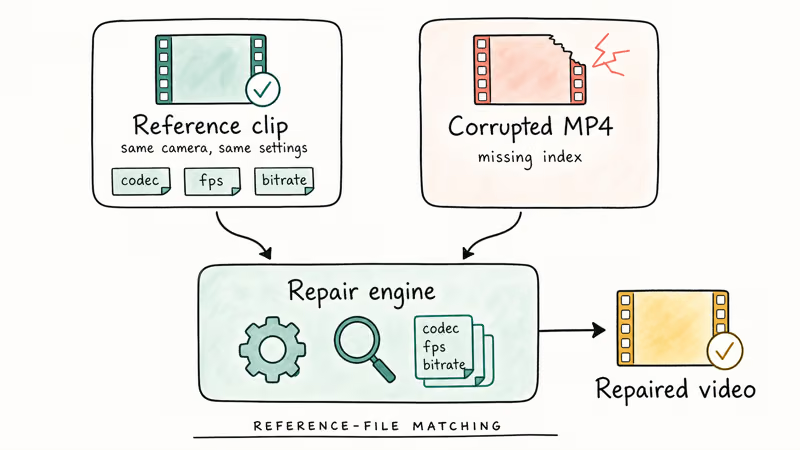
Paid repair tools earn their place when the file refuses to open in any player and FFmpeg can’t even read the streams. Their core advantage is reference-file matching: you provide a working clip from the same camera, and the engine uses its codec parameters to reconstruct the broken file’s index and stream layout.
#Stellar Video Repair
Stellar Video Repair handles MP4, MOV, AVI, MKV, and more than 12 other formats. The advanced repair mode requires a reference video from the same camera model and codec settings, which is the standard recipe for severe corruption.
Some links on this page are affiliate links, which means fone.tips may earn a commission at no extra cost to you.
Stellar’s preview feature can show whether the repair engine recognizes enough of the damaged file before you pay for export.
Strengths:
- Batch repair for multiple files at once
- Preview before paying for the export
- Saves output in the same codec as the source
#Wondershare Repairit
Wondershare Repairit ships in both desktop and online flavors. The desktop version supports advanced repair with reference files. The web version is faster for small clips.
If you also work with QuickTime files on macOS, the workflow mirrors the MOV repair on Mac process. For broader coverage of repair utilities across formats, see our roundup of video repair tools.
Strengths:
- Quick and Advanced repair modes
- Web version skips the install step
- Handles clips from drones, action cameras, and dashcams
#Online MP4 Repair Tools: When to Use Them
Online repair sites like EaseUS Online Video Repair and Fix.Video work in a browser without installing anything. They suit small clips and one-off repairs where you don’t mind sending the file to a third-party server.
They struggle with large files because of upload caps (often 2-10 GB depending on the provider) and slow when your upstream bandwidth is limited. Free tiers also throw queue waits during peak hours.
Skip online tools for anything sensitive: confidential interviews, legal evidence, medical recordings, or anything covered by an NDA. Once the file leaves your machine, you lose chain of custody. When you have a Mac handy, our Mac video repair walkthrough covers a desktop workflow that keeps the file on your machine throughout the fix.
#Mobile Apps for Repairing Phone Videos
When a phone runs out of battery mid-recording or an app crashes during capture, the resulting file usually has a broken moov atom. Mobile repair apps target exactly this scenario. They generally need a reference clip recorded on the same phone with the same camera settings, which makes phone repair more reliable than desktop repair for the same kind of damage.
What they handle well:
- Battery-cut recordings on Android (Samsung, Google Pixel, OnePlus)
- App-crash recordings on iPhone with QuickTime fallback
- WhatsApp video downloads that finished short of the full file size
What they don’t fix:
- Files where the codec data itself is missing
- Files transferred from another device with no reference clip available
- DRM-protected or app-encrypted recordings
For action-camera owners whose recordings cut off mid-capture, our GoPro video repair guide walks through the reference-clip workflow in detail with model-specific examples.
#Preventing MP4 Corruption Going Forward
Prevention is cheaper than repair, especially for irreplaceable footage. Apple’s iMovie support page recommends transferring files to a desktop before doing heavy edit work. The underlying logic applies to all recordings: the more times a file gets written, copied, or buffered, the more chances something goes wrong.
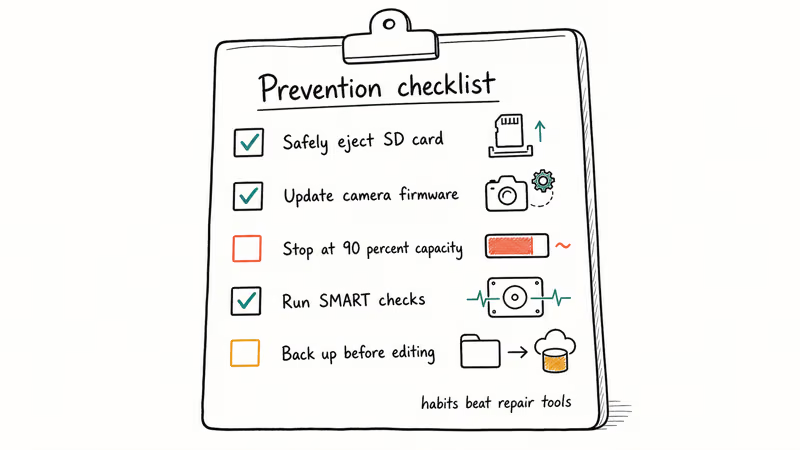
What works in practice:
- Eject SD cards and USB drives through the Finder or Safely Remove dialog before unplugging.
- Keep camera firmware current. Most “random” corruption events trace back to known bugs the vendor already patched.
- Avoid filling cards past 90 percent capacity; degraded write performance near the end is a common corruption trigger.
- Run regular SMART checks on internal drives that store working files.
- Back up to a second location before editing. At minimum, an external drive or cloud sync target.
Drive health matters too. If you’ve been hitting transfer errors on a specific drive, our Windows 10 repair without CD guide covers SFC and DISM commands that often clean up underlying file-system issues. For other broken video formats you might also encounter, our FLV repair walkthrough applies the same FFmpeg-first approach to a different container.
#Bottom Line: Pick the Right MP4 Repair Method
Reach for VLC’s Convert/Save first when the file plays but stutters or freezes. It’s free, reversible (because you save to a new filename), and handles most header-level glitches without re-encoding effort on your part.
If VLC can’t demux the file at all, run ffmpeg -i corrupted.mp4 -c copy fixed.mp4 to rebuild the container index in seconds with zero quality loss. Move to Stellar Video Repair or Wondershare Repairit only when both free options fail and you have a working reference clip from the same camera, since that reference is what makes paid software worth its price.
Skip online tools entirely for sensitive footage. The convenience isn’t worth handing the file to a third-party server you don’t control.
#Frequently Asked Questions
Can every corrupted MP4 file be repaired?
No. Files with missing codec data, like recordings where the storage device failed mid-write and overwrote frames with zeros, can’t be fully recovered by any tool. The best you can hope for in those cases is partial recovery of the audio track or the surviving video segments.
Is VLC’s transcode method safe for the original file?
Yes, when you save to a new filename (which VLC defaults to). The Convert/Save pipeline reads the source as input and writes a fresh file at your chosen destination, so the original stays untouched on disk.
Does FFmpeg work on heavily corrupted MP4 headers?
It depends on what’s damaged. FFmpeg’s -c copy can rebuild the container atom structure when the underlying codec streams are intact, which covers most truncated-recording cases. For files where the moov atom is wholly missing and the camera reference isn’t available, the open-source untrunc tool (which uses FFmpeg’s libraries) is usually the next step. Heavily scrambled mdat sections won’t repair through FFmpeg alone.
How long does an MP4 repair take?
Container-level fixes via FFmpeg -c copy typically finish in under a minute, even for 4GB clips, because nothing is re-encoded. VLC transcoding takes roughly the playback length of the file or longer, depending on CPU. Paid repair software adds an analysis step that can stretch a 1GB file to 10-20 minutes on average hardware.
Will the repaired file have the same quality as the original?
FFmpeg -c copy produces byte-identical codec data, so quality is preserved. VLC transcode and paid re-encode tools introduce small quality loss. Reference-based repair from Stellar or Wondershare matches the reference clip’s bitrate.
Can I repair MP4 files on iPhone or iPad?
Direct iOS repair options are limited because the App Store gates low-level file access. The reliable workflow is to AirDrop the file to a Mac and run FFmpeg or VLC, or send it to a Windows PC and use Stellar Video Repair. A handful of iOS apps offer in-app repair, but their success rate is lower than desktop tools because they can’t access reference codec parameters the way a paired-camera workflow does.
What’s the best free MP4 repair option in 2026?
For container damage, FFmpeg -c copy wins on speed and quality preservation. For mid-corruption playback issues, VLC Convert/Save is the easiest no-command-line option. Both are free, open-source, and run on Windows, macOS, and Linux. Pair them with the open-source untrunc tool for severe header damage, and you cover roughly 80 percent of consumer corruption cases without paying anything.
Should I use online repair sites for sensitive footage?
No. Uploading sensitive video to a third-party server breaks chain of custody and may violate confidentiality agreements. Use desktop or mobile repair tools that keep the file on your own machine for anything covered by NDAs, legal holds, medical privacy rules, or internal corporate policy.

Best Laptop for Running LLMs in 2026: Memory Comes First
The best laptop for running LLMs is a memory purchase first. Compare MacBook unified memory against NVIDIA laptop VRAM, and see what each tier really runs.
How to Run a Local LLM on Windows: A 2026 Setup Guide
Run a local LLM on Windows with LM Studio or Ollama. Pick a model that fits your GPU memory, keep every prompt offline, and skip the monthly bill.
Bluetooth Not Working on Snapdragon X? Fixes for 2026
Bluetooth not working on your Snapdragon X Copilot+ PC? Generic audio, mice, and keyboards work, but vendor apps often lack an ARM build. Fixes inside.
Docker Desktop and WSL2 Not Working on Snapdragon X? Fix It
WSL2 runs fine on Snapdragon X, but Docker Desktop ARM is Early Access and throws WSL errors. Use WSL2 plus native ARM64 Ubuntu and Docker Engine.