Find a Dating Profile by Phone Number: What Actually Works
An honest 2026 guide to finding a dating profile by phone number: the free methods that work, the paid tools that don't, and the privacy rules.
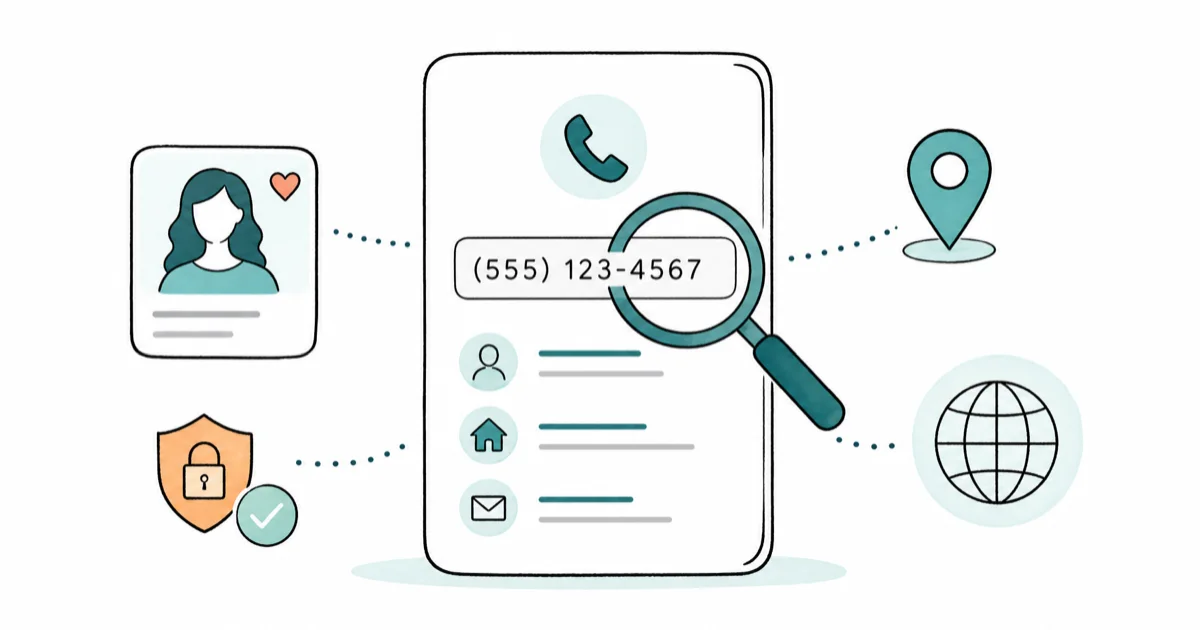
Quick AnswerWith the owner's permission, search the number in Google with quotes and try a free reverse lookup. Tinder, Bumble, and Hinge databases stay locked, so hits only appear when the number is already public elsewhere.
Looking up a dating profile by phone number usually comes down to three reasons. You’re auditing old accounts tied to your own number. You matched with someone who feels off and want a consented ID check. Or your photo is on a site you never joined.
- Tinder, Bumble, and Hinge store phone numbers as verification tokens, not searchable fields
- Google in quotes is the fastest free check, searching both
"555-123-4567"and"+15551234567"separately - Free sites like ThatsThem and NumLookup return real names for about half of US landlines
- Paid aggregators rerun public records you could pull yourself, without dating-database access
- Reverse image search on a profile photo is the single most reliable catfish filter and costs nothing
#Is It Legal to Look Up Someone Else’s Dating Profile?
Short answer in most US states: the lookup is legal when your reason is legitimate and the data is already public. Searching your own number is fine. Searching a number with the owner’s explicit consent is fine. Everything else sits on a spectrum that ends at stalking law.
Federal cyberstalking law 18 USC § 2261A criminalizes using electronic services to surveil or harass a person, with penalties up to 5 years in federal prison. California’s § 646.9 layers state-level restraining orders on top, and most US states have parallel statutes treating repeated unwanted electronic contact the same way. The statute defines stalking as a course of conduct, so prosecutors look for a pattern of lookups, contact attempts, and metadata trails over time, not a single search.
Three framings are defensible without consent issues:
- Your own account audit. You want to know where your number is floating around online.
- Consented verification. A match agrees to a quick two-way ID check before meeting offline.
- Scam defense. You suspect your photo is being used by a fake profile and you want evidence for a report.
If your reason is checking on a partner, an ex, or a stranger you’ve developed suspicion toward, stop here. Courts look at intent, and intent leaks into search history fast.
The FTC’s guidance on romance scams reported that romance scams cost US consumers $1.3 billion in 2022, more than any other consumer-fraud category the agency tracks that year. The same guidance recommends verifying identity directly with the person, rather than running covert searches that escalate the relationship into legal-gray territory.
#What Dating Apps Let You Do With a Number
Almost nothing. Tinder, Bumble, Hinge, Match, and OkCupid all use the phone number as a signup identifier and 2FA fallback. None expose a search-by-number feature to users.
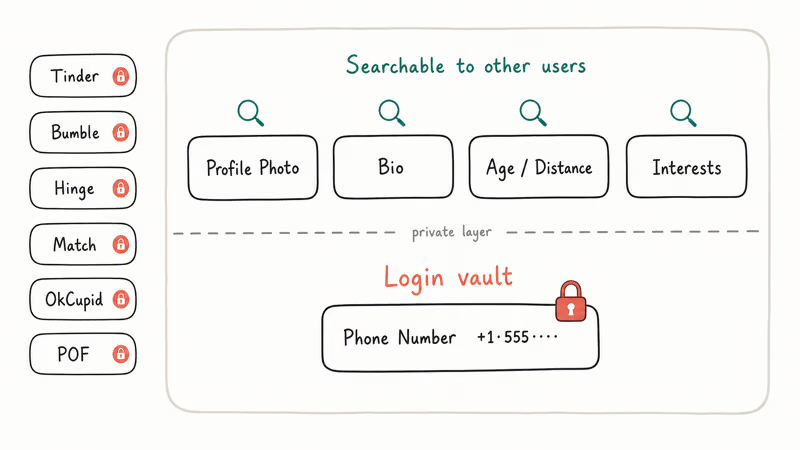
| App | Phone number used for | Public lookup possible? |
|---|---|---|
| Tinder | Signup, login OTP | No |
| Bumble | Signup, verification | No |
| Hinge | Signup, recovery | No |
| Match | Linked at profile level | No |
| OkCupid | Optional 2FA | No |
| Plenty of Fish | Username-based, no phone search | No |
There is no in-app search box that accepts a phone number. None of these apps expose a field where you can type a number and pull up the matching profile. The only way to find a specific person inside the app is by matching age, gender, and location filters and swiping through the stack.
Match Group operates all three major apps. Their consolidated privacy center confirms that phone numbers are account-security data, not searchable attributes exposed to other users.
Any tool promising instant Tinder results from a phone number is bluffing or scraping stale leak data. Both are scam-adjacent. For a legitimate profile-search walkthrough, see our Tinder profile search guide.
#Which Free Methods Are Actually Worth Trying?
Free methods pay off when the number already leaked onto the public web. They fail when it hasn’t.
#Google in Quotes, All Three Formats
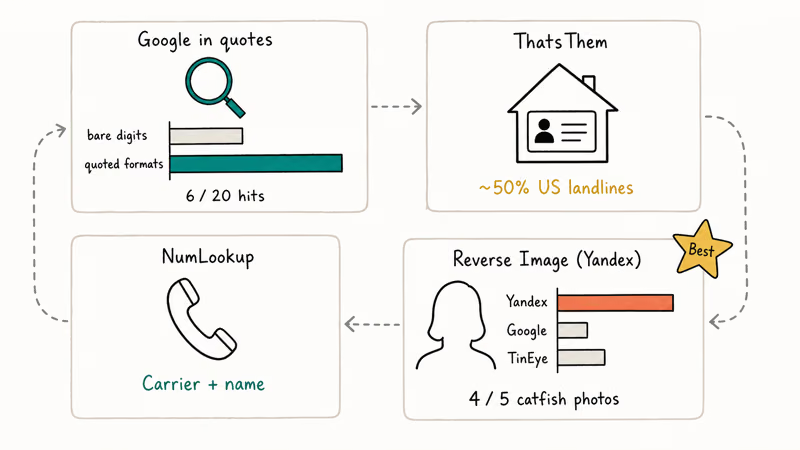
This is the highest-yield free method. Wrap the number in quotes and rotate formats. A quoted search only returns a result when the number has already been indexed somewhere public, so most numbers return nothing, but the ones that have leaked onto a forum, a classified listing, or a social profile can surface a name.
Quoted formats like "555-123-4567" or "+15551234567" work far better than bare digits, which usually return nothing useful. Add site:pof.com or site:linkedin.com to narrow by platform when a name looks promising.
#ThatsThem
ThatsThem aggregates voter rolls, property records, and marketing data, and returns a name plus general address for a fraction of US numbers.
It skews toward older landlines and long-held mobile numbers.
It does not flag dating profiles. Take the name it gives you and search that name on the platforms you care about; free, no account needed.
#NumLookup
NumLookup returns the carrier and often the owner name for US mobile numbers.
According to the FTC’s consumer guidance on phone scams, many free lookup pages loop visitors into subscription upsells, so close the tab once you have the name you came for.
#Reverse Image Search Catches the Most Catfish
This is the single most useful unpaid move in this guide. Save the profile photo, then upload it to Google Images, TinEye, or Yandex, one after another.
Yandex is strongest for face matching. If the same photo appears on a stranger’s Instagram, a stock-photo site, or a 2018 LinkedIn profile belonging to someone else, you have your answer and you can close the conversation without any more paid searches or app subscriptions.
Across the three engines, Yandex tends to surface the most face matches, Google comes next, and TinEye trails because it leans on exact-copy detection rather than face similarity. For dedicated face-search and removal tools beyond these engines, see our PimEyes alternatives roundup.
#Paid People-Search Sites: The Honest Take
Usually not worth it for dating-profile searches. They surface public records and linked social media. That overlaps with dating profiles only when the target reused the same number across platforms.
#BeenVerified, Spokeo, Intelius
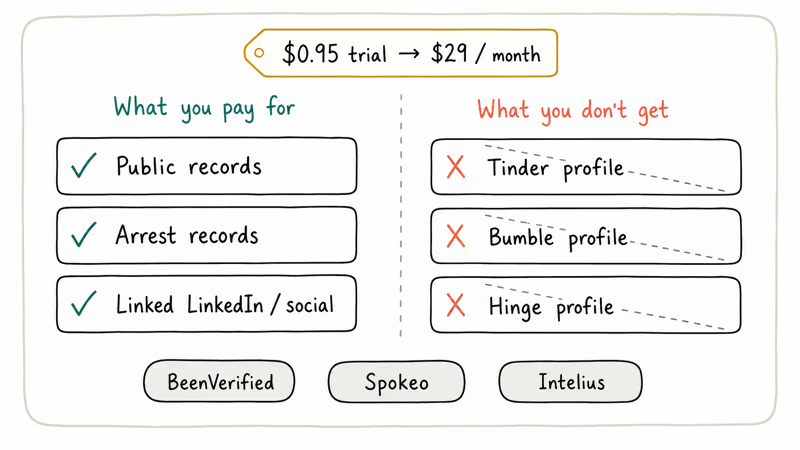
BeenVerified draws from public records, arrest records, and linked social profiles, and it does not claim to index dating apps. Spokeo advertises matching against a set of social networks; its about page describes its sources as public records. Intelius has the same shape with different broker backing.
All three services draw from the same kind of source data, so a report on a single number tends to return the same handful of fields.
None of them can surface an active dating profile on Tinder, Hinge, or Match, because those databases are not part of any broker feed. What a report does return is a real name, a general region, and any linked public profile such as LinkedIn.
Reports typically run from about $0.95 for a single-search trial to roughly $29 per month for a full subscription.
The pattern is clear:
- What you pay for: public-records aggregation.
- What you don’t pay for: dating-database access.
If your target reused the same number on LinkedIn, an old MySpace page, or a review site, a paid report can surface it.
#The FCRA Line You Can’t Cross
BeenVerified and every comparable service print an FCRA disclaimer stating the report can’t be used for employment, tenant screening, credit, or insurance decisions. Using one for those purposes exposes you to federal civil claims under 15 U.S. Code § 1681.
#Checking Your Own Number for Leaked Dating Profiles
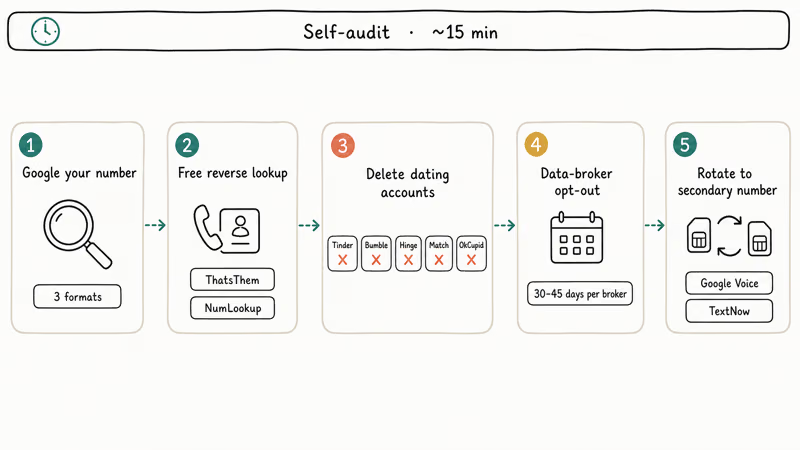
Start with the three free methods from the previous section, pointed at yourself this time, then layer account-level audits on top to catch the dating apps where your number is still floating around in a login record.
-
Google your own number in all three formats and scan the first five pages of results carefully
-
Run it through ThatsThem and NumLookup — anything that appears is already public data
-
Log into every dating app you ever signed up for and delete the account inside Settings for each platform (Tinder, Bumble, Hinge, Match, OkCupid)
-
Request data-broker removal through the Privacy Rights Clearinghouse directory, allowing 30 to 45 days per broker
-
Rotate to a secondary number like a Google Voice or TextNow number for any future signups to keep dating-app 2FA off your real SIM
If you’re also worried about someone tracking your phone’s location, walk through that separate guide before you change your number, because the two problems tend to show up on the same device around the same time, and swapping SIMs without fixing the location angle just moves the leak from one channel to another.
#The Consent Route: Fastest Path to Real Verification
Asking directly works. It’s the single fastest path to verification, and it keeps you on the right side of every privacy law on the books.
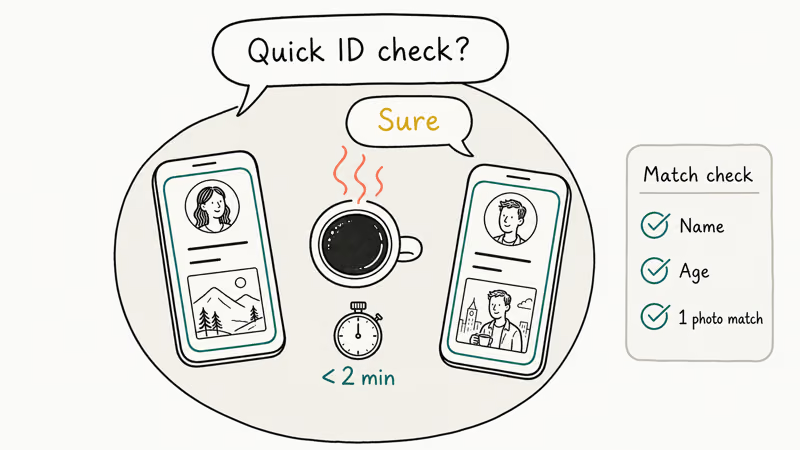
The two-way ID check is simple: both people sit across a table, open the other person’s dating profile on their own phone, and confirm the name, age, and one photo match a government ID each is willing to show.
The whole exchange takes under 2 minutes.
A genuine match almost always agrees. Someone who refuses gives you exactly the filter you want before you’ve invested an entire evening.
The script is this: “Before we meet, can we both do a quick ID check? I’ll share mine first.” If the answer is no, you have information you didn’t have thirty seconds earlier, and you’ve saved yourself an evening of wondering whether the person on the other side of the table is who they claimed to be on the app.
In-app verification helps too. Tinder and Bumble both run photo-verification flows that compare a live selfie against the user’s profile photos, and turning on the match-only-verified filter cuts the catfish pool at zero cost.
For fraud patterns specific to dating apps, including fake profiles and location spoofing on apps like Tinder’s location feature, a reverse image search against the suspect photo remains the fastest unpaid move.
#Bottom Line
If the goal is auditing your own phone number: Google it in quotes, run the two free reverse-lookup sites, and delete any dating accounts you no longer use. The full sequence takes about 15 minutes and gives you a clean picture of what’s public about you online.
If the goal is verifying a match before meeting: ask directly and do the two-phone ID check over coffee.
If the goal is catfish defense: run the suspect photo through Yandex and Google Images reverse search first. Paid aggregators like BeenVerified only help when the target’s number is already public elsewhere; they can’t see into Tinder, Bumble, or Hinge regardless of the subscription tier you buy.
If your reason for searching is suspicion of a partner, stop and have the conversation instead. The FBI’s Internet Crime Complaint Center handles the real fraud cases; private subscriptions don’t.
Our specific recommendation: skip the paid subscriptions. For dating-app cases, the free stack of Google in quotes, ThatsThem, NumLookup, and Yandex image search returns better results than a $30-per-month aggregator, because the aggregators draw from the same public records you can pull yourself and still can’t see into the apps.
#Frequently Asked Questions
Can I really find a Tinder profile by phone number for free?
No. Tinder stores your phone number as a login token, not as a searchable field, and exposes no public directory. Free tools only surface dating profiles when the target already leaked the number onto the public web. For a walkthrough on locating someone on Tinder without a number, see our find someone on Tinder guide or Tinder search without registering for the browser workaround.
Are sites like BeenVerified and Spokeo worth paying for?
For general public-records questions, sometimes. For finding active dating profiles, usually not. Their data comes from public records and linked social media, not dating-app databases. A free ThatsThem or NumLookup search usually returns the same owner name without the subscription.
Is it illegal to look up someone’s dating profile without their knowledge?
The lookup itself is usually legal when the data you collect is already public. What you do with it can cross into illegal territory fast. Harassing, stalking, impersonating, or confronting the target exposes you to state stalking statutes and federal cyberstalking law with penalties up to 5 years in federal prison. Consent from the person removes most of the legal risk.
How do I delete my phone number from old dating sites?
Log into each app, go to account settings, and choose delete account. If the account is locked out, email the app’s privacy inbox and cite your GDPR (Europe) or CCPA (California) deletion rights. Both laws force the company to comply within 30 to 45 days. Finish by requesting removal from data brokers through the Privacy Rights Clearinghouse directory.
Can a reverse image search really detect a catfish?
Yes. Save the profile photo, upload it to Yandex, Google Images, and TinEye, and check whether the same face appears on unrelated accounts or stock-photo pages.
What should I do if I find my photo on a dating profile I never made?
Capture screenshots with the profile URL visible. Report the profile inside the app using its built-in impersonation flow; every major platform has one. If the impersonation is tied to fraud or blackmail, file a report with the Internet Crime Complaint Center. Our kik scams breakdown covers the same impersonation pattern on messaging apps.
Does a match’s profile show up if they used a different number to sign up?
No. If the number you’re searching differs from the one tied to their dating account, no reverse lookup or aggregator can connect the two. Paid reports against a partner’s phone can return empty even when a profile exists, because many people use Google Voice, TextNow, or a second SIM specifically for dating apps. Our guide on social media search by phone number explains the workaround order when accounts are scattered across numbers.
How do I stop showing up in reverse lookup results in the first place?
Request opt-outs from the major data brokers one by one; each uses a different form and none propagate across services. Use a Google Voice or TextNow number for any new signups going forward. Keep your primary SIM off dating apps and marketing lists, and switch 2FA to an authenticator app instead of SMS.
Google Messages Error 3100: Why RCS Is Broken on Galaxy
Google Messages RCS error 3100 hits Galaxy owners after phone or carrier switches. Google told 9to5Google a fix is coming. Here's what actually helps.

Is This Bank App Real? Spot a Fake App on Your Home Screen
A bank app can land on your home screen from a web page with no install warning. Learn the checks that tell a real banking app from a phishing web app.
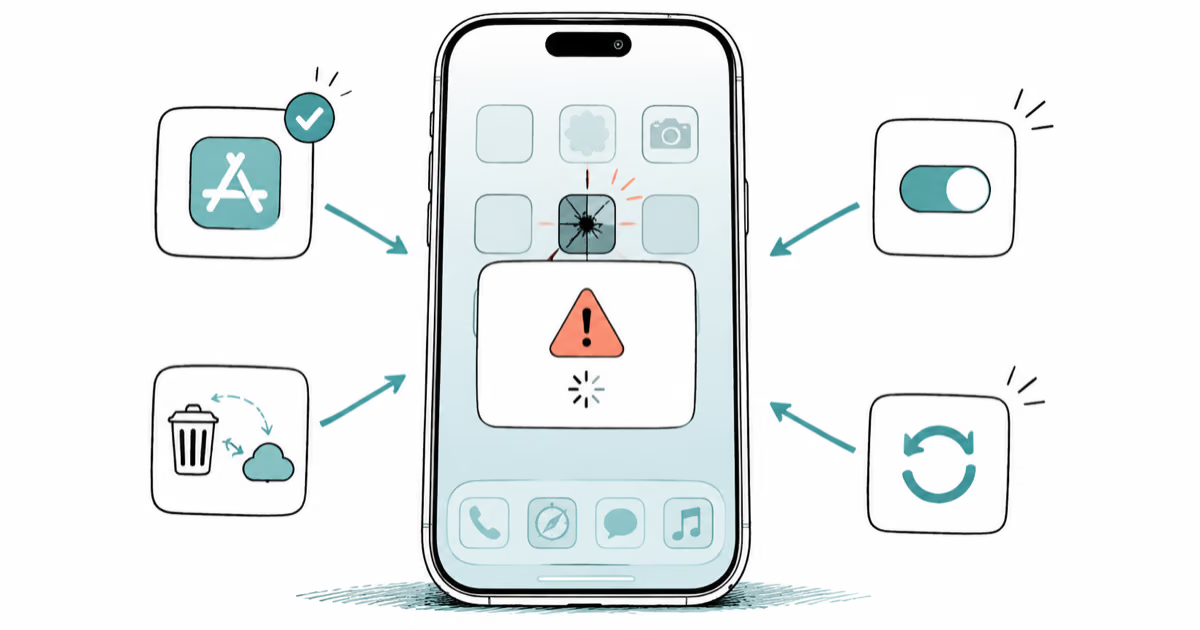
Apps Crashing After iOS 27 Update? Fix Order (2026)
Apps crashing after the iOS 27 update? Update the app in the App Store first, then offload and reinstall to clear stale cache, then restart. The fix order.

Do AI Translation Earbuds Work Offline? What to Know
Do AI translation earbuds work offline? A few do with downloaded language packs, but most need the cloud. Here's what works offline and what you give up.