WireGuard vs OpenVPN: Which VPN Protocol Wins in 2026?
WireGuard vs OpenVPN, compared for everyday iPhone, Mac, and Android users: speed, battery, security, and the one case where OpenVPN still wins.

Quick AnswerWireGuard is the better VPN default for most phones and laptops in 2026: faster, lighter on battery, and simpler. OpenVPN wins on locked-down networks that need TCP over port 443.
WireGuard vs OpenVPN is the protocol choice hiding inside almost every VPN app, and for most people both are secure enough for daily use. The real gap shows up in a few specific places: reconnection speed, battery, and surviving a restrictive firewall. Those differences are where the choice actually matters on a phone or laptop.
- WireGuard is the better default for everyday phone and laptop use, with faster reconnects and lighter battery use.
- OpenVPN’s one durable edge is running over TCP port 443, slipping through firewalls that block WireGuard’s UDP traffic.
- WireGuard uses a single fixed cipher suite, which removes the misconfiguration risk that flexible OpenVPN setups carry.
- OpenVPN’s open-source core is far larger than WireGuard’s, which is small enough for one person to audit.
- Mullvad dropped OpenVPN entirely in January 2026, a clear signal of where the industry is heading.
#How WireGuard and OpenVPN Differ
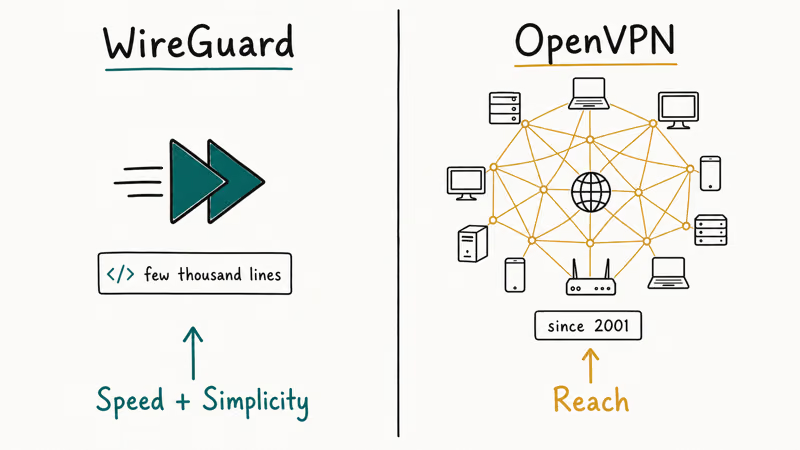
OpenVPN has been the workhorse VPN protocol since 2001, flexible enough to run on almost any device and entrenched in enterprise networks. WireGuard reached the mainstream when it merged into the Linux kernel in 2020, built on the opposite idea: do one job, do it fast, and keep the code tiny. That single design split explains nearly everything below. That long history is also why OpenVPN still shows up in corporate VPN clients and older router firmware today.
New to all this? Our guide to what a VPN actually does on your iPhone covers the basics first.
| Dimension | WireGuard | OpenVPN |
|---|---|---|
| Speed | Faster on the same hardware, less CPU overhead | Solid, but heavier userspace processing |
| Mobile reconnection | Near-instant after a Wi-Fi or cellular handoff | Slower to re-establish the tunnel |
| Battery | Lighter draw on phones | Heavier, especially on long sessions |
| Security model | Fixed modern cipher suite, no negotiation | Configurable ciphers, strong but easy to misconfigure |
| Code base and audit | A few thousand lines, auditable by one person | Roughly 70,000-line core (OpenVPN's own figure) |
| Restrictive networks | UDP is easy to block; needs an obfuscation add-on | Runs on TCP port 443, blends with HTTPS |
| Port flexibility | Limited | High, TCP or UDP on any port |
The pattern is consistent: WireGuard leads on speed and simplicity, while OpenVPN leads on reach into networks that actively fight VPNs.
#Is WireGuard Always Faster Than OpenVPN?
Not always, but usually. The win people actually feel is reconnection speed.
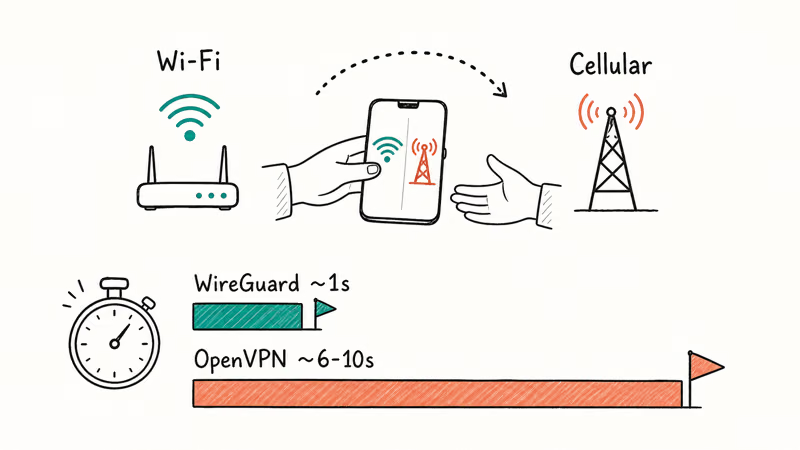
WireGuard typically reconnects in about a second after a Wi-Fi-to-cellular handoff, while OpenVPN over UDP often takes closer to six to ten seconds before traffic flows again. On a phone that hops between home Wi-Fi, office Wi-Fi, and LTE all day, those seconds become fewer stalled pages and video buffers.
According to WireGuard’s official documentation, the protocol is built to be “considerably more performant than OpenVPN” while running in very few lines of code. That speed edge is the headline reason it became the default in most apps.
Prefer a clean setup? The official WireGuard app is the native tool the project supports on iPhone, Mac, and Android.
#Battery and Mobile Roaming
Battery follows the same logic. The lighter WireGuard tunnel leaves noticeably more charge after a full day of on-and-off use. The protocol simply wakes the radio less often and burns fewer cycles per packet.
Roaming is where this compounds. Every Wi-Fi-to-cellular switch is a fresh handshake, and WireGuard’s is far quicker.
If your VPN keeps disconnecting on iPhone, switching the app’s protocol to WireGuard often fixes it on its own. To pick an app that already defaults to WireGuard, see our best VPN for iPhone roundup.
#When Does OpenVPN Still Win?
OpenVPN earns its keep the moment a network turns hostile. Because it can run over TCP on port 443, the same port ordinary HTTPS traffic uses, it blends in where a firewall blocks WireGuard’s UDP packets outright.
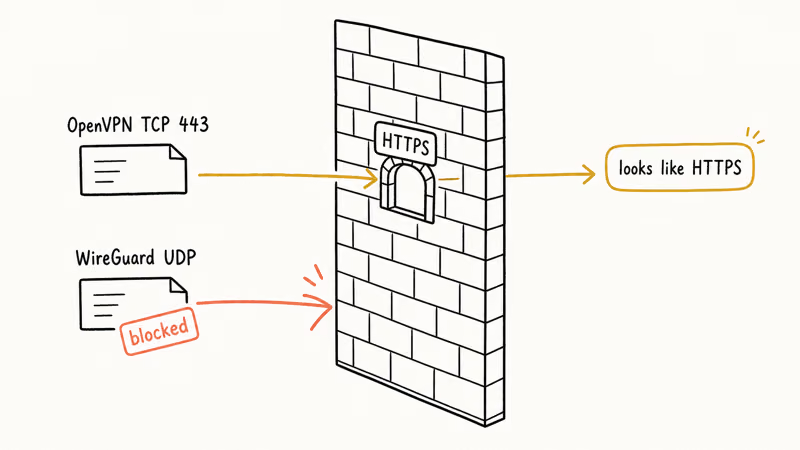
This is its one irreplaceable trick.
On a hotel or guest network that throttles UDP, WireGuard often times out repeatedly, while OpenVPN over TCP 443 connects on the first attempt. On restrictive networks, that reliability still matters.
The industry’s fix has been to teach WireGuard the same disguise. Mullvad’s January 2026 announcement confirms that it removed every OpenVPN server on January 15, 2026, going WireGuard-only and steering censorship-bound users to UDP-over-TCP on port 443 or Shadowsocks instead. That matters because censorship resistance was OpenVPN’s last big advantage, and once WireGuard can copy the disguise, the strongest reason to keep the older protocol around quietly disappears for most people.
Tom’s Guide reported that the cutover would pull all of Mullvad’s OpenVPN servers, framing it as part of a broad shift toward WireGuard across the industry.
#Older Hardware and Self-Hosting
OpenVPN also stays useful on older hardware and self-hosted setups that need fine control over ciphers and ports. If you’re running a VPN on a Firestick or an aging router, its broad compatibility can be the difference between a working tunnel and none. People who host their own VPN server often keep OpenVPN for exactly this reason, since it hands them granular control that WireGuard deliberately leaves out of its design.
On open networks, though, the protocol matters far less than using protection at all, which is why we still recommend a VPN on public Wi-Fi no matter which one your app picks.
#Security: Fixed vs Configurable Encryption
Both protocols are cryptographically strong, so security is about design philosophy, not one being safe and the other not. WireGuard locks in one modern cipher set built on ChaCha20, Curve25519, and Poly1305, with no negotiation, so a server can’t accidentally offer weak encryption. OpenVPN supports many ciphers, which is powerful but leaves room for a sloppy setup to weaken itself. For the average user who never opens a config file, WireGuard’s lack of options is a feature, not a limit.
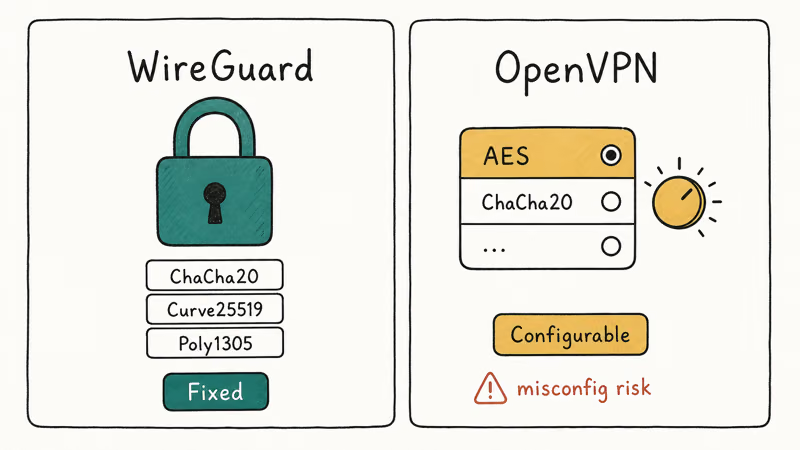
Smaller code is easier to trust because it’s easier to review. OpenVPN’s own blog states that its open-source core is about 70,000 lines of code, and fairly notes that the larger figures near 600,000 unfairly count shared OpenSSL used across the web. WireGuard, by contrast, is built to be read and audited by a single person.
Either way, the protocol is just one layer. It helps to also tighten your iPhone privacy settings so less data ever leaves the tunnel.
#Bottom Line
For everyday use on an iPhone, Mac, or Android phone, including streaming, commuting, and public Wi-Fi, choose WireGuard. The faster reconnects and lighter battery are exactly what mobile use rewards. Most readers stop here and never look back.
Two exceptions remain. On a locked-down network, a school, hotel, corporate firewall, or a censored country, reach for OpenVPN over TCP 443, or a WireGuard obfuscation mode if your provider offers one. And for a self-hosted tunnel on old router hardware that needs maximum cipher and port flexibility, OpenVPN’s configurability still makes it the safer pick.
#Frequently Asked Questions
Is WireGuard safe to use?
Yes. WireGuard uses a modern, fixed cipher suite and a small code base that security researchers can review in full. Its simplicity is a big part of why providers like Mullvad now run it exclusively. The design has also held up well to public scrutiny since it reached the Linux kernel.
Does WireGuard drain less battery than OpenVPN?
Generally, yes, and the gap is most noticeable on phones. The lighter WireGuard tunnel leaves more charge after a day of mixed Wi-Fi and cellular use.
Can OpenVPN still get past firewalls that block WireGuard?
Often, yes. OpenVPN can run over TCP on port 443, the same port used by normal HTTPS traffic, so it blends in where a firewall blocks WireGuard’s UDP packets. That’s the main reason it stays relevant in 2026, though some providers now add similar obfuscation to WireGuard.
Which protocol is better for streaming on an iPhone?
WireGuard, in most cases. Its higher throughput and quick reconnection handle 4K video with fewer buffers, and OpenVPN only pulls ahead on a network that blocks WireGuard outright.
Is WireGuard or OpenVPN better for privacy?
Both can be private when run by a trustworthy no-logs provider. WireGuard once assigned static internal IP addresses, but major providers now mask that with double-NAT systems, so the practical privacy difference is small. The factors that matter more are the provider’s logging policy and your own device settings.
Should I switch my VPN from OpenVPN to WireGuard?
For most people, yes. If your app offers WireGuard, switching usually brings faster connections and better battery life with no real downside. Keep OpenVPN in your back pocket only for networks that block WireGuard, and many apps will fall back to it automatically when that happens. If you mostly use a VPN on your phone, the switch is close to a free upgrade.

Is This Bank App Real? Spot a Fake App on Your Home Screen
A bank app can land on your home screen from a web page with no install warning. Learn the checks that tell a real banking app from a phishing web app.
Passkeys Not Syncing Between iPhone and Windows? Read This
Passkeys not syncing between iPhone and Windows is by design, not a bug. Here is why iCloud passkeys skip Windows Hello and the three ways to fix it.
VPN Not Working on Snapdragon X? Why It Fails, How to Fix
Your VPN won't install or connect on a Snapdragon X Copilot Plus PC because Windows on ARM can't emulate the network driver. Here are the fixes that work.

How to Check If a Link Is Safe Before You Click It
Learn how to check if a link is safe with official-first steps: read the real domain, use the app instead, and treat scanners as a second opinion only.