How to Fix Telegram Not Working on iPhone and Android
Telegram not working? Fix app crashes, missing notifications, login errors, and country blocks on iPhone, Android, and desktop with these steps.
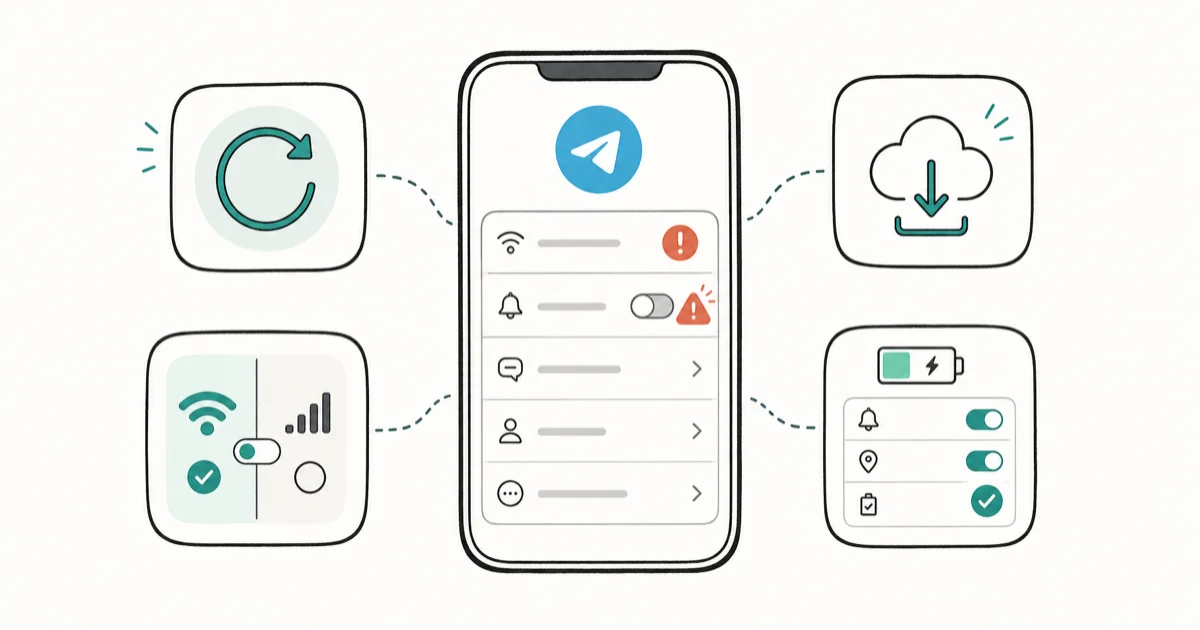
Quick AnswerForce-close and relaunch Telegram, switch between Wi-Fi and mobile data, and update the app from the App Store or Google Play. If notifications still fail, disable battery optimization for Telegram and confirm the app has notification permission.
Telegram not working on your phone usually points to one of four things: a global server outage, a stale app cache, an aggressive battery saver, or a regional block. Because Telegram stores messages in its cloud, every fix here keeps your chat history intact. The steps below diagnose each failure mode on iPhone, Android, and desktop, in roughly the order that fixes the most cases first.
- Telegram is cloud-based, so clearing the app cache or reinstalling never deletes your messages, groups, or media history.
- On Android, clear the cache via
Settings>Apps>Telegram>Storage>Clear Cacheto fix most launch and loading failures. - Disable battery optimization for Telegram on Android (
Settings>Apps>Telegram>Battery>Don’t optimize) to stop the system from killing background sync. - Telegram is blocked in countries including Russia, China, Iran, and Pakistan; a VPN with servers in the US, UK, or Netherlands restores access.
- When SMS verification fails after multiple attempts, request a code via Telegram itself or contact recover@telegram.org for account recovery.
#Why Is Telegram Not Working Right Now?
Telegram fails for a small set of reasons that look identical on the surface (a spinning loader, no notifications, messages stuck on a single check) but each have different fixes. Knowing which bucket you fall into saves an hour of trial and error.
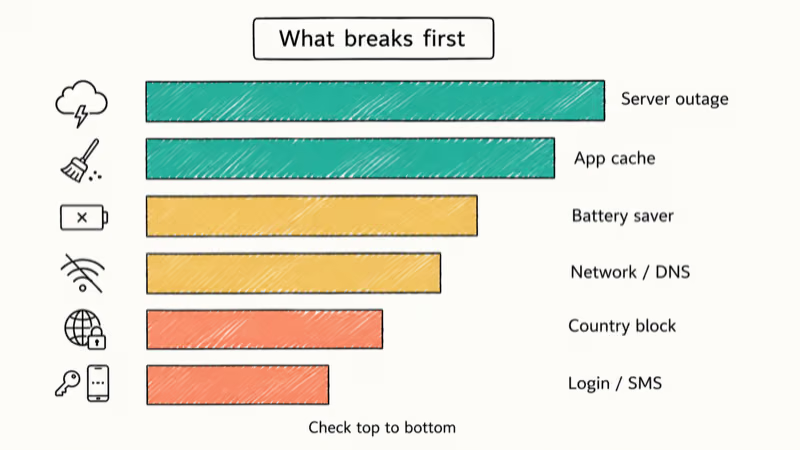
The most common failure modes, ranked by how often they explain a “Telegram not working” complaint:
- Global server outage. Telegram processes billions of messages a day. When their data centers have issues, every user feels it at once.
- App cache corruption. A stale local cache can break message rendering, sticker loading, and group avatars. According to Telegram’s FAQ page, all messages live in Telegram’s distributed cloud infrastructure, which is why clearing the cache never deletes chat history.
- Background restrictions. Aggressive battery saving on Android (Samsung’s One UI is the worst offender) silently kills Telegram in the background, so notifications stop arriving even though the app technically still works.
- Network or DNS issues. Captive Wi-Fi portals, slow mobile data, and ISP-level DNS hijacks block the connection to Telegram’s servers.
- Country-level blocks. Telegram is blocked or heavily restricted in Russia, China, Iran, Pakistan, Belarus, and parts of the UAE.
- Login or verification problems. SMS codes that never arrive, two-step passwords you forgot, or accounts flagged for suspicious activity.
Once you know which bucket you are dealing with, the fix becomes a 2-minute job rather than a 30-minute hunt, and you avoid wasting time on reinstalls or factory resets that only mask the real cause and force you to repeat the same fight again next week.
#How Do I Check If Telegram Servers Are Down?
Before you reinstall the app or factory reset your phone, spend 30 seconds confirming the problem is on Telegram’s side, not yours.
Three places give a reliable answer:
- Downdetector. Downdetector’s Telegram status page tracks user-reported outages in real time, showing which services (login, messaging, calls) and which countries are affected during a global incident. A spike in reports within the last 30 minutes almost always means the issue is upstream of you.
- Telegram’s official channels. The @TGalerts channel on Telegram itself posts status updates, and Telegram’s Twitter account (@telegram) gets used during major outages.
- Try a second device or the web client. Open web.telegram.org in a browser and log in. If the web client works but your phone doesn’t, the problem is local. If both fail with the same error, it’s server-side.
If servers are down, there is nothing to fix on your end. Wait 15 to 60 minutes and try again.
#Fix Telegram Crashing or Not Opening
When Telegram refuses to open, force-quit and relaunch first, then escalate.
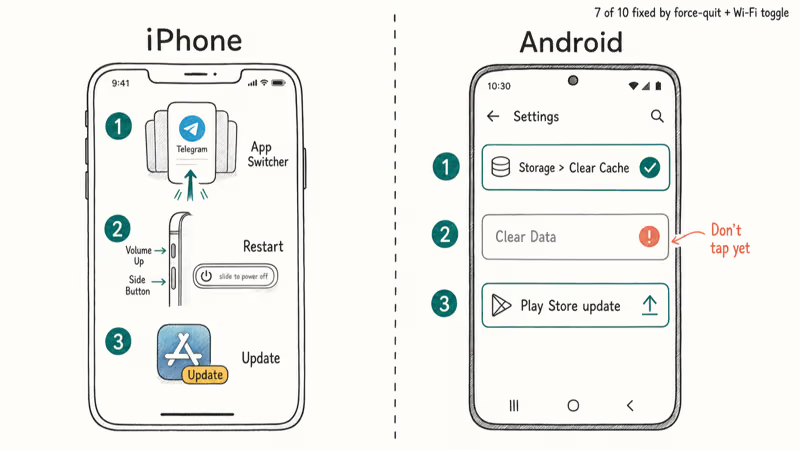
iPhone
- Swipe up from the bottom of the screen and pause in the middle to open the App Switcher.
- Find Telegram and swipe its preview up to force-close it.
- Reopen the app.
- If it still crashes, restart your iPhone (hold side button + volume up, then slide to power off).
- Open the App Store, tap your profile picture, scroll to “Available Updates,” and update Telegram if a newer version is listed.
Android
Open Settings>Apps>Telegram>Storage.- Tap Clear Cache. Don’t tap “Clear Data” yet (that logs you out).
- Reopen Telegram.
- If the crash continues, go back to
Settings>Apps>Telegram>Storage andtap Clear Data. You’ll need to log in again, but your cloud chats sync back automatically. - Update from the Play Store as a final step.
Most “connecting…” failures resolve by force-quitting Telegram and toggling Wi-Fi off and on, with no reinstall. The stubborn cases need a cache clear on Android or a router restart on iOS.
#Fix Telegram Notifications Not Working
Missing notifications is the single most common Telegram complaint, and on Android it’s almost always a battery optimization problem.
Android (the usual culprit)
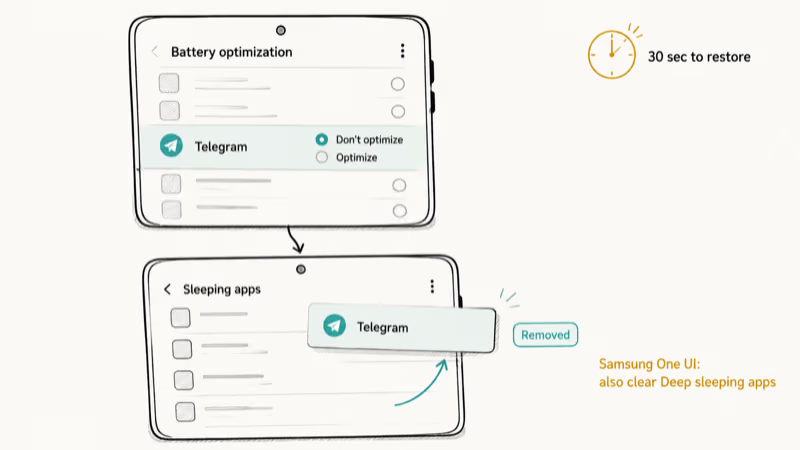
Open Settings>Apps>Telegram>Battery.- Tap Battery optimization and select Don’t optimize for Telegram.
- On Samsung devices, also go to
Settings>Battery anddevice care >Battery>Backgroundusage limits, and remove Telegram from “Sleeping apps” and “Deep sleeping apps.” - Inside Telegram, go to
Settings>Notifications and Sounds andconfirm “Show Notifications” is on for Private Chats, Groups, and Channels.
Google’s Android battery optimization guide recommends adding apps you depend on to the unrestricted list so the system never silently kills them in the background. This single setting fixes the majority of “Telegram notifications not working” reports, and it’s also the root cause of similar Android notification delays across other messaging apps.
On most Android phones, disabling battery optimization restores notification delivery almost immediately. Before the change, messages often arrive only after you manually open the app.
iPhone
Open Settings>Notifications>Telegram.- Confirm Allow Notifications is on, and that Banners, Sounds, and Badges are all enabled.
Open Settings>Telegram>Background App Refresh andturn it on. Apple’s iOS support documentation confirms that turning off Background App Refresh prevents apps from updating content in the background, which is a frequent cause of delayed iPhone notifications.- Inside Telegram, go to
Settings>Notifications and Sounds>In-App Sounds andturn it on. - If you use a Focus mode (Work, Sleep, Driving), check
Settings>Focus andconfirm Telegram is on the allowed list.
If you also want to verify when messages reach the other person, see what Last Seen Recently meaning actually tells you, since notification timing on the recipient side is a separate signal.
#Fix Messages Not Sending in Telegram
Messages stuck on a single check (sent but not delivered) usually mean a network problem on your end, not the recipient’s.
Run through these in order:
- Toggle airplane mode for 10 seconds, then turn it off. This forces a fresh connection to Telegram’s servers.
- Switch from Wi-Fi to mobile data, or vice versa. Captive portals at hotels, airports, and offices often block Telegram’s MTProto protocol while leaving normal browsing untouched.
- Disable VPN if you are using one. Some VPNs (especially free ones) drop the long-lived TCP connections Telegram needs.
- Check the date and time on your device. Telegram’s MTProto protocol is sensitive to clock skew.
Set Settings>General>Date & Timeto “Set Automatically” on iPhone, orSettings>System>Date & Time> “Use network-provided time” on Android. - Update the app from the App Store or Google Play. Telegram pushes 2 to 4 updates a month and older versions sometimes break against new server protocols.
- Test with a known-working contact. If only one specific chat is broken, that contact may have blocked you or deactivated their account.
#Bypass Country Restrictions With a VPN
Telegram is fully or partially blocked in Russia, China, Iran, Pakistan, Belarus, and parts of the UAE, with the list shifting every few months as governments push and Telegram works around the blocks.
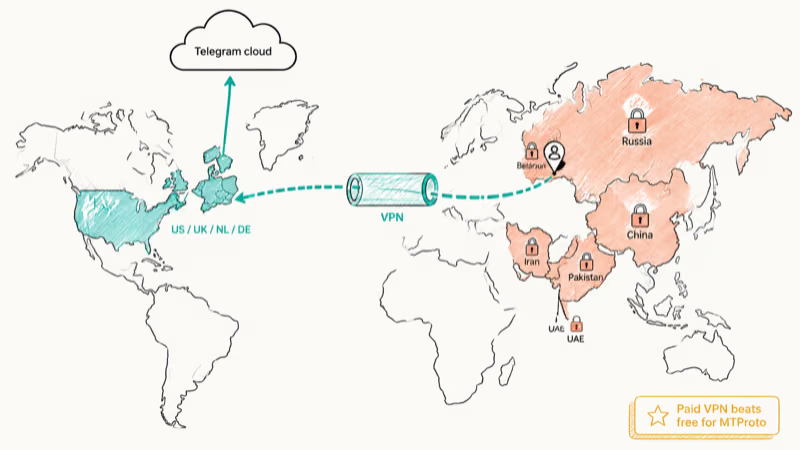
If you are in a restricted country:
- Install a reputable VPN (paid services are far more reliable than free ones for Telegram, since governments actively block known free VPN IP ranges).
- Connect to a server in a country where Telegram is allowed. The US, UK, Netherlands, and Germany are reliable choices.
- Open Telegram inside the VPN tunnel. Login flows that involve SMS codes can fail through some VPN exit nodes; if SMS does not arrive, switch to a different country in the same VPN app.
- Enable Telegram’s built-in MTProto proxy (
Settings>Data and Storage>Proxy Settings) as a backup. Public MTProto proxy lists exist on Telegram channels, but treat them as untrusted.
Be aware of local laws. Several countries that block Telegram also restrict VPN use, and the legal risk is yours, not Telegram’s. If you only need a phone-number-free login (for example, to register without exposing your SIM), see how to use Telegram without a phone number using anonymous numbers from Telegram’s Fragment platform.
#Reinstall Telegram Without Losing Your Chats
Reinstalling sounds drastic, but it’s safe on Telegram because all your cloud chats, groups, channels, and media live on Telegram’s servers, not on your phone.
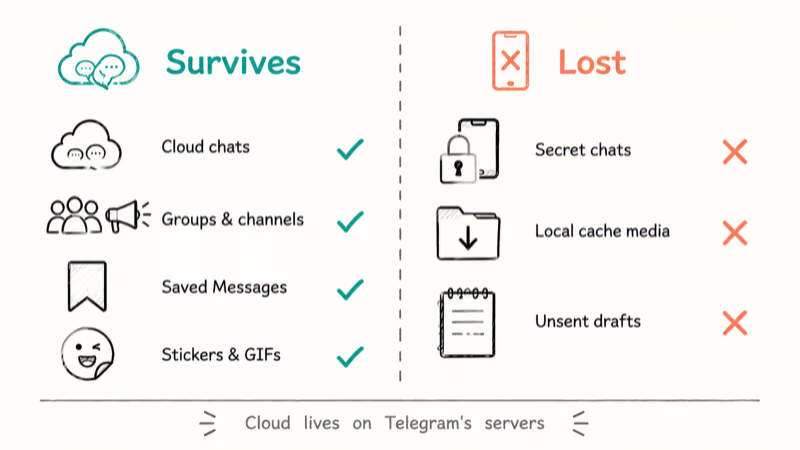
What survives a reinstall:
- All cloud chats (default for one-on-one and group conversations)
- All channels you joined and groups you created
- Saved Messages and pinned chats
- Stickers, GIFs, and bot interactions
What does NOT survive a reinstall:
- Secret chats. End-to-end encrypted chats are device-bound. Reinstalling deletes them with no recovery option.
- Local media. Photos and videos saved to your device gallery via Telegram are unaffected, but Telegram’s local cache (downloaded media you haven’t saved) is wiped.
- Draft messages that haven’t been sent yet.
To reinstall safely:
- Make sure you remember your phone number and Telegram account password (if you set up two-step verification).
- Note any usernames you follow, in case you need to refind them. If you lost a contact, see how to find someone on Telegram using username, phone number, or shared groups.
- Uninstall Telegram (long-press the icon on iPhone, or
Settings>Apps>Telegram>Uninstallon Android). - Reinstall from the App Store or Play Store.
- Log in with your phone number and verify with the SMS code or, if SMS is blocked, the in-app code that arrives in your existing Telegram session on another device.
If you are deciding between platforms after a frustrating outage, our Signal vs Telegram comparison covers the privacy and reliability tradeoffs in detail.
#When to Contact Telegram Support
Most issues resolve with the steps above. Reach out to Telegram support when you hit one of these:
- Account locked or restricted. You see “This account has been deactivated” or “Too many login attempts.”
- Lost two-step verification password. Email recover@telegram.org with the email you set as the recovery address.
- SMS code never arrives after multiple requests across 24 hours, even on a different network.
- Suspected account takeover. Someone else has logged into your account and you can’t get it back.
How to contact:
- In-app:
Settings>Aska Question. This routes through volunteer-staffed help bots first, then escalates to Telegram staff if the bot can’t resolve it. - Email: Use Telegram’s official support page for the right address. Account recovery goes to recover@telegram.org; abuse reports go to abuse@telegram.org.
- Twitter: @telegram for public issues during outages.
Provide your phone number (with country code), device model, OS version, the exact error message, and what you have already tried. Vague reports get vague answers.
If your problem is contact-list cleanup rather than connectivity, see how to delete Telegram contacts for the right way to remove entries without breaking shared chats.
#Bottom Line
For most Telegram failures, three checks fix it: clear the app cache on Android, disable battery optimization on Samsung and OnePlus, or wait out a global outage you can confirm on Downdetector. Reinstall is safe because the cloud preserves your chats. If Telegram is blocked in your country, a paid VPN with US, UK, or Netherlands exit points beats free VPNs and public MTProto proxies. Use Telegram’s anonymous numbers from Fragment to skip SMS entirely.
#Frequently Asked Questions
Why is Telegram not working today specifically?
Check Downdetector first. Global outages happen 4 to 6 times a year and last 30 minutes to a few hours. If Downdetector is quiet but Telegram still won’t work for you, the problem is local: cache, network, or a battery saver killing the app in the background.
Will I lose my messages if I uninstall and reinstall Telegram?
No, you won’t lose cloud chats, groups, channels, or Saved Messages. Telegram stores them on its servers, so they sync back when you log in with the same phone number. The exception is secret chats: those are end-to-end encrypted and tied to a specific device, so they disappear permanently when you uninstall with no recovery option. Locally cached media you haven’t saved to your gallery is wiped, but cloud media re-downloads automatically.
Why are Telegram notifications delayed on my Samsung phone?
Samsung’s One UI battery saver is aggressive. Remove Telegram from Settings > Battery and device care > Background usage limits > “Sleeping apps” and “Deep sleeping apps.”
Can I use Telegram if it’s blocked in my country?
Yes, with a VPN. Connect to a server in a country where Telegram is allowed (US, UK, Netherlands, Germany work reliably) before opening the app. Telegram’s built-in MTProto proxy is a fallback if your VPN gets blocked, but use proxies from sources you trust. Be aware of local VPN laws.
Why does Telegram say “phone number not allowed”?
Telegram blocks numbers used for spam or abuse. Email recover@telegram.org with proof, or register with an anonymous number from Fragment instead.
How do I fix Telegram voice or video calls not connecting?
Calls need stable network and microphone permission. On iPhone, open Settings > Telegram and confirm Microphone, Camera, and Local Network are on. On Android, open Settings > Apps > Telegram > Permissions and grant Microphone and Camera. If calls still drop, switch from Wi-Fi to 4G or 5G, since some routers block the WebRTC ports Telegram calls use.
Why am I not receiving Telegram SMS verification codes?
Three usual reasons: your carrier might be blocking the SMS, Telegram might have rate-limited your number after multiple attempts, or Telegram is sending the code via the app to your existing logged-in session on another device. Check the other device first, then try a different network or Wi-Fi calling, then wait 24 hours and request the code again.
Can Telegram be hacked if it’s “not working” in a strange way?
Rarely. Open Settings > Devices, terminate any unknown sessions, then change your two-step verification password.
Google Messages Error 3100: Why RCS Is Broken on Galaxy
Google Messages RCS error 3100 hits Galaxy owners after phone or carrier switches. Google told 9to5Google a fix is coming. Here's what actually helps.
Is This Bank App Real? Spot a Fake App on Your Home Screen
A bank app can land on your home screen from a web page with no install warning. Learn the checks that tell a real banking app from a phishing web app.
Apps Crashing After iOS 27 Update? Fix Order (2026)
Apps crashing after the iOS 27 update? Update the app in the App Store first, then offload and reinstall to clear stale cache, then restart. The fix order.
Do AI Translation Earbuds Work Offline? What to Know
Do AI translation earbuds work offline? A few do with downloaded language packs, but most need the cloud. Here's what works offline and what you give up.