Best Splunk Alternatives 2026: Cheaper SIEM and Log Tools
Splunk pricing is steep. Compare 10 Splunk alternatives in 2026 including Elastic Stack, Datadog, Sumo Logic, Graylog, and seven more options.

Quick AnswerTop Splunk alternatives in 2026 are Elastic Stack (free open-source), Datadog (cloud monitoring with logs), Graylog (centralized log management), and Sumo Logic (cloud SIEM). Most cost a fraction of Splunk''s enterprise licensing, with several free open-source options for self-hosted deployments.
Splunk alternatives matter once the platform’s per-GB licensing pushes past what your team can justify. This guide compares cheaper SIEM and log management tools across cloud-native, self-hosted, and hybrid setups, ranked by cost model, search fit, and team-size requirements.
- Splunk’s per-GB enterprise pricing pushes most mid-size teams toward open-source or cloud-native alternatives within their second renewal cycle.
- Elastic Stack covers core search and dashboarding when your team has ops capacity to self-host Elasticsearch and Kibana.
- Datadog and Sumo Logic suit cloud-first teams that want managed SIEM without rack space, in trade for per-host or per-GB billing.
- Graylog, Grafana Loki, and Sentry give DevOps teams centralized log search and error tracking without enterprise licensing fees.
- Migration from Splunk takes weeks for typical workloads, with most effort going into dashboard recreation and alert mapping.
#What Is Splunk and Why Look for Alternatives?
Splunk is a SIEM and log management platform that ingests, indexes, and searches machine-generated data at scale.
Splunk states that it launched in 2003 and now ingests data from servers, networks, applications, and cloud services for unified search. Wikipedia’s Splunk overview traces the company’s history and product line. Teams pick it for the mature query language, polished dashboards, and enterprise-grade support that competitors took years to match.
The catch is cost.
Splunk licensing scales with daily ingestion volume, and large deployments routinely run into six- and seven-figure annual contracts. For many mid-size teams, renewal sticker shock is the point where a migration project starts to look realistic.
Performance can also surprise teams pushing past tens of terabytes a day. The indexer architecture handles steady ingestion well, but search latency degrades at extreme scale. For another take on enterprise tool replacement in the analytics category, our Tableau alternatives roundup walks through similar tradeoffs.
#How Splunk Alternatives Compare on Cost
Pricing is the single biggest reason teams move off Splunk.
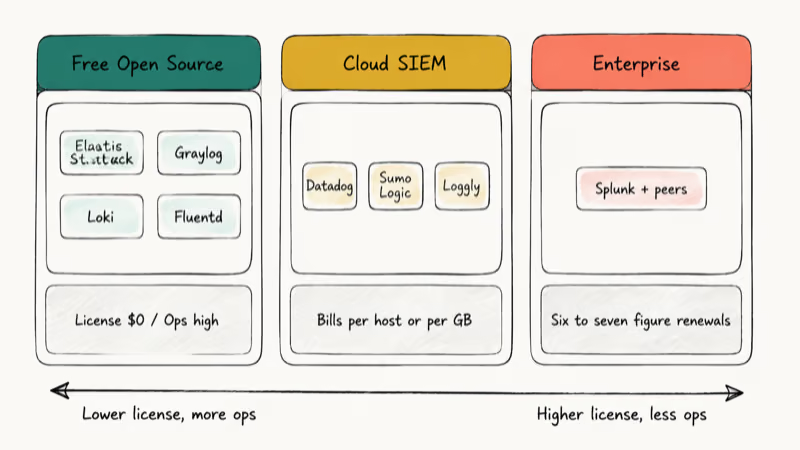
The market splits into three tiers. Free open-source platforms like Elastic Stack, Graylog, Grafana Loki, and Fluentd cost nothing to license but require ops time to deploy and maintain. Subscription cloud SIEM tools (Datadog, Sumo Logic, Loggly) bill by host count or ingested volume. Enterprise paid tools sit in Splunk’s price band but compete on features and ease of use.
Open source isn’t truly free if your team can’t run it.
Compare hidden costs honestly. A self-hosted Elastic Stack needs at least one engineer dedicated to cluster operations. Elastic states that the Stack has 4 main components (Elasticsearch, Logstash, Kibana, and Beats), and each adds operational surface area you’ll be responsible for. The Elastic Stack overview walks through each layer.
Cloud SIEM platforms wrap that work into the subscription fee, which sounds expensive on paper but often nets out cheaper after you factor in headcount.
#Top 10 Splunk Alternatives in 2026
The 10 candidates below cover small, mid-size, and large log workloads across self-hosted, cloud-managed, and specialty deployment models.
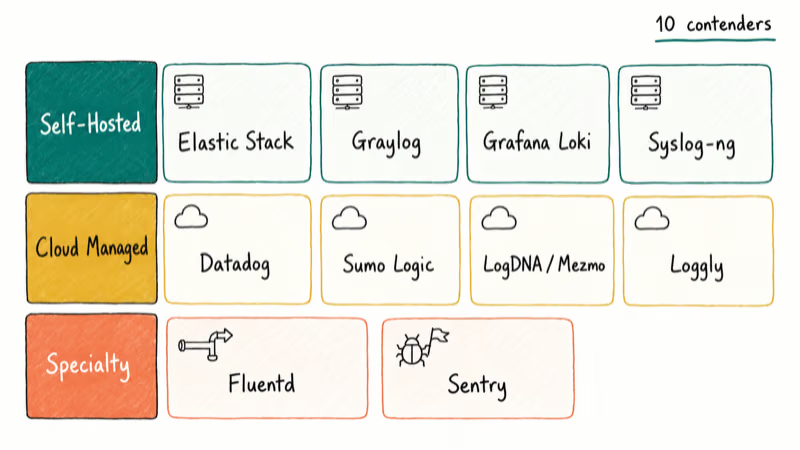
#1. Elastic Stack (ELK)
Elastic Stack is the most popular open-source replacement for Splunk. The four-component architecture covers Elasticsearch for search, Logstash for ingestion, Kibana for dashboards, and Beats for shipping. Together they give you a Splunk-equivalent stack without licensing fees.
The catch: you’re now an Elasticsearch operator.
Elastic can scale well when shard sizing, storage, and retention are tuned carefully. Cluster operations take time, however, and small teams without dedicated ops capacity often regret the move within the first quarter.
#2. Datadog
Datadog is the obvious cloud-native pick for teams that already run on AWS, GCP, or Azure. It bundles infrastructure monitoring, APM, and log management into one subscription, with native integrations for hundreds of cloud services. The Datadog Log Management product page details ingestion-and-retention pricing.
Pricing is per-host plus per-ingested-GB, which adds up fast at scale.
That tradeoff is worth it for small and mid-size cloud-first teams who’d rather pay for managed simplicity than hire ops engineers.
#3. Sumo Logic
Sumo Logic positions itself as cloud-native SIEM, a direct shot across Splunk’s bow for security teams. The Sumo Logic Cloud SIEM product page lists threat intelligence, compliance dashboards, and pre-built detection rules out of the box.
You get pay-as-you-go ingestion, default retention windows, and managed cluster operations. The UI feels more approachable than Splunk’s for analysts coming from spreadsheet-heavy backgrounds, and the search syntax is forgiving.
#4. Graylog
Graylog is the open-source choice for teams that want centralized log management without owning Elasticsearch operations end-to-end. According to Graylog’s official site, the platform sits on top of Elasticsearch and MongoDB but wraps both in an approachable web UI with streams, processing pipelines, and alerts.
Mid-size DevOps teams often land on Graylog because it splits the difference between Splunk’s polish and ELK’s rawness. You get most of the Splunk feature set with no licensing fee, plus a community edition that handles real production workloads.
#5. LogDNA (Mezmo)
LogDNA, now branded as Mezmo, is a cloud log management platform aimed at DevOps and SRE teams. Per-GB ingestion pricing means small teams can run it for less than the cost of a single Splunk indexer.
Live tail and full-text search are responsive even on multi-terabyte archives.
It supports cloud, on-prem, private cloud, and multi-cloud deployments. The dashboard is configurable, and the search syntax is forgiving for analysts coming from grep and awk pipelines.
#6. Fluentd
Fluentd isn’t a full Splunk replacement — it’s a data collector and router. It ingests structured, semi-structured, and unstructured data, then forwards to whichever backend you pick. Teams use it as the shipping layer in front of Elastic Stack, S3, or Kafka.
You won’t replace Splunk with Fluentd alone.
But pair Fluentd with Elasticsearch and Kibana, and you have a flexible pipeline that uses less memory and CPU than Logstash. The plugin ecosystem is large, and most cloud platforms ship with Fluentd connectors. Initial installation is heavier than Logstash but pays off once you’re routing logs from a dozen sources.
#7. Loggly
Loggly is a SolarWinds-owned cloud log service with HTTP/HTTPS ingestion that doesn’t require an agent for many integrations. It supports Docker, AWS, Syslog, Heroku, Windows, and Linux logs, plus custom parsing rules for novel formats.
The Field Explorer view is the standout feature.
It lets you filter, search, and summarize logs from a single screen without writing queries. Plans scale by ingested volume per day and retention window. Entry tiers suit small teams, and higher tiers handle enterprise compliance retention.
#8. Sentry
Sentry is technically an error-monitoring platform rather than a full SIEM, but it overlaps heavily with Splunk’s application-error use case. It captures stack traces, release context, and user impact data for application errors in real time.
The free tier is generous, and paid tiers stay affordable for mid-size teams.
If your Splunk usage is mostly “where did production break and who’s affected,” Sentry replaces that workflow at a fraction of the cost. Pair it with one of the log platforms above and you have the broader observability story without enterprise licensing.
#9. Grafana Loki
Grafana Loki is the log management piece of the Grafana observability stack. It indexes only log labels rather than full content, which keeps storage costs low compared to Elasticsearch-style index-everything platforms.
You query Loki using LogQL, which mirrors Prometheus’ PromQL syntax. Teams already running Grafana for metrics often pick Loki because the dashboards integrate cleanly. The tradeoff is search speed: high-cardinality queries on body content can lag Elasticsearch, but indexing costs drop dramatically at scale.
#10. Syslog-ng
Syslog-ng is an open-source log shipper for Unix-like systems. It collects, parses, and routes log data to your storage layer of choice. Two editions exist: Open Source Edition (free) and Premium Edition (paid, with extras like SQL destinations and Hadoop integration).
This is infrastructure plumbing, not a full Splunk alternative.
Use it on the collector layer and pair with Elasticsearch or Loki for storage and search. Filtering options are extensive, but advanced features sit behind the premium edition.
#Which Splunk Alternative Works Best for Real-Time Log Analysis?
Real-time analysis means sub-second from log emission to searchable index. Three platforms stand out for that workload.
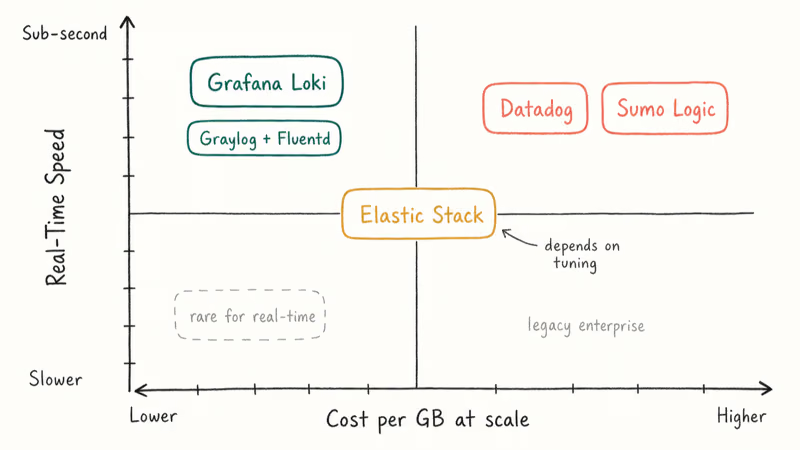
Elastic Stack with Beats agents and a tuned ingestion pipeline can deliver sub-second indexing at moderate volumes. Datadog handles real-time ingestion well thanks to its managed pipeline, with the trade-off being per-GB cost at high volume. Sumo Logic sits in a similar place with managed real-time analytics and usage-based billing.
For pure velocity at low cost, Loki or Graylog with Fluentd often beats both.
The right answer depends on whether your team values managed simplicity or self-hosted cost control. Small teams often thrive on Datadog because the ops overhead disappears entirely. Larger teams with dedicated SREs often pick Elastic for the cost ceiling at scale.
#Choosing the Right Splunk Alternative for Your Team
Pick by use case, not by feature checklist. Three questions narrow the field fast.
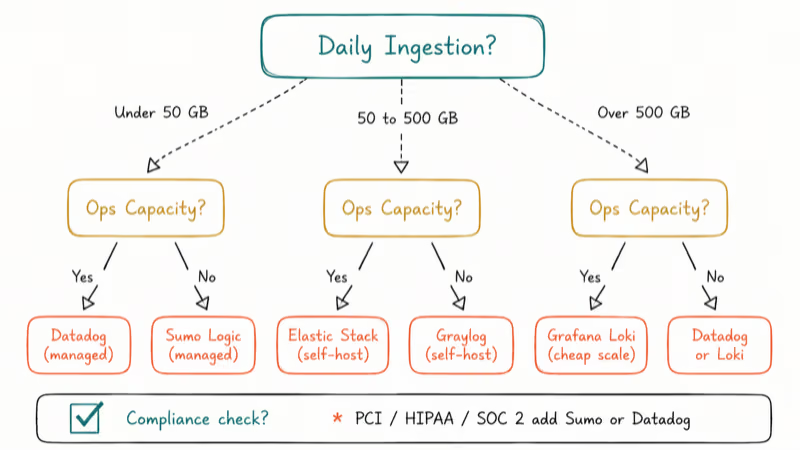
#What’s your daily ingestion volume?
Under 50GB per day: any cloud SIEM (Datadog, Sumo Logic, Loggly) works without breaking the budget. Between 50 and 500GB per day: Elastic Stack or Graylog start to win on total cost of ownership. Over 500GB per day: only Elastic Stack, Loki, or Graylog stay sustainable without enterprise contracts.
#Do you have ops capacity?
Self-hosted Elastic, Graylog, and Loki need ongoing cluster operations. If your team is fewer than 10 engineers, the ops burden often outweighs the licensing savings. Managed cloud SIEM platforms convert ops work into a predictable subscription line.
#What’s your compliance posture?
Regulated workloads (PCI, HIPAA, SOC 2) often need dedicated retention windows and audit trails. Sumo Logic and Datadog ship with compliance-ready packages out of the box. Self-hosted Elastic can meet the same bar, but you’re responsible for the audit story.
Run a 30-day proof of concept before signing.
A proof of concept should use production-shape data, realistic retention settings, and real alert rules. The platform that wins on paper can still lose once search latency, alert noise, and dashboard rebuild time show up in daily use.
For parallel takes on platform-versus-platform comparisons, browse these companion breakdowns:
- Splunk vs ELK breakdown for log-stack head-to-head
- Power BI vs Tableau vs QlikView roundup for BI layer choices
If you’re stitching together a broader DevOps stack alongside the log layer, our Redmine vs Jira comparison covers issue tracking with the same evaluation method.
#Common Pitfalls When Migrating from Splunk
Most teams underestimate three things during a Splunk migration: dashboard recreation, alert mapping, and historical data retention.
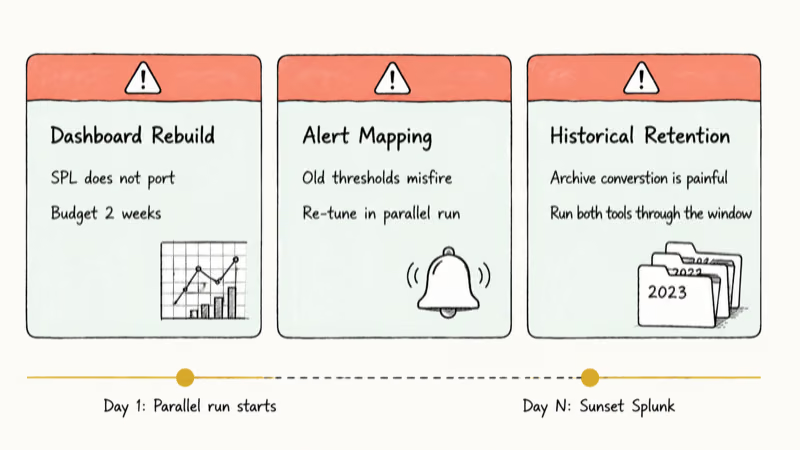
Dashboard recreation eats more time than expected. SPL queries don’t translate one-to-one into the new platform’s query language, and saved searches with complex correlations need a redesign. Budget at least two weeks for a typical dashboard set.
Alert mapping is the hidden surprise. Splunk alert thresholds were tuned to your specific data shape, and porting them blind to a new tool floods on-call with false positives. Re-tune from production traffic over the first two weeks of parallel run.
Historical data retention is the third trap. Most teams skip migrating Splunk’s archive into the new platform because the format conversion is painful. If compliance requires long retention, plan a parallel-run period where both systems collect new data, then sunset Splunk only after the new tool has covered the full retention window.
#Bottom Line
Pick Datadog if you’re a cloud-first team under 50 engineers and want managed everything without ops overhead. Pick Elastic Stack if you have ops capacity and your daily volumes will scale past 100GB, where the licensing savings dominate. Pick Graylog if you want most of Splunk’s polish at zero licensing cost and you’re willing to operate Elasticsearch underneath.
Don’t pick anything before running a real 30-day pilot on production-shape data.
For analysts comparing visualization stacks alongside log tools, our Looker vs Tableau guide walks the parallel BI tradeoffs.
#Frequently Asked Questions
What are the main drawbacks of using Splunk?
Splunk’s licensing model scales with daily ingestion volume, which becomes painful as data grows. Performance can degrade at high terabyte-scale ingestion. Some teams also find horizontal scaling complex compared to cloud-native alternatives, and SPL has a learning curve for newcomers.
Is it easy to migrate from Splunk to alternative solutions?
Migration complexity depends on data volume, custom dashboards, and alert mapping. A typical mid-size deployment takes weeks of focused work. The heaviest lift is recreating SPL queries and dashboards in the new tool’s query language.
Are Splunk alternatives cost-effective?
Yes, in most scenarios. Open-source options like Elastic Stack and Graylog eliminate licensing fees entirely in trade for ops time. Cloud SIEM platforms like Sumo Logic and Datadog typically cost a fraction of equivalent Splunk ingestion at mid-size volumes, though final pricing depends heavily on retention windows and host counts.
Can Splunk alternatives handle large-scale data ingestion?
Most modern alternatives are built for horizontal scale. Elastic Stack, Datadog, Sumo Logic, and Graylog all handle multi-terabyte daily ingestion when correctly architected. The differentiator is operational simplicity, not raw throughput.
Which Splunk alternative is best for real-time log analysis?
Datadog and Sumo Logic offer real-time managed analytics out of the box. Elastic Stack with a tuned Beats and Logstash pipeline matches that speed at lower cost if you have ops capacity. Grafana Loki suits teams already running Prometheus and Grafana for metrics.
How long does it take to deploy a Splunk alternative?
Cloud SIEM platforms (Datadog, Sumo Logic, Loggly) deploy in hours for a basic setup. Self-hosted platforms (Elastic Stack, Graylog) need days to weeks for a production-ready cluster. Plan time for log shipper rollout across your fleet either way.
Do open-source Splunk alternatives include security features?
Elastic Stack ships with built-in security in the basic tier, including authentication, role-based access, and encrypted communications. Graylog includes role-based access and audit logging. Most other open-source tools rely on infrastructure-level security and need additional configuration to clear compliance bars.
What’s the easiest Splunk alternative for small teams?
Datadog and Sumo Logic top the list for small-team ease. Both offer cloud-managed deployment and integrate with cloud providers in minutes. Sentry adds an excellent error-monitoring layer at minimal cost if your primary Splunk use case is application error tracking.

Google Messages Error 3100: Why RCS Is Broken on Galaxy
Google Messages RCS error 3100 hits Galaxy owners after phone or carrier switches. Google told 9to5Google a fix is coming. Here's what actually helps.

Is This Bank App Real? Spot a Fake App on Your Home Screen
A bank app can land on your home screen from a web page with no install warning. Learn the checks that tell a real banking app from a phishing web app.

Apps Crashing After iOS 27 Update? Fix Order (2026)
Apps crashing after the iOS 27 update? Update the app in the App Store first, then offload and reinstall to clear stale cache, then restart. The fix order.

Do AI Translation Earbuds Work Offline? What to Know
Do AI translation earbuds work offline? A few do with downloaded language packs, but most need the cloud. Here's what works offline and what you give up.