How to Remove Date Stamps and EXIF Dates from Photos in 2026
Remove burned-in date watermarks or hidden EXIF dates from photos on iPhone, Android, Mac, and Windows using ExifTool, Photoshop, Snapseed, and Photopea.
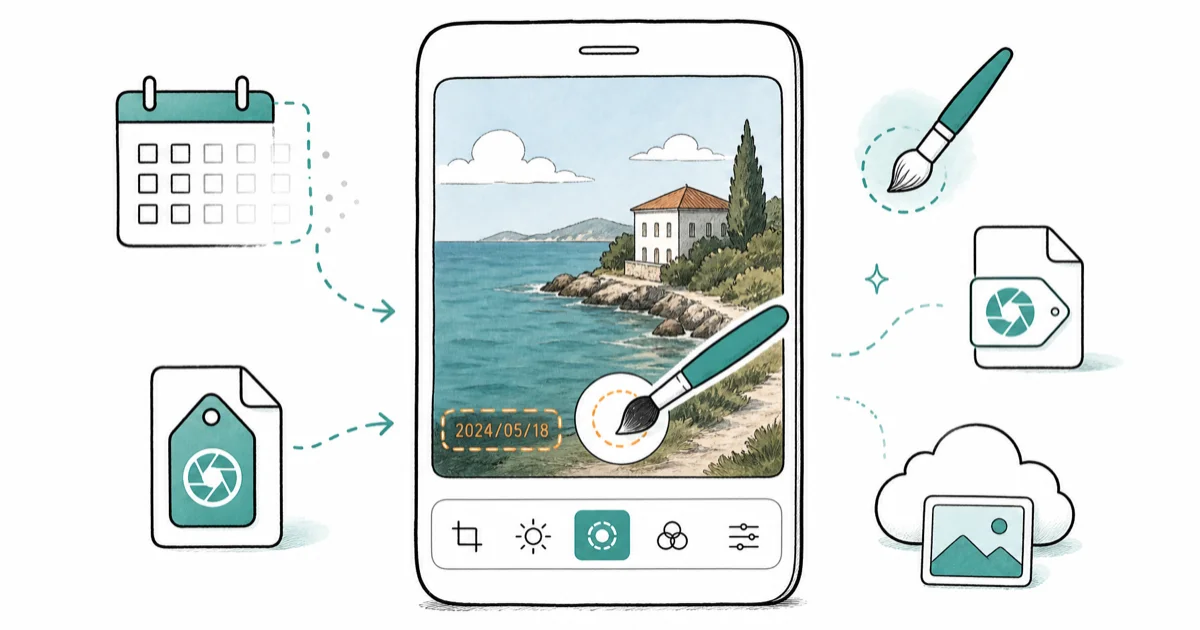
Quick AnswerFor burned-in date stamps on the pixels, use the Healing tool in Snapseed, Spot Healing Brush in Photoshop, or the inpainting brush at Photopea. For hidden EXIF dates in the file metadata, use ExifTool with the command exiftool -alldates= file.jpg or edit the date in the iOS Photos app and the Google Photos app.
People ask the same question two different ways. One person sees a yellow 1998 timestamp baked into the corner of an old print scan. Another sees a clean photo whose iCloud date reads 2003 because the camera clock was wrong. This guide covers both paths on iPhone, Android, Mac, and Windows with free and paid tools to pick the right one for each case.
- A burned-in date stamp lives in the pixels and needs an inpainting tool such as Snapseed Healing, Photoshop Spot Healing Brush, or the free web app Photopea.
- An EXIF date lives in the file metadata and never appears on the image; use ExifTool, the iOS Photos Adjust Date and Time menu, or the Google Photos info panel to change it.
- Simple uniform backgrounds like sky or pavement clean up perfectly in seconds; cluttered backgrounds with text or fine detail will show artifacts and need manual clone-stamp work.
- The single ExifTool command exiftool -alldates= file.jpg strips every date field at once and works on JPEG, HEIC, PNG, and most RAW formats on macOS, Windows, and Linux.
- Stripping EXIF before posting online removes GPS coordinates and camera serial numbers, which is a privacy upgrade most photographers should run on any image leaving their phone.
#Date Stamp or EXIF Date: Which Problem Are You Solving?
Open the photo and look at it. If the date appears as visible text on top of the picture, often yellow, orange, or red, in a corner, that’s a burned-in date stamp. The numbers are pixels. No metadata edit will erase them.
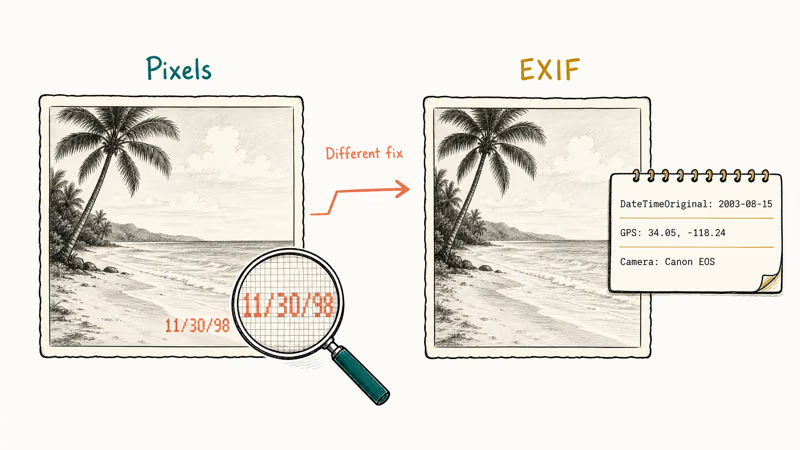
If the photo looks clean but a Photos app or Lightroom panel shows the wrong date, that’s an EXIF date hiding in the file header.
Some photos have both at once. A JPEG from a 1998 point-and-shoot might show 11/30/01 burned in the corner AND carry a 2001-11-30 DateTimeOriginal field in EXIF metadata, in which case you’ll need both methods in this guide and should run them in the order pixel-stamp first, EXIF strip second to keep the cleanup tidy.
According to Adobe’s Photoshop retouching documentation, the Spot Healing Brush samples the surrounding pixels and rebuilds the area under your brush in a single click, which is exactly what date-stamp removal needs. EXIF editing is a different beast: it’s a metadata operation that never touches the image.
Phil Harvey’s ExifTool documentation states that the tool reads, writes, and edits metadata in over 200 file formats covering more than 100 tag groups. JPEG, HEIC, PNG, and most RAW formats from Canon, Nikon, Sony, and Fuji are all in scope.
#Removing a Burned-In Date Stamp from a Photo
This is the visible-text-in-corner problem. There are four practical paths. The right tool depends on which device you’re on and how clean the background under the stamp looks.
#Snapseed on iPhone and Android (free, top mobile pick)
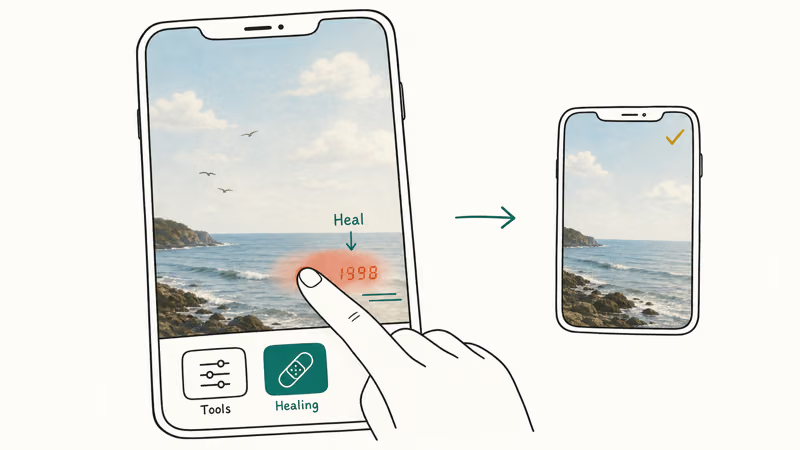
Snapseed is Google’s free editor for iOS and Android, and its Healing tool is among the cleanest mobile inpainting you’ll find.
- Install Snapseed from the App Store or Google Play.
- Open the app and tap the plus icon in the center to load the photo.
- Tap Tools at the bottom, then choose Healing.
- Pinch-zoom into the corner with the date stamp.
- Drag your finger across the date numbers. The brush turns the area red while you paint, then redraws the underlying texture when you lift.
- Tap the checkmark in the lower-right corner.
- Tap Export and choose Save a copy to keep the original untouched.
On a date stamp over plain sky, the result is indistinguishable from a stamp-free shot. When the stamp overlaps a textured wall or a face, expect two passes plus a manual zoom-in to clean up edge artifacts.
#Photoshop and Affinity Photo (best for cluttered backgrounds)
If your date stamp sits on top of grass, hair, water ripples, or anything with fine repeating texture, mobile healing will smear. Desktop tools give you per-pixel control.
In Photoshop, the workflow is: Lasso around the date, then Edit > Fill > Content-Aware, then patch any artifacts with the Spot Healing Brush at 100% hardness. Affinity Photo’s Inpainting Brush in the photo persona behaves nearly identically. Pixelmator Pro on Mac uses the Repair Tool with similar results.
For clone-stamp lovers, set the source point with Alt-click on a clean adjacent area, lower the brush opacity to about 80%, and paint over the date in short strokes. This is slower than inpainting but produces the cleanest results on tough backgrounds. If you ever need to flip the source patch before stamping, our walkthrough on how to flip an image in Photoshop covers the transform shortcut.
#Photopea (free, browser-based, no install)
Don’t want to install anything? Photopea is a free browser app that copies the Photoshop interface closely, including the Spot Healing Brush. It runs entirely in your browser, so the photo never leaves your device. It’s a solid option on a Chromebook or any machine without native Photoshop access, and a clean stamp comes off in a couple of minutes.
Other free web inpainters worth knowing:
- Cleanup.pictures: drag, paint, download. No account, AI inpainting.
- Inpaint at theinpaint.com: same simple flow with a small free tier.
- Pixlr: has a Heal tool inside Pixlr E, the desktop-class editor.
#TouchRetouch on iPhone and Android ($3.99 one-time)
TouchRetouch is the closest thing to a one-tap stamp eraser on mobile. The Object Removal tool lets you draw a rough box around the date, and it inpaints in a single pass. The app costs $3.99 on iOS and similar on Google Play.
PS: figuring out how to remove emojis from pictures uses the exact same inpainting workflow, and our guide on Pixlr remove watermark covers the same Heal tool we mentioned above.
#Editing or Stripping the EXIF Date from a Photo
This is the hidden-metadata problem. The image looks fine. But every cloud library says the photo was taken on the wrong date because the camera clock was wrong, the file was scanned, or the timezone shifted on import.
#iPhone Photos app (built-in, no install)
Apple added inline date editing in iOS 15 and refined it in iOS 17.
- Open the Photos app and tap the photo.
- Tap the info icon (lowercase i in a circle) at the bottom.
- Tap Adjust next to the date and time.
- Pick a new date, time, and timezone.
- Tap Done.
This rewrites the EXIF DateTimeOriginal field in iCloud and on every device synced to that library. According to Apple’s Photos user guide, Photos rewrites the metadata across iCloud-synced devices once the device next connects to the network. The new date usually appears on a second iPhone within a couple of minutes on Wi-Fi.
#Google Photos app on Android, iOS, and the web
Open the photo, tap the three-dot menu, choose Edit date & time. The Android and iOS apps offer the same flow. The web version at photos.google.com adds a Lightroom-style metadata panel under the Info sidebar where you can edit the date in place.
#macOS Photos app
Select photos in the Photos app, then Image > Adjust Date and Time in the menu bar. You can shift dates relative to the current value (useful for the wrong-timezone case where every photo is off by the same offset) or set an absolute date.
#Windows File Explorer (limited)
Right-click a JPEG, choose Properties, then the Details tab. Some EXIF fields are editable here. The Date Taken field is sometimes locked depending on the camera that wrote it. For reliable batch edits, use ExifTool below.
#ExifTool (the gold standard, command line)
Phil Harvey’s ExifTool is the canonical tool for reading and writing EXIF, IPTC, and XMP metadata. It’s free, open-source, and runs on macOS, Windows, and Linux. It’s the go-to for batch date corrections across a whole shoot.
Common commands you’ll reach for:
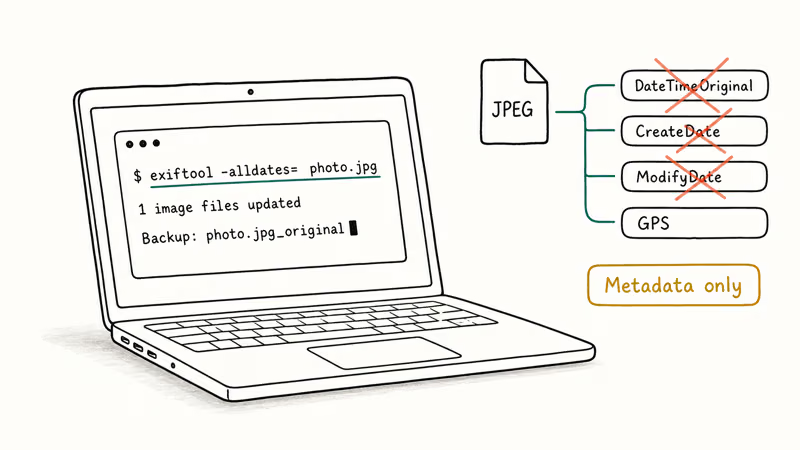
- Strip every date field from one file:
exiftool -alldates= photo.jpg - Strip every date from every JPEG in a folder:
exiftool -alldates= -ext jpg . - Set DateTimeOriginal to a specific timestamp:
exiftool -DateTimeOriginal="2024:01:15 12:00:00" photo.jpg - Shift every date back by 1 hour for a timezone fix:
exiftool "-alldates-=01:00:00" . - Strip ALL metadata, including GPS and camera info:
exiftool -all= photo.jpg
ExifTool keeps a .jpg_original backup of every file it modifies unless you add the -overwrite_original flag, so you can always roll back. The batch flag strips a folder of several hundred JPEGs in seconds, and it runs at similar speed on macOS and Windows.
#Lightroom Classic and Adobe Bridge
Both Adobe apps expose date editing in their metadata panel. In Lightroom Classic, select photos and use Metadata > Edit Capture Time. Bridge offers similar fields in the Metadata panel. These are great when you’re already inside an Adobe workflow and don’t want to drop to the command line.
#Browser-based EXIF editors
Want a one-off edit without installing anything? Both jimpl.com and verexif.com let you upload a photo, edit or strip dates, and download the result. Both delete the upload after a short window. ExifTool is still the safer choice for anything you wouldn’t be comfortable uploading to a third party.
For an end-to-end refresher on photo formats and metadata, our guide on converting RAW to JPEG covers what survives the conversion and what gets dropped.
#Privacy and Forensic Considerations
Stripping EXIF before sharing photos online is a small privacy win that pays back over years. Modern smartphones embed GPS coordinates accurate to a few meters, the device serial number, and sometimes the user’s iCloud or Google account ID in every photo.
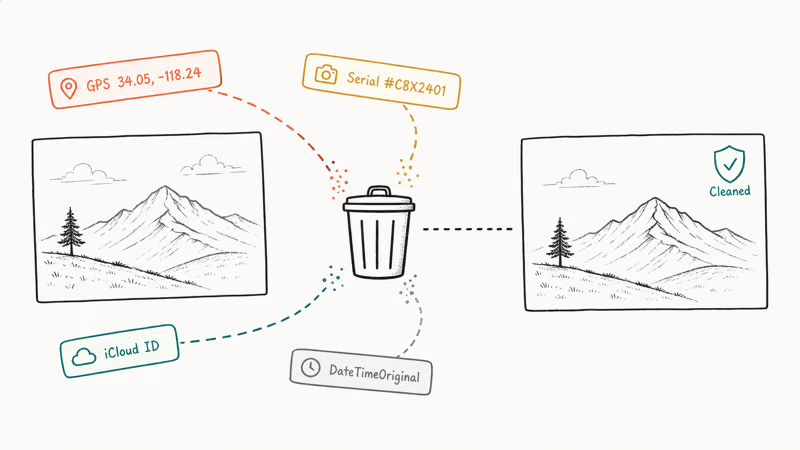
The Electronic Frontier Foundation recommends stripping metadata before uploading to social networks because location data alone has been used to deanonymize protest photos and dating-app posts. The single command exiftool -all= photo.jpg removes those fields.
Two cautions before you batch-strip:
- Don’t edit dates on photos that may end up as evidence. Insurance claims, court cases, and journalism workflows often depend on chain-of-custody for image metadata. Editing the date can invalidate the photo as evidence and, in some jurisdictions, create legal exposure.
- Keep an unedited master. ExifTool’s automatic
_originalbackup is a safety net, but storing a clean copy in a separate folder is better long-term insurance.
For the social-sharing case, our guide on the best watermark app for iPhone covers the inverse workflow: adding a visible owner mark before posting, instead of stripping identifying metadata.
#Why Doesn’t My iPhone Have a Built-In Date-Stamp Eraser?
Apple’s Photos app on iOS exposes EXIF date editing (covered above) and a basic Markup tool. It doesn’t include an inpainting or healing brush as of iOS 17. The official path for burned-in stamps is to install a third-party editor.
Snapseed, TouchRetouch, Photoshop Express, and Pixelmator are the four most reliable picks on iPhone. Google Photos on Android has the same gap. Even Magic Eraser on Pixel handles people and small objects well but struggles with text-overlay artifacts.
If you want to avoid the problem at capture time, every modern phone camera (iPhone, Pixel, Samsung Galaxy) ships with the date-stamp option turned off by default. The only way it shows up on a fresh phone shot is if the user enabled it in a third-party camera app. For inherited photos from older cameras, removal is your only path.
#Tool Picks at a Glance
Quick decision matrix:
- Burned-in stamp on iPhone, simple background: Snapseed Healing tool, free, ninety seconds.
- Burned-in stamp on iPhone, busy background: TouchRetouch ($3.99) or Photopea on a laptop.
- Burned-in stamp on Windows or Mac, any background: Photoshop, Affinity Photo, or Photopea.
- EXIF date wrong on a single photo: built-in Photos app on iPhone, Android, or Mac.
- EXIF date wrong on a folder of photos: ExifTool one-liner with the
-alldatesflag. - Need to also strip GPS for privacy: ExifTool with
-all=or share-sheet location toggle on iPhone.
This split mirrors a sensible day-to-day workflow: phones for quick fixes, desktops for batches, ExifTool for anything that touches more than five files at once.
#Bottom Line
Match the tool to the problem. If the date is visible text on the image, install Snapseed for a free mobile fix or open Photopea in a browser and paint over the stamp with the Healing tool.
If the background under the stamp is busy with detail, jump to Photoshop or Affinity Photo for the Spot Healing Brush plus manual cleanup on a desktop. If the date lives in the file metadata, the iPhone Photos app, Google Photos, or one ExifTool command will fix it in under thirty seconds.
ExifTool is the right call for any batch over five files, Snapseed for one-off mobile cleanups, and Photopea on the rare laptop without Photoshop installed.
#Frequently Asked Questions
Can I remove a date stamp from a photo for free?
Yes. Snapseed on iPhone and Android, Photopea in any browser, GIMP with the Heal Selection plugin on desktop, and Cleanup.pictures online are all free and capable of removing burned-in date stamps. Free tools handle uniform backgrounds (sky, pavement) flawlessly. For cluttered backgrounds, paid tools like Photoshop save time, but the free path will still get there with patience.
Will removing the date stamp lower image quality?
Not in any way you’ll notice. A clean inpainting on a uniform background is visually lossless at typical viewing sizes.
Does deleting EXIF data also remove the visible date stamp?
No. They live in completely different places inside the file: the visible stamp is in the image pixels and needs an inpainting tool, while EXIF data is a separate metadata block that travels invisibly. If you have both, do the inpainting first and the EXIF strip last.
Can I batch-remove EXIF dates from hundreds of photos at once?
ExifTool handles batches natively. The command exiftool -alldates= -ext jpg /path/to/folder strips date fields from every JPEG in a folder in seconds. Add -r for recursive folder traversal. For Lightroom Classic users, select all photos and use Metadata > Edit Capture Time to set or shift dates in bulk.
Is it legal to remove or change a date on a photo?
For personal use, yes. For evidence, no. Insurance claims, court submissions, journalism, and scientific records may require unaltered metadata. When in doubt, keep an unedited master.
What’s the easiest way to remove a date stamp on iPhone?
Install the free Snapseed app from the App Store. Open the photo, tap Tools > Healing, paint over the date with your finger, tap the checkmark, then export. The whole flow takes about thirty seconds for a clean background. For more cluttered backgrounds, the paid TouchRetouch app handles it in one tap with the Object Removal tool.
Does the iPhone Photos app strip GPS data when I share a photo?
Yes, but only the location field. iOS 15 and later let you tap the share icon, choose Options, then turn Location off before completing the share. Other EXIF fields like camera model and capture date stay in place, so use ExifTool or jimpl.com if you want a full wipe.
How do I check what EXIF data is on my photo?
On iPhone or Android, tap the photo and then the info icon to see date, location, and camera model. On Mac, open Preview and pick Tools > Show Inspector, then click the i tab. For a complete dump on any OS, run exiftool photo.jpg and read every field in the terminal.
Google Messages Error 3100: Why RCS Is Broken on Galaxy
Google Messages RCS error 3100 hits Galaxy owners after phone or carrier switches. Google told 9to5Google a fix is coming. Here's what actually helps.

Is This Bank App Real? Spot a Fake App on Your Home Screen
A bank app can land on your home screen from a web page with no install warning. Learn the checks that tell a real banking app from a phishing web app.
Apps Crashing After iOS 27 Update? Fix Order (2026)
Apps crashing after the iOS 27 update? Update the app in the App Store first, then offload and reinstall to clear stale cache, then restart. The fix order.

Do AI Translation Earbuds Work Offline? What to Know
Do AI translation earbuds work offline? A few do with downloaded language packs, but most need the cloud. Here's what works offline and what you give up.