How to Remove Canva Watermark Legally in 2026 (5 Methods)
Remove the Canva watermark the legitimate way. Swap Pro elements, buy them per-asset, subscribe, or switch to a free editor that never adds one.
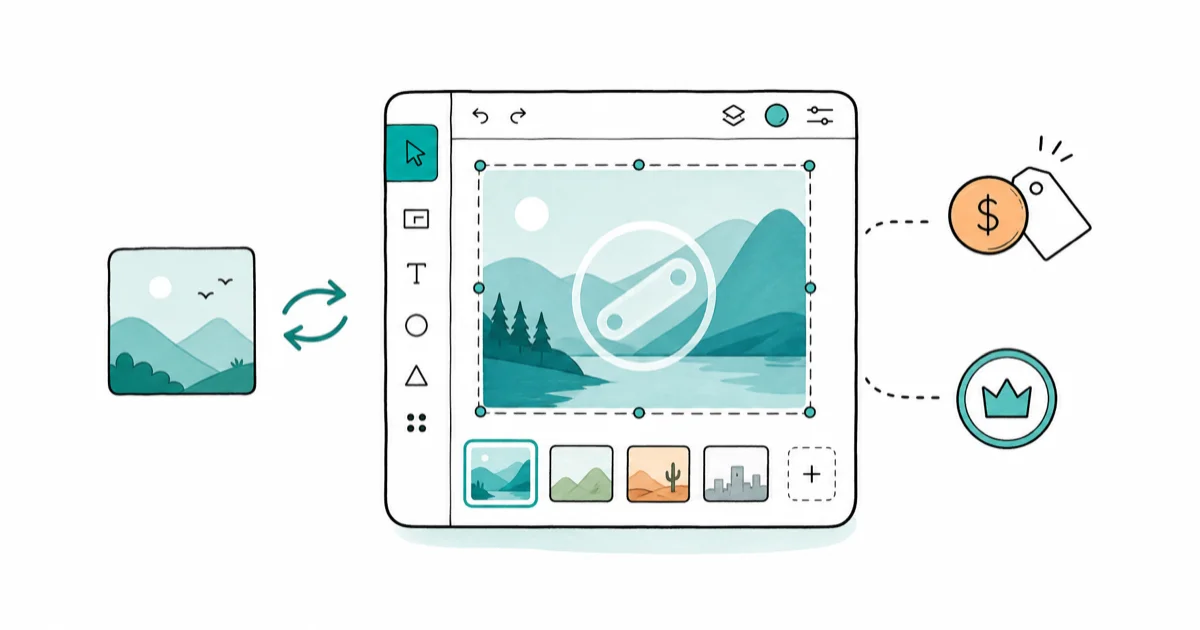
Quick AnswerCanva does not watermark your own designs. The watermark only appears when your design uses a Pro-licensed photo, element, or template. Swap each Pro item for a free alternative in the editor, buy the element for around one dollar, or subscribe to Canva Pro to clear it.
If you opened a free Canva account, dragged a few shapes around, and your export came out clean, that’s expected. Canva’s free tier does not stamp your work. The watermark you keep seeing on someone else’s tutorial is a license badge for Pro-only assets that snuck into a free design. This guide assumes you own the design itself and just want to ship it without breaking Canva’s terms.
- Canva never watermarks free elements you placed yourself; the badge is attached to Pro photos, videos, fonts, and templates that need a license.
- Pro-locked items show a small diamond or crown badge in the editor, so you can spot and replace them before exporting.
- Canva Pro is $14.99 per month or $119.99 per year and unlocks the full premium library plus Background Remover and Magic Resize.
- Single Pro elements can be bought one-off for about one dollar per asset without a subscription.
- Free desktop editors like GIMP, Krita, Photopea, and Inkscape never add a watermark on any export, on any plan, ever.
#What Does the Canva Watermark Actually Mean?
The myth is everywhere: Canva stamps your work to push you toward Pro. It doesn’t. According to Canva’s pricing page, Canva Free costs $0 and includes unlimited downloads at full resolution with no watermark. The watermark you see is a license-attribution overlay tied to specific premium assets that Canva licenses from its contributor network.
That distinction matters because it changes the fix. You’re not paying to remove a watermark. You’re either replacing the licensed asset with a free one, paying the contributor for the right to use it, or moving to a tool that doesn’t have a Pro tier at all.
The myth costs people money. Read it once, then move on.
Pro-locked content includes the premium photo library, premium illustrations and stickers, animated elements, premium templates, premium fonts, premium video clips, and the Background Remover output. Free designs assembled from free shapes, free fonts, and your own uploaded images export with no watermark at all.
#How Do You Find Which Element Is Locked?
Open your design in the Canva editor and zoom out so the whole canvas is visible. Look for one of three indicators on each placed item:
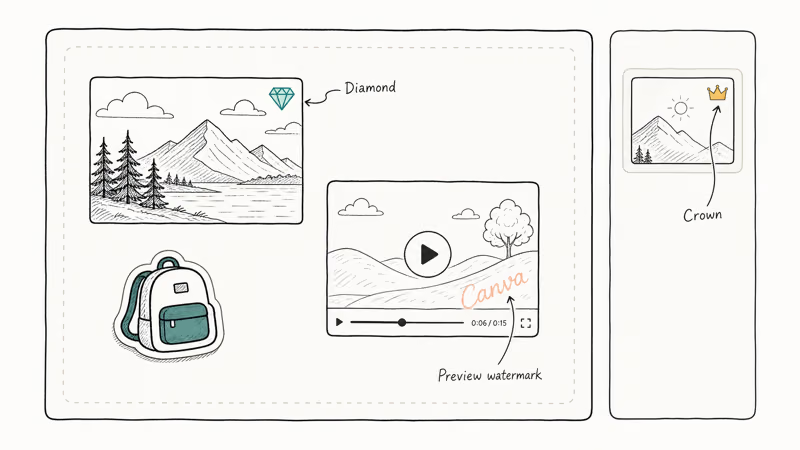
- A small diamond icon in the top-right of the element when you click it.
- A crown icon badge in the asset’s thumbnail in the left sidebar.
- A faint Canva watermark text running across that specific element on the canvas during preview.
Many “watermarked” exports come from a single Pro photo or video clip; replacing just that one element can produce a clean download. Hover the cursor over each element on the canvas one at a time. Anything labeled with a price (often “$1”) or “Pro” in the metadata panel is the culprit.
Canva also surfaces a “Pro content” panel at export time. According to Canva’s official download help documentation, the export dialog lists every premium item the design depends on before you confirm the download — this is the built-in tool for auditing Pro assets without third-party software. That list is your shopping list.
#Method 1: Replace Pro Elements With Free Ones
This is the cheapest fix and the one most users miss.
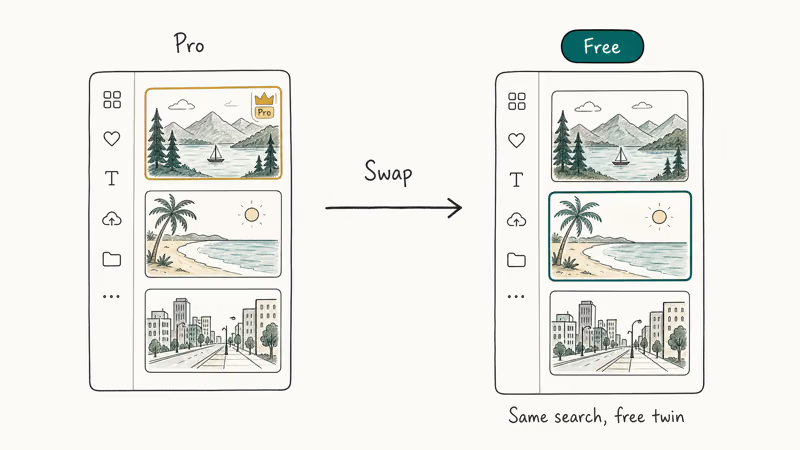
Canva ships with millions of free photos, illustrations, fonts, shapes, and templates spread across every asset panel; the Free filter sits as a toggle at the top of every search result list, and most Pro items have a near-identical free twin somewhere in the library that another contributor published months or years earlier and that the algorithm doesn’t surface by default.
In the editor, click the Pro element so it’s selected, then open the relevant left-sidebar tab (Photos, Elements, or Text). Type the same search term and toggle the Free filter at the top of the results. Drag the new free asset onto the canvas, drop the Pro version, then re-export. The watermark warning disappears with the last Pro asset removed.
A short list of practical swaps:
- Pro stock photos → free Pixabay or Unsplash photos already indexed inside Canva’s Photos tab.
- Pro icon sets → the “Free” filter on Elements returns thousands of usable icons.
- Pro fonts → Google Fonts equivalents are pre-loaded; “Lato”, “Inter”, and “Roboto” cover most premium sans-serif slots.
- Pro templates → the same template often has a “Free” variant published by another contributor; search the same theme and re-filter.
If you started from a Pro template, deleting the Pro photo placeholder and re-uploading your own image (or a free Canva photo) clears the watermark for that slot without rebuilding the whole layout. For a related workflow, our guide on making a transparent background in Canva walks through PNG export options once your design is clean.
#Method 2: Buy the Premium Element One-Off
Sometimes the Pro photo is the design. You found one perfect stock shot, the layout is built around it, and a free swap would change the whole composition. Canva sells these elements à la carte without forcing a Pro subscription.
Click the watermarked element on the canvas, then click Use One-Time or Pay for the element in the top toolbar. The price is usually around $1 USD per asset. Pay with the card on file or PayPal; the watermark on that specific element is removed for that specific design. The license is non-transferable to other designs.
Use one-off purchases when:
- You need exactly one Pro asset and a swap would force a full redesign.
- You’ll never reuse this design and don’t want recurring billing.
- The total cost stays under $10. Past four or five elements per design, the math flips and Pro becomes cheaper.
The receipt shows up in your Canva account billing history, and the unlocked asset stays attached to that design even after re-edits.
#Method 3: Subscribe to Canva Pro
Canva Pro is the path Canva designed for users who hit Pro elements regularly. According to Canva’s pricing page, Pro costs $14.99 per month for a single user or $119.99 per year billed annually, which works out to roughly $9.99 per month if you commit to a year. Canva Teams runs higher and adds collaboration features.
What Pro unlocks beyond watermark removal:
- The full premium photo, video, and audio libraries (over 100 million assets per Canva’s marketing page).
- Background Remover, Magic Resize, and Magic Edit.
- Brand Kit with custom fonts, color palettes, and logos.
- 1 TB of cloud storage.
- Schedule Posts to social platforms.
- Premium templates and animation effects.
Canva Pro also includes a 30-day free trial. Cancel before day 30 to avoid auto-renewal billing.
Set a calendar reminder if you only need Pro for one project; auto-renewal hits the same card and the email warning gets buried. Ship one Pro-heavy design every few months? The per-element math at $1 each beats a $14.99 subscription.
#Method 4: Switch to a Free Editor With No Watermark
If the watermark feels like a tax you don’t want to pay, the cleanest answer is to use a different tool. Several established image editors export without any watermark on any tier; four of them are free.
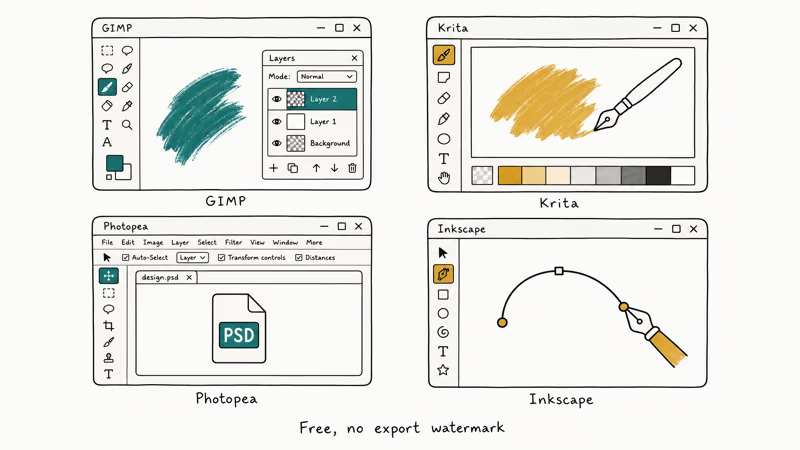
- GIMP is the long-standing free Photoshop alternative for Windows, macOS, and Linux. Layers, masks, brushes, and a healing tool that handles most of what Canva’s photo editor does. No watermark, no account, no in-app purchases.
- Krita is open-source paint and illustration software with strong brush engines. Best for hand-drawn graphics and illustrations rather than photo composition.
- Photopea runs in any modern browser, opens PSD, AI, and Sketch files, and looks almost identical to Photoshop. Funded by sidebar ads, with no export watermark on any plan.
- Inkscape is a free vector editor that works for logos, icons, and illustrations. Our Inkscape review covers its strengths and weaknesses for print-versus-screen work.
- Affinity Designer is one-time-purchase software (about $70) with no subscription. It targets the Illustrator user base and exports clean across every format.
For video projects, our roundup of free video editing software with no watermark compares DaVinci Resolve, Shotcut, OpenShot, Kdenlive, and CapCut.
#Method 5: Use the Canva Free Trial Strategically
Canva’s 30-day Pro trial gives full access to every premium asset without payment, provided you cancel before day 30. This is the right choice when you have a single Pro-heavy project, you want everything done in one push, and you’ll actually audit your subscriptions monthly. For one-off launches, brand refreshes, and time-bounded campaigns, this can clear an entire backlog of Pro designs.
Set a recurring 28-day calendar event on day one. Cancel on day 28 in account settings. Canva sends a reminder email 72 hours before billing, but it’s emailed once and easy to miss in a flood of design reviews. Cancellation does not lock your free designs; only the Pro premium assets you placed during the trial get re-watermarked on re-export.
This route is honest about the legal frame: you used the assets while you held a license, so the export is clean and stays clean. The downloaded files don’t retroactively gain a watermark even after the subscription lapses.
#What You Should Never Do (And Why It Fails)
Every tactic in this section breaks Canva’s terms of service, copyright law, or both. Most fail technically.
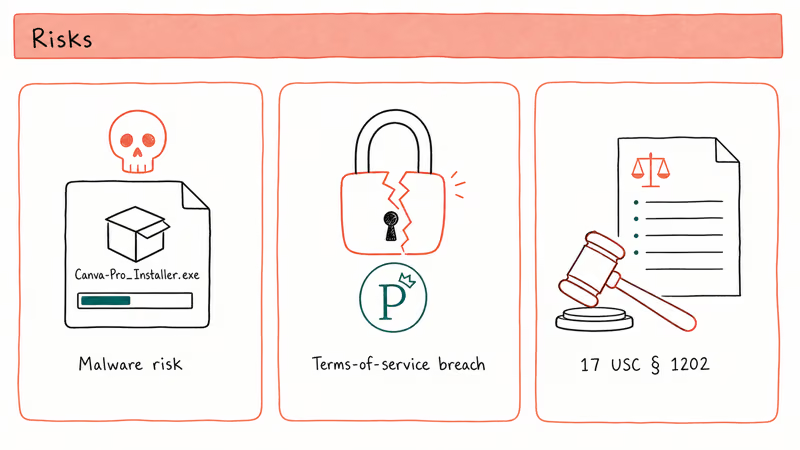
- Third-party “Canva watermark remover” tools advertise AI-based stripping and almost universally either fail to detect Canva’s overlay (it’s rendered at full asset opacity, not as a translucent stamp), introduce visible content-aware fill artifacts, or distribute malware bundled with the installer. Wikipedia’s article on copyright infringement states that willful US infringement carries fines up to $150,000 per work.
- “Canva Pro Crack” or “Canva Pro mod APK” downloads are scams. Canva’s editor is server-side and most premium asset rendering happens in Canva’s cloud, so a client-side mod has nothing to patch. The downloaded “crack” is commonly credential-stealing malware; this also breaks Canva’s terms of service.
- Screen-recording the Canva editor and post-cropping the output still uses the licensed asset commercially without paying for the license. Canva’s terms cover capture and re-rendering, and the watermark is sometimes embedded in the rendered preview itself.
- Cropping or photo-editing the watermark out of an exported PNG removes copyright management information protected under 17 USC § 1202 in the US. That law makes the act itself illegal regardless of whether you also infringe the underlying copyright.
- Bypassing the watermark through browser dev tools appears to work in the editor preview, but the export request to Canva’s render server applies the watermark on the server side. The clean image never reaches your browser on a free account using a Pro asset.
The cost-of-getting-caught math is brutal. If your use case is commercial (selling prints, client work, ads, social campaigns where the design is the product), the only legitimate paths are subscribing to Pro, buying the Pro element, or removing the Pro element from the design entirely; one cease-and-desist costs more than a year of Pro, and one DMCA takedown burns the campaign you spent two weeks building. Anything else creates downstream legal exposure worth far more than $14.99 a month.
What about watermarks on images you actually own?
Our guides cover the legitimate tools for that scenario:
- Pixlr’s watermark removal for browser-based photo edits.
- Kinemaster watermark removal options for mobile video projects.
- Best watermark remover apps for photos and videos for a broader comparison.
The principle is identical: own the rights or pay for them.
#Bottom Line
Pick the method by use case, not by cost alone.
One Pro photo in a single design? Replace it with a free alternative inside the editor. Thirty seconds, zero dollars. One to three Pro elements you can’t replace? Buy them one-off for about $1 each at the watermark-click prompt and avoid recurring billing.
Hitting Pro features weekly? Subscribe to Canva Pro at $14.99 per month and treat it as overhead. Everything else? Move to a free editor with no Pro tier, like GIMP for raster, Inkscape for vector, or Photopea for browser-based PSD editing.
The deciding factor is frequency: the more often you reach for Pro assets, the further down the list you should walk. The one thing not to do is reach for a “remover” tool, a “crack”, or a screen-record-and-crop trick. Those break the law in the US under 17 USC § 1202, breach Canva’s terms of service, and fail technically more often than they work.
#Frequently Asked Questions
Does Canva watermark my own designs?
No.
Free-tier exports of designs you assembled from free elements have no watermark. The badge only appears when your design includes a Pro-licensed photo, video, font, sticker, or template that hasn’t been paid for. Replace or buy that one asset and the watermark is gone.
How much is Canva Pro in 2026?
Canva Pro is sold as a monthly or discounted annual subscription for a single user, and Canva’s pricing page lists the current rates. Canva Teams runs higher and adds collaboration tooling. A free trial is available with auto-renewal enabled by default, so check the live price before you subscribe.
Can I buy a single Canva Pro element without subscribing?
Yes. Click the watermarked element, choose Use One-Time or Pay for the element, and pay roughly $1 per asset.
Are third-party Canva watermark remover tools safe?
No. Most fail technically because Canva renders premium assets server-side, and many bundle malware in the installer. They also expose you to copyright liability under 17 USC § 1202 in the US.
What is the cheapest legal way to remove a Canva watermark?
Replace the Pro element with a free one inside the editor. Free.
Will the watermark return on a Pro design after I cancel my subscription?
Designs you exported during your Pro period stay clean. New exports after cancellation will re-watermark any Pro elements still in the layout, because the request goes through Canva’s render server with your account back on the free tier. Replace Pro elements with free ones before you cancel if you want the file to stay clean for future edits.
Can I use a free Canva alternative that never adds a watermark?
Yes. GIMP, Krita, Photopea, and Inkscape are free desktop or browser editors that never apply an export watermark on any tier.
Is removing a Canva watermark legal if the design is mine?
The design layout is yours; the licensed photo or font in it isn’t. If the watermark is attached to a Pro-licensed asset that’s not your own work, removing it without buying the license breaks Canva’s terms of service and removes copyright management information under 17 USC § 1202 in the US. Pay for it, replace it, or remove it from the design.
Google Messages Error 3100: Why RCS Is Broken on Galaxy
Google Messages RCS error 3100 hits Galaxy owners after phone or carrier switches. Google told 9to5Google a fix is coming. Here's what actually helps.

Is This Bank App Real? Spot a Fake App on Your Home Screen
A bank app can land on your home screen from a web page with no install warning. Learn the checks that tell a real banking app from a phishing web app.
Apps Crashing After iOS 27 Update? Fix Order (2026)
Apps crashing after the iOS 27 update? Update the app in the App Store first, then offload and reinstall to clear stale cache, then restart. The fix order.
Do AI Translation Earbuds Work Offline? What to Know
Do AI translation earbuds work offline? A few do with downloaded language packs, but most need the cloud. Here's what works offline and what you give up.