How to Play M2TS Files in VLC: Settings and Stutter Fixes
Play M2TS files in VLC without stutter or audio loss. Fix Blu-ray AACS errors, raise file caching, and enable hardware decoding the right way.
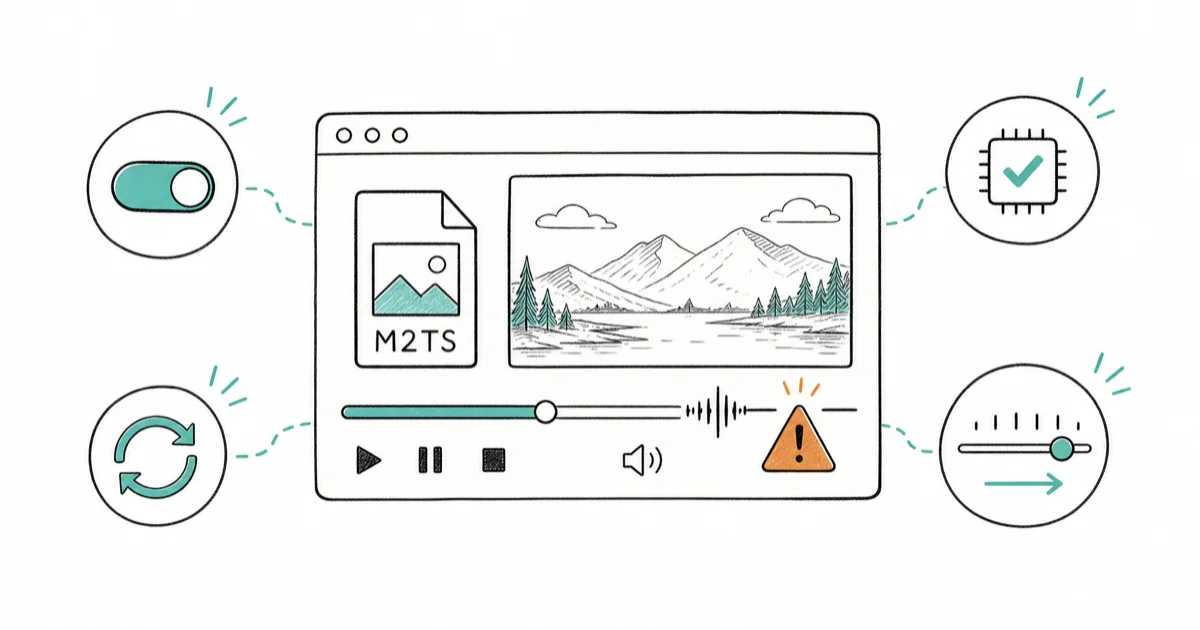
Quick AnswerVLC plays unprotected M2TS files natively on Windows, Mac, and Linux. Open VLC, choose Media > Open File, and select your .m2ts file. If playback stutters, raise file caching to 1500 ms under Tools > Preferences > Input/Codecs and turn on hardware-accelerated decoding.
M2TS files run natively in VLC, but high-bitrate Blu-ray rips and AVCHD camcorder clips can stutter on default settings.
- M2TS is the MPEG-2 Transport Stream container used on Blu-ray discs and AVCHD camcorders, usually wrapping H.264 video and AC-3 audio.
- VLC plays unprotected M2TS files natively on Windows, macOS, and Linux without external codec installs.
- AACS-protected M2TS streams from retail Blu-ray discs won’t play in VLC because the player needs the external libaacs library plus a key database.
- Stuttering on 1080p AVCHD clips usually clears once you turn on hardware-accelerated decoding under
Tools>Preferences>Input/Codecs. - For long-term storage, convert M2TS to MP4 with VLC or HandBrake instead of fighting playback issues every time.
#How Does VLC Handle M2TS Files?
VLC ships with its own decoders, so it doesn’t depend on the operating system’s codec stack. According to VideoLAN’s official VLC site, the player includes built-in support for H.264, MPEG-2, AC-3, and DTS, which covers every codec you find inside a typical M2TS file.
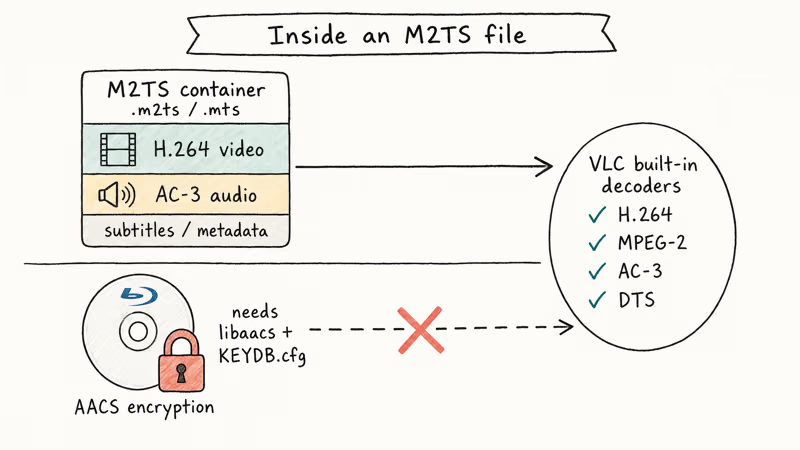
The container is just a wrapper. As long as the inner streams are codecs VLC understands, AVCHD camcorder output and Blu-ray rips open out of the box on every supported OS.
AACS encryption is the one situation where this breaks. Retail Blu-ray discs scramble the M2TS streams in the BDMV/STREAM folder, so the player can’t read them without a decryption helper. VideoLAN’s libaacs page states that VLC needs the external libaacs library and a matching key database (KEYDB.cfg) to decrypt those streams, and even then only some discs work because keys rotate per release. New 4K UHD discs almost never play.
If your M2TS came off an AVCHD camcorder, a phone backup, or a personal recording, you won’t hit AACS at all. If it came off a retail Blu-ray, that’s your first hint about what’s breaking. The MTS to MP4 conversion route is what most camcorder users end up taking anyway.
#Step-by-Step: Open M2TS Files in VLC
The flow is the same on Windows and macOS. Linux differs only in the menu accelerator.
- Launch VLC Media Player.
- Click Media in the top menu bar (on macOS this is File).
- Choose Open File.
- Browse to your M2TS file and click Open.
- Playback starts in the main window.
The drag-and-drop method is faster. Drag the .m2ts file straight onto the VLC window or its Dock/taskbar icon, and VLC starts playback without any menu clicks.
If you have a folder of M2TS files from a camcorder shoot, the playlist works better than opening files one at a time:
- Press Ctrl+L on Windows or Cmd+L on macOS to open the playlist.
- Drag every M2TS file into the playlist pane.
- VLC plays them sequentially in the order you dropped them.
You can also point VLC at the BDMV/STREAM folder of an unprotected Blu-ray rip (Media > Open Folder) and it’ll queue every clip on the disc. Clips on commercial discs are AACS-protected, so this only works for personal recordings or rips that have already been decrypted.
#Why Does My M2TS File Stutter or Skip in VLC?
Five things cause stutter on M2TS playback, in rough order of frequency.
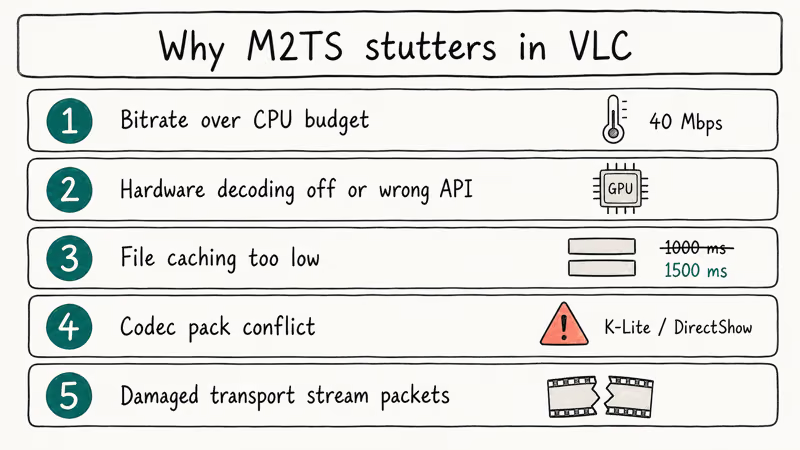
Bitrate exceeds your CPU’s software-decode budget. AVCHD clips run 17 to 28 Mbps. Blu-ray streams climb to 40 Mbps. On older laptops without hardware decoding, software H.264 alone can push CPU usage past 80%, and the player drops frames.
Hardware decoding is off or set to the wrong API. Pick your GPU’s matching API instead of Automatic.
File caching is too low for high-bitrate content. VLC’s default file caching is 1000 ms. That works for MP4 streams off SSDs but not for big AVCHD chunks read off slow USB drives or network shares.
Codec conflict with another media stack. When K-Lite or another codec pack registers system-wide DirectShow filters, VLC sometimes loads them instead of its internal decoder. That conflict is the most common cause of M2TS files opening in VLC but routing audio or video through a stale third-party filter that has been broken since the last Windows update, and the internal decoder is almost always more reliable for M2TS.
The file itself is damaged. Corrupted Blu-ray rips and interrupted camcorder transfers leave broken transport stream packets. VLC tries to skip them, which looks like stutter even when the player is healthy.
#Fixing Audio, Video, and AACS Errors in VLC
Match the symptom to the fix. None of these need third-party software.
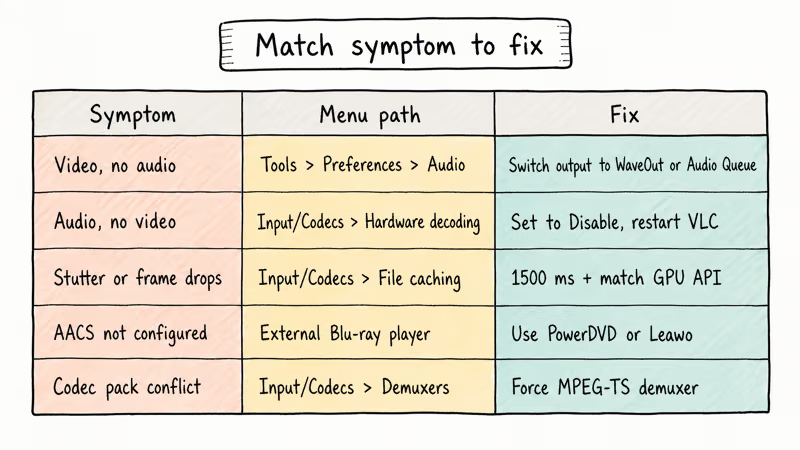
Video plays but no audio. Open Tools > Preferences > Audio and switch the output module. WaveOut on Windows and Audio Queue on macOS recover audio in most cases where the default module silently fails. If the M2TS has multiple audio tracks (common on Blu-ray rips), use Audio > Audio Track during playback to pick a different one.
Audio plays but no video. This is almost always a hardware-acceleration mismatch. Set Tools > Preferences > Input/Codecs > Hardware-accelerated decoding to Disable, restart VLC, and play the file. If it works, software decoding is the safe fallback.
Stuttering or frame drops. Turn hardware decoding back on and raise file caching to 1500 ms in Tools > Preferences > Show settings: All > Input/Codecs > File caching (ms). According to VideoLAN’s hardware-accelerated decoding guide, VLC supports DXVA2 and D3D11VA on Windows, VA-API on Linux, and VideoToolbox on macOS, so pick the one that matches your GPU rather than leaving the option on Automatic and hoping for the right pick.
“AACS not configured” or playback halts after one frame. This is a retail Blu-ray. VLC won’t decode the stream without libaacs and a current key database. Use a licensed Blu-ray player like PowerDVD or Leawo that ships AACS keys built in, or rip the disc using software you own a license for and play the resulting M2TS files separately.
Codec pack conflict. Open Tools > Preferences > Show settings: All > Input/Codecs > Demuxers and force Demux module to MPEG-TS demuxer. That stops VLC handing the file to a system DirectShow filter.
For deeper system-side troubleshooting that overlaps with VLC tuning, our notes on QuickTime error 2048 cover the same kind of demuxer mismatch in Apple’s ecosystem.
#Optimizing VLC for High-Bitrate Playback
Three settings cover almost every M2TS playback problem.
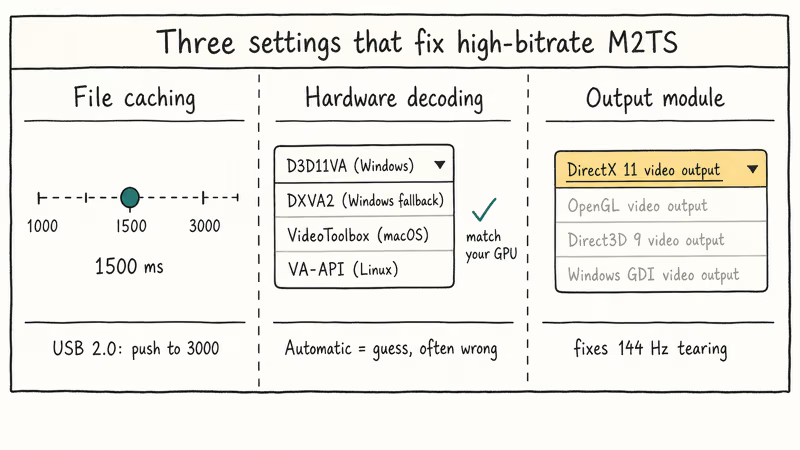
File caching. Open Tools > Preferences, click Show settings: All at the bottom, and go to Input/Codecs > File caching (ms). Raise it from 1000 to 1500. For Blu-ray rips read off USB 2.0 drives, push it to 3000.
Hardware-accelerated decoding. Under Input/Codecs, set Hardware-accelerated decoding to your GPU’s matching API. VideoToolbox is the usual macOS choice, while D3D11VA or DXVA2 are the usual Windows choices.
Output module. If Automatic output causes tearing on Windows, try DirectX 11 video output and restart VLC.
Two extras matter for camcorder workflows. The deinterlace filter under Video > Deinterlace > On smooths AVCHD’s interlaced footage. Apple’s AVCHD documentation for Final Cut Pro confirms that consumer AVCHD records 1080i in most modes, which is why standalone playback often looks combed without deinterlacing.
#Editing and Converting M2TS Files in VLC
VLC is a player first, but the Media > Convert/Save dialog handles the basics if you don’t want a separate tool.
For batched edits across multiple clips:
- Merge audio and video in VLC is useful when a camcorder splits the streams.
- Trim videos in VLC on Mac walks through the record-button workaround that ships with the macOS build.
- Merge multiple videos with VLC covers stitching M2TS chunks from a single shoot into one file.
If you regularly hit playback issues, conversion is the durable fix. Open Media > Convert/Save, add your M2TS, choose Convert, pick the Video - H.264 + MP3 (MP4) profile, and set an output path. The result is a standard MP4 that streams cleanly off any drive.
HandBrake is faster than VLC’s converter for batch jobs and preserves full HD without re-encoding the audio.
Our comparison of free video players for Windows ranks PotPlayer, mpv, and MPC-HC against VLC.
#Bottom Line
If M2TS playback breaks in VLC, raise file caching to 1500 ms and turn hardware-accelerated decoding on first. That clears the smooth-playback issues most readers come here for, and you don’t need K-Lite, MPC-HC, or any other download.
AACS-protected Blu-ray streams are the one place where VLC can’t help by itself; for those, use a licensed Blu-ray player. For camcorder footage you’ll keep around, batch-convert it to H.264 MP4 once and stop tuning playback.
#Frequently Asked Questions
Why does my M2TS file play video but no audio in VLC?
The default audio output module sometimes fails silently on AC-3 tracks. Open Tools > Preferences > Audio, change the output module to WaveOut on Windows or Audio Queue on macOS, restart VLC, and reload the file. If the M2TS has multiple audio tracks, use Audio > Audio Track during playback to swap tracks; some discs ship the main track in DTS-HD MA, which the free VLC build can’t decode without a plugin.
Can VLC play M2TS files from Blu-ray discs?
Unprotected M2TS files play out of the box. Retail discs use AACS encryption, and VLC needs libaacs plus a current key database to decrypt them. Many still fail because keys rotate per release.
How do I fix stuttering when playing M2TS files in VLC?
Turn hardware-accelerated decoding on under Tools > Preferences > Input/Codecs and raise file caching to 1500 ms in the same panel. Pick the API that matches your GPU (D3D11VA on modern Windows, VideoToolbox on macOS, VA-API on Linux). If the file lives on a slow USB drive, copy it to your internal SSD before playback.
Is it legal to play M2TS files ripped from Blu-ray discs?
It depends on your country and on whether you own the original disc. Anti-circumvention laws in the United States and several EU member states make ripping AACS-protected Blu-ray discs legally risky even for personal backups. Check your local rules. The safest path is to play the disc in a licensed Blu-ray player rather than ripping.
Can I edit M2TS files directly in VLC?
VLC isn’t a full editor, but Media > Convert/Save handles cuts and joins. For timelines or color grading, use DaVinci Resolve or iMovie.
What’s the difference between M2TS and MTS files?
Both are MPEG-2 Transport Stream containers. AVCHD camcorders write .MTS files when recording; consumer Blu-ray authoring tools save the same streams as .M2TS on the disc. The internal codecs (H.264 video, AC-3 audio) are identical, so VLC plays both with the same settings.
How can I play BUP files associated with M2TS content?
BUP files are DVD backup files for IFO control files. They appear next to VOB files, not M2TS, and Blu-ray discs don’t use BUP files at all. If you have a DVD VIDEO_TS folder with BUP files, our BUP file player guide covers VLC’s playback steps.

Best Laptop for Running LLMs in 2026: Memory Comes First
The best laptop for running LLMs is a memory purchase first. Compare MacBook unified memory against NVIDIA laptop VRAM, and see what each tier really runs.
How to Run a Local LLM on Windows: A 2026 Setup Guide
Run a local LLM on Windows with LM Studio or Ollama. Pick a model that fits your GPU memory, keep every prompt offline, and skip the monthly bill.
Bluetooth Not Working on Snapdragon X? Fixes for 2026
Bluetooth not working on your Snapdragon X Copilot+ PC? Generic audio, mice, and keyboards work, but vendor apps often lack an ARM build. Fixes inside.
Docker Desktop and WSL2 Not Working on Snapdragon X? Fix It
WSL2 runs fine on Snapdragon X, but Docker Desktop ARM is Early Access and throws WSL errors. Use WSL2 plus native ARM64 Ubuntu and Docker Engine.