BUP File Player Guide: Open DVD Backup Files in VLC (2026)
Learn how to play a BUP file from DVD backups using VLC and the VIDEO_TS folder, plus when to convert .bup data to MP4 for modern devices today.
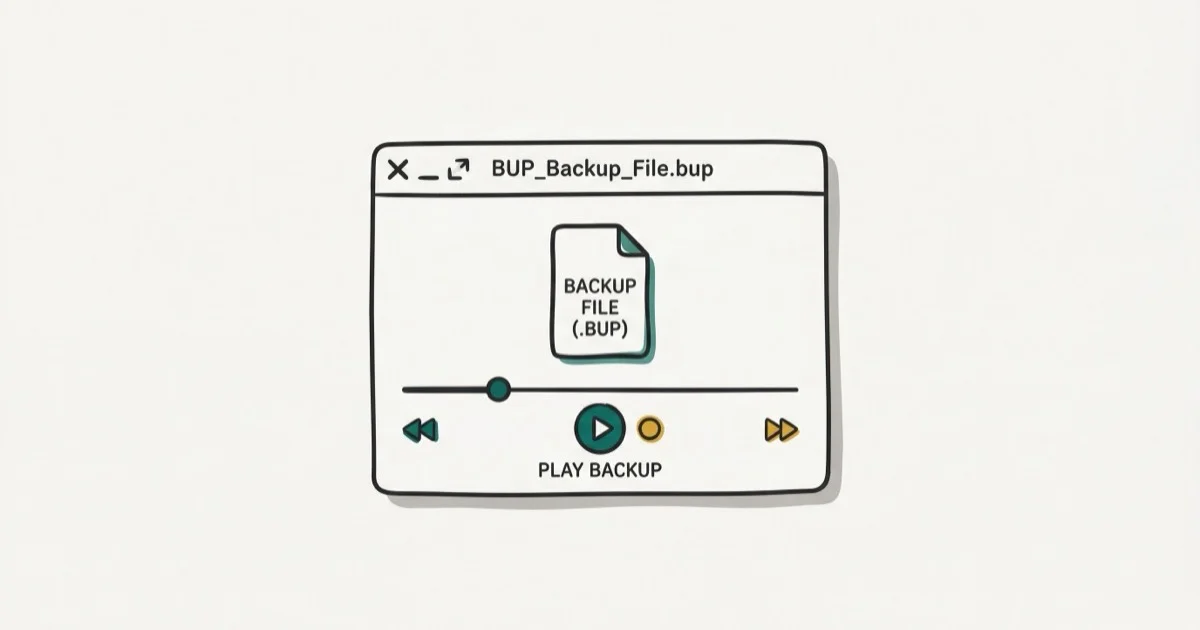
Quick AnswerOpen VLC, choose Media then Open Folder, and select the entire VIDEO_TS folder containing the .bup file. The .bup itself is a backup of the DVD navigation index, not a video file, so single-file playback won't work.
A BUP file player is rarely a separate program. The .bup file is a backup of the DVD-Video navigation index stored alongside IFO and VOB data in the VIDEO_TS folder, and the practical move is to point a DVD-aware media player at the parent folder instead. VLC handles this on both Windows and macOS, so the same approach carries across either system.
- A .bup file is a binary backup of the matching .ifo navigation file, not a standalone video stream you can scrub through in a player.
- VLC, MPC-HC, and Apple DVD Player can read .bup data when you open the whole VIDEO_TS folder, because they walk the DVD-Video file structure the way a real disc would.
- Windows Media Player on Windows 10 and 11 dropped native DVD-Video playback, which is why a .bup or .vob file looks broken when you double-click it from Explorer.
- Converting the VIDEO_TS folder to MP4 with HandBrake or MakeMKV is the most reliable way to get menu-free playback on phones, tablets, and modern smart TVs.
- Personal backups are legal in some jurisdictions but bypassing CSS or AACS copy protection is restricted under the US DMCA and similar laws elsewhere.
#What Is a .bup File and Why Is It in the VIDEO_TS Folder?
A .bup file (short for “backup”) is a byte-for-byte copy of the matching .ifo (Information) file in the DVD-Video format.
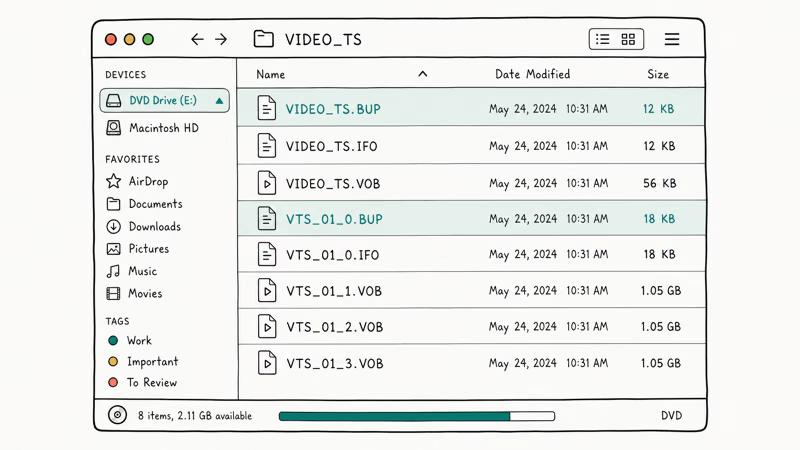
Each DVD title has a paired set, and the drive falls back to the .bup if the matching .ifo on the disc surface becomes unreadable. The DVD-Video specification states that 3 file types live in VIDEO_TS, namely .ifo for navigation, .vob for the multiplexed audio and video, and .bup as the redundant safety copy of each .ifo. The spec also caps each .vob at 1 GB, which is why long films span 4 to 6 chunks across multiple VOB segments.
So “playing” the .bup directly doesn’t produce video. The actual movie lives in the .vob containers, and the .ifo (or its .bup twin) tells the player which chapter, audio track, and subtitle stream to load next.
Treat the entire folder as the unit of playback.
A typical full backup of a commercial DVD includes paired files such as VIDEO_TS.IFO plus VIDEO_TS.BUP, and VTS_01_0.IFO plus VTS_01_0.BUP, followed by one or more VTS_01_1.VOB chunks. If any of these are missing, menus may break and seeking can fail mid-title.
#Opening a BUP File in VLC Step by Step
VLC Media Player is the simplest cross-platform option for opening a ripped DVD folder that contains .bup files. The steps below work the same on Windows and macOS, and playback usually starts within a few seconds of pointing VLC at the folder.
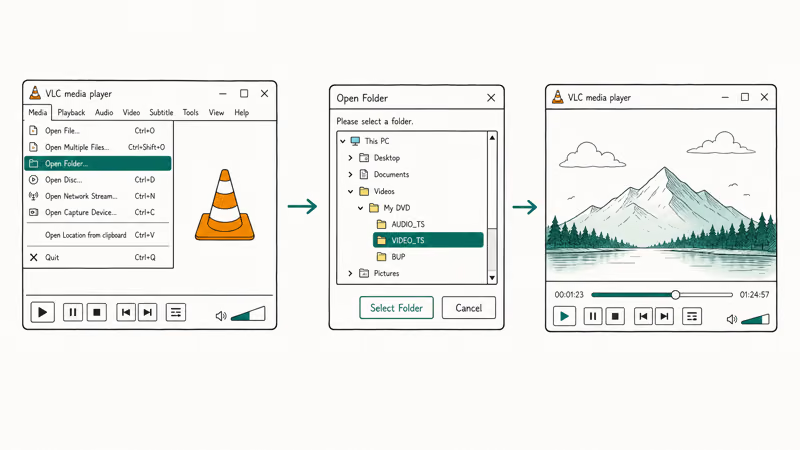
The VideoLAN project confirms that VLC can play DVD video folders directly without mounting an ISO or burning a disc.
That makes VLC the fastest route from “I have a DVD rip” to “I’m watching it” with zero conversion time. The same binary works on Windows, macOS, and most Linux distributions, so a workflow you learn once carries across every desktop you own without retraining or paying for a separate license per platform.
- Install VLC from the official VideoLAN download page.
- Launch VLC and open the Media menu (or File menu on macOS).
- Choose Open Folder (Windows or Linux) or Open Disc then point to the folder (macOS).
- Browse to the VIDEO_TS folder that contains your .bup, .ifo, and .vob files.
- Select the folder itself rather than a single file inside it.
- VLC reads the DVD structure, loads the main title, and starts playback.
Press Shift + M if the disc menu doesn’t appear.
Subtitles and audio tracks live in the Subtitle and Audio menus. For longer playback on slower machines, switch the output module under Tools > Preferences > Video > Output to DirectX (DirectDraw) on Windows or OpenGL on macOS. That change often clears frame-drop stutter on older laptops that struggle with large titles.
VLC also helps when a DVD rip is partially damaged. The player skips past missing sectors and keeps going, while a stricter DVD-only player like Apple DVD Player won’t.
#Which Other Players Recognize BUP and IFO Files?
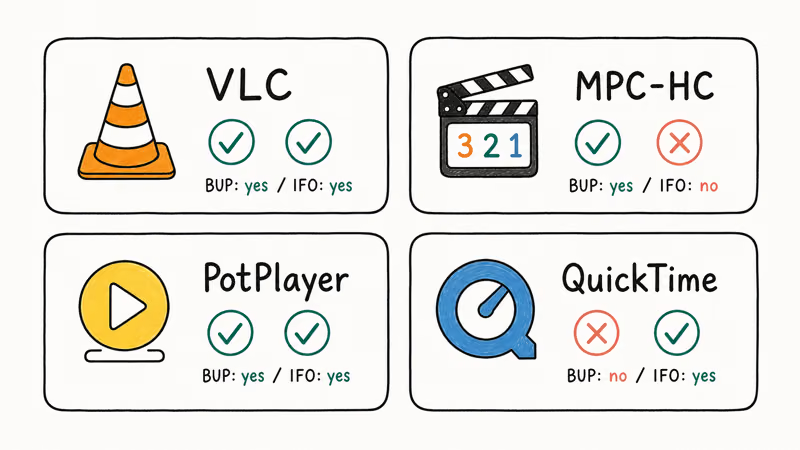
You aren’t locked into VLC. Several Windows, macOS, and Linux apps still walk the DVD-Video tree correctly when you point them at the parent folder.
#Media Player Classic - Home Cinema (Windows)
MPC-HC is a lightweight open-source player maintained by the community after the original team stepped back. It opens VIDEO_TS folders via File > Open DVD/BD and handles AC-3 and DTS audio tracks without extra codecs. On Windows it loads the disc menu quickly even on modest hardware.
#Apple DVD Player (macOS)
Apple DVD Player ships with macOS.
According to Apple’s DVD Player support guide, the app handles full DVD-Video navigation including chapter selection and bookmarks. Drag a VIDEO_TS folder onto its icon and it behaves like an inserted disc, with menus, subtitles, and chapter jumps all responsive from the macOS playback HUD.
#PotPlayer and 5KPlayer
Both options accept VIDEO_TS folders.
PotPlayer (Windows) and 5KPlayer (Windows or macOS) read the folder through their open-folder dialog and are reasonable backups if VLC misbehaves on a specific rip, though their installers occasionally bundle optional extras you have to decline during setup.
#What about Windows Media Player?
Skip it. Microsoft removed DVD-Video playback starting with Windows 8 and never returned it, so DVD playback isn’t included with Windows and you need a third-party player. Double-clicking a .bup or .vob in Windows Media Player throws a codec error.
#Converting BUP Files to MP4 for Modern Devices
Conversion is usually the right call. The DVD-Video structure was designed for set-top players from the late 1990s, and phones, tablets, smart TVs, and game consoles all expect a single-file container like MP4, MKV, or MOV instead.
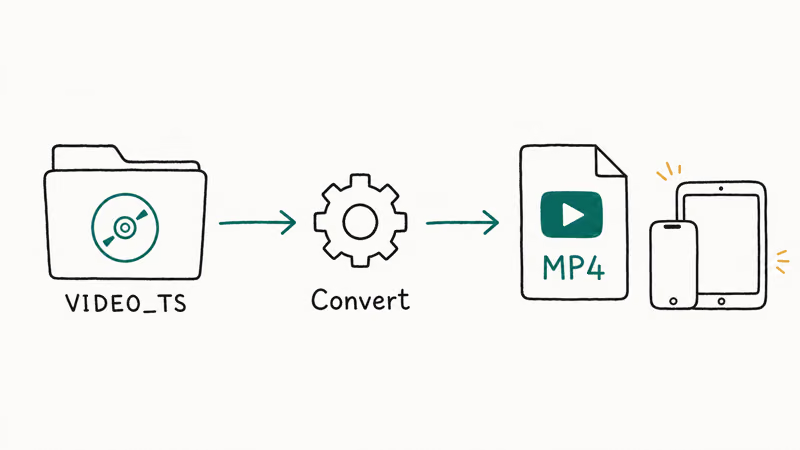
HandBrake and MakeMKV take different approaches to the same VIDEO_TS folder. MakeMKV produces a lossless MKV with no re-encoding, so the file stays close to the original size. HandBrake re-encodes to a smaller MP4 using H.264 at a preset like Fast 1080p30. Both formats play natively in modern browsers and on current smart TVs without compatibility shims.
Adjacent format guides cover the next decisions.
Our walkthroughs on converting MP4 to WAV and VOB and disc-format conversion extend this workflow if you already work with related container formats.
If you also need to stitch multiple titles into one continuous output, our guide on merging videos in VLC covers the end-to-end pipeline, including how to handle mismatched codecs, frame rates, and audio tracks without re-encoding the entire timeline from scratch.
Pick MKV when you want every audio track, subtitle, and chapter preserved. Pick MP4 when device compatibility matters more than fidelity.
AVI is outdated in 2026.
Tools worth knowing:
- HandBrake (free, open-source) for MP4 and MKV encodes with device profiles.
- MakeMKV (free during beta) for lossless one-shot ripping to MKV.
- WinX DVD Ripper (paid) for batch jobs with a simpler UI.
- VLC itself via
Media>Convert/Save, useful when you already have it open.
A common stumbling block is copy protection. Commercial DVDs ship with CSS scrambling, and DRM-aware tools like libdvdcss (used by VLC and HandBrake when installed) handle this on personal backups. Bypassing protection is the legally sensitive step covered in the next section.
#Troubleshooting BUP Playback Failures
Most “I can’t play this .bup file” reports trace back to one of four root causes. Each one has a straightforward fix.
#Opening the wrong target
Double-clicking the .bup file directly won’t work. Open the parent VIDEO_TS folder instead. This single change fixes the majority of cases.
#Missing VOB files
A .bup without its matching .vob siblings is useless.
If you copied only the .ifo and .bup files from a disc, recopy the entire VIDEO*TS folder including every VTS*\*.VOB. Each .vob is capped at 1 GB by the DVD-Video spec, so a long film often spans four to six .vob chunks.
#Partial or corrupted rip
If the original disc had scratches or the rip was interrupted, some sectors may be unreadable. Tools like MP4Fix video repair help with damaged container files. For DVD rips specifically, re-ripping with the decrypter built into MakeMKV usually recovers more data than a plain file copy.
#Wrong region or copy protection
Some DVDs use region coding (Region 1 for US, Region 2 for Europe, Region 4 for Australia, and so on) or layered protections beyond plain CSS. A region-free player like VLC handles most of these on personal backups, but heavily protected discs may still refuse to play without third-party decryption libraries.
#The Legal Side of Ripping Your Own DVDs
The rules vary sharply by country.
Check your local law before you start. The general shape across major jurisdictions looks like this:
- United States. The Library of Congress granted DMCA exemptions in 2024 for circumventing CSS on lawfully owned DVDs in narrow educational and accessibility cases. General personal backups remain a gray area because Section 1201 of the DMCA broadly prohibits bypassing access controls.
- United Kingdom. The UK High Court struck down the personal-copy exception in 2015, meaning ripping even your own purchased DVD technically infringes copyright.
- European Union. Member states vary. Some (France, Germany) allow personal copies under levy schemes; others don’t.
- Australia, Japan, Canada. All have rules where format-shifting may be allowed but circumventing technological protection is restricted.
Distributing converted files, sharing them on torrents, or selling them is illegal almost everywhere regardless of whether you bought the original disc. When in doubt, convert only discs you physically own and keep the output for your personal devices.
For workflows involving other media types, our notes on playing M2TS files in VLC and opening MOD files on Mac are useful adjacent reading.
If you need to repurpose DVD content for presentations, our guide on embedding DVD clips into PowerPoint covers that workflow.
#Bottom Line
If you only need to watch the content stored alongside a .bup file once, install VLC, point it at the parent VIDEO_TS folder, and you’re done in two clicks. If you’ll watch the same disc on a phone, tablet, or smart TV later, spend 15 to 40 minutes running MakeMKV (lossless) or HandBrake (smaller file) to convert the VIDEO_TS tree to MKV or MP4 once. The .bup itself is never the playback target.
#Frequently Asked Questions
Can I play a .bup file on its own without the rest of the DVD folder?
No. The .bup file only holds a copy of the navigation index. Without the matching .vob files in the same VIDEO_TS folder, there’s nothing to decode into video.
Why does my .bup file open as gibberish in a text editor?
It’s a binary file, not text. The .bup format uses the DVD-Video IFO byte layout, so Notepad or TextEdit just shows random characters.
Is a .bup file the same as a .vob file?
No.
A .vob contains the actual MPEG-2 video, AC-3 or LPCM audio, and subpicture subtitle streams. A .bup is just the safety copy of the .ifo navigation index that tells the player how to traverse those .vob files.
Will VLC play a damaged or partial VIDEO_TS folder?
Often, yes.
VLC is forgiving about missing sectors and incomplete rips, and it’ll usually start playback from the first readable .vob it finds. A stricter player like Apple DVD Player tends to refuse the whole folder if any one file is malformed.
Should I convert my DVD rips to MP4 or MKV?
MKV for archival, MP4 for compatibility.
Choose MKV if you want every audio track, subtitle stream, and chapter preserved with no quality loss. Choose MP4 if you mainly care about playing the file on phones, tablets, and smart TVs without thinking about codec support. For long-term archival, MKV is the safer bet because it preserves the original streams without re-encoding.
Why does my BUP file say “unsupported format” in Windows Media Player?
Microsoft removed DVD-Video playback from Windows starting with version 8, so Windows Media Player doesn’t know how to read the DVD-Video file structure that .bup and .vob files belong to. Install VLC or MPC-HC instead, and they’ll open the VIDEO_TS folder without complaint.
Is it illegal to make a backup copy of a DVD I bought?
It depends on where you live. In the United States the DMCA prohibits bypassing CSS copy protection except under narrow exemptions, even on discs you own. The UK and several EU countries also restrict format-shifting. Check the rules in your jurisdiction before ripping commercial discs.

Best Laptop for Running LLMs in 2026: Memory Comes First
The best laptop for running LLMs is a memory purchase first. Compare MacBook unified memory against NVIDIA laptop VRAM, and see what each tier really runs.
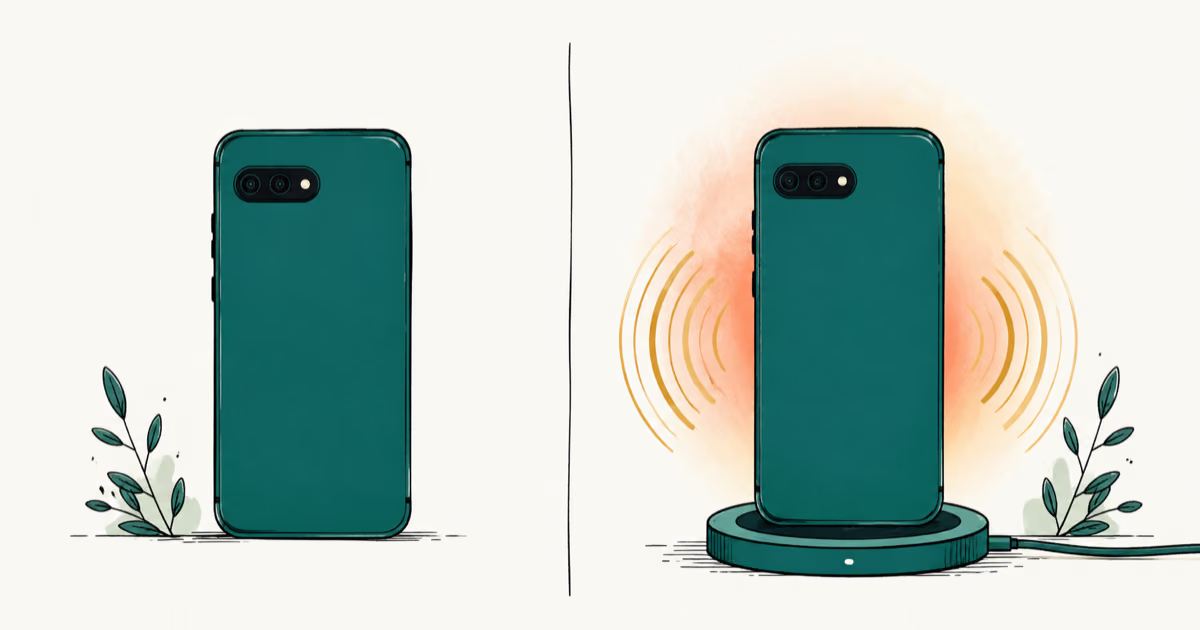
Pixel 11 vs Pixel 10: What Changed and Who Should Upgrade
Pixel 11 vs Pixel 10: same screen and camera resolution, new Tensor G6, 25W wireless, and Gemini Intelligence. Here is who should actually upgrade.
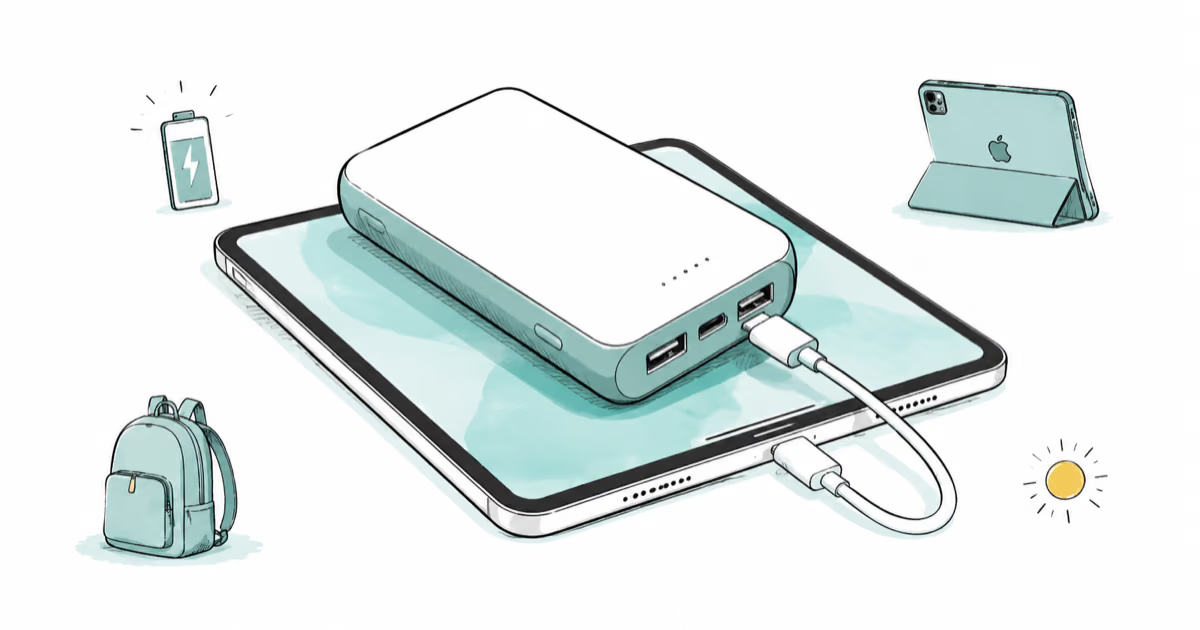
Best Power Bank for iPad in 2026: Pro, Air, and Mini
Best power bank for iPad in 2026. Compare mAh tiers and USB-C PD wattage for iPad Pro, Air, and mini, plus airline Wh math, cables, and travel tips.
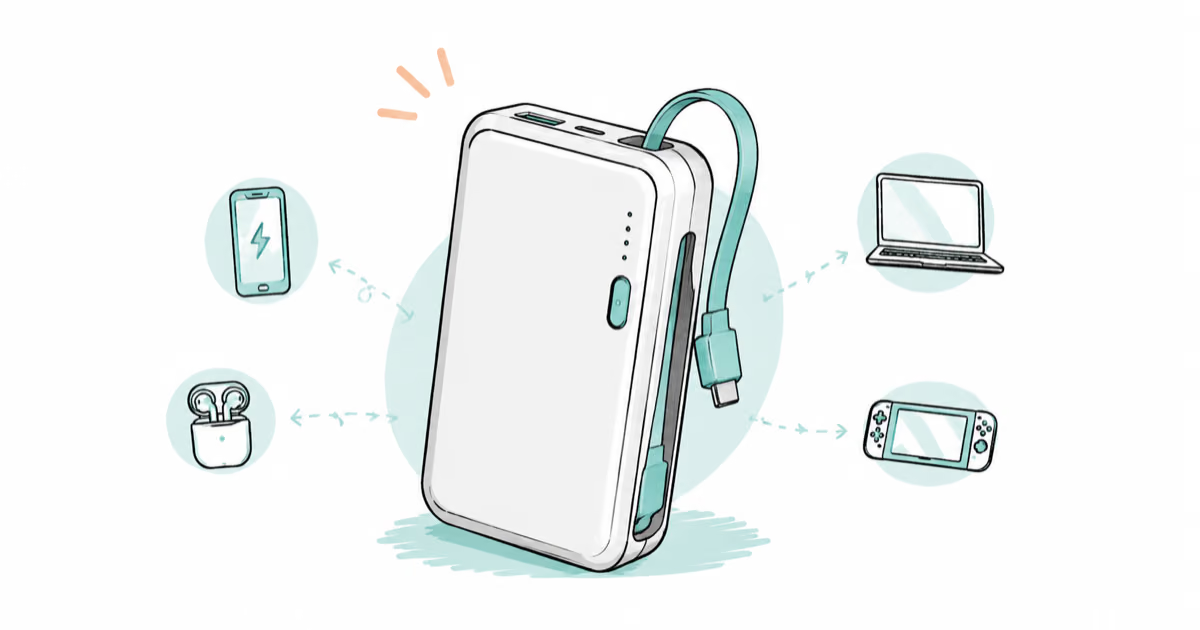
Best Power Bank With Built-In Cable: Top 2026 Picks
Best power bank with built-in cable picks for 2026. Compare single USB-C, multi-connector, and retractable laptop banks, plus airline Wh math.