IMEI Number Tracker: What It Actually Does (and Does Not)
IMEI tracker reality check: what an IMEI is, how to use yours legally to recover a stolen phone, and why third-party tracker apps mostly do not work.
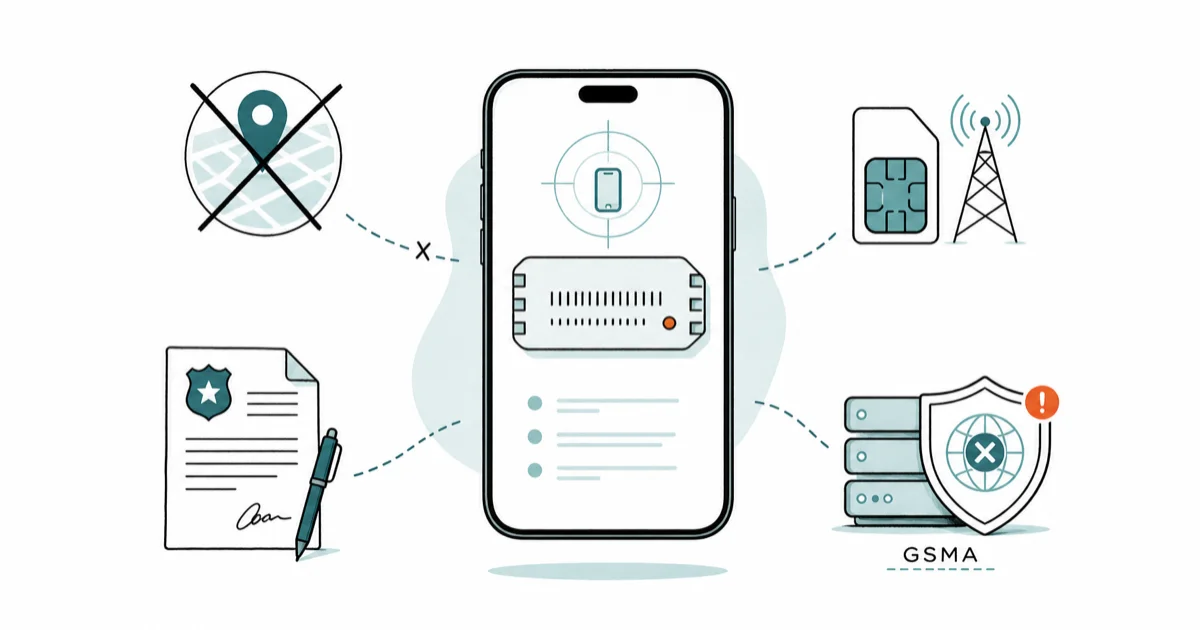
Quick AnswerAn IMEI alone can't pinpoint a phone on a map. Use it to file a police report and have your carrier blacklist the device through the GSMA database.
The phrase “IMEI number tracker” gets searched thousands of times a month, and almost every top result oversells what it can do. An IMEI is a 15-digit serial number that identifies the device hardware, not a GPS beacon.
Public IMEI lookup services don’t return a real-time location for a phone. This guide is for owners who lost a phone they paid for, or who want to verify that a used phone is not on a stolen list. It’s not a how-to for locating other people, which is illegal in all 50 US states.
- An IMEI is a 15-digit hardware ID. It doesn’t transmit GPS coordinates and can’t be used to map a phone in real time
- The legitimate uses are theft recovery through your carrier and police, insurance claims, and verifying a used phone is not blacklisted
- Apple’s Find My and Google’s Find My Device are the only consumer tools that actually return a live location, and both require the phone to be powered on, online, and signed in to your account
- The GSMA Device Registry and the FCC stolen-device blacklist let carriers refuse service to a reported IMEI across most US networks
- Locating someone else’s phone without consent is stalking under federal law, and most “anonymous IMEI tracker” apps are scams or stalkerware
#What Is an IMEI Number, Really?
The International Mobile Equipment Identity, or IMEI, is a 15-digit serial number assigned to every cellular device. It identifies the hardware itself, similar to a vehicle identification number on a car.
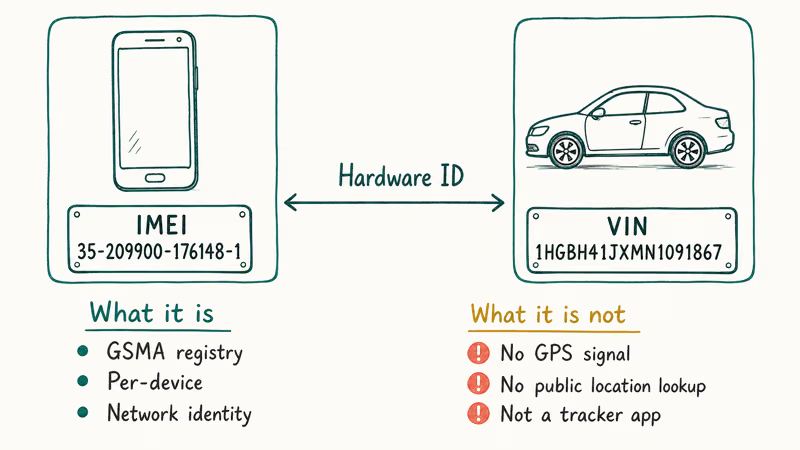
The GSM Association maintains the master registry, and carriers worldwide use it to authorize devices on their networks. The GSMA confirms that more than 120 country-level mobile operators contribute to its Device Registry, which is what lets one carrier block a phone reported stolen on another network in minutes rather than days.
A few important limits to set right up front:
- An IMEI does not contain or transmit location data
- An IMEI can’t be queried by the public to return a phone’s coordinates
- Carriers can see which cell tower a SIM connected to, but they share that information with law enforcement only
eSIM-only devices like newer iPhones in the United States use an IMEI plus a separate EID (eSIM identifier). Both numbers should go on a police report.
#How to Find Your Own IMEI
You’ll need this number before a phone goes missing, not after. Save it in a password manager or a note synced to your laptop. Three reliable methods:
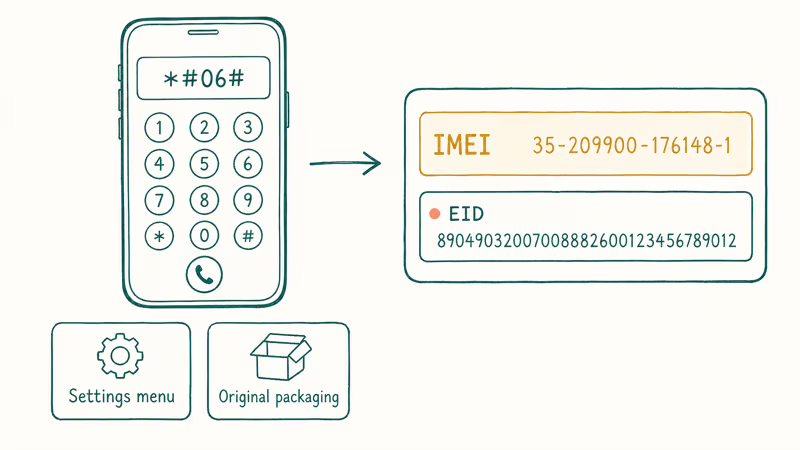
- Dial
*#06#on the phone’s keypad. The IMEI (and EID, on eSIM devices) appears on screen instantly. Works on iPhone, Android, and basic feature phones. - Settings menu. On iPhone, go to Settings, General, About, then scroll to IMEI. On Samsung and most Android phones, Settings, About phone, Status, then IMEI.
- Original packaging. The IMEI is printed on the retail box label and on the receipt from the carrier. Keep both.
Already stolen and you never recorded the IMEI? You can still retrieve it. For iPhone, sign in at appleid.apple.com and click the device name to view its serial and IMEI; for a Google account, go to myaccount.google.com, Security, then Your devices. Carriers also keep the IMEI on file from when you activated service.
#Can a Lost Phone Actually Be Tracked by IMEI?
Honestly, no, not in the way the search results suggest. Here is what’s real and what is fiction.
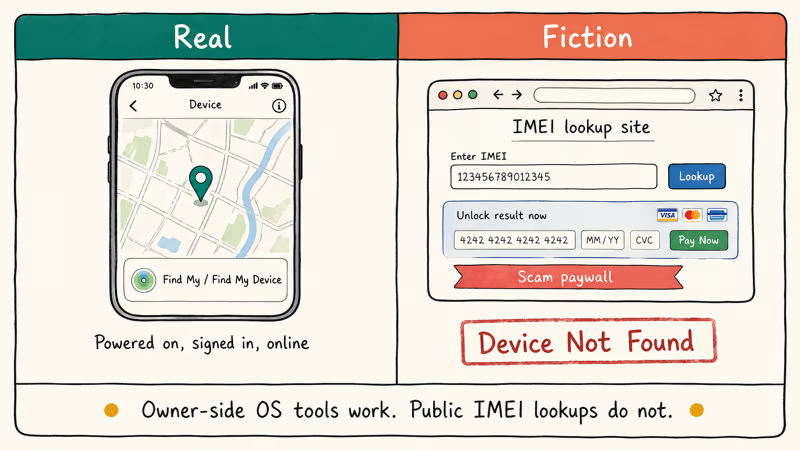
What’s real: When a phone with a SIM card connects to a tower, the carrier’s network logs the IMEI alongside the IMSI (the SIM identifier). Law enforcement, with a subpoena, can request that connection log to triangulate a rough location. The carrier won’t give that data to you directly, even if you own the phone.
What’s fiction: Public IMEI lookup websites that claim to map the device live. These sites, including many of the highest-ranked Google results, typically either return a “device not found” error or ask for a credit card after promising free results. None produce a working location. Reddit’s r/scams subreddit catalogs hundreds of similar complaints about IMEI lookup sites.
The tools that do return a real live location use the operating system’s built-in location reporting:
- Apple Find My for iPhone, iPad, AirPods, and Apple Watch
- Google Find My Device for Android phones and Wear OS watches
- Samsung SmartThings Find for Galaxy devices, which extends Find My Device with a Bluetooth mesh
All three require the phone to be powered on, connected to mobile data or Wi-Fi, and signed in to the original account. None of them ask for the IMEI.
For older devices that no longer power on, our deeper walkthrough covers what realistically remains: how to locate a lost cell phone that is turned off.
#Authorization and the Law (Read This First)
This guide is only for tracking devices you own and can prove ownership of, ideally working alongside your carrier and local police. Locating someone else’s phone without their consent is a separate problem entirely, and it carries criminal penalties.
Under the federal Computer Fraud and Abuse Act and parallel stalking statutes in every US state, accessing another person’s location data without authorization is a crime. The FBI’s stalking resource page states that stalkers commonly use technology, including tracking apps and GPS devices, to monitor their victims, and lists tracking apps among the most common digital surveillance tools in such cases.
Apple and Google both detect persistent unauthorized tracking devices and now notify the target automatically. Most apps that advertise “anonymous IMEI tracking” or “track without them knowing” have been targeted by FTC enforcement actions over the past decade.
The concrete rule for this article: every method below assumes you’re the owner and you have documentation. That means a purchase receipt, a carrier account in your name, or the IMEI printed on the original retail box. If you don’t have that paper trail, stop here and contact the device owner or the police instead.
#The Truth About IMEI Tracker Apps
Almost none are legitimate. The top Google Play results for “IMEI tracker” are typically flagged with negative reviews mentioning a paywall after install, get removed from the store quickly, or have developer pages that link to no working website.
Common patterns to watch for:
- The app asks for your credit card before showing any tracking interface
- The app demands SMS, contacts, microphone, and location permissions for an IMEI lookup, which are unrelated and a red flag for stalkerware
- The app’s developer has no verifiable business address
- Reviews mention the same fake locations being returned for every IMEI
If you want a sanity check on a phone you’re buying secondhand, free public services like the GSMA-backed CheckMEND and Swappa’s IMEI checker query the carrier blacklist directly. They return a yes/no answer without claiming to map the device. That is the only legitimate use of an IMEI lookup tool.
#What to Do if Your Phone Is Lost or Stolen
The order matters here. Skip the IMEI lookup websites and follow the chain that actually recovers phones.
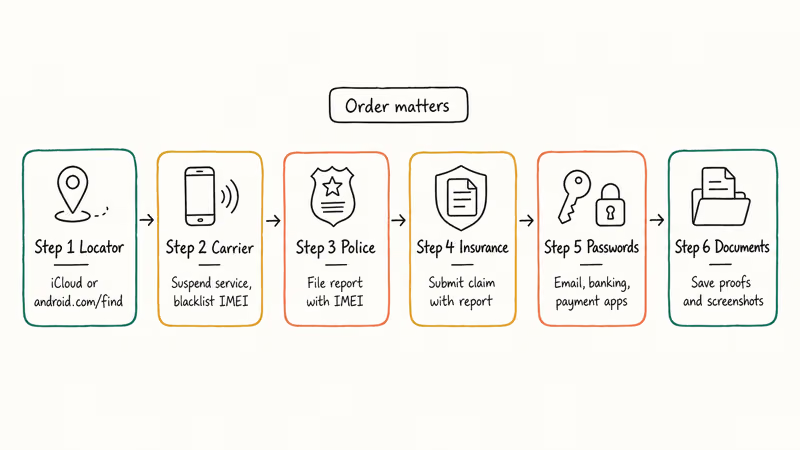
- Try the official locator first. Sign in to iCloud.com or android.com/find from another device. If the phone is online, you’ll see it on a map within a minute. Trigger Lost Mode (iPhone) or Secure Device (Android), which locks the screen and displays a contact number. Apple’s Lost Mode walkthrough confirms that Lost Mode also disables Apple Pay on the missing device immediately.
- Call your carrier. Ask them to suspend service so a thief can’t run up charges, and report the IMEI as stolen so it goes onto the GSMA blacklist. AT&T, Verizon, T-Mobile, and most MVNOs honor each other’s blacklists, which makes the phone unusable on the four major US networks. Our guide on how to track a lost phone walks through the carrier scripts.
- File a police report. Bring the IMEI and proof of purchase. The report number is what insurance and the carrier will ask for, and police are the only party that can subpoena cell tower logs.
- Submit an insurance claim. AppleCare+, Samsung Care+, and most homeowner or renter policies cover theft once you have a police report number.
- Change passwords. If your phone was unlocked when stolen, immediately change passwords for email, banking, and any payment app, in that order. Apple’s Apple ID security page shows how to revoke device sessions.
- Document everything. Save the police report, IMEI confirmation from your carrier, and any Find My location screenshots in case of a dispute later.
If you bought your phone through MetroPCS or a similar prepaid carrier, the activation and reporting process differs slightly from the postpaid majors. Our MetroPCS activation walkthrough has the carrier-specific contact path.
#Verifying a Used Phone Is Not Stolen
This is the cleanest legitimate use of an IMEI lookup. Before paying a stranger for a used iPhone or Android, ask them to dial *#06# in front of you and read out the IMEI. Then run that IMEI through one of three services:
- Swappa ESN/IMEI Check is free, returns the carrier blacklist status, and pulls from the same GSMA feed the carriers use
- CheckMEND charges a small fee but covers more international networks
- Your carrier’s IMEI tool. T-Mobile and AT&T both let you check IMEI eligibility on their websites; the same lookup also surfaces blacklist status
If the IMEI returns “blacklisted” or “blocked,” walk away. The phone won’t activate on any major US network, and the seller is either passing along stolen goods or offloading a phone with unpaid carrier financing. The FCC’s mobile device protection guide recommends reporting a stolen phone to your carrier so the IMEI can be added to the cross-carrier blacklist that prevents activation on any participating US network.
If you’re buying an unlocked iPhone, also verify Activation Lock status. Apple’s iCloud activation lookup was retired in 2018, so the seller should sign out of iCloud in front of you before you hand over money. Our walkthrough on Apple Watch activation lock explains the same logic for wearables.
#Frequently Asked Questions
Can someone track my phone with just my IMEI?
No, not in any practical sense. A random person with your IMEI can’t map your real-time location, and any website or app that claims to do so is almost always either a scam paywall or stalkerware in disguise. Your carrier is the only party that can link an IMEI to recent cell-tower connections, and they only release that data to law enforcement under a subpoena, never to ordinary customers, even the device’s rightful owner.
Will IMEI tracking work if the phone is turned off?
No.
Every form of phone location, IMEI-based or otherwise, requires the device to be powered on and connected to a cellular or Wi-Fi network. The one partial exception is iOS 15 and later, which broadcasts a low-power Bluetooth signal for up to 24 hours after shutdown that other Apple devices can relay through Find My. That feature still doesn’t depend on IMEI.
Is changing an IMEI illegal?
Yes, in the United States and most other jurisdictions. The Stop Cellphone Trafficking Act of 2012 made IMEI alteration a federal crime when done to enable stolen-phone resale. A deeper guide on whether you can change the IMEI on an iPhone covers the legal context and why software claiming to do this is almost always malware.
Can I block my stolen phone from being used?
Yes, through your carrier.
Reporting the IMEI as stolen adds it to the GSMA Device Registry, which most US and international carriers honor by refusing to activate the device. The phone becomes a paperweight on cellular networks, although Wi-Fi-only use may still work, which is why a parallel remote wipe through Find My matters.
What is the difference between IMEI and serial number?
The serial number is the manufacturer’s internal product ID, while the IMEI is the network identifier registered with the GSMA. A police report and carrier blacklist use the IMEI; AppleCare and warranty claims sometimes use the serial number instead. Save both for any phone you own.
Are free online IMEI checkers safe?
It depends. Reputable ones (Swappa, CheckMEND, carrier-run tools) are safe; ones promising a “live location” in exchange for personal data are not.
What should I never do with someone else’s IMEI?
Don’t track them. Attempting to locate another person’s phone, even a partner’s or an adult family member’s, without their explicit consent is stalking under federal and state law and may constitute domestic abuse depending on the relationship. If you suspect a child or vulnerable adult is in danger, contact local police rather than trying to locate the phone yourself, because anything you find without authorization may not be admissible later.
#Bottom Line
For your own lost or stolen phone, skip the IMEI tracker apps entirely. The sequence that actually works: Find My or Find My Device first, then carrier blacklist, then police report. That chain recovers phones, or at least bricks them.
For a used phone you’re considering buying, run the IMEI through Swappa or a carrier eligibility tool before paying. Anything that promises to map a stranger’s phone live from an IMEI is a scam, stalkerware, or both. Save your IMEI now, somewhere that isn’t the phone itself, so you have it ready if you ever need it.
Is This Bank App Real? Spot a Fake App on Your Home Screen
A bank app can land on your home screen from a web page with no install warning. Learn the checks that tell a real banking app from a phishing web app.
Passkeys Not Syncing Between iPhone and Windows? Read This
Passkeys not syncing between iPhone and Windows is by design, not a bug. Here is why iCloud passkeys skip Windows Hello and the three ways to fix it.
VPN Not Working on Snapdragon X? Why It Fails, How to Fix
Your VPN won't install or connect on a Snapdragon X Copilot Plus PC because Windows on ARM can't emulate the network driver. Here are the fixes that work.
How to Check If a Link Is Safe Before You Click It
Learn how to check if a link is safe with official-first steps: read the real domain, use the app instead, and treat scanners as a second opinion only.