Change IMEI Number on iPhone: Is It Possible and Legal?
Can you change an iPhone's IMEI? Here's the legality in 2026, the technical reality, and official routes carriers offer when IMEI is the real issue.
Quick AnswerYou can't change an iPhone's IMEI. The number is fused into the baseband chip at the factory, and modifying it is illegal in the UK under the Mobile Telephones (Re-programming) Act 2002 and prosecutable as fraud or device tampering in the US. If your IMEI is the problem (carrier lock, blocklist, lost device), the official routes are carrier support, Apple, or the police.
If you’re asking whether you can change the IMEI on your own iPhone, the short answer is no, and the longer answer is that you shouldn’t try. The IMEI is welded into the baseband hardware, the legal regime around tampering is strict in most countries, and the situations that drive people to ask (carrier locks, lost-device flags, blocklists) all have legitimate carrier-side or Apple-side fixes.
This article covers what the IMEI actually is, why iPhones don’t allow changing it, the legal exposure if you tried, and what to do instead when the IMEI is the real issue.
A scope note before anything else. We’re talking about your own iPhone and your own carrier account here, not someone else’s device. Modifying the IMEI of a phone that isn’t yours, or doing it to evade theft tracking or carrier blocklisting, is a separate criminal matter, and nothing on this page applies to those situations.
- You can’t change an iPhone’s IMEI because Apple fuses the number into the baseband processor at manufacture. There’s no Apple-supported software path to overwrite it.
- IMEI tampering is explicitly illegal in the UK under the Mobile Telephones (Re-programming) Act 2002, with up to 5 years’ imprisonment on conviction.
- In the US, IMEI modification has no dedicated statute but is routinely prosecuted under wire fraud and device-tampering laws when used to evade a blocklist.
- Tools claiming to “change IMEI on jailbroken iPhone” don’t actually rewrite the baseband. They spoof the number reported to apps, and the change resets on reboot.
- If your IMEI is blocklisted, locked, or attached to a lost-device flag, the legitimate fix is a carrier support call or an Apple Store appointment, not a software hack.
#What an IMEI Number Means on iPhone
The IMEI (International Mobile Equipment Identity) is a 15-digit identifier assigned to every cellular phone at manufacture. It identifies the physical device on a carrier network, separate from the SIM/eSIM (which identifies the line) and the Apple ID (which identifies you).
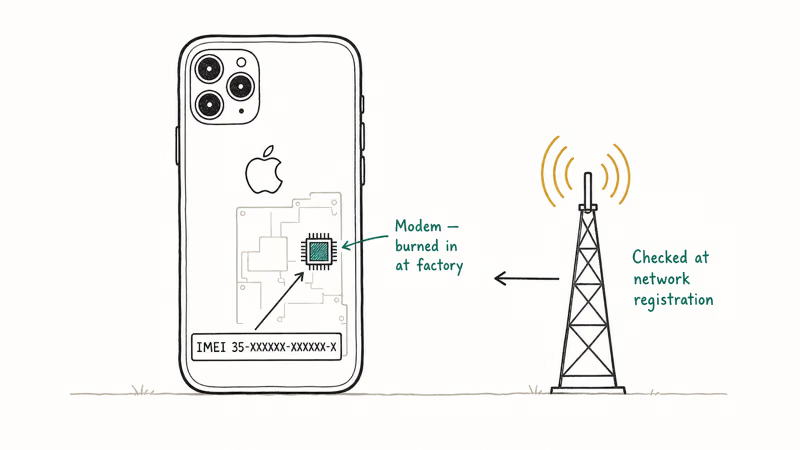
On iPhone the IMEI lives in three places at once: in the baseband chip, in a Type Allocation Code (TAC) registry maintained by the GSMA, and in your carrier’s account record when the device is activated.
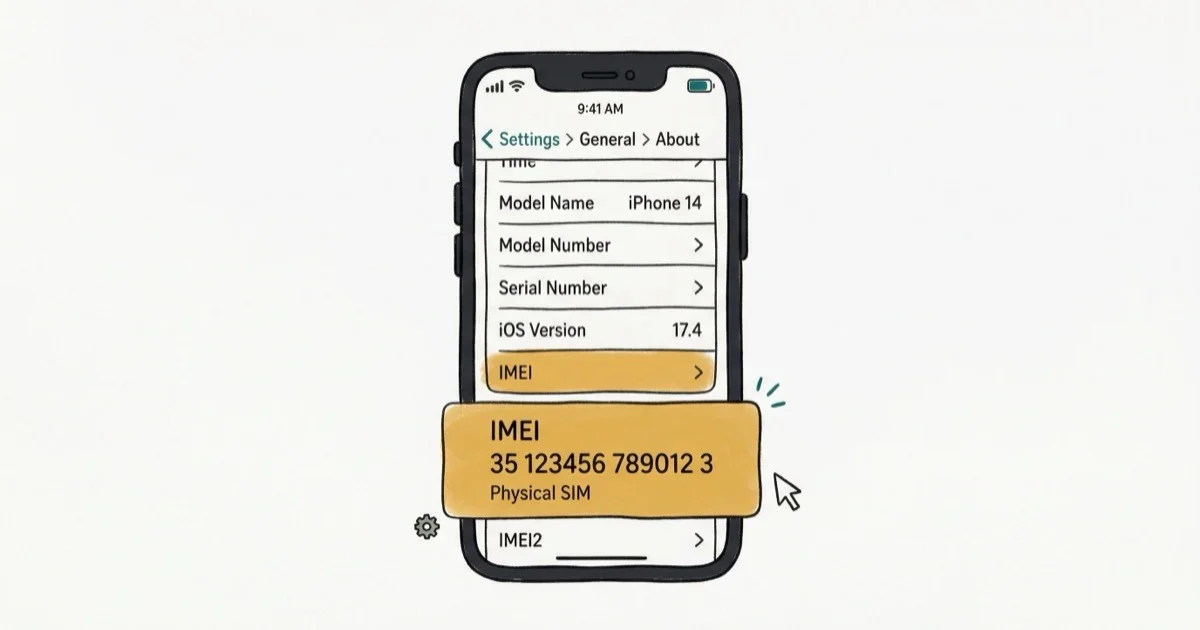
You can read your iPhone’s IMEI in four ways:
- Dial
*#06#on the Phone keypad. The number appears in a popup. - Open
Settings>General>Aboutand scroll to the IMEI row. - Look at the SIM tray on iPhone models that still have one.
- Check the original box (the IMEI is printed on the retail label).
Apple documents the same lookup paths on its official IMEI page.
#Is It Legal to Change an iPhone’s IMEI Number?
In most jurisdictions, no. The legal status varies, but in every country where mobile commerce is regulated, tampering with the IMEI carries a criminal exposure if it’s used to evade tracking, evade a blocklist, or facilitate theft resale.

In the United Kingdom, the rule is direct. According to the Mobile Telephones (Re-programming) Act 2002, it’s an offence to change or interfere with the IMEI of a mobile telephone. The Act states that conviction on indictment carries up to 5 years’ imprisonment or an unlimited fine, and it covers both the person who reprograms a device and anyone who supplies the tools to do it.
In the United States, there’s no dedicated federal statute, but the FCC’s stolen-phone consumer guide confirms carriers operate a shared stolen-IMEI database, and tampering is prosecuted under wire fraud.
In the EU, IMEI alteration is a criminal offence in Belgium, Bulgaria, Greece, Hungary, Latvia, Lithuania, the Netherlands, Slovakia, and the UK, per the GSMA’s IMEI tampering legal framework summary. Most other EU members treat it as fraud under general anti-tampering statutes. So even where no dedicated statute exists, the practical enforcement risk is real.
If you’re trying to change your IMEI because you bought a phone that turned out to be blocklisted, the legal exposure stays with whoever rewrites the IMEI, regardless of how the device was acquired. That’s worth knowing before you pay anyone for an “IMEI change” service.
#Why Apple Doesn’t Change IMEI Numbers
Apple doesn’t offer this even for the original owner. The reason is structural, not policy.
Modern iPhones (from iPhone 4 onward) store the IMEI in a one-time-programmable (OTP) region of the baseband processor, manufactured by Qualcomm or Intel depending on the model year. OTP fuses are physically blown during factory provisioning, which means the bit pattern is set by literally destroying tiny silicon links inside the chip. They can’t be re-burned in software because the destruction is permanent at the transistor level.
The baseband itself runs signed firmware. Tools that advertise “iPhone IMEI change” mostly operate at the app layer, spoofing the number returned by API calls but never reaching the baseband, so the carrier network still sees the real IMEI.
With these third-party “IMEI changer” tools on a jailbroken iPhone, any new value persists only until the next reboot. The Settings > About page reverts to the factory IMEI on restart, and the network never sees the spoofed value at any point.
#Real Consequences of Trying to Change IMEI
Beyond the legal risk, the technical fallout from attempting an IMEI change on iPhone is severe.
- Bricked baseband. Hardware mod attempts that physically replace the baseband chip routinely fail. Even when the swap succeeds, the new chip isn’t paired with Apple’s factory-stored serial, and the device loses cellular service permanently.
- No warranty. Apple Limited Warranty terms state that damage caused by unauthorized service or modification is not covered. The warranty service itself goes away the moment Apple’s diagnostics detect tampering.
- iMessage and FaceTime break. Both services bind to the device’s hardware identifiers including IMEI. A mismatch causes activation failures that no carrier or software reset can fix.
- Network blocklist propagation. If the carrier detects the altered IMEI, they don’t just block the new value, they often blocklist the original IMEI too on suspicion of fraud, leaving you with a device that’s worse off than before.
- Detection of theft chain. Carriers and Apple share IMEI databases. An attempt to change the IMEI on a previously-flagged device often surfaces the chain of custody, which puts the current holder under the same scrutiny as the original thief.
This pattern shows up repeatedly in forum reports where users tried “IMEI clean services” sold by overseas vendors, and the iPhone typically ends up less usable, not more.
#What Should You Do If Your IMEI Is the Real Problem?
The right answer depends on what you’re actually trying to solve. Here are the official routes for the situations that drive people to ask about IMEI changes.
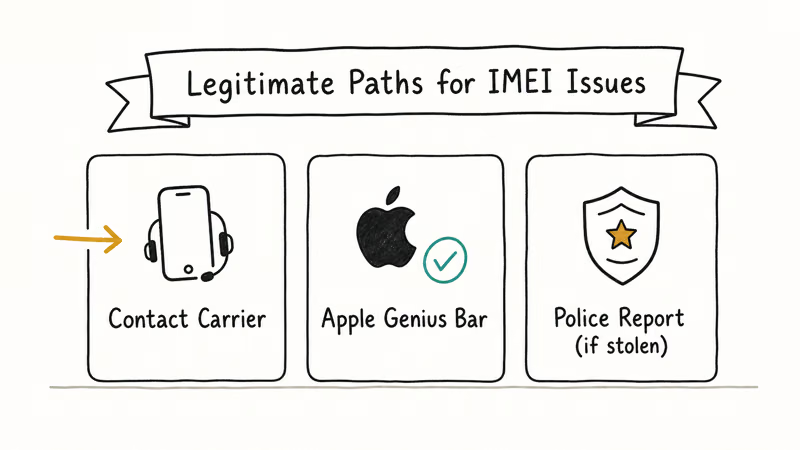
Carrier-locked iPhone. Contact the original carrier. According to the FCC’s wireless device unlocking rules, carriers in the US are required to unlock paid-off devices on request. The unlock is recorded against the IMEI in the carrier’s database, no hardware change involved. If your account is in good standing, our locked-out-of-iPhone guide walks through the request process.
Blocklisted iPhone after a private purchase. Contact the original account holder if possible. If not, contact the carrier with proof of purchase. Some carriers will lift a “lost” flag if the device is recovered and the buyer can document a legitimate sale. Our walkthrough on unlocking a blacklisted phone for free covers what to ask for.
If the device was reported stolen, return it to the police, not a “clean” service.
Stolen iPhone you’ve recovered. Contact your local police and your carrier. The IMEI is the receipt.
iCloud-locked iPhone. This is Activation Lock, not an IMEI issue. The official path is documented in our unlock iCloud Activation Lock guide. Apple removes the lock when the original owner signs the device out of their Apple ID, or with proof-of-purchase verification through Apple Support.
Suspected spyware. See our guide to detecting spyware on iPhone; the IMEI isn’t the right lever.
Privacy concerns about IMEI leakage. The IMEI is broadcast to whatever network your phone authenticates with. The mitigation is operational, not technical: don’t share the value publicly, don’t post screenshots of your About page, and watch your account against unauthorized SIM swaps. Our coverage of changing caller ID on iPhone walks through related privacy adjustments.
For verifying what’s currently on file for your device, you can run an iPhone IMEI check which cross-references the GSMA database.
#How to Protect Your iPhone’s IMEI
A few habits that actually help, distinct from what doesn’t.
- Don’t share the IMEI publicly. It’s not as sensitive as your account password, but it’s enough for a determined SIM-swap attempt.
- Enable Find My iPhone. It binds the device to your Apple ID, which makes resale by a thief much harder regardless of what they do to the IMEI.
- Keep the proof-of-purchase. If the IMEI ever gets flagged in error, the original receipt is the fastest path to clearing it.
- Report theft within 24 hours. The faster the IMEI hits the carrier blocklist, the less a thief can do with the phone.
- Don’t pay strangers to “clean” an IMEI. Every offer of this kind is either a scam, illegal, or both.
#Bottom Line
You can’t change an iPhone’s IMEI because the hardware doesn’t permit it. You shouldn’t try because the legal exposure is real and the technical fallout makes the device worse.
If your IMEI is causing a real problem (carrier lock, inherited blocklist flag, stolen-device report), the actual fix is a five-minute call to the carrier or an appointment with Apple. The “IMEI change” services advertised online either fail outright, revert on reboot, or quietly take the customer’s payment and walk away. The official routes work; the unofficial ones don’t.
#Frequently Asked Questions
Is it possible to change IMEI without jailbreaking an iPhone?
No.
Will Apple change my iPhone’s IMEI if I ask?
No, Apple doesn’t offer it.
What happens if I install a fake IMEI on a jailbroken iPhone?
The fake value only persists at the application layer until reboot. The baseband continues to broadcast the original IMEI to the carrier network, so calls, SMS, and data use the real number. The “change” is essentially a display trick that breaks at the first restart and gets you nothing useful.
Can I unlock an iCloud-locked iPhone by changing the IMEI?
No. Activation Lock is bound to the Apple ID stored on Apple’s servers, not the IMEI. Changing the IMEI (if it were possible) wouldn’t reach the lock at all. The only legitimate way through Activation Lock is the original Apple ID password or proof-of-purchase removal through Apple Support.
Is IMEI change legal anywhere in the world?
Not in any major mobile market.
How can I find my iPhone’s real IMEI to give to my carrier?
Dial *#06# from the Phone app, or open Settings > General > About. The IMEI is also printed on the original box and on the SIM tray of older models. If the device powers on, the dial code is fastest.
Does changing my iPhone’s IMEI hide me from law enforcement?
No, and trying is itself a crime in most jurisdictions. Carriers and law enforcement coordinate through shared device databases, and attempts to alter an IMEI typically surface the device under additional scrutiny rather than removing it from view.
Apple Siri Settlement: Who Qualifies and How to Claim
Apple's $250 million Siri settlement covers iPhone 15 Pro and iPhone 16 models bought June 2024 to March 2025. See who qualifies and how claims work.
iOS 26.6.1 Security Update: What Apple Fixed and Who Gets It
Apple released iOS 26.6.1 on August 17 with 29 security fixes, including an IPSec interception bug. See what it patches, who gets it, and how to update.
iPhone Adaptive Power: How It Works and When to Use It
Learn how iPhone Adaptive Power works, which models support it, what it changes, and when Low Power Mode is still the better battery-saving choice.
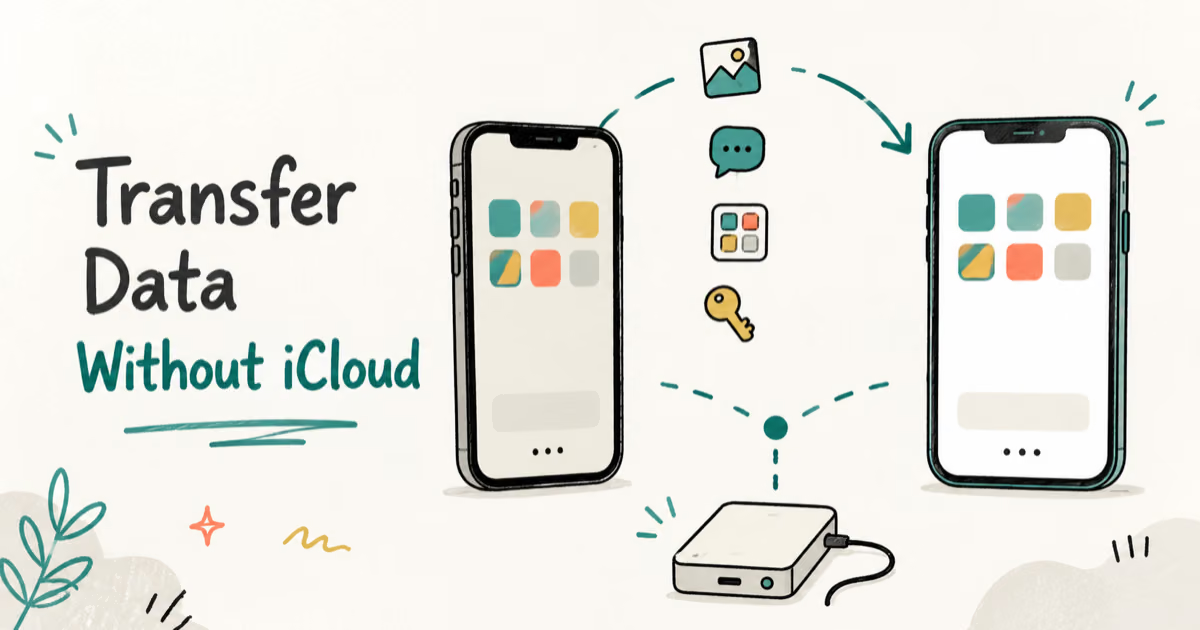
How to Transfer Data to a New iPhone Without iCloud
Move everything to your new iPhone without iCloud: Quick Start device-to-device transfer, wired migration, and encrypted Finder or iTunes backups.