How to Humanize AI Text: 9 Edits That Actually Work
AI text reads flat because of uniform sentences and hedge words. Here are 9 edits that make ChatGPT sound human, plus the truth about detectors.
Quick AnswerTo humanize AI text, cut hedge phrases, vary sentence length, replace em dashes with periods, and add a specific detail only a human would know. No tool guarantees a detector pass.
If you’ve pasted a ChatGPT draft into an email and thought “this sounds like a robot wrote it”, you’re not imagining things. AI prose has a smell. Once you learn to spot it, you can edit it out in about five minutes.
- AI prose reads flat because of three habits: uniform sentence length, hedge openers, and overuse of em dashes.
- Detectors score text on perplexity (how predictable each word is) and burstiness (how much sentence length varies).
- Nine concrete edits handle the worst tells: shorten unevenly, kill hedges, add a specific detail, use contractions.
- No humanizer tool can guarantee a detector pass, and editors and teachers spot the rhythm anyway.
- For graded work or client deliverables, treat AI as a brainstorming partner and write the final draft in your own voice.
#Why Does AI Writing Sound Robotic?
AI text reads flat for a few overlapping reasons. Most of them come down to rhythm.
Large language models pick the next word by averaging across millions of training examples. That averaging produces prose that’s grammatically clean but textureless. Every sentence lands at about the same length. Paragraphs march in lock-step.
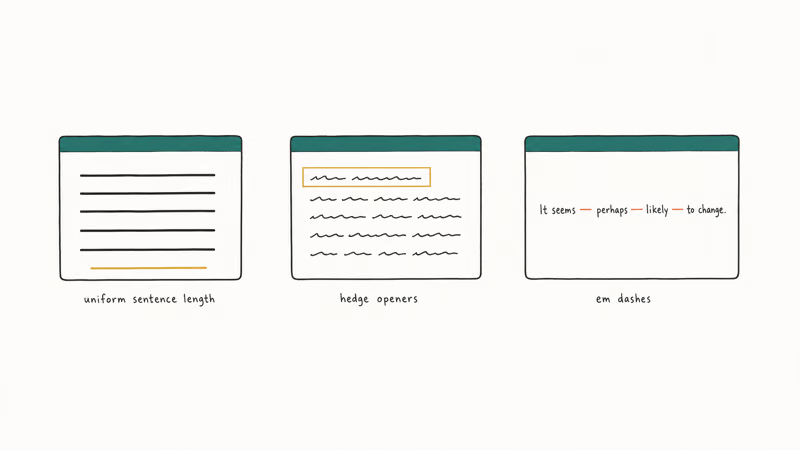
Three habits do most of the damage.
- Uniform sentence length. A human draft has 4-word sentences next to 28-word sentences. AI drafts cluster between 15 and 22 words almost every time.
- Hedge openers. Throat-clearing phrases pad every other paragraph. So do certain stock conjunctive adverbs parked at the start of sentences.
- Em dashes everywhere. ChatGPT loves the em dash. A 500-word human draft typically has 0 to 2; a ChatGPT draft of the same length often has six or more.
AI drafts often lean on repeated em dashes, sometimes several times in a short email or article section. The em dash alone is often enough to make a reader say “this feels off” before they can name why.
The model also matters. Each tool has its own stylistic tics at default settings. If you want to see how each one sounds in long-form output, our guides on how to use Claude AI and Gemini Gems show the personality of each model.
#How Do AI Detectors Actually Work?
Detectors don’t read meaning. They measure two statistical signals: perplexity and burstiness.
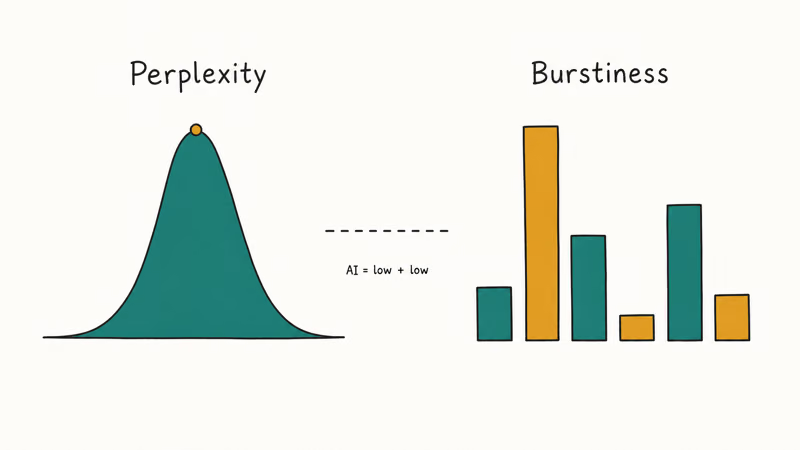
Perplexity is how predictable the next word is. Models pick safe words. Humans don’t.
According to GPTZero’s explainer on how detectors work, low perplexity is the single strongest signal that text came from a language model. The mathematical definition of perplexity on Wikipedia gives the formal background.
Burstiness measures variation in sentence length and complexity. Human writers naturally write in bursts: a punchy three-word sentence, then a long winding one, then a medium one with a parenthetical. AI drafts cluster around the mean.
That’s the whole game. Everything else a detector reports is a wrapper around those two signals.
Two consequences worth knowing. First, the detectors don’t actually see text fingerprints from OpenAI, Anthropic, or Google — they infer from statistical patterns alone. Second, anything you write that happens to have low perplexity and low burstiness can get flagged as AI, including formal academic writing, technical documentation, and prose from non-native English speakers who learned from textbooks.
Turnitin’s AI writing detection update states that false positives on student writing do occur. Teachers should use detector output as a conversation starter, not as proof.
OpenAI announced on July 20, 2023 that its public AI Text Classifier was being shut down. According to OpenAI’s classifier post-mortem, the tool flagged only 26% of AI-written text correctly during the 6-month trial before retirement. If the company that made the model couldn’t reliably detect its own output, the third-party tools running on the same signals aren’t doing magic either.
#9 Edits That Make AI Text Sound Like a Person
These edits move the needle, in rough order of impact.
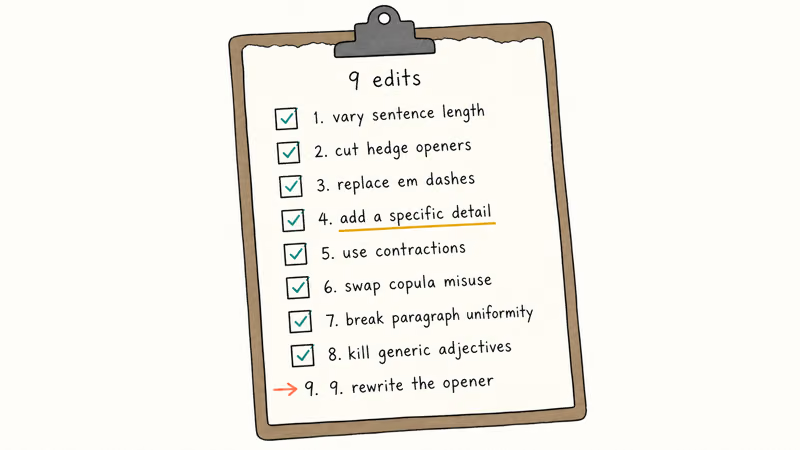
- Vary sentence length on purpose. Read your draft aloud. If three sentences in a row land at about the same length, break one in half. Glue two together. Aim for a mix from 4 to 30 words across any given paragraph.
- Cut hedge openers. Search-and-delete the formal throat-clearing phrases AI loves at the top of sentences. They add nothing.
- Replace em dashes with periods or commas. Keep at most two em dashes in any piece. The rest become full stops.
- Add a specific detail only you would know. A number, a place name, a moment. “A 2022 MacBook Air in a coffee shop with spotty WiFi” is harder for a model to generate at random than a generic laptop sentence.
- Use contractions. AI defaults to the formal uncontracted forms. Humans write don’t, can’t, won’t, you’ll, it’d. Eight to ten contractions in a 1,000-word piece is normal.
- Swap copula misuse for plain verbs. “Features a fast processor” becomes “has a fast processor”. “Utilizes” becomes “uses”. “Facilitates” becomes “helps”.
- Break paragraph uniformity. AI loves four-sentence paragraphs in a row. Drop in a one-sentence paragraph. Let another run six.
- Kill the generic adjectives. Vague qualifiers never describe anything specific. Either replace them with a concrete attribute or delete the sentence.
- Rewrite the opener in your voice. Start with a fact, a question, or a moment. The first 30 words decide whether a reader trusts the rest.
You can prevent some of this at the prompt stage too. If you set up ChatGPT custom instructions that tell the model to write in short, varied sentences with no em dashes, the default output gets less robotic before you start editing. ChatGPT Projects lets you store voice guides as project files so every chat in that project inherits them.
#Editing a ChatGPT Paragraph: Before and After
Here’s a paragraph ChatGPT produced when asked to write about choosing a laptop.
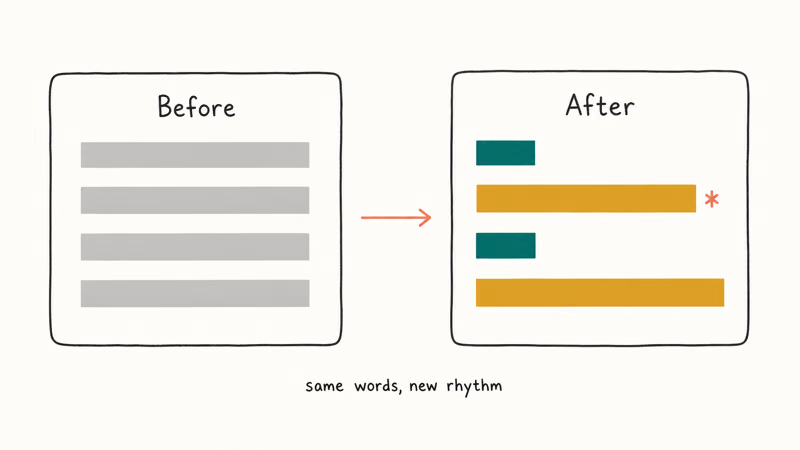
Selecting the right laptop has become an increasingly involved decision that requires careful consideration. The modern professional must work through a wide array of options. Battery life, performance, and portability often act as the primary criteria. Price-to-performance ratio remains a key factor for most buyers.
Four sentences, roughly nineteen words each. No specific detail anchors any claim, the vocabulary is mid-register and safe, and the reader gets no signal that an actual person wrote this.
Same paragraph after a five-minute pass.
Buying a laptop in 2026 is harder than it should be. The choices stretch from ultraportables you can fold into a tote bag to workstations that need a power brick the size of a paperback. Most people end up weighing three things: battery, speed, and weight. Price matters too, but if you skimp on the wrong one, you’ll regret it within a month.
Sentence lengths: 10, 23, 11, 28, same word count as the original. One concrete detail anchors the second sentence (“a power brick the size of a paperback”), contractions appear twice, and the prose now reads like a person who’s actually shopped for a laptop.
Hand-editing changes the signals detectors look for more directly than a paid humanizer tool, and the prose usually reads better afterward too.
#When “Undetectable” Becomes a Myth
Paid humanizer tools promise to make AI text undetectable. Most work by swapping words for synonyms, breaking sentences at random, and shuffling word order until the perplexity and burstiness signals shift. The output often passes a free detector. It also often reads worse than the original AI draft.
Three problems with the “undetectable” promise.
First, detectors update, so a humanizer trained against last quarter’s GPTZero won’t necessarily fool this quarter’s. Second, even when the statistical detector misses, a human editor or teacher catches the rhythm — a paragraph that reads like a thesaurus exploded has its own signature. Third, the more aggressively a humanizer rewrites, the more factual errors slip in, because synonym swaps don’t preserve meaning when the word is technical.
Hand-editing using the nine moves above wins on all three fronts. It’s durable against detector updates because you’re writing as a human. It reads cleanly to human reviewers. And it preserves your meaning, because you, the writer, are in the loop.
#The Honest Path for Schoolwork and Client Work
The right way to use AI in your work depends on what you’re producing.
For your own writing (work emails, marketing copy, blog drafts, internal documentation), humanizing AI output is just editing. ChatGPT or Claude gives you a first pass. You cut the hedge phrases, add the specific details, and ship it. Nobody loses.
For schoolwork, journalism, or anything you submit as your original work, the honest path is different. Use AI for brainstorming and outlining, then write the final draft in your own voice. Most academic policies allow AI as a study aid; almost none allow it as a ghostwriter, and the risk-reward math is bad. A flagged paper is a real consequence, while a slightly faster turnaround is a small gain.
For coding tasks, the calculus shifts again. Code review processes catch most quality issues regardless of who wrote the line, and most teams now treat AI assistants as standard tooling. Our roundup of the best AI for coding covers the workflow assumptions in more detail. The same goes for in-document AI assistants like Gemini in Google Docs, where the AI is openly part of the writing surface and humanizing means editing in the doc.
#Bottom Line
For your own work, humanizing AI text is editing: cut the hedges, vary your sentences, add a detail only you’d know, use contractions, and replace em dashes with periods. The output reads like you wrote it, because in the way that matters, you did.
For graded or attributed work, use AI as a brainstorming partner. Write the final draft in your own voice. No humanizer tool guarantees a detector pass, and the honest path is also the lower-risk one. The nine edits above take five minutes per page and make every AI-assisted piece you ship better.
AI Tools Guide
#Frequently Asked Questions
Why does AI writing sound robotic?
AI picks the most probable next word at every step. That averaging produces uniform sentences and predictable vocabulary. The grammar’s clean, but the rhythm is flat.
How do AI detectors actually work?
Detectors measure two signals. Perplexity is how predictable each word is given the prior context, and AI text scores low because models pick safe, probable words. Burstiness measures sentence-length variation; human writers mix short and long sentences while AI clusters around the mean. When both signals are low, detectors flag the text.
Can you really make AI text undetectable?
No tool can guarantee an undetectable result. Detectors update regularly, humanizer outputs often introduce factual errors through synonym swaps, and human reviewers spot the rhythm even when an automated detector misses. Hand-editing using the nine moves in this guide is more durable than any paid humanizer.
Is it cheating to humanize AI text?
It depends on what you’re producing. For your own work emails, marketing copy, or blog drafts, editing AI output is just editing. For schoolwork or anything you submit as your original work, most academic policies treat AI ghostwriting as misconduct, and a humanized draft is still AI-authored at its core. The honest path for graded work is to use AI for brainstorming and write the final draft yourself.
What words give away ChatGPT?
The biggest tells are formal hedge openers, vague adjectives, and the em dash used more than twice in a short piece. If you skim a draft and the same opening pattern repeats, that’s a strong signal.
Will editing fool Turnitin?
Hand-editing significantly reduces a Turnitin AI detection score in most cases, but no editing approach guarantees a clean result. Turnitin’s own documentation acknowledges that false positives occur and that detector output should be a starting point for a conversation, not proof. If you’re submitting graded work, the safer path is to write the final draft in your own voice rather than rely on editing tricks.
Do paid humanizer tools work better than editing by hand?
Hand-editing usually wins. Paid humanizers shuffle words to defeat pattern matching, which can introduce factual errors and produce prose that reads worse than the original AI draft. Hand-editing keeps you in the loop on meaning, applies more durable changes, and improves the writing instead of just disguising it.
ChatGPT Conversation History Missing? How to Get It Back
ChatGPT conversation history missing? Fix it fast with these proven steps: check archived chats, re-enable data controls, verify your account, and more.
ChatGPT Voice Mode Not Working? 7 Fixes That Actually Work
Fix ChatGPT Voice Mode fast. Covers mic permissions, app updates, network fixes, account tier checks, and reinstall steps for iOS and Android.
ChatGPT vs Claude vs Gemini: Which AI to Use in 2026
ChatGPT vs Claude vs Gemini compared side-by-side for writing, coding, research, and everyday tasks. Find out which AI to use and when in 2026.
Claude vs ChatGPT for Writing: Which AI Is Better?
Claude wins on tone and long-form coherence. ChatGPT is faster for brainstorming and short copy. A side-by-side comparison for writers in 2026.