How to Use AI to Make a Resume: 2026 Prompt Workflow
Use ChatGPT or Claude to draft a one-page resume in under an hour with copy-paste prompts for each section, ATS keywords, and JD-tailoring steps.
Quick AnswerUse ChatGPT or Claude as a drafting partner. Paste the job description, your raw work history, and a section-specific prompt, then fact-check every bullet in your own voice before you send it.
A blank resume page is the worst place to start. Most job seekers stare at one for an hour, write three weak bullets, and quit. AI fixes the staring problem. It won’t fix the lying problem, so the workflow matters more than the tool.
ChatGPT, Claude, and Gemini can all help turn raw work history and a job description into a cleaner draft, but they need tight prompts and a human fact-check. The prompts below are structured to keep metrics, titles, and dates tied to your actual records.
- Use AI to draft and tailor, not to author. You stay responsible for every metric, title, and date on the page.
- Feed the AI three things: your raw work history, the exact job description, and one section-specific prompt at a time.
- ChatGPT, Claude, and Gemini all produce usable drafts. Claude tends to keep your voice; ChatGPT pads more; Gemini is the most cautious about specifics.
- Run a human edit after the draft to strip AI vocabulary, add contractions, and verify every number against your actual records.
- Skip the AI workflow entirely for executive roles, security-cleared positions, and creative or design portfolios where the document itself is the test.
#What an AI Resume Workflow Actually Looks Like
The workflow is shorter than the AI marketing copy suggests. There are four steps. Each step has one job.
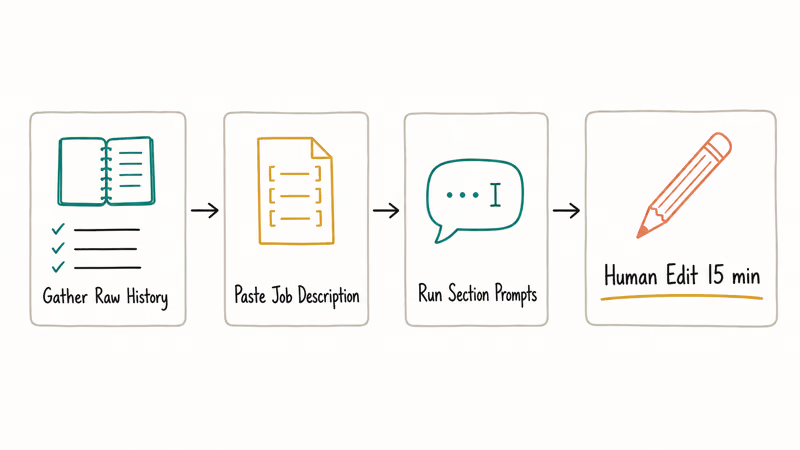
First, gather your raw history in one place. Past titles, dates, employers, two or three sentences of what you actually did, any metrics you remember. This is the part AI can’t generate, because it doesn’t know your career. A messy bullet list in a text file is fine.
Second, give the AI the job description you’re targeting. Copy the whole posting, including the boilerplate at the bottom. The model uses it as a keyword source and as a tone reference.
Third, run section-specific prompts. One for the summary, one for bullet points per role, one for skills, one for keyword extraction. Don’t ask the AI to write your whole resume in one shot. The output goes generic, the metrics drift, and you lose control of length.
Fourth, you edit. This is the part nobody talks about. The AI draft is a starting point, not a finished document. A focused pass in your own voice is the difference between a resume that lands an interview and one that gets filtered on the first read.
#Which AI Tool Works Best for a Resume Draft
Any of the three big chat models will produce a workable first draft. The differences show up at the edges.
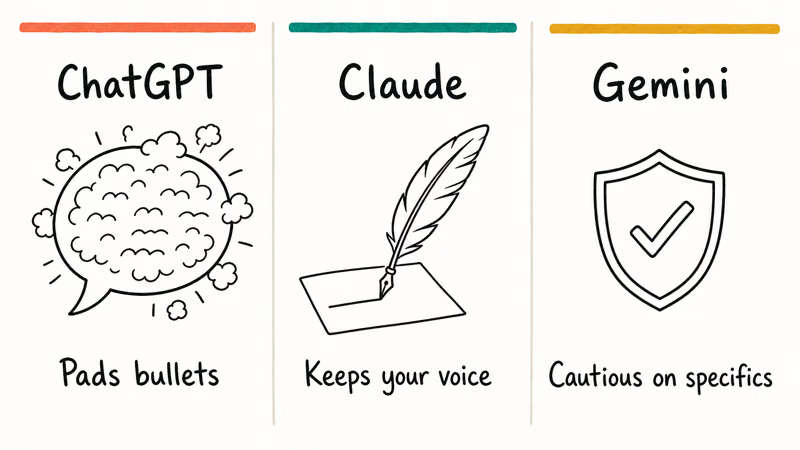
ChatGPT (Free or Plus) is the easiest entry point because most people already have an account. It pads bullets more than the others, so you’ll spend more editing time cutting filler. The Plus tier adds memory and uploaded-file support, which helps if you want to keep your raw history loaded across sessions. For a deeper walkthrough of the workspace feature that holds your files and instructions in one place, see the guide on ChatGPT Projects.
Claude tends to keep your original phrasing more faithfully when you ask it to rewrite bullets, but you still need to check that every metric comes from your own notes.
If you haven’t used it before, the how to use Claude walkthrough covers the basics. According to Anthropic’s product page, Claude is positioned as an assistant for writing, analysis, and coding, which matches what it does well in resume drafting.
Gemini is the most cautious of the three. It refuses to invent specifics, which is good, but it also sometimes refuses to be opinionated about tone.
According to Google’s own Gemini help docs, the assistant is built to be careful with claims it can’t verify. That conservatism shows up in resume drafts.
The honest answer is the model you already pay for is the right one.
#Copy-Paste Prompts for Every Resume Section
These prompts assume you have your raw work history in front of you and the target job description copied. Paste each prompt into a fresh chat, then paste your inputs underneath when the AI asks.
#The Summary Prompt
You are a professional resume writer. I will paste my work history and the
target job description. Write a 3-sentence resume summary that opens with
my current role and years of experience, names two relevant skills from the
job description, and closes with one concrete result I have delivered.

Never invent any metric, title, or date. If a specific number is not in
my input, write the sentence without a number rather than estimate.

My work history:
[paste your raw bullet list]

Target job description:
[paste the full posting]
Two notes. The “never invent” line matters most. Without it, AI rounds 11% up to 15% to make a sentence sound stronger. The 3-sentence cap forces editing.
#The Bullet Point Prompt
Take the role I describe below and rewrite my responsibilities as 4-5
resume bullet points. Each bullet must start with a strong verb, name
a specific tool or process where applicable, and include a metric only if
the metric is in my input. If no metric exists, write a bullet that names
a scope or outcome without faking precision.

Role:
[paste one job: title, employer, dates, what you did]

Target job description (for tone and keyword cues):
[paste]
Run this prompt once per role. Treating each job separately keeps the bullets focused.
#The Skills Section Prompt
Read the job description below and list the 10 most important hard skills
or tools it mentions, ranked by how often or how emphatically they appear.
Then list 5 soft skills the posting implies. Never add skills that are
not in the posting.

Job description:
[paste]
This is the keyword extraction step. Anything in the AI’s top 10 that you legitimately have and your resume doesn’t mention is a gap to close.
#The ATS Keyword Prompt
From the job description below, extract every exact-match keyword phrase
of 2-4 words that a typical ATS parser would scan for. Include exact
spelling, capitalization, and pluralization. Output as a plain list, one
phrase per line, with no commentary.

Job description:
[paste]
You then check whether those exact phrases appear in your resume. If a posting says “stakeholder management” three times, the phrase needs to be in your document verbatim.
Custom instructions save you from re-typing the “no invented metrics” rule in every chat. The ChatGPT custom instructions guide covers how to set a global rule that the model carries into every new conversation.
#How Do You Tailor an AI Resume to a Specific Job?
Tailoring is where AI earns its keep. A general resume is fine for casting a wide net. For any role you actually want, a tailored version gives the posting’s keywords and priorities a clearer place on the page, and AI makes the rewrite less tedious.
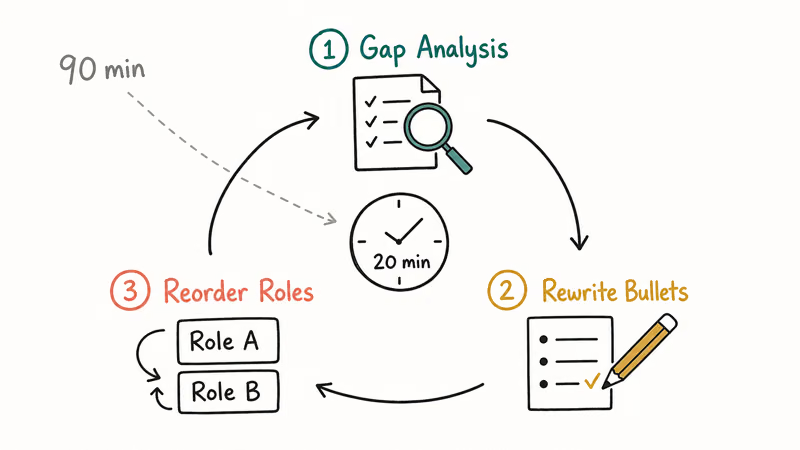
The tailoring workflow has three moves. Start by feeding your generic resume and the target job description into the AI and asking it to identify the gaps:
Compare my current resume to the target job description below.
List three keywords from the JD that should appear in my resume
but are missing, two existing bullets that could be reworded to
better mirror the JD's tone, and any section heading I should
rename for this role. Output as a plain list, no rewriting yet.
My resume:
[paste]
Target job description:
[paste]
Review the AI’s gap analysis. Some suggestions will be useful. Others will push you to add things you don’t actually do.
Cut those. Then go back to the bullet prompt and rewrite the specific bullets the AI flagged, one role at a time.
The third move is reordering. The most relevant role for the posting should be the most prominent. If the job is heavy on data analysis and your most recent role was customer success, you may want a “Relevant Experience” section that surfaces an older analytics role. Ask the AI which 2-3 of your roles best match the JD and order accordingly.
You do this once per application. It feels like a lot the first time, then becomes a repeatable checklist.
#Will an AI-Written Resume Pass ATS Filters?
ATS parsers don’t care who wrote your resume. They care about keywords and format.
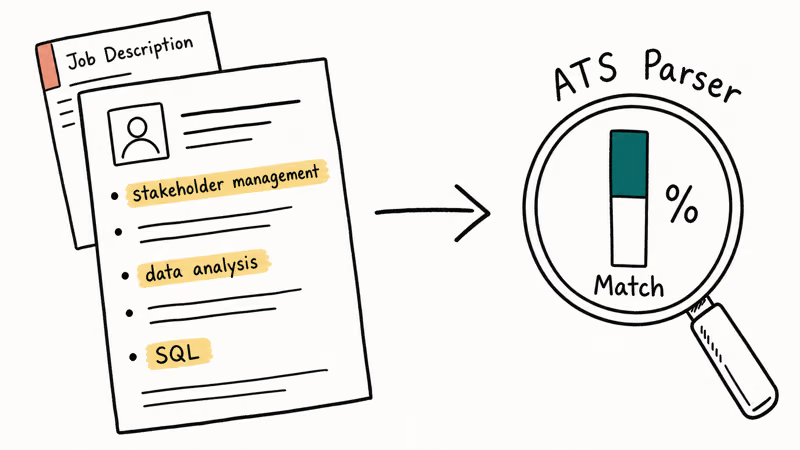
The parsing side is the easier half. Use a single-column layout with standard section headings (Experience, Education, Skills) and a common font, and skip tables, columns, headers, footers, and graphics.
Submit as PDF unless the application form asks for .docx. AI doesn’t affect any of this — format is your responsibility regardless of who drafted the words.
The keyword side is where AI helps. If you ran the ATS keyword prompt and built your skills and bullets to mirror the posting’s phrasing, you’ve already done the work that matters. Most ATS systems look for a percentage match between your document and the posting. Hitting the top-10 keywords cleanly is usually enough to pass the algorithmic filter and reach a human reviewer.
What ATS parsers won’t catch is voice. A bullet that reads “Spearheaded synergistic cross-functional initiatives to optimize stakeholder alignment” passes the keyword check and gets thrown out by the human on the next desk. AI loves that kind of sentence. You have to edit it out.
According to the BLS, more than 300 occupations are tracked in its Occupational Outlook Handbook, each with current employment counts and projected growth rates. It’s a useful sanity check when the AI invents a job title that doesn’t match real industry terminology.
If you’re worried about a detector being run against your resume on the recruiter side, the AI detector benchmarks cover the actual accuracy you should expect. The short version is that no detector is reliable enough to be the deciding factor on a hire. A busy recruiter can still spot AI rhythm quickly. That’s the real filter.
#The Verification Step Most People Skip
The AI draft will look polished. That polish is the trap. Three things tend to be wrong. You have to catch them before the document leaves your laptop.
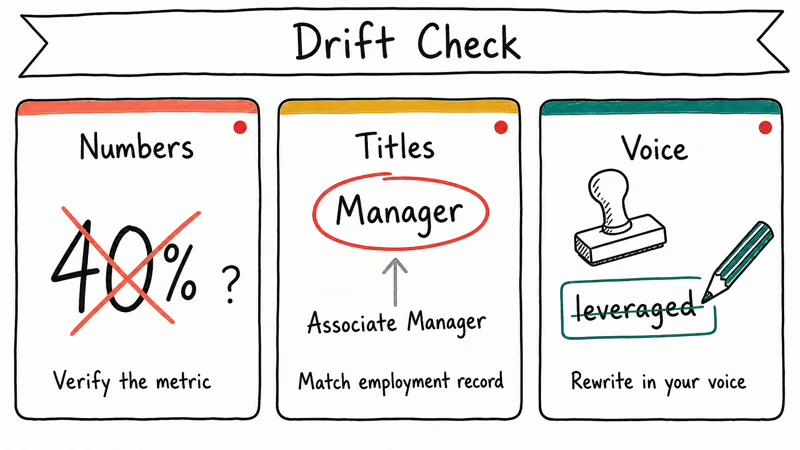
Numbers drift. AI rounds, paraphrases, and sometimes invents. If you told the model you “managed a small team” it may write “led a team of eight”. If your input said “grew newsletter signups” the output might say “grew newsletter signups by 40%”.
You didn’t say 40%. Read every bullet against your actual records and either confirm the number or strip it out. A bullet with a wrong number is a fireable offense at any company that checks references.
Titles drift. AI sometimes promotes you. “Associate Marketing Manager” becomes “Marketing Manager”.
“Senior Engineer II” becomes “Staff Engineer”. That isn’t polish, it’s misrepresentation, so match every title to your actual employment record.
Voice flattens. AI writes in a recognizable cadence: parallel sentence structures, hedged claims, polished but anonymous tone. Recruiters spot it immediately.
Spend a focused pass rewriting bullets in the way you actually talk. Use contractions if your industry allows them, cut filler words like “spearheaded” and “synergized”, and replace generic verbs with specific ones: ran, built, shipped, hired, sold.
For a deeper cleanup pass on AI rhythm, the guide on how to humanize the AI draft covers the specific edits that strip the worst tells. If you also need a formatting reference for the cover letter that goes with this resume, keep it to a one-page structure with an opening line that gets read first.
#Bottom Line
Use AI to draft and to tailor, not to author. Paste your raw work history and the job description into ChatGPT or Claude, then run the section-by-section prompts above.
Spend a focused edit in your own voice and verify every number against your actual records. Skip the workflow entirely for executive roles, security-cleared positions, and creative or design portfolios.
In those contexts the document itself is the test, and AI-flattened prose tells the hiring panel exactly the wrong story. For everyone else, an AI-assisted resume you’ve edited honestly is faster, more keyword-targeted, and at least as strong as the one you’d write on a Sunday night with three browser tabs open.
AI Tools Guide
#Frequently Asked Questions
Can AI write my whole resume from scratch?
It can produce a complete draft from your work history and a target role, but the draft won’t be ready to send without editing.
What is the best ChatGPT prompt for resume bullet points?
Use the bullet-point prompt in the section above. The two constraints that make it work are the “never invent any metric” rule and the explicit 4-5 bullet cap per role. Without those guardrails the output drifts long and fakes precision.
Will an AI-written resume pass ATS filters?
Usually yes. Use a single-column layout with standard section headings, and make sure your skills and bullet wording mirror the keywords in the job description. ATS parsers don’t detect AI authorship.
Is using AI to write my resume considered cheating?
No. AI is a writing tool, the same way a thesaurus or a template is a writing tool. The line is at fabricated facts, not at drafting assistance, so letting AI invent achievements that didn’t happen, inflate titles, or claim metrics you can’t verify is where you cross it.
Which AI is best for resumes, ChatGPT or Claude or Gemini?
The one you already pay for. ChatGPT pads more and needs more editing, Claude keeps your original voice better in rewrites, and Gemini is the most cautious about inventing specifics. Switching tools to save editing time is rarely worth the friction.
How do I tailor an AI resume to a specific job description?
Run the gap-analysis prompt in the tailoring section, then rewrite the bullets the AI flagged. With repetition you’ll have the rhythm down.
Should I tell employers I used AI on my resume?
You don’t need to disclose drafting tools. What you should never do is claim you don’t use AI when the hiring conversation directly asks, especially for roles where AI fluency is part of the job description.
Can recruiters tell when a resume was written by AI?
Detectors aren’t accurate enough to be a hiring decision. The practical answer, though, is that recruiters can spot AI rhythm quickly. Parallel sentence structures, hedged claims, and the same corporate filler in different bullets give it away. A human edit removes the smell.
ChatGPT Conversation History Missing? How to Get It Back
ChatGPT conversation history missing? Fix it fast with these proven steps: check archived chats, re-enable data controls, verify your account, and more.
ChatGPT Voice Mode Not Working? 7 Fixes That Actually Work
Fix ChatGPT Voice Mode fast. Covers mic permissions, app updates, network fixes, account tier checks, and reinstall steps for iOS and Android.
ChatGPT vs Claude vs Gemini: Which AI to Use in 2026
ChatGPT vs Claude vs Gemini compared side-by-side for writing, coding, research, and everyday tasks. Find out which AI to use and when in 2026.
Claude vs ChatGPT for Writing: Which AI Is Better?
Claude wins on tone and long-form coherence. ChatGPT is faster for brainstorming and short copy. A side-by-side comparison for writers in 2026.