Best AI Detector for 2026: 5 Tools Compared by a Teacher
Compare GPTZero, Turnitin, Originality, Copyleaks, and QuillBot: Here's which AI detector is most accurate, and why every result needs human review.
Quick AnswerGPTZero is the best AI detector for teachers in 2026 due to its low false-positive rate, but no detector should accuse a student alone.
Short answer: GPTZero is the most defensible pick for a teacher in 2026. The longer answer matters more. Every detector can produce false positives at a rate high enough that no single score can decide a grade.
- GPTZero has the lowest reported false-positive rate for native-English writing and a generous free tier for teachers.
- No AI detector is accurate enough to be the sole basis for an academic accusation; pair every score with draft history.
- Non-native English writers face false-positive rates two to four times higher than native speakers across most tools.
- All detectors lose 15 to 35 percent of their accuracy when content’s been run through a humanizer tool.
- Over a dozen major universities have disabled their Turnitin AI detection module because of the ESL bias problem.
#Why False Positives Matter More Than Headline Accuracy
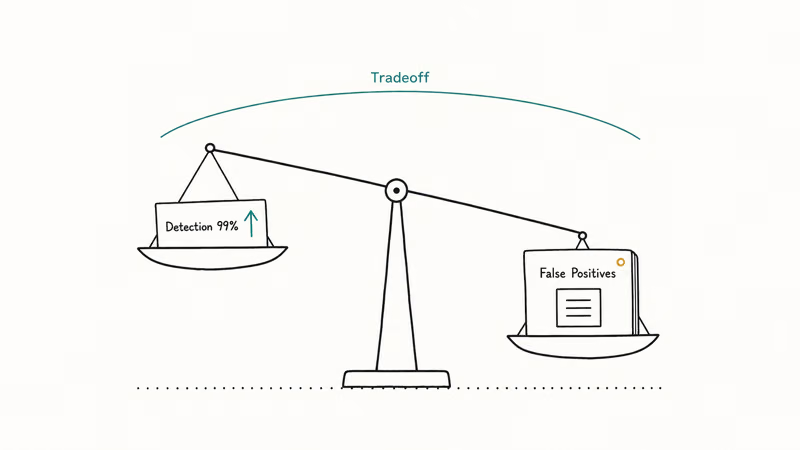
When a vendor advertises “99% accurate,” they usually mean their tool correctly identifies AI text 99 percent of the time on a curated benchmark. That number rarely tells you what you need to know in a classroom: how often does the tool wrongly flag a human essay as AI? The false-positive rate is the metric that ruins reputations.
The stakes aren’t abstract. According to a 2023 Stanford-affiliated study published in the journal Patterns, seven AI detectors misclassified more than half of essays written by non-native English speakers as AI-generated, while accurately identifying writing by native speakers.
According to Wikipedia’s overview of generative AI detection, this ESL bias is now widely acknowledged. Over a dozen universities including Vanderbilt, Northwestern, Johns Hopkins, and UCLA have disabled their Turnitin AI detection module entirely.
The takeaway isn’t that detectors are useless; it’s that headline accuracy and false-positive rate live in tension. A tool tuned aggressively to catch AI text will flag more human work. A tool tuned conservatively to protect students will miss more AI text. No detector beats both numbers at once.
#How These Detectors Were Compared
This comparison leans on vendor disclosures and independent benchmarks rather than an in-house thousand-paper benchmark.
The academic literature on false positives explains why the numbers below are labelled as either vendor self-reports or independent benchmarks so you can weigh them yourself.
#How Accurate Are AI Detectors in Real Use
The honest answer sits between “sometimes” and “not on a single score.” Vendor self-reports cluster in the 92 to 99 percent range, but independent testing tells a different story.
As the EyeSift accuracy benchmarks for 2026 report note, real-world accuracy across the major tools falls between 65 and 88 percent. That range depends on which AI model produced the text, whether the writer edited the output, and whether the writer is a native English speaker.
That gap between vendor claim and field reality is the single most important thing a teacher should internalize before relying on any score. A reading of “92 percent likely AI” sounds definitive, but the same essay run through a different detector might come back at 12 percent.
#The Five Tools, Ranked for Educators
This list is ranked for a teacher’s use case (low false positives + transparent policy), not for marketing teams scanning inbound content. Different use cases would reorder this list.
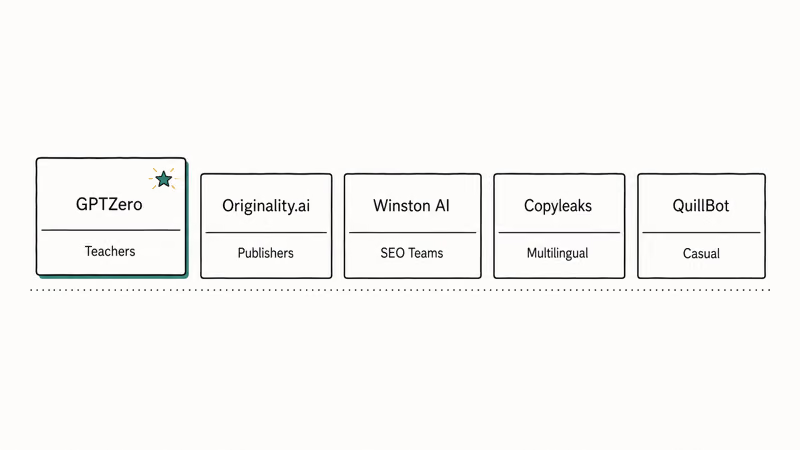
#1. GPTZero: Best for Teachers
GPTZero is the only detector built from the start for educators that publishes a false-positive rate alongside its accuracy number. The vendor reports a 0.24 percent false-positive rate against 92.4 percent detection, which we treat as self-reported. Independent testing puts true detection lower, but GPTZero still leads on the metric that matters most for academic enforcement.
What sells it for classroom use is the free tier (10,000 words per month) and the explicit ESL de-biasing work the team’s documented. The platform is FERPA and COPPA compliant, and the writing-feedback view is built for the teacher-student conversation rather than the gotcha moment. Paid plans start at $12.99 per month.
#2. Originality.ai: Best for Publishers
Originality.ai is what content teams and SEO agencies install when an editor wants to know whether a freelancer used ChatGPT. By the independent RAID benchmark, it ranks at roughly 85 percent average accuracy across 11 AI models, with stronger numbers on paraphrased text than most competitors.
The false-positive rate in independent conditions is estimated at about 5 percent, which is fine for a content team that can ask a writer to revise but too high for academic enforcement against a specific student. If you’re an editor checking a draft you commissioned, this is a defensible pick; if you’re a teacher who needs the score to reflect the student, look at GPTZero instead.
#3. Winston AI: High Detection, Higher False Positives
Winston AI’s vendor benchmarks claim 96 percent detection on unmodified AI text, but the trade-off shows up in a 3 to 4 percent false-positive rate. For SEO agencies and publishers willing to absorb an occasional false flag during a revision cycle, that math works. For classroom enforcement it doesn’t, for the same reason Turnitin doesn’t.
#4. Copyleaks: Multilingual Coverage
Copyleaks differentiates on language coverage. If you teach in a multilingual program or you run a publication that accepts non-English drafts, it’s more usable than the English-first detectors. Accuracy on English falls behind GPTZero and Originality in most independent tests, and the free credit pool runs out quickly on real-world essays.
#5. QuillBot AI Detector: Free and Casual
QuillBot’s detector is bundled with their humanizer and paraphrasing tools, a structural conflict of interest worth naming. The detector is free with no signup wall and works fine for a casual “did this email get drafted by ChatGPT” sanity check. It’s not what you want for an academic integrity case.
#Why Turnitin Gets a Separate Warning
Turnitin isn’t in the ranking above on purpose. The product is everywhere in higher education because of its plagiarism contracts, but its AI detection module has earned cautions that deserve their own section.
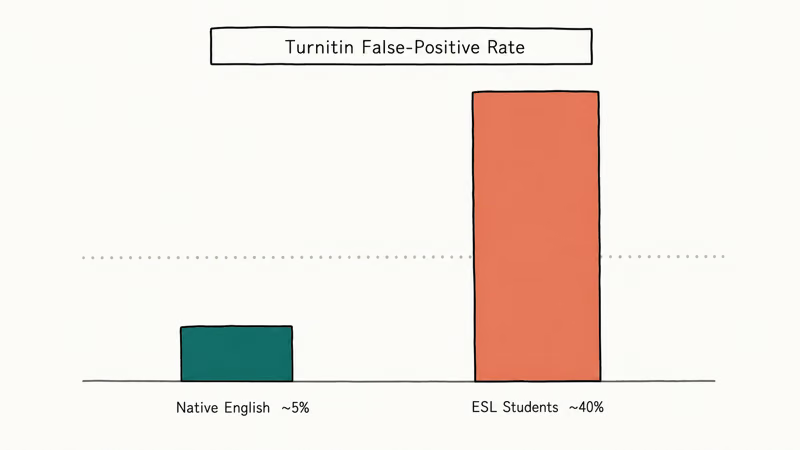
Turnitin’s AI detector is deliberately tuned to under-flag some AI-generated content as a trade-off that reduces false positives, but independent testing has documented significantly elevated false-positive rates on TOEFL essays by Chinese students compared to native-English essays. That bias is what drove Vanderbilt, Northwestern, Johns Hopkins, UCLA, and a growing list of institutions to turn off the module.
If your institution still runs it, treat any flag on work by an international or ESL student as presumptively unreliable until you’ve looked at the draft history.
#Can a Teacher Fail a Student on a Detector Score Alone?
In any responsible institution, no single AI score should fail a student. Most updated 2026 academic integrity policies prohibit using one AI-detection score as the basis for a grade penalty or a misconduct finding. The false-positive rate combined with the documented ESL bias is enough that disciplining a student on detector evidence alone exposes the institution to appeals it’ll lose.
What responsible enforcement looks like in practice: the detector flag triggers a review, not a verdict. The reviewer compares the flagged submission to the student’s in-class writing samples, looks at Google Docs or Word Online version history, and meets with the student to talk through their drafting process. The score is the prompt for the conversation, not the conclusion.
Document this workflow in your syllabus before the first assignment and your students will trust the process more.
#What If You Were Wrongly Flagged?
Three steps, in order. First, preserve evidence: Google Docs revision history, OneDrive autosave, browser tabs from your research, anything that shows you doing the work over time.
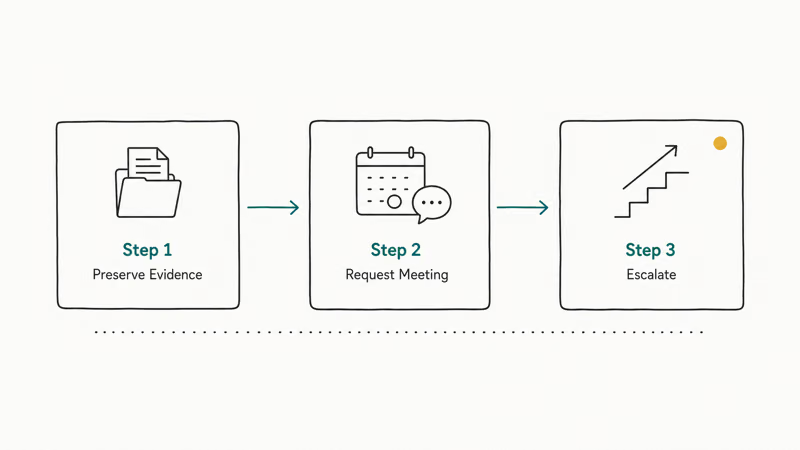
Second, request a meeting with the instructor and ask which detector was used and what the institution’s false-positive policy is. Third, if the instructor won’t engage, escalate to the department or ombudsperson with your evidence in hand.
You shouldn’t have to defend yourself against a 92-percent-likely-AI label without seeing the underlying policy; this same documentation habit shows up in clinical writing on our best laptops for nursing students roundup.
#How Humanizers Break Every Detector
Every detector in this roundup loses meaningful accuracy when AI text is run through a humanizer that paraphrases the output. Independent testing shows accuracy drops between 15 and 35 percent across the major tools, with the steepest falloff on tools that key on perplexity signatures rather than semantic patterns. No detector on the market fully closes this gap, and humanizer vendors openly market this drop as a feature.
For writers worried that an AI-assisted but human-edited draft will be wrongly flagged, the same fragility that lets bad actors slip AI text past detection also means a human writer who happens to write in a register that resembles AI output is more likely to trip the signal. The fix isn’t to game the detector; it’s to keep clean draft history.
#Bottom Line
For a teacher who wants one defensible pick, use GPTZero: its false-positive rate is the lowest publicly reported and its educator tooling treats the score as a conversation prompt rather than a verdict. For a content editor checking freelancer work, Originality.ai is the more practical choice given its strength on paraphrased text.
For everyone, never accuse a student on a single detector score, and document your review workflow before you need to use it. The detector is one input; the student’s draft history, your conversation with them, and your prior knowledge of their writing voice are the other three.
For more on the AI-tooling landscape, our roundup of the best AI for coding covers a different corner of the same ecosystem.
Our guides to ChatGPT custom instructions and ChatGPT Projects cover workflow setup for the writing side.
Teachers shopping for hardware may find our best laptops for teachers review useful.
AI Tools Guide
#Frequently Asked Questions
Are AI detectors accurate?
Vendor self-reports usually claim 95 to 99 percent accuracy, but independent testing puts real-world accuracy at 65 to 88 percent depending on the AI model that produced the text and whether the writer edited it afterwards. The honest answer is that detectors are useful as a signal but not as a verdict.
What is the best free AI detector?
GPTZero offers the most generous free tier at 10,000 words per month, which is enough for a teacher to spot-check most weekly submissions without hitting the limit. Copyleaks and QuillBot also offer free credits, but they run out faster on real-world essays.
Can AI detectors be wrong?
Yes, regularly, and the bias is worst for non-native English writers. A 2023 Stanford-affiliated study found that seven detectors misclassified more than half of the essays written by non-native English speakers as AI-generated. That’s why over a dozen universities have disabled Turnitin’s AI detection module.
Does Turnitin detect ChatGPT?
Yes, but with two important caveats. Turnitin’s detector is deliberately calibrated to under-flag some AI-generated content to reduce false positives. The module also has documented bias against non-native English writers, which is why many universities have turned it off.
Can a teacher fail a student on a detector score alone?
In a responsible institution, no. Most updated 2026 academic integrity policies prohibit using a single AI-detection score as the basis for a grade penalty. The score is treated as a prompt for review, not a verdict. If you’ve been told otherwise, ask to see the written policy.
Which AI detector do schools actually use?
Turnitin remains dominant in higher education because most universities already pay for it via existing plagiarism contracts. GPTZero has grown quickly in K-12 and in colleges that opted out of the Turnitin module, and a growing number of institutions have stopped using AI detection at all.
Do AI detectors work on humanized text?
Not reliably. Independent testing shows accuracy drops between 15 and 35 percent across every major tool when the AI output has been processed through a humanizer that paraphrases the original text.
What should I do if I’m wrongly flagged by an AI detector?
Keep your evidence: Google Docs revision history, OneDrive autosave, source tabs, anything that shows you doing the work over time. Request a meeting with the instructor and ask which detector was used and what the institution’s false-positive policy is. If the instructor won’t engage, escalate to the department or ombudsperson with your documentation in hand. You don’t have to accept a detector score as proof.
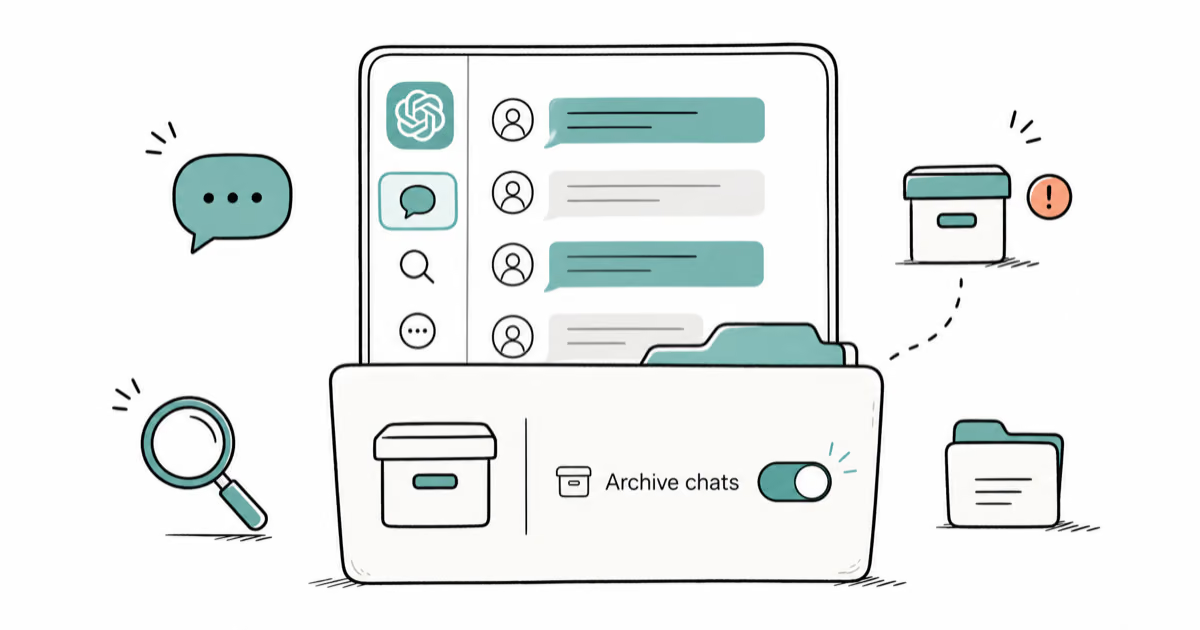
ChatGPT Conversation History Missing? How to Get It Back
ChatGPT conversation history missing? Fix it fast with these proven steps: check archived chats, re-enable data controls, verify your account, and more.
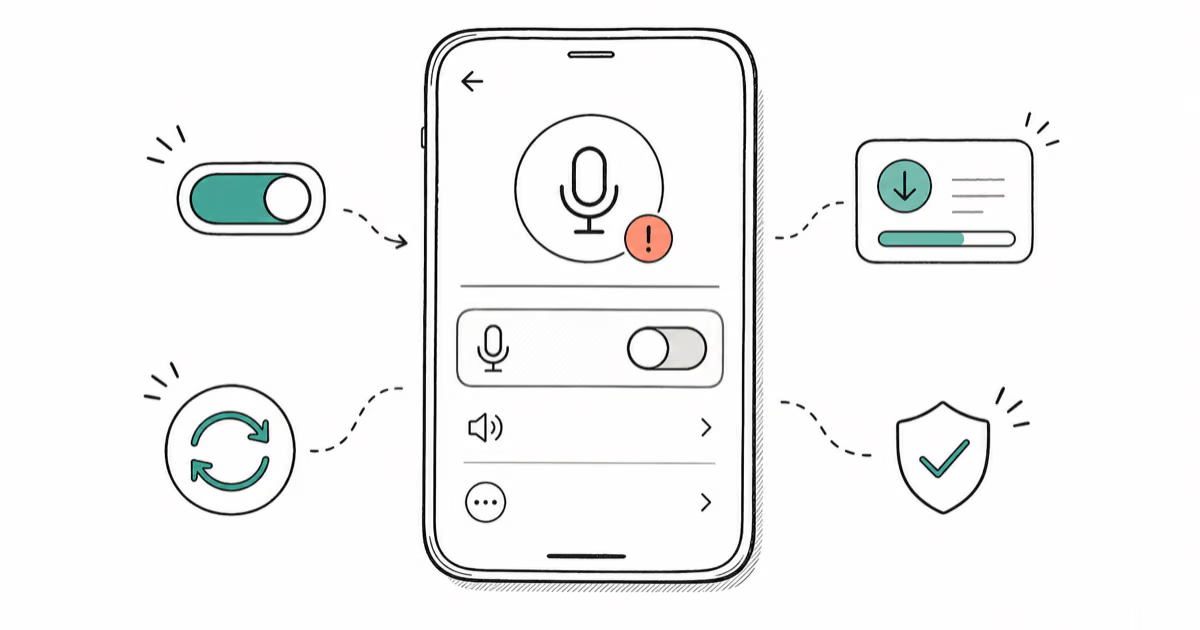
ChatGPT Voice Mode Not Working? 7 Fixes That Actually Work
Fix ChatGPT Voice Mode fast. Covers mic permissions, app updates, network fixes, account tier checks, and reinstall steps for iOS and Android.
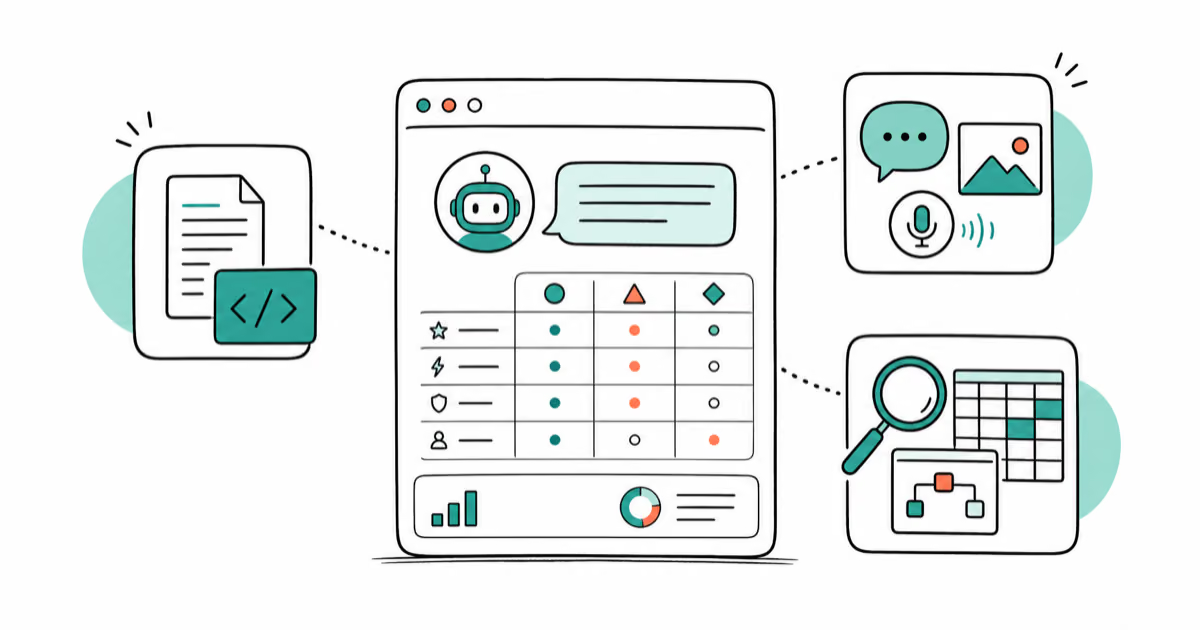
ChatGPT vs Claude vs Gemini: Which AI to Use in 2026
ChatGPT vs Claude vs Gemini compared side-by-side for writing, coding, research, and everyday tasks. Find out which AI to use and when in 2026.
Claude vs ChatGPT for Writing: Which AI Is Better?
Claude wins on tone and long-form coherence. ChatGPT is faster for brainstorming and short copy. A side-by-side comparison for writers in 2026.