Free Msg Unable to Send Message: How to Fix SMS Blocking
Fix the "Free msg: unable to send message" error on Android and iPhone with carrier account, network reset, and device steps that actually work.
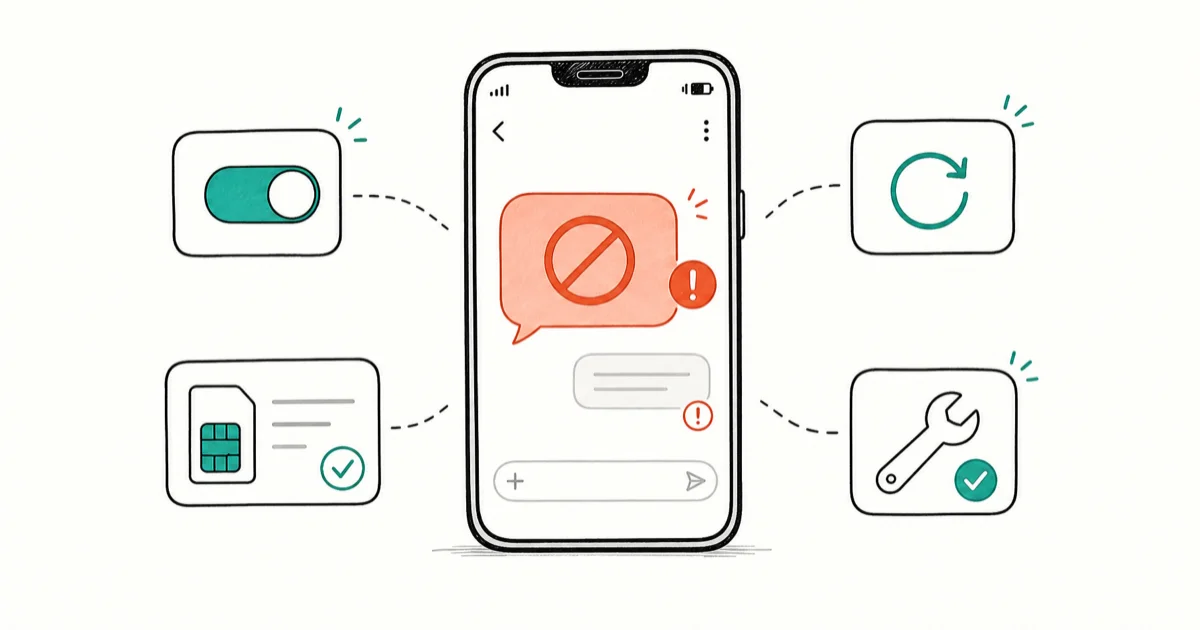
Quick AnswerMessage blocking is almost always a carrier-side setting. Sign in to your carrier account to turn off message blocking, clear any past-due balance, reset network settings on your phone, then try sending again.
The “Free msg: unable to send message” error interrupts outgoing texts on both Android and iPhone, and it’s almost never a phone hardware problem. The error behaves the same way across Samsung Galaxy and iPhone hardware on the major US carriers, and the fix path is the same on both platforms because the block sits on the carrier side, not the phone.
This guide applies only to a device or account you own.
-
Message blocking is a carrier setting, not a phone setting.
-
Past-due balances, paused lines, and fraud-alert holds all generate the identical “Free msg: unable to send message” bounce text, so the quickest diagnosis is the account portal, not the Settings app, because the phone has no visible indicator when the line is held upstream.
-
Short code messaging (banks, two-factor codes, delivery alerts) is filtered separately from person-to-person SMS on most carriers.
-
Resetting network settings on Android clears Wi-Fi and Bluetooth pairings, and on iPhone the same reset wipes saved Wi-Fi passwords, so have those handy before you reset.
-
On prepaid or reseller brands (Mint, Metro, Cricket, Visible, US Mobile), the owning network (T-Mobile, AT&T, or Verizon) still controls the block and the reseller’s app may not expose the toggle at all.
#What Does the “Free Msg: Unable to Send Message” Error Actually Mean?
The message is a courtesy notification from your own carrier, sent back to you as SMS, telling you it refused to deliver your outbound text. The word “Free” signals that the carrier isn’t charging for this alert, so it’s not a premium SMS deduction.
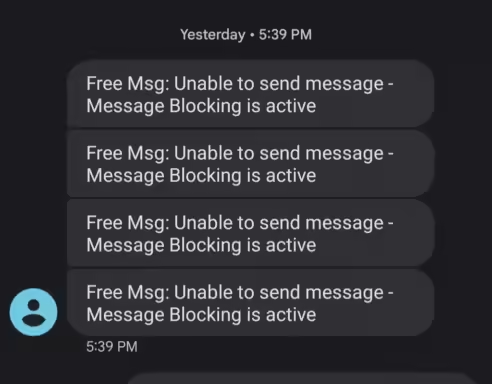
According to T-Mobile’s Message Blocking support article, the page states that 5 reply keywords (STOP, END, CANCEL, UNSUBSCRIBE, and QUIT) are documented as official opt-out keywords for commercial senders, and the Message Blocking feature lets the primary account holder turn off SMS, MMS, and short code traffic from the T-Mobile account portal or T-Life app. When that feature is on, any outbound text from the blocked line gets bounced with this exact error.
Three triggers produce the same bounce message.
The first is an account-level block your carrier placed, usually because of a past-due balance or a manual setting change on a line. The second is a plan that doesn’t include SMS for the destination, which shows up often on prepaid and international texting. The third is a short code that your carrier has filtered, which affects two-factor codes and delivery alerts but leaves person-to-person SMS untouched.
The carrier account portal is usually the only place where the full block state is visible. The Messages app on iPhone and Google Messages on Android both look perfectly normal, with no visible toggle for the account-level block.
A damaged SIM or a wrong APN can also cause silent SMS failure, but those usually produce a different error or no error at all.
#Common Causes of Message Blocking
Carriers turn message blocking on for three main reasons: overdue balances, plan restrictions, and fraud or spam filters.
#Past-Due Balances and Suspended Lines
A past-due balance is the most common trigger on both prepaid and postpaid accounts. Most carriers keep voice service live during a short grace period but cut SMS first, which explains why calls still work while texts bounce. Some budget brands cut SMS on the same day the bill is due, with no grace period at all, so even a short payment delay produces the error.
#Plan Restrictions on Prepaid and Budget Brands
Prepaid and budget brands don’t always include short codes, picture messaging, or international SMS by default. Texting a bank’s two-factor code line can fail on a prepaid line even when person-to-person SMS works fine.
#Fraud and Spam Filters
Fraud filters flag high volumes of outgoing SMS from a single line. If you recently used a third-party texting app, sent a bulk group text, or fell victim to a port-out attempt, your carrier may apply a temporary block until you call in and verify the activity.
#Recipient-Side Blocks
Recipient-side blocks also produce this error on some carriers. If you suspect a contact blocked your number, our guide on how to unblock yourself from WhatsApp covers what the signs look like across messaging apps.
#How Do You Fix the Error on Android and iPhone?
Work through these in order. Roughly half the fixes land at the account step before you even get to device settings, so resist the urge to start with a factory reset.
#Step 1: Check the Recipient Isn’t Blocked
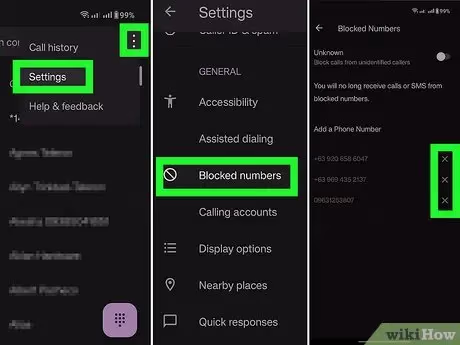
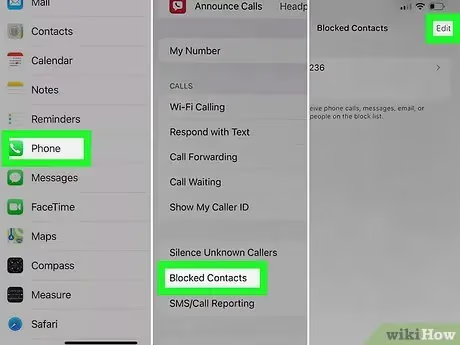
An accidental block on your end produces the identical bounce. Go to your phone’s block list first, because this takes 10 seconds and it resolves many cases before they even reach the carrier stage, especially when the texting pattern started failing after a recent fat-finger on a group thread.
On Android, open the Phone app, tap the three-dot menu, go to Settings > Blocked numbers, and remove the recipient’s number if it appears there. On iPhone, open Settings > Phone > Blocked Contacts and swipe left to unblock any number.
#Step 2: Sign Into Your Carrier Account
This fixes the majority of cases.
Open your carrier app or go to the carrier’s website on a browser, look for messaging or blocking settings, turn off message blocking for the affected line, and check the balance tab to pay any past-due amount. Path varies by carrier, see the next section for the exact menu structure.
#Step 3: Toggle Airplane Mode
Quick cellular refresh.
Swipe into the Control Center (iPhone) or Quick Settings (Android), turn Airplane mode on for 20 seconds, turn it off, and wait for signal bars to return. Once a carrier-side account block has been cleared, this toggle forces the phone to re-register on the network so a previously bounced text can go through.
#Step 4: Reset Network Settings
If the error persists, reset the phone’s saved network state.
On Android (Samsung example), go to Settings > General management > Reset > Reset network settings and confirm. On iPhone, go to Settings > General > Transfer or Reset iPhone > Reset > Reset Network Settings.
This step wipes saved Wi-Fi passwords and Bluetooth pairings, so reconnect those after the phone reboots.
#Step 5: Update Carrier Settings
Carrier settings push silently most of the time, but a manual check forces it. On iPhone, go to Settings > General > About, and if an update is available a prompt appears within 10 seconds. Android phones receive carrier settings through system updates, so go to Settings > System > System update to pull the latest.
#Step 6: Test in a Different Messaging App
Rule out the default app. Google Messages and Apple Messages are the baseline tests. A third-party SMS app working while the default app fails points to an app-side problem, not a carrier-side one. Short.
For related troubleshooting, see our guide on fixing iPhone text messages out of order and the companion piece on iMessage not showing delivered.
#Carrier-Specific Steps
The path to the message blocking toggle differs by carrier. Each section below shows the exact menu path and the support page worth bookmarking.
#T-Mobile
T-Mobile’s documentation states that Message Blocking can be enabled or disabled by the primary account holder through the T-Mobile.com web portal or the T-Life app. Call 611 from your T-Mobile line if the toggle isn’t visible under your account. Sign in to T-Mobile.com, go to Account > Profile > Line permissions, find Message Blocking, set it to off, and wait up to 10 minutes for the change to propagate before you resend.
#Verizon
According to Verizon’s Texting FAQs page, SMS on Verizon Wireless is capped at 160 characters per message, EMS extends to 1000 characters, and MMS covers multimedia traffic including picture and video messaging. The page also recommends checking block settings first when messages won’t send. Sign in to your My Verizon account, go to Services & Perks > Block Services, confirm no active blocks apply to text messaging, save, and wait for propagation before resending.
#AT&T
AT&T customers manage message blocking through the myAT&T app or website. Sign in, open My Wireless, tap Manage features on the affected line, tap Blocking options, and disable any active message blocks. Save the change and wait a few minutes before you retry sending.
#Prepaid and Reseller Brands
Mint Mobile, Metro by T-Mobile, Cricket, Visible, and US Mobile run on the big three networks. If your prepaid app doesn’t show a messaging block toggle, call the reseller’s support line and ask them to escalate to the host carrier.
On Mint and Metro, the host carrier is T-Mobile. On Cricket, it’s AT&T. Visible sits on Verizon.
The reseller’s support staff can often see the block but can’t clear it without a host-side ticket, which is why escalation matters.
#Device-Side Fixes That Actually Help
After the carrier steps above, a narrow set of phone-side fixes can clear edge cases. Treat this list as a second-pass checklist, not a replacement for the carrier portal work.
#Check for Cellular Data Issues
If cellular data is broken, SMS often still works because voice and SMS ride a different channel on legacy 2G and 3G carriers. Modern carriers route SMS over data (VoLTE SMS), so a data outage can block both on those accounts. Our guide on cellular data not working covers the diagnostic path.
#Rule Out a SIM Problem
Try a SIM reseat first.
A cracked or loose SIM triggers intermittent SMS failure. Pull the SIM, clean the contacts with a dry microfiber cloth, and reseat it. If your phone is eSIM-only (recent iPhone models in the US), skip this step because there’s no physical card to reseat.
#Clear the Messaging App Cache (Android Only)
Stale cache.
On Android, the Messages app cache can hold outdated carrier configuration. Go to Settings > Apps > Messages > Storage, tap Clear cache, and restart the phone. iOS doesn’t expose per-app cache clearing, so offloading Messages via Settings > General > iPhone Storage > Messages > Offload App is the closest equivalent and preserves conversation history.
#Check Wi-Fi Calling Settings
Wi-Fi Calling uses your carrier’s IMS infrastructure. On some accounts a billing block can prevent outgoing SMS over Wi-Fi while cellular SMS still works. On iPhone, go to Settings > Phone > Wi-Fi Calling and toggle off to test. On Android, go to Settings > Connections > Wi-Fi Calling and toggle off (path varies by manufacturer).
#Verify Date and Time Are Automatic
Network authentication depends on accurate device time. Go to Settings > General > Date & Time on iPhone or Settings > General management > Date and time on Android, and turn on Set Automatically.
#Short Codes and Two-Factor Authentication Issues
Short codes are the 5 or 6 digit numbers used by banks, delivery services, and two-factor authentication. They’re filtered separately from regular SMS, and a partial block is a common cause of “I can text my friends but not my bank.”
Google’s Messages troubleshooting article recommends confirming that your carrier supports SMS, MMS, or RCS on your plan, checking your plan or credit balance, and verifying that the recipient phone number includes the country code such as +1 for US numbers. That guidance applies directly to short codes, which prepaid plans sometimes exclude by default.
Ask the rep directly.
Call your carrier and say: “Is short code messaging enabled on my line?” The answer is yes or no, and if it’s no the rep can flip it in the system. Don’t skip this question, because a generic “is blocking off?” often misses the short code flag.
If you rely on two-factor codes for banking, keep an authenticator app as a backup. For iMessage and FaceTime network port requirements, Apple’s iMessage ports support article lists the exact ports (80, 443, and 5223) that Apple’s messaging services need through firewalls, which matters mainly if you’re on corporate Wi-Fi during troubleshooting.
#Preventing This From Happening Again
Three habits keep the error from coming back, and none of them take more than a few minutes to set up the first time.
Set up autopay. Payment lapses trace back to the majority of message blocking cases. Removing manual billing from your mental checklist removes the single most common trigger.
Watch plan limits. Prepaid plans cap monthly SMS.
Track port-out alerts. Carriers flag ports to slow fraud, which looks identical to a message block until you call in. Don’t ignore unexpected fraud-team texts, because that’s often the upstream signal that an account freeze is imminent even if SMS still works at that moment.
For more delivery troubleshooting across messaging platforms, see our guides on Facebook Messenger sent but not delivered and iPhone messages keep indexing.
#Bottom Line
Start every fix in your carrier account, not in the phone’s Settings app. Message blocking is a carrier-side switch in most real cases, and the account portal is where you actually see whether the switch is on or off.
If the account looks clean, an Airplane mode toggle plus a network settings reset clears most of the remaining device-side causes on both Samsung Galaxy and iPhone.
If short codes specifically are affected, call the carrier and ask them to verify short code messaging is enabled on your line, because a generic blocking check often misses that flag.
#Frequently Asked Questions
Can message blocking be turned on accidentally?
Yes.
Line permission changes on a shared family account, plan downgrades during billing cycles, and automated fraud flags triggered by unusual SMS volume can all activate a block without any customer-facing notification on the affected line. The primary account holder might not even know until a secondary line reports that texts are bouncing. Always log into the carrier portal first instead of assuming the phone is broken.
Will clearing the Messages app data delete my texts?
Clearing the cache on Android only removes temporary data, so your conversation history stays intact. Clearing app data on Android is a different action and will wipe stored SMS, so back up first via Samsung Messages export or Google Messages export before you go that route. iOS doesn’t expose per-app cache clearing at all, so this distinction only matters on Android.
How do I know if the recipient blocked my number?
No absolute signal exists, but the pattern is consistent. Texts always show as sent but never delivered. Calls route to voicemail on the first ring. The person’s profile photo disappears in some apps.
Does a VPN interfere with SMS?
Usually no. SMS rides the cellular voice channel on most carriers, so a VPN on the phone’s data connection leaves it alone. VoLTE SMS is the exception because it rides cellular data.
Can I still send messages while the block is active?
Not over regular SMS. Data-based apps like WhatsApp, iMessage, Signal, Telegram, and Facebook Messenger keep working because they use your internet connection instead of the cellular SMS channel, so they bypass the carrier block entirely. Use those for important messages until the carrier-side fix lands.
Could a damaged SIM trigger this error?
Yes. A cracked, dirty, or loose physical SIM can cause intermittent SMS failure that looks like message blocking. Reseat the card, clean the contacts gently with a dry microfiber cloth if needed, and if the error follows the SIM to a second phone, request a replacement from the carrier (eSIM-only phones skip this step).
Why do some SMS work but short codes fail?
Short codes (5 and 6 digit numbers) are filtered on a separate lane from person-to-person SMS. Prepaid plans exclude short codes by default.
Pixel 11 vs Pixel 10: What Changed and Who Should Upgrade
Pixel 11 vs Pixel 10: same screen and camera resolution, new Tensor G6, 25W wireless, and Gemini Intelligence. Here is who should actually upgrade.

Verizon Not Receiving Texts? How to Fix It in 9 Steps
Verizon not receiving texts? Fix it in 9 steps: check Message Blocking in My Verizon, reset network settings, deregister iMessage, and call support.
Pixel Battery Drain: What Google's July Fix Really Covers
Google marked the Pixel idle battery drain bug fixed in July, but only some phones got the patch. Here is who is covered, who is not, and what to try.
iPhone Stuck on EDGE? How to Get 5G or LTE Back (2026)
iPhone stuck on EDGE with crawling data? Here's why the E icon appears, which settings force 5G or LTE back, and when the problem is your carrier.