Fix Visual Voicemail Currently Unavailable on iPhone
This guide compares nine ways to fix the "Visual Voicemail is currently unavailable" error on iPhone, from Airplane Mode to carrier re-provisioning.
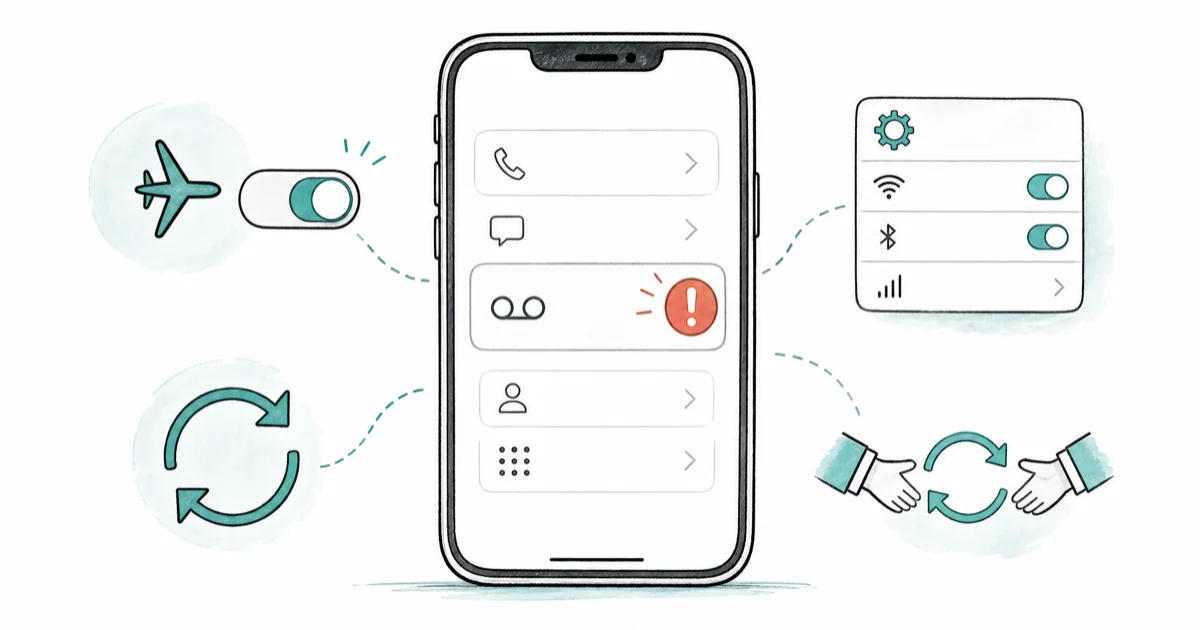
Quick AnswerToggle Airplane Mode, then go to Settings > General > Transfer or Reset iPhone > Reset > Reset Network Settings, wait 60 seconds for the carrier handshake, and open Phone > Voicemail again. If the error persists, call your carrier to re-provision Visual Voicemail on the line.
The “Visual Voicemail is currently unavailable” error on iPhone almost always points to a carrier provisioning mismatch, not a broken handset. The Phone app’s Voicemail tab depends on a live IMAP session to your carrier’s voicemail server, so anything that breaks the cellular handshake, VoLTE registration, or MMSC settings trips the banner.
Before changing these settings, use the steps only on your own device, computer, or account, or with explicit permission from the owner. Unauthorized access can violate law, privacy rights, and platform terms, so don’t use this guide to bypass someone else’s controls. When available, start with the official support option, built-in settings menu, or vendor documentation before trying manual fixes, especially if the device or account belongs to work, school, or another person.
The recovery path usually starts with refreshing cellular registration, then moves to carrier provisioning if the Phone app still can’t sync.
- Toggling Airplane Mode forces the iPhone to redo the VoLTE and voicemail registration
- Reset Network Settings wipes saved Wi-Fi passwords, VPN profiles, and APN entries
- Visual Voicemail is a per-line carrier feature, not an iOS toggle on the device
- Verizon, AT&T, and T-Mobile all include Visual Voicemail on standard postpaid iPhone plans
- Tenorshare ReiBoot reinstalls iOS firmware without erasing data when CommCenter is corrupt
#What Does “Visual Voicemail Is Currently Unavailable” Actually Mean?
The banner appears when the Phone app tries to sync your voicemail inbox over the carrier’s data channel and the request times out. Unlike traditional voicemail, which you dial into, Visual Voicemail uses an IMAP push from the carrier’s MMSC (Multimedia Message Service Center).
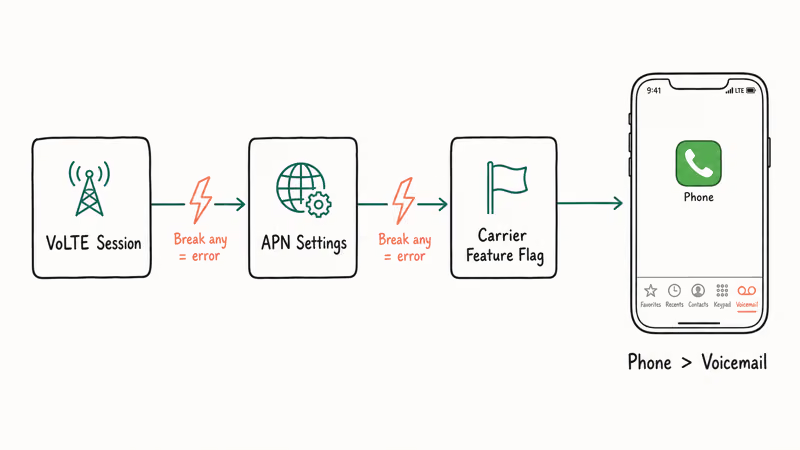
Three things must line up.
The iPhone needs a registered VoLTE session, it needs correct APN settings for the carrier it’s on right now, and the line itself needs a feature flag at the carrier that says “this number is entitled to Visual Voicemail.” Break any of those three and the Phone app throws the banner immediately.
The common failure paths are stale VoLTE registration after roaming or a SIM swap, plus carrier-side provisioning where the line has lost the Visual Voicemail flag.
Start with Airplane Mode plus a restart because those steps refresh the phone-side registration without changing account settings.
#Fix 1: Toggle Airplane Mode and Restart the IMS Session
This is the fastest fix and it works more often than most people expect, because it forces a fresh VoLTE handshake in under a minute.
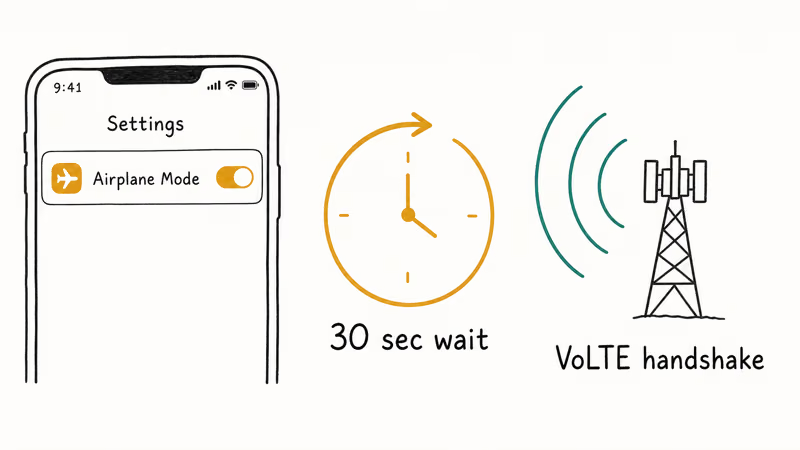
Step 1. Open Settings on your iPhone.
Step 2. Tap the Airplane Mode toggle so it turns green.
Step 3. Wait 30 seconds, then toggle it off. Let the carrier name reappear in the status bar before you test.
Step 4. Open Phone > Voicemail. If the inbox loads, you’re done.
If one Airplane Mode pass doesn’t work after roaming or a SIM change, try a second pass after the carrier name reappears.
#Fix 2: Reset Network Settings to Rebuild APN and VPN Profiles
If Airplane Mode didn’t move the needle, the next layer is your saved network settings. VPN profiles, manual APN entries, and saved Wi-Fi credentials are the most common culprits.
Step 1. Open Settings, then tap General.
Step 2. Scroll to Transfer or Reset iPhone, then tap Reset.
Step 3. Choose Reset Network Settings and enter your passcode. Confirm the action.
Step 4. Your iPhone reboots in about 30 seconds. Wait for the carrier signal to return, then open Phone > Voicemail.
This wipes every Wi-Fi password on the device, so keep your home Wi-Fi credentials handy. If you use a corporate VPN through a configuration profile, you’ll need to reinstall it afterward. For a broader look at the side effects of this reset, our guide on the iPhone incorrect Wi-Fi password error walks through what Reset Network Settings changes and how to restore saved networks quickly.
#Carrier Provisioning Checks for Verizon, AT&T, and T-Mobile
Visual Voicemail is a feature flag attached to your line. The iPhone is just the client. Each of the big three US carriers handles the flag slightly differently, and the fix sometimes lives entirely on the carrier side rather than on the device, which is why the next three subsections matter before you reach for software tools.
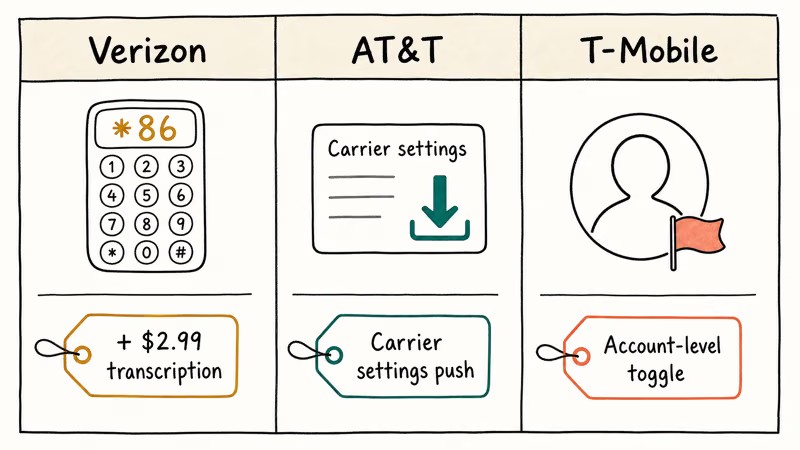
Verizon. Basic Visual Voicemail is included with postpaid iPhone plans. According to Verizon’s Visual Voicemail FAQ, Voicemail-to-Text costs $2.99 per line per month, and ported lines sometimes drop the basic flag and need re-enabling by dialing *86 or calling *611.
AT&T. AT&T pushes Visual Voicemail through a carrier settings update rather than a server flag, so if the iPhone hasn’t pulled carrier settings since you joined AT&T the feature stays unavailable.
T-Mobile. T-Mobile requires Visual Voicemail enabled at the account level, and Sprint-legacy lines occasionally lost the flag after the merger and had to be re-added through T-Mobile support.
If none of the software steps work, the carrier path is usually the shortest. Call from a second phone. That way you keep the iPhone free for testing while the support agent walks through the provisioning steps on their side and asks you to toggle Airplane Mode or restart.
#Fix 3: Update Carrier Settings Through Settings > General > About
Carrier settings are tiny configuration files that Apple and carriers push independently of iOS updates. They control VoLTE, APN endpoints, voicemail server addresses, and the Visual Voicemail feature flag itself.
Step 1. Make sure the iPhone is on Wi-Fi. Carrier settings pull over Wi-Fi in the background.
Step 2. Go to Settings > General > About and stay on this screen for at least 30 seconds so the carrier update check has time to pull the latest configuration from the carrier’s server in the background.
Step 3. If a carrier update is available, a popup appears asking you to install it. Tap Update.
Step 4. After the update, toggle Airplane Mode once, then test Voicemail again.
Apple’s iPhone support documentation confirms that carrier settings pushes happen transparently in the background when the iPhone is on Wi-Fi. If an update prompt appears on the About screen, install it and restart before checking Voicemail again.
#Fix 4: Restart the iPhone and Refresh the CommCenter
A straight restart clears the CommCenter daemon, which is the iOS process that handles the voicemail IMAP session. This is different from Airplane Mode because it kills the underlying service and reloads it from scratch.
Step 1. Press and hold the side button and either volume button until the power slider appears.
Step 2. Slide to power off and wait 15 seconds.
Step 3. Press the side button until the Apple logo appears.
Step 4. Let the phone boot fully, wait for the carrier name, then open Phone > Voicemail.
If your iPhone keeps cycling the power slider or won’t fully restart, our guide on iPhone keeps restarting covers the deeper recovery steps. When CommCenter is stuck in a restart loop, Visual Voicemail is usually one of several symptoms.
#Fix 5: Dial Into Voicemail Manually to Force Re-Provisioning
Dialing your voicemail number directly forces the carrier to acknowledge your line is active and sometimes triggers a re-provisioning of Visual Voicemail.
Step 1. Open the Phone app and tap the Keypad tab.
Step 2. Press and hold the 1 key to dial your voicemail. If nothing happens, dial *86 (Verizon) or your carrier’s specific voicemail shortcode.
Step 3. If you hear voicemail, hang up and wait 2 minutes.
Step 4. Open Phone > Voicemail again. The inbox should sync.
On Verizon, dialing *86 can refresh the line-side voicemail state before Visual Voicemail syncs again. For a deeper dive into account-level Verizon issues, see our Verizon Visual Voicemail troubleshooting guide.
#Why Does Visual Voicemail Break After a SIM Swap or Number Port?
SIM swaps reset the flag. Moving a line between SIMs or carriers resets the Visual Voicemail feature flag at the account level, which is a different layer from the handset entirely, and the iPhone hardware is ready to sync voicemail but the carrier’s provisioning system hasn’t re-attached the flag to your IMSI yet, where IMSI is the identifier on the new SIM that the carrier uses internally to track the line.
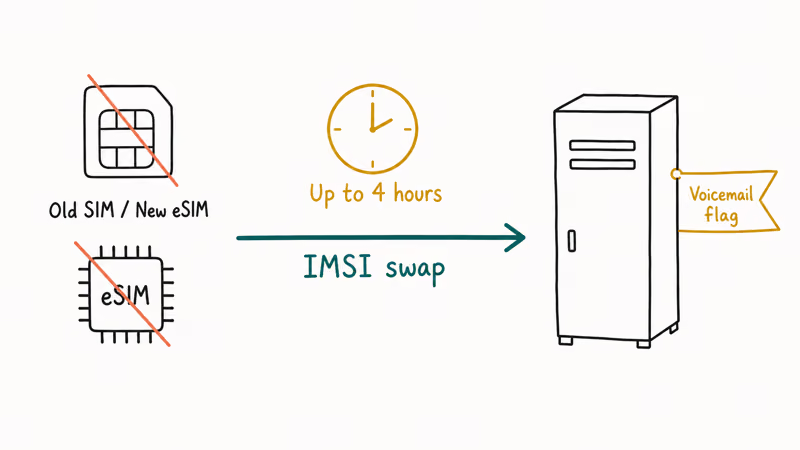
Apple’s SIM card support guide confirms iPhone 14 and later US models use eSIM only, and the carrier has to re-register the eSIM to the voicemail server before the tab syncs. Fix it with a carrier settings pull (Fix 3) or a call to support.
After a SIM or eSIM swap, carrier provisioning can take several hours even after the software steps are clean. If you just swapped SIMs in the last 24 hours, give it time before assuming the iPhone is broken.
Lost your voicemail password in the same transition? Our forgotten voicemail password recovery guide walks through the reset paths for each US carrier and the extra steps that apply when the line was recently ported.
#Fix 6: Check VPN, DNS, and Private Relay Settings
Visual Voicemail traffic needs to reach carrier servers over cellular, not Wi-Fi, and a VPN or Private Relay can intercept that traffic and break the sync.
Step 1. Open Settings > General > VPN & Device Management. If a VPN is on, toggle it off temporarily.
Step 2. Go to Settings > Apple Account > iCloud > Private Relay. Turn it off.
Step 3. Open Settings > Wi-Fi and tap the (i) next to your current network. Scroll to Configure DNS and set it to Automatic.
Step 4. Toggle Airplane Mode once and test Voicemail.
Verizon’s support page explicitly states that “Visual Voicemail for Android doesn’t work on Wi-Fi” and warns that VPNs can interfere on both platforms. The same interference applies to iPhone when the VPN routes cellular data through a remote endpoint.
#Fix 7: Check Call Forwarding, Wi-Fi Calling, and Focus Mode
Call Forwarding can redirect voicemail deposits before they reach the carrier’s voicemail server. Wi-Fi Calling uses a different registration path that occasionally conflicts with Visual Voicemail. Focus modes can silence voicemail notifications without touching the inbox itself, making the feature look broken when it’s actually working.
Step 1. Go to Settings > Phone > Call Forwarding. Turn it off.
Step 2. Go to Settings > Phone > Wi-Fi Calling. Toggle it off, wait 10 seconds, and turn it back on.
Step 3. Open Settings > Focus. Check each mode and confirm Phone notifications are allowed.
Step 4. Open Phone > Voicemail.
If incoming calls are also going straight to voicemail or acting strangely, the root cause might be broader. See our guide on why an iPhone won’t ring for the full call-handling checklist.
#Fix 8: Repair iOS With Tenorshare ReiBoot (No Data Loss)
When CommCenter is corrupted or an iOS update interrupted carrier provisioning, reinstalling the firmware fixes it. Tenorshare ReiBoot’s Standard Repair does this without erasing photos, messages, or apps, which is why it’s the last software step we recommend before a full factory reset.
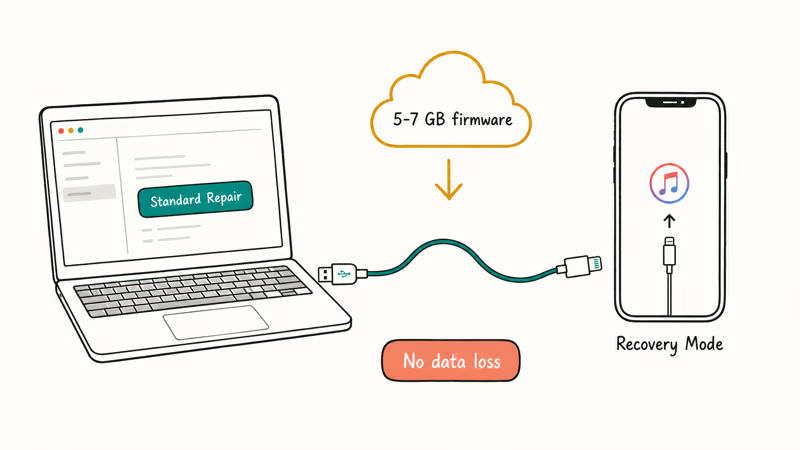
Step 1. Download Tenorshare ReiBoot on a Mac or Windows PC, install it, and launch the program.
Some links on this page are affiliate links, which means fone.tips may earn a commission at no extra cost to you.
Step 2. Connect your iPhone with a Lightning or USB-C cable. Trust the computer when prompted.
Step 3. Click Standard Repair on the main menu. Put the device in Recovery Mode using the on-screen walkthrough for your iPhone model.
Step 4. Select the iOS version to reinstall and click Download. The firmware package is usually 5 to 7 GB in total size, so allow extra time on a slow connection and keep your computer plugged into power during the entire download process to avoid interruption.
Step 5. After the download finishes, click Start Standard Repair. Don’t disconnect the cable at any point in the next 10 to 15 minutes.
Step 6. When the phone reboots, open Phone > Voicemail. The inbox should sync within 60 seconds of the carrier signal returning.
Use this step only when software and carrier provisioning point at an iOS-level CommCenter problem. ReiBoot also repairs related iOS symptoms, including the AirDrop not working error and iMessage not showing Delivered, which share the same underlying CommCenter dependency.
#Fix 9: Call Your Carrier to Re-Provision the Line
When software fixes fail, the feature flag on your account is the next place to look. Every carrier has a path to re-send the Visual Voicemail provisioning packet.
- Verizon. Call *611 or (800) 922-0204 and ask the agent to re-provision Visual Voicemail and send a CSIM refresh
- AT&T. Call 611 or (800) 331-0500 and ask for a Visual Voicemail re-provision plus a carrier settings push
- T-Mobile. Call 611 or (800) 937-8997 and ask for Visual Voicemail enabled at the account level, then restart
Have your account PIN ready before you dial. The re-provision takes 5 to 15 minutes, and the agent will ask you to toggle Airplane Mode or restart before hanging up.
If the agent says the flag is already active but the iPhone still shows the banner, ask them to escalate to the voicemail engineering team and open a ticket under your account.
#What to Try When the iPhone Can’t Keep a Cellular Signal
If the iPhone also drops calls, shows “No Service” intermittently, or throws the “Last Line No Longer Available” banner, Visual Voicemail is a downstream symptom of a broader cellular issue. Solving the cellular problem usually solves the voicemail problem automatically. Start with our guides on cellular data not working and cellular update failed to rule out the radio stack first.
The Last Line No Longer Available error walkthrough handles the third common fault: a stale dual-SIM line that masks itself as a voicemail outage. Together these three faults cover the common cellular-driven Visual Voicemail breakpoints.
For existing voicemails you need to recover while Visual Voicemail is down, our deleted voicemail recovery guide walks through the 30-day retention window on most carriers.
#About Tenorshare ReiBoot
Tenorshare ReiBoot is an iOS repair tool that reinstalls Apple-signed firmware without erasing your data, which makes it the go-to for errors like Visual Voicemail unavailability, the Apple logo loop, and stuck Recovery Mode.
- Standard Repair. Reinstalls iOS without data loss and covers most carrier and voicemail bugs
- Deep Repair. A more aggressive reinstall that erases all data — use only after Standard Repair
- Enter/Exit Recovery Mode. One-click entry and exit, useful when iTunes or Finder can’t see the device
#Bottom Line
Start here. For the “Visual Voicemail is currently unavailable” error specifically, the two best first steps are Airplane Mode (Fix 1) and Reset Network Settings (Fix 2), and most users won’t need to go further than that.
If the banner persists after a restart and a carrier settings update, call your carrier. That’s the single highest-impact fix for SIM swaps, number ports, and plan changes.
Drop to Tenorshare ReiBoot only after both software and carrier paths are exhausted — it’s a firmware-level fix for the tiny minority of cases where CommCenter is the real problem.
#Frequently Asked Questions
Why does my Visual Voicemail suddenly say unavailable?
The most common triggers are a recent SIM swap, a number port, a failed carrier settings update, or a VPN intercepting the cellular data channel. Carrier-side feature-flag drops after plan changes and stale VoLTE registrations after international roaming can trigger the same banner. A rarer trigger is a corrupt CommCenter cache inside iOS.
Can I use Visual Voicemail on Wi-Fi only?
No. It needs cellular data.
Visual Voicemail requires a live cellular data session on the carrier’s network, even when your iPhone is connected to Wi-Fi, because the IMAP session that syncs the voicemail inbox runs over the carrier APN, not over IP. Verizon’s support documentation confirms the feature won’t sync on Wi-Fi alone.
Will resetting network settings delete my voicemails?
No. Voicemails live on the carrier server, not on the iPhone. Resetting network settings wipes Wi-Fi passwords, VPN profiles, and paired Bluetooth devices, but the inbox is untouched and reappears once the Phone app reconnects.
Does Visual Voicemail cost extra on Verizon, AT&T, or T-Mobile?
Basic Visual Voicemail is included at no extra cost on standard postpaid iPhone plans across all three carriers. Verizon charges an extra $2.99 per line per month for Voicemail-to-Text transcription as an add-on. Some prepaid plans on each carrier exclude Visual Voicemail entirely unless you pay a small monthly fee, and prepaid customers should check their specific plan terms.
How long after a SIM swap should Visual Voicemail start working?
Most carriers re-provision the feature flag within 15 minutes, but some eSIM swaps can take several hours. If it’s still showing after 24 hours, call support and ask for a manual re-provision.
Why does Visual Voicemail work on one iPhone but not another on the same account?
Visual Voicemail is tied to the specific line, not the device. If you moved a SIM or eSIM from one iPhone to another and the new device shows the unavailable banner, the carrier needs to re-register the new device identifier with the voicemail server, a process that usually runs automatically but sometimes stalls after hardware changes. A carrier settings update (Fix 3) or a call to support almost always resolves it within the same session.
Does Apple support confirm these fixes?
Yes. Apple’s iPhone documentation confirms that carrier settings updates and Reset Network Settings are the approved first-line fixes for voicemail sync problems. Apple recommends calling the carrier if the banner persists after both steps.
What if I forgot my voicemail password and the unavailable error shows?
Fix the password first. Run the password reset path your carrier publishes (dial *611 on Verizon, 611 on AT&T or T-Mobile), then retest Visual Voicemail once the carrier confirms the reset went through. A forgotten password doesn’t cause the unavailable banner on its own, but a failed password reset attempt can sometimes lock the line temporarily and trigger it as a side effect.
Apple Siri Settlement: Who Qualifies and How to Claim
Apple's $250 million Siri settlement covers iPhone 15 Pro and iPhone 16 models bought June 2024 to March 2025. See who qualifies and how claims work.
iOS 26.6.1 Security Update: What Apple Fixed and Who Gets It
Apple released iOS 26.6.1 on August 17 with 29 security fixes, including an IPSec interception bug. See what it patches, who gets it, and how to update.
iPhone Adaptive Power: How It Works and When to Use It
Learn how iPhone Adaptive Power works, which models support it, what it changes, and when Low Power Mode is still the better battery-saving choice.
How to Transfer Data to a New iPhone Without iCloud
Move everything to your new iPhone without iCloud: Quick Start device-to-device transfer, wired migration, and encrypted Finder or iTunes backups.