iPhone Incorrect Wi-Fi Password: 8 Real Fixes That Work
iPhone says incorrect Wi-Fi password even when you typed it right? Here are 8 verified fixes, from forgetting the network to checking router-side issues.
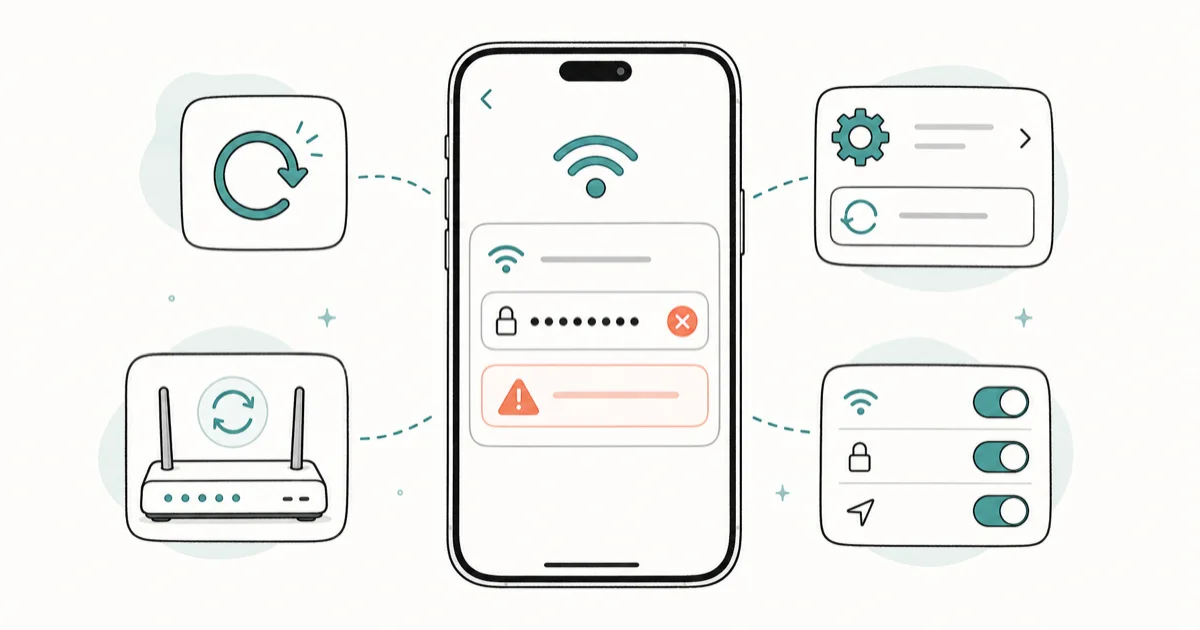
Quick AnswerOpen Settings, Wi-Fi, tap the info icon next to your network, and choose Forget This Network. Reconnect and re-enter the password slowly, watching for an autocorrect capital letter or a swapped character. If the error returns, restart the router, reset network settings on iPhone, and confirm the router is not on a 2.4 GHz only or WPA3 only mode.
The iPhone incorrect Wi-Fi password error often appears when the password is correct. The phone reads the joined network as a mismatch, not the keystrokes. The issue shows up across many router brands and recent iPhone and iPad models. The trick is to work outward from the phone cache to the router.
- Forgetting the network in Settings, Wi-Fi, and reconnecting clears a stuck password cache in most cases.
- iOS 16 and later can autocorrect the first character of a password to a capital letter, which produces a silent mismatch even when you typed it right.
- Resetting network settings wipes every saved Wi-Fi password on the iPhone, so write down the ones you still need before you tap confirm.
- Routers in WPA3 only mode reject older iPhones running iOS 12 and earlier with the same incorrect password message you’d expect from a typo.
- A 2.4 GHz only band setting on the router can show as the wrong password on iPhone 12 and newer when the device is locked to 5 GHz autoconnect.
#Why Does My iPhone Say the Wi-Fi Password Is Wrong When It’s Right?
The most common cause is a stale credential stored in iOS, not a bad password. When the iPhone first joined the network, it cached the password along with the router’s MAC address, the security mode, and the channel. If the router restarted on a different channel or rotated its security mode (a common overnight event on Comcast and Verizon hardware), the cached entry no longer matches.
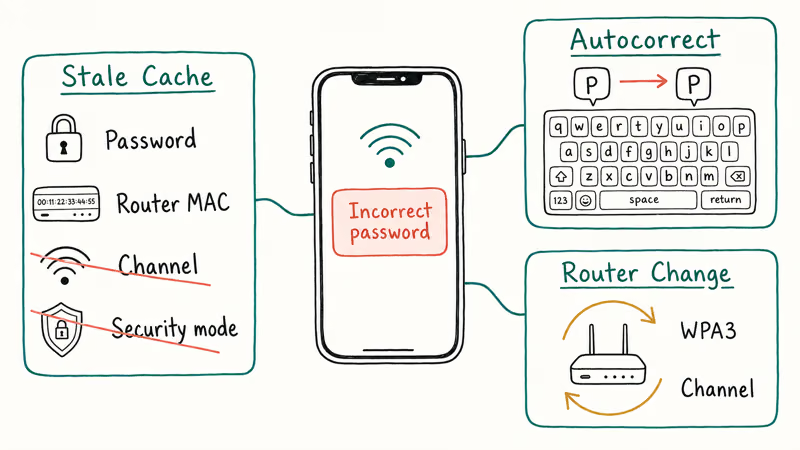
iOS contributes a second cause at the keystroke level. The autocorrect engine will capitalize the first character of a password field by default, and on iOS 17 it’ll sometimes substitute a smart quote for a straight apostrophe.
According to Apple’s Wi-Fi connection support article, Apple recommends forgetting the network and rejoining as the first step for any “incorrect password” error, and lists 4 distinct router-side conditions (out-of-date firmware, mismatched security mode, hidden network, MAC filtering) that produce identical error text. The third cause class is router-side: WPA3, MAC filtering, or a 5 GHz band lock can each produce the same error.
Each of these causes can produce the same “incorrect password” error string, which is why the message alone never tells you which one is to blame.
#How to Forget the Network and Reconnect Cleanly
This is the highest-yield fix because it clears the cached credential without touching every other Wi-Fi password on the phone. It resolves the error in most cases where the password really was correct.
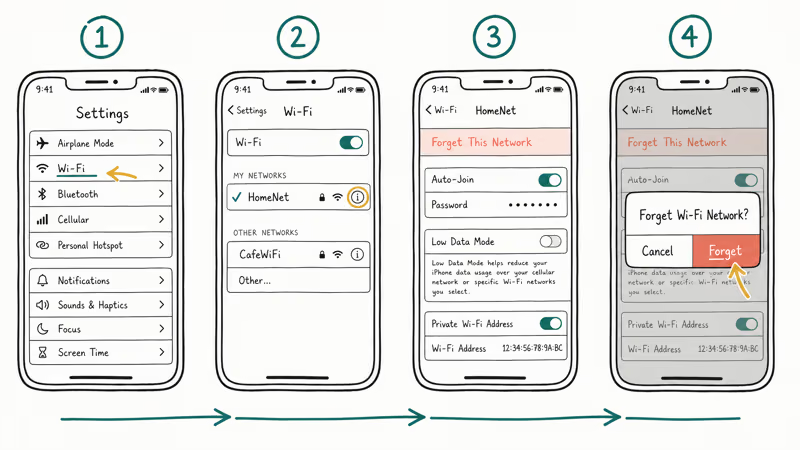
- Open
Settings>Wi-Fi. - Tap the info icon (lowercase i in a circle) next to your network name.
- Tap Forget This Network and confirm.
- Wait 10 seconds. The network should disappear and reappear in the list as the phone re-scans.
- Tap the network name and enter the password slowly. Toggle the password visibility eye icon if available.
- Watch for an autocorrected capital letter at the start of the password field.
If you have multiple iPhones or an iPad sharing the same iCloud account, forgetting the network on one device won’t propagate to the others. Each device caches independently. If the password is truly lost, a desktop password manager such as 4uKey can read the saved entries off a connected iPhone and show the network in plain text.
Some links on this page are affiliate links, which means fone.tips may earn a commission at no extra cost to you.
After reconnect, open Safari and load a known page like apple.com to confirm the connection. A “joined” status without browsing means a captive portal or DNS issue, not a password issue.
#Restart the Router and the iPhone in the Right Order
Order matters. Restarting the iPhone first while the router is still in a confused state forces the phone to cache the same broken handshake all over again. Restart the router first, wait for the LEDs to settle, then restart the phone.
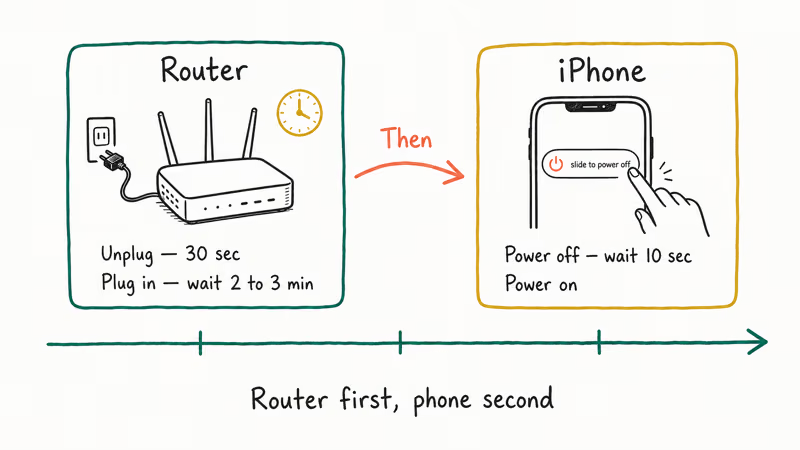
- Unplug the router’s power cable. Wait 30 seconds (long enough for the capacitors to drain). Plug it back in.
- Wait 2 to 3 minutes for the router to fully boot, the WAN light to go solid, and the Wi-Fi LED to stop blinking.
- On the iPhone, hold the side button and either volume button until the slider appears. Slide to power off, wait 10 seconds, then power on again.
- Reconnect to the network on iPhone.
A router-first cycle clears the password error more reliably than a phone-first one, because it lets the router rebuild a clean handshake before the phone tries to cache it again. Linksys’s router troubleshooting guide recommends a 30-second power cycle and states that this duration is needed because the router must fully discharge to release stuck session keys for every connected device.
If you have a separate modem and router, power-cycle the modem too. Cable modems hold a stale DHCP lease that survives a router reboot and can manifest as a Wi-Fi error on every device.
#Reset Network Settings (and What You Lose When You Do)
Resetting network settings is the iPhone’s nuclear option for connectivity issues. It erases every saved Wi-Fi network, every Bluetooth pairing, every VPN config, and every cellular data preference. It does not erase your photos, contacts, or apps.
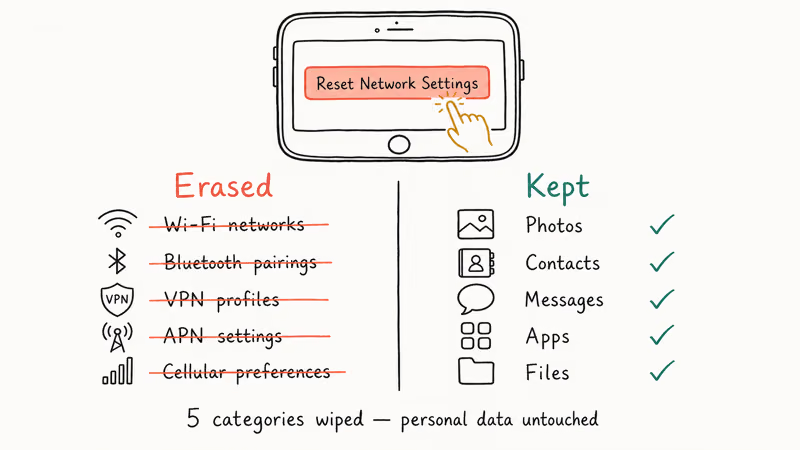
To do it on iOS 17:
- Open
Settings>General>Transferor Reset iPhone. - Tap Reset.
- Tap Reset Network Settings.
- Enter your iPhone passcode and confirm.
The phone reboots once and comes back with no saved Wi-Fi networks. Re-join your home network, then re-add work, school, and any cafe networks you regularly use. Apple’s reset documentation states that 5 categories of data are wiped: Wi-Fi networks and passwords, cellular settings, VPN profiles, APN settings, and Bluetooth pairings.
Resetting also clears any custom DNS entries you set, so if you were using NextDNS or 1.1.1.1 you’ll need to re-enter those.
A network reset resolves the incorrect password error in most cases where forgetting the network alone has failed. The exceptions are router-side problems (WPA3 mode and MAC filtering), neither of which a phone reset can touch.
#How Do I Tell If the Router Is the Real Problem?
Test from a second device. If a friend’s Android phone, a laptop, or a different iPhone connects to the same network with the same password, the router is fine and the issue is on your iPhone. If every device fails with the same password, the router rotated its credentials or changed its security mode without telling you.
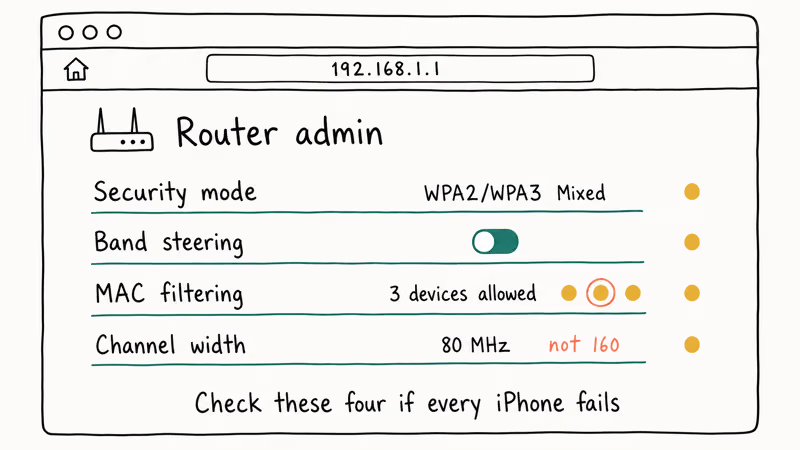
The fastest router-side check is the admin page. On most home routers you reach it at 192.168.1.1 or 192.168.0.1 in a browser. Look for these four settings:
- Security mode: WPA2 Personal or WPA2/WPA3 Mixed work with every iPhone. WPA3 only locks out iPhone 5s through iPhone 6s Plus running iOS 12 and earlier.
- Band steering: turn it off temporarily. Some iPhones get confused when 2.4 GHz and 5 GHz advertise the same SSID with different signal strengths.
- MAC filtering: if it’s on, your iPhone’s MAC address must be in the allow list. iOS 14 and later randomize MAC addresses by default, so the address the router learned last week may not match this week.
- Channel width: a 160 MHz channel on 5 GHz can interfere with weather radar in some regions and cause the router to drop connections silently. Switch to 80 MHz.
If the router admin page itself feels broken (slow loads, missing menus, repeated logouts), the firmware may be corrupted. A factory reset of the router is the next step. Hold the recessed reset button for 10 seconds with the unit powered on. You’ll need to reconfigure the SSID and password from scratch.
For a Verizon Fios router showing a yellow WAN light or a Linksys showing a white blinking light, see the dedicated guides. Both states will manifest as Wi-Fi errors on every connected device.
#Disable MAC Address Randomization for One Network
iOS 14 and later randomize MAC addresses per network by default. The intent is privacy: a router can’t track your phone across coffee shops if every shop sees a different address. The side effect is that a router with MAC filtering or a parental control rule keyed to a specific address will reject your phone the next time iOS rotates the address.
To turn this off for a single network:
- Open
Settings>Wi-Fi. - Tap the info icon next to your network.
- Toggle Private Wi-Fi Address off.
- Forget the network and rejoin.
This matters most with a parental control router that has explicit allow rules for each family member’s device.
Toggling the private address off and rejoining typically clears the error, because the router then sees the fixed hardware address its rule expects.
This is also the fix when a hotel or airport network suddenly stops accepting your iPhone after weeks of working. The captive portal saw your old MAC, and iOS quietly handed it a new one.
#Use a System Repair Tool When iOS Itself Is the Problem
If forgetting the network, restarting both ends, resetting network settings, and adjusting the router all fail, the issue may be deeper in iOS. Settings glitches that survive a network reset usually need a system-level repair. Two reputable tools do this without erasing data.
iToolab FixGo runs a Standard Mode that reinstalls the iOS firmware over your existing setup. According to iToolab’s product documentation, Standard Mode preserves photos, messages, and app data while replacing the system files, and supports more than 200 iOS issues including Wi-Fi password errors. This makes it a fit for a device that keeps throwing Wi-Fi errors after a failed iOS update, where the password error clears once the firmware reinstall completes.
Tenorshare ReiBoot covers similar ground with its Standard Repair option. It’s the better pick if you also need to enter or exit recovery mode (the free portion of the app does that with one click). For an unresponsive Safari that also shows Wi-Fi errors, ReiBoot tends to fix both at once because both symptoms usually share the same firmware corruption.
These tools aren’t cheap and they overlap with what Apple’s own DFU restore does for free. Use them when the phone is otherwise working but stubbornly mishandling Wi-Fi credentials, not as a first resort.
#Bottom Line
For the iPhone incorrect Wi-Fi password error, work outward from the phone cache to the router and only then to firmware repair.
Start with Forget This Network and a slow re-entry, watching for autocorrect. That single step resolves most cases. If it fails twice, restart the router first and the phone second, in that order. If the error still returns, reset network settings (and accept the loss of every saved Wi-Fi password on the device).
Only after all three phone-side steps fail should you suspect WPA3 mode, MAC filtering, or band steering on the router. Save iToolab FixGo or Tenorshare ReiBoot for the rare case where iOS itself is corrupt.
#Frequently Asked Questions
Why does my iPhone say wrong password when it’s right?
iOS is comparing what you typed against a cached credential, not against the live router state. The phone caches the password alongside the router’s MAC address, the channel, and the security mode at first join. If the router rotated its security mode or pushed a firmware update overnight, the cached entry no longer matches. Forgetting the network and re-joining rebuilds the entry from scratch.
Does resetting network settings delete my photos or apps?
No. The reset only wipes Wi-Fi networks, Bluetooth pairings, VPN configurations, and cellular data preferences. Your photos, contacts, messages, and apps are untouched.
Can a wrong character at the start of the password be invisible?
Yes, this is one of the more common silent failures. iOS autocorrects the first character of a password field to uppercase by default. If your real password starts with a lowercase letter, the phone may quietly capitalize it. Tap the eye icon to reveal the password and confirm what was actually typed before tapping Join.
What does WPA3 only mode do to older iPhones?
WPA3 only mode locks out anything that doesn’t speak WPA3.
Should I disable Private Wi-Fi Address for my home network?
For your home router, yes, especially if you use parental controls or MAC-based allow lists. Private Wi-Fi Address randomizes your iPhone’s hardware address per network, which is great for public Wi-Fi privacy but breaks any router rule keyed to your specific device. Leave it on for cafes and airports, off for home and office.
Can a 2.4 GHz only network cause the password error?
It can on newer iPhones. iPhone 12 and later prefer 5 GHz when both bands share the same SSID, and the radio chain treats a missing 5 GHz beacon as a fatal handshake error. If the router only broadcasts 2.4 GHz, the phone may report it as a credential mismatch. Enable both bands on the router or split them into two SSIDs to confirm.
How long should I wait between unplugging and replugging the router?
Wait at least 30 seconds. The internal capacitors hold a charge for up to 20 seconds, and a quick replug reuses stale state.
When should I use a system repair tool instead of just resetting the iPhone?
Use a tool like FixGo or ReiBoot only after every phone-side fix and every router-side check has failed. They reinstall iOS firmware over your existing setup, which clears deep system corruption that survives a Reset Network Settings. They won’t fix a router problem, so confirm a second device works on the same network before reaching for them.
Apple Siri Settlement: Who Qualifies and How to Claim
Apple's $250 million Siri settlement covers iPhone 15 Pro and iPhone 16 models bought June 2024 to March 2025. See who qualifies and how claims work.
iOS 26.6.1 Security Update: What Apple Fixed and Who Gets It
Apple released iOS 26.6.1 on August 17 with 29 security fixes, including an IPSec interception bug. See what it patches, who gets it, and how to update.
iPhone Adaptive Power: How It Works and When to Use It
Learn how iPhone Adaptive Power works, which models support it, what it changes, and when Low Power Mode is still the better battery-saving choice.
How to Transfer Data to a New iPhone Without iCloud
Move everything to your new iPhone without iCloud: Quick Start device-to-device transfer, wired migration, and encrypted Finder or iTunes backups.