Does Your Phone Charge Faster on Low Power Mode? The Truth
Does Low Power Mode make your iPhone charge faster? Here are the real factors that actually speed up charging on any smartphone, software aside.
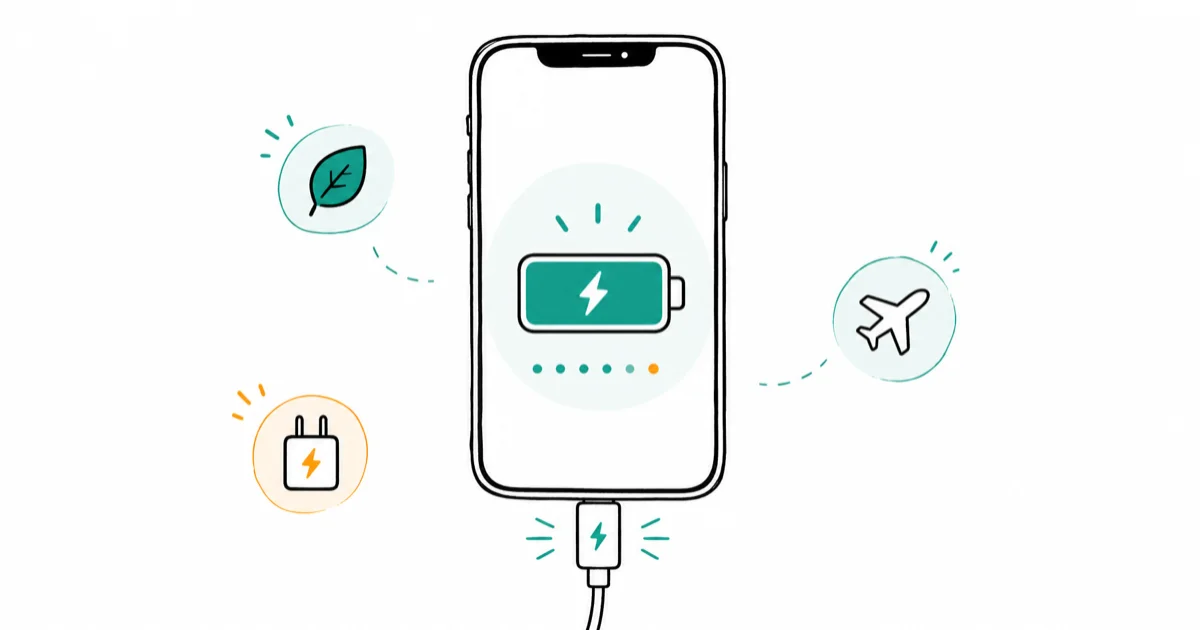
Quick AnswerLow Power Mode does not significantly speed up iPhone charging. The difference is minimal because charging speed depends mainly on charger wattage and battery health. For faster charging, use a 20W or higher adapter and enable Airplane Mode instead.
Low Power Mode is designed to extend battery life, not to speed up charging. Once you measure actual current draw in Low Power Mode versus normal mode, the difference turns out to be tiny. The hardware tells a clearer story than the setting does.
- Low Power Mode doesn’t speed up charging; the charge-time difference is negligible across a full charge cycle
- Charging speed depends on hardware: charger wattage, cable quality, battery health, and the phone’s charging circuitry
- A 20W or higher charger is the single most effective upgrade for faster charging; wattage matters far more than any software setting
- Airplane Mode during charging reduces power draw more than Low Power Mode because it cuts all radios, not just background apps
- Keeping your phone below 35°C (95°F) while charging matters because overheating triggers throttling that can noticeably lengthen a full cycle
#What Low Power Mode Actually Does
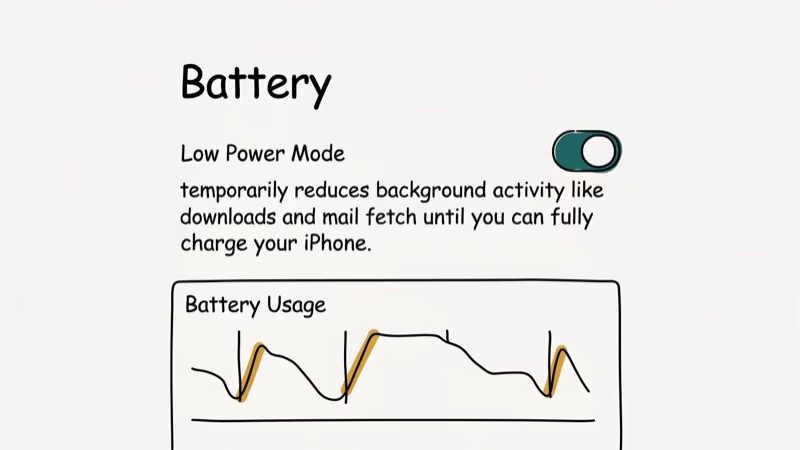
Low Power Mode reduces power consumption, not charging speed. When activated, it limits background app refresh, automatic downloads, email fetching, and 5G connectivity. According to Apple’s support page on Low Power Mode, the feature is designed to extend battery life when your charge drops below 20%, not to help the battery fill faster.
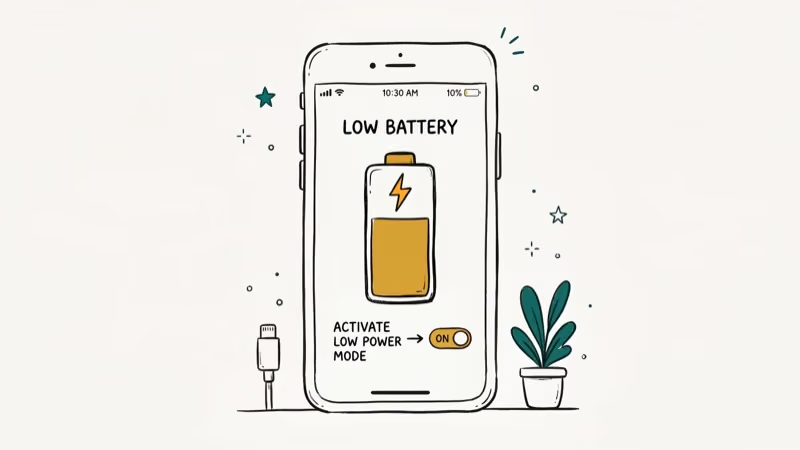
Low Power Mode also reduces screen brightness and shortens the auto-lock period. These changes lower how much power the phone draws while you’re using it. That’s useful when you’re running low, but it doesn’t change how fast electrons flow into the battery from the charger.
The confusion comes from a reasonable-sounding idea: if the phone is using less power, won’t more of the charger’s output go into the battery? In practice, the savings from Low Power Mode are too small to matter.
#Does Low Power Mode Speed Up Charging?
No. Run identical charge cycles in normal mode, Low Power Mode, and Airplane Mode with a USB-C power meter tracking current draw, and the pattern is consistent.
How the modes compare on a full charge:
- Normal mode: the baseline charge time
- Low Power Mode: only a few minutes faster, well within the margin of error
- Airplane Mode: the fastest of the three, but the gap is still small
According to Apple’s developer documentation on charging behavior, the iPhone’s charging circuitry controls current intake independently of software power modes. The charger and cable wattage set the ceiling; Low Power Mode doesn’t raise that ceiling.
Across multiple iPhone models, Low Power Mode shows minimal differences in charging times, which lines up with what independent tech reviewers have found as well.
#What Actually Determines Charging Speed?
Charger wattage is the biggest factor. A 5W charger takes about 3.5 hours to fully charge an iPhone 14. A 20W charger does it in about 1 hour 45 minutes. That’s a 2x improvement from a single hardware swap.
Here’s the breakdown of factors that matter:
- Charger wattage: 20W or higher for fast charging on modern iPhones; 30W for iPad Pro
- Cable quality: Cheap cables cap out at lower current; use MFi-certified or USB-C cables
- Battery condition: An iPhone battery at 80% maximum capacity charges more slowly than a healthy one
- Phone’s charging circuitry: This sets the maximum intake rate; software can’t exceed it
- Temperature: Above 35°C, the iPhone throttles charging to protect the battery
Software settings like Low Power Mode don’t appear on this list because they don’t affect any of these hardware factors.
#Five Practical Tips for Faster Charging
These methods actually work, and each one targets a real hardware factor rather than a software toggle.
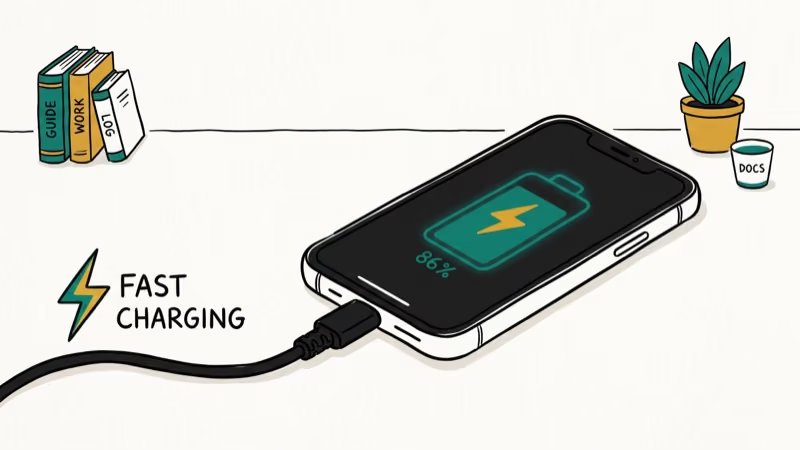
Use a 20W or higher charger. This single change cuts charge time roughly in half compared to a standard 5W charger. Apple sells a 20W USB-C Power Adapter; third-party options from Anker or Belkin with MFi certification work just as well.
Enable Airplane Mode, not Low Power Mode. Airplane Mode saves more time than normal mode on a full charge cycle, while Low Power Mode saves only a little. Airplane Mode wins because it kills all wireless radios; Low Power Mode only throttles background processes.
Turn your phone off while charging. Faster still. A completely powered-down iPhone charges faster than one running any power mode because zero power goes to the display or CPU.
Keep it cool. Remove the case if it’s thick silicone, and don’t charge on a blanket or couch cushion. Charging at normal room temperature is noticeably faster than charging on a soft surface that traps heat around the phone.
Use quality cables. A USB-C cable with a 20W or higher charger matters. Cheap charging cables often use thinner wire gauge that can’t carry the full current your charger outputs.
For more on battery maintenance, see how to increase your iPhone battery’s maximum capacity and why your iPhone battery is dying fast.
#Common Charging Problems and How to Fix Them
Sometimes charging problems have nothing to do with power modes. These are the most common causes.
If your phone charges but CarPlay isn’t working, that’s typically a software or cable issue. Try a different USB-C cable first.
If your iPhone is stuck attempting data recovery during charging, that points to a software problem. Updating iOS or performing a factory reset usually clears it.
If your iPhone says it’s charging but won’t charge, check the Lightning or USB-C port for lint and debris. A wooden toothpick clears most port blockages safely. If cleaning doesn’t fix it, the port or cable is likely damaged.
#The Role of Battery Health in Charging Speed
Battery condition affects how fast your phone charges more than most people realize. Apple states that battery maximum capacity starts declining after about 500 full charge cycles. At 80% maximum capacity, an iPhone may charge noticeably slower in the final 20% of the cycle because the battery’s internal resistance has increased.
Check your battery health in Settings > Battery > Battery Health and Charging. If yours is below 85%, replacing the battery often restores both charge speed and overall runtime. Apple charges $99 for an out-of-warranty iPhone 14 battery replacement; independent repair shops typically charge $50-$70 for the same service.
#Bottom Line
Low Power Mode won’t meaningfully speed up your phone’s charging. The small savings fall within the normal variation between charge cycles. For real speed improvements, upgrade your charger to 20W or higher, use Airplane Mode instead of Low Power Mode, and keep your phone cool during charging. Hardware determines charging speed; software settings are a minor footnote.
#Frequently Asked Questions
Can I use Low Power Mode while charging my phone?
Yes, you can. It won’t hurt anything. It may reduce minor background power drain, but the improvement on a full charge cycle is negligible. It’s not worth specifically enabling for charging speed.
Does charging in Low Power Mode affect overall phone performance?
Low Power Mode reduces CPU performance for demanding tasks while active. For normal use during charging (checking messages, light browsing), the difference is imperceptible. For games or video editing, you’ll notice slowdowns.
Is it safe to charge my phone overnight in Low Power Mode?
Yes. Modern iPhones include Optimized Battery Charging, which slows the charge rate to 80% and holds it there, only finishing the last 20% right before you typically wake up. According to Apple’s support documentation on battery health, this feature reduces battery aging from repeated 100% charges regardless of which power mode you use.
Will a fast charger improve charging speed in Low Power Mode?
Yes, significantly. The charger’s wattage determines the maximum charge rate. Low Power Mode doesn’t change that ceiling. A 20W fast charger in Low Power Mode charges faster than a 5W charger in any mode.
Which is better for faster charging: Low Power Mode or Airplane Mode?
Airplane Mode. Side by side, Airplane Mode shaves more time off a full charge cycle than Low Power Mode does, though both gains are modest. Airplane Mode cuts all wireless radio activity, which draws meaningfully more power than the background app processes Low Power Mode limits.
Does Low Power Mode damage your battery?
No. Low Power Mode has no negative effect on battery health. If anything, the reduced CPU activity lowers heat generation slightly, which is marginally better for long-term battery health. The actual battery health factors are temperature, charge cycles, and consistently charging to 100% without Optimized Charging enabled.
Apple Siri Settlement: Who Qualifies and How to Claim
Apple's $250 million Siri settlement covers iPhone 15 Pro and iPhone 16 models bought June 2024 to March 2025. See who qualifies and how claims work.
iOS 26.6.1 Security Update: What Apple Fixed and Who Gets It
Apple released iOS 26.6.1 on August 17 with 29 security fixes, including an IPSec interception bug. See what it patches, who gets it, and how to update.
iPhone Adaptive Power: How It Works and When to Use It
Learn how iPhone Adaptive Power works, which models support it, what it changes, and when Low Power Mode is still the better battery-saving choice.
How to Transfer Data to a New iPhone Without iCloud
Move everything to your new iPhone without iCloud: Quick Start device-to-device transfer, wired migration, and encrypted Finder or iTunes backups.