iPhone Battery Dying Fast: 10 Fixes That Actually Work
iPhone battery dying fast? These 10 proven fixes cover Settings tweaks, iOS update recovery, and battery health checks. Works on iOS 16 through iOS 18.
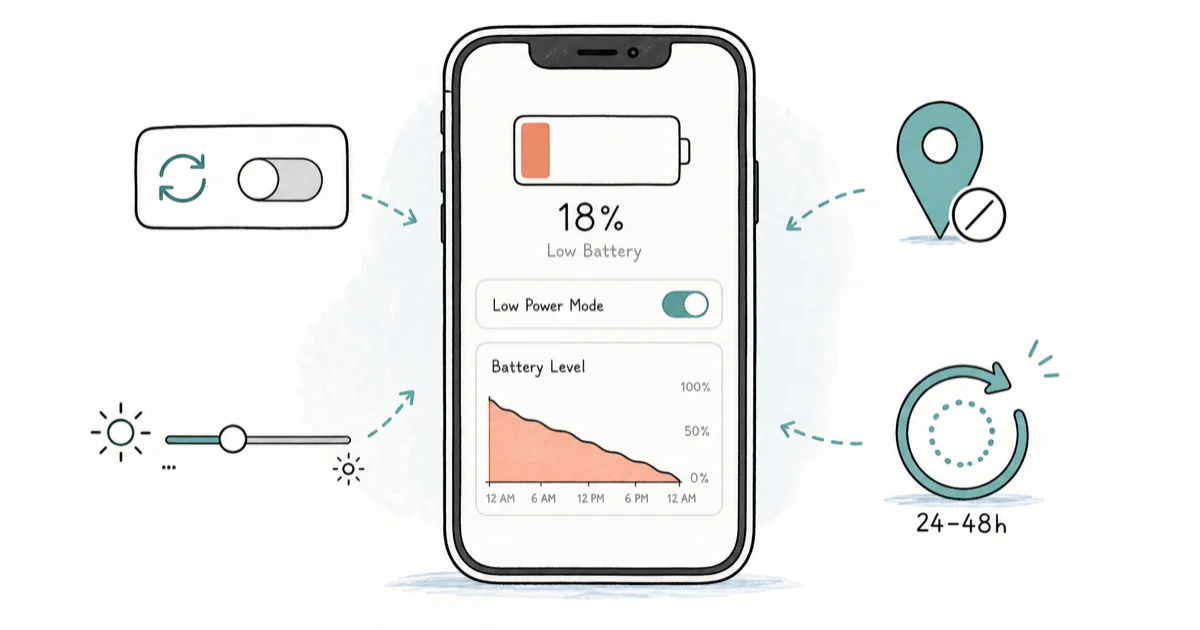
Quick AnswerCheck Settings > Battery to find power-hungry apps, turn off Background App Refresh for apps you don't use, lower screen brightness, and disable unnecessary Location Services. If battery drain started after an iOS update, give your iPhone 24-48 hours for background reindexing to finish.
iPhone battery dying fast is one of the most common complaints across every iPhone model, from the iPhone 12 through the iPhone 16 series. Start with the settings that control background activity, screen power, cellular registration, and battery health before you assume the battery itself has failed.
- Background App Refresh and Location Services are the two biggest hidden battery drains on most iPhones
- Post-update battery drain typically stabilizes within 24-48 hours as Spotlight reindexes your data
- Battery Health below 80% means Apple considers it degraded and eligible for replacement
- Low Power Mode cuts background activity and helps stretch remaining battery life
- Disabling push email and switching to scheduled fetch can cut unnecessary background activity
#Why Is Your iPhone Battery Draining So Fast?
Before jumping into fixes, it helps to understand what’s actually pulling power. Go to Settings → Battery and scroll down to the app usage chart. This screen shows which apps consumed the most battery over the last 24 hours or 10 days.
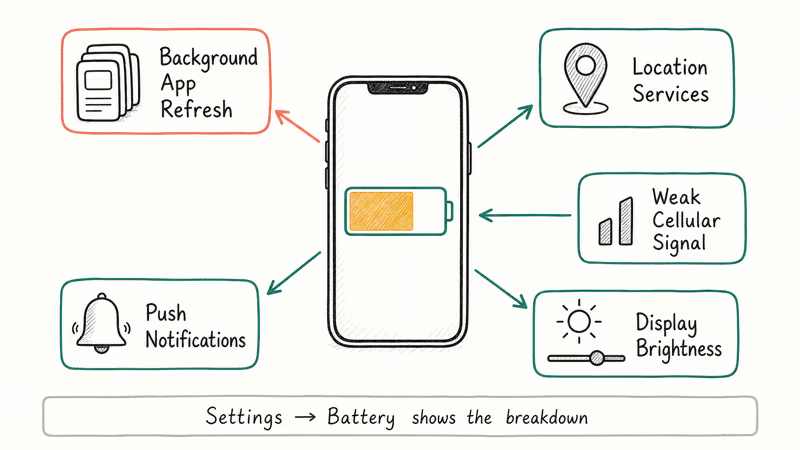
Background app activity tops the list of battery killers. Apps like Facebook, Instagram, and Snapchat fetch content even when you’re not using them. Location Services running in “Always” mode also drains battery quickly.
A weak cellular signal forces your iPhone’s radio to work harder, burning through power faster than a strong connection would. Apple’s battery performance support page states that lithium-ion batteries have a limited lifespan of roughly 500 complete charge cycles before capacity drops noticeably. That natural degradation compounds with software-driven drains to make older iPhones feel like they can’t hold a charge.
#iOS Updates and Battery Drain
After every major iOS update, your iPhone runs background tasks like Spotlight indexing, photo analysis, and iCloud syncing. These processes are CPU-intensive and can cause noticeable battery drain for 24-48 hours.
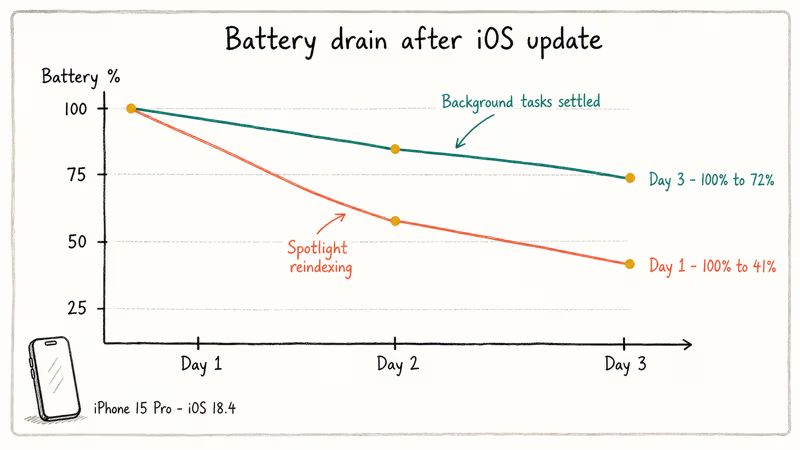
Post-update battery drain is often worst on the first day because indexing, photo analysis, and iCloud sync run in the background. Apple’s iOS update support documentation confirms that performance improvements and bug fixes in each release require initial background processing that settles within a few days.
If your iPhone keeps restarting after an update, that restart loop will drain your battery much faster than normal background indexing.
#Biggest iPhone Battery Drains Ranked
On an iPhone specifically, here’s what pulls the most power:
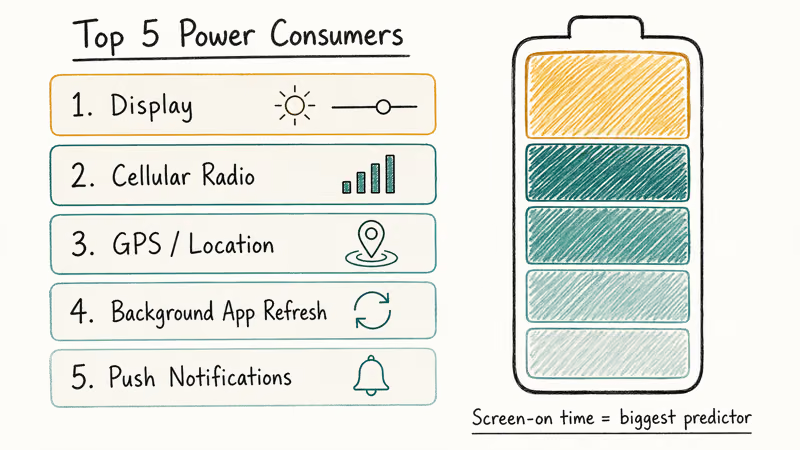
- Display at full brightness
- Cellular radio searching for weak signals
- GPS and Location Services running continuously
- Background App Refresh for multiple apps
- Push notifications from dozens of apps
If your iPhone isn’t charging properly alongside the battery drain, check our guide on iPhone won’t charge but says it’s charging and how to charge your iPhone without a charger for backup power options.
#10 Fixes to Stop iPhone Battery Drain
#1. Turn Off Background App Refresh
Go to Settings → General → Background App Refresh. You can disable it entirely or pick specific apps. For social media and other frequently refreshing apps, turning off Background App Refresh is one of the quickest ways to reduce idle drain.
#2. Manage Location Services
Go to Settings → Privacy & Security → Location Services. Set apps to “While Using” instead of “Always.” Pay special attention to weather apps and social media. If your location is showing wrong on your iPhone, fixing that issue can also reduce unnecessary GPS polling.
#3. Lower Screen Brightness and Enable Auto-Brightness
Your display is the single biggest power consumer. Turn on Auto-Brightness in Settings → Accessibility → Display & Text Size. On OLED iPhones (iPhone X and later), Dark Mode also helps because black pixels are literally turned off.
#4. Switch Email From Push to Fetch
Push email keeps a constant connection to mail servers. Go to Settings → Mail → Accounts → Fetch New Data. Turn off Push and set Fetch to every 15 or 30 minutes. Scheduled fetch reduces how often Mail wakes the phone in the background.
#5. Enable Low Power Mode
Go to Settings → Battery → Low Power Mode. This cuts background downloads, mail fetch, and some visual effects. Apple’s Low Power Mode documentation recommends enabling it when your battery is running low to extend its life. You can also learn more about whether your phone charges faster on Low Power Mode.
If you’re on an iPhone 15 Pro or newer running iOS 26, try Adaptive Power first — it manages this automatically day to day, and you can save manual Low Power Mode for travel days and low-battery moments.
#6. Disable Unnecessary Widgets
Widgets on your Home Screen and Lock Screen update frequently. Remove widgets you don’t check often by long-pressing the Home Screen, tapping the minus button, and confirming removal. Weather, stocks, and news widgets are common offenders.
#7. Turn Off Raise to Wake
Every time you pick up your phone, the screen lights up. Go to Settings → Display & Brightness and toggle off Raise to Wake. This small change adds up across hundreds of pickups per day.
#8. Update iOS and Your Apps
Outdated apps sometimes have bugs that cause excessive battery usage. Open the App Store, tap your profile, and update all pending apps. Also check Settings → General → Software Update for the latest iOS version.
#9. Reset All Settings
If nothing else works, try Settings → General → Transfer or Reset iPhone → Reset → Reset All Settings. This won’t delete your data, but it resets Wi-Fi passwords, Bluetooth pairings, and notification preferences back to defaults.
#10. Check Battery Health and Consider Replacement
Go to Settings → Battery → Battery Health & Charging. The Maximum Capacity percentage shows your battery’s current health relative to when it was new. Below 80% means the battery is considered degraded.
You can increase the maximum capacity of your iPhone battery with proper charging habits, or contact Apple for a replacement. Apple charges $89-$119 for out-of-warranty battery replacements depending on your iPhone model.
#How Do You Check iPhone Battery Health?
The Battery Health screen is your most important diagnostic tool. Go to Settings → Battery → Battery Health & Charging and look at two numbers: Maximum Capacity and Peak Performance Capability.
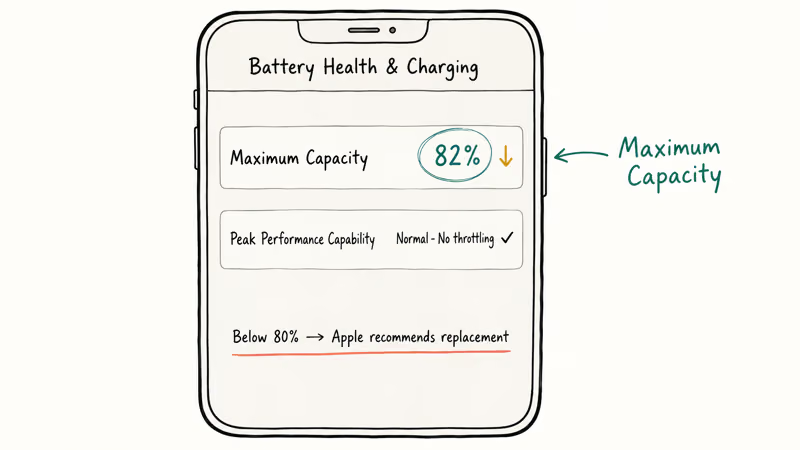
Maximum Capacity tells you how much charge your battery can hold compared to when it was new. A brand-new iPhone shows 100%. After about 500 charge cycles, most batteries drop to around 80%. If yours reads below 80%, Apple recommends replacement.
Peak Performance Capability tells you whether iOS is throttling your processor to prevent unexpected shutdowns. If you see a message about performance management being applied, your battery can’t deliver enough peak power for demanding tasks.
#Battery Replacement Options and Costs
When settings tweaks aren’t enough, replacement is the next step. Apple offers official battery replacement through Apple Stores, authorized service providers, and mail-in service. Out-of-warranty pricing runs $89 for older models (iPhone SE through iPhone 13) and up to $119 for newer models (iPhone 14 through iPhone 16 series).
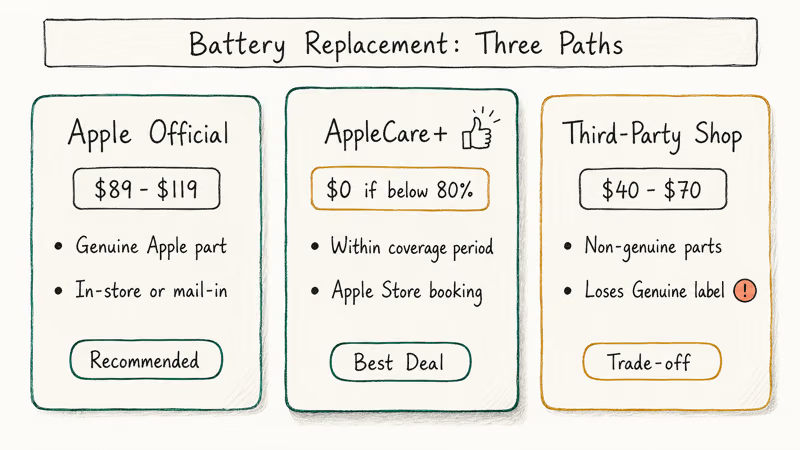
Third-party repair shops typically charge $40-$70 but use non-genuine parts. That trade-off means you lose the “Genuine Apple Part” label in Battery Health settings, though the battery itself often performs comparably for the first year.
AppleCare+ covers battery replacement at no cost if your battery drops below 80% Maximum Capacity during the coverage period. If you don’t have AppleCare+, the $89-$119 Apple charges is still worth it for a phone you plan to keep another 1-2 years.
#Bottom Line
Start with the free fixes: turn off Background App Refresh for social media apps, switch email from Push to Fetch, and lower screen brightness. Those changes target the biggest daily drains before you move to resets or service. If your iPhone battery is below 80% Maximum Capacity, book a battery replacement through Apple Support rather than fighting a losing battle with settings tweaks. For post-update battery drain, wait 48 hours before troubleshooting because background indexing resolves itself.
iPhone battery problems
#Frequently Asked Questions
How long should an iPhone battery last on a full charge?
A healthy iPhone battery should last a full day of typical use, roughly 10-17 hours of screen-on time depending on the model. The iPhone 15 Pro Max and iPhone 16 Pro Max offer the longest battery life in the lineup. If you’re consistently reaching for a charger before dinner, something is wrong.
Why is my iPhone battery draining fast overnight?
Background App Refresh, push notifications, and Location Services keep running while your phone sits on the nightstand. Go to Settings, check Battery usage by app for the “Last 24 Hours” view, and look for apps using power during overnight hours. Putting your iPhone in Sleep Focus mode before bed also helps.
Does closing apps save battery on iPhone?
No. Force-closing apps and reopening them actually uses more battery than leaving them in the background. Apple’s system management already suspends background apps efficiently. The exception is apps that show abnormal battery usage in Settings, which might indicate a bug worth force-closing.
Is 85% battery health bad for an iPhone?
Not terrible, but noticeable. At 85%, your iPhone holds less charge than when it was new, and you’ll start seeing shorter battery life. Apple considers a battery “degraded” at 80%, which triggers a service recommendation. Between 85% and 80%, managing settings aggressively can bridge the gap for several more months.
Will a factory reset fix iPhone battery drain?
Sometimes. A factory reset eliminates software bugs, rogue processes, and corrupted settings that can cause excessive battery usage. Try “Reset All Settings” first since it preserves your data. A full factory reset should be your last resort before seeking hardware service.
How do I find which app is draining my iPhone battery?
Go to Settings → Battery and scroll down past the graph. You’ll see a list of apps sorted by battery usage percentage. Tap “Show Activity” to see both screen time and background time for each app. High background time relative to screen time usually points to the culprit.
Does 5G drain iPhone battery faster than LTE?
Yes. 5G uses more power than LTE, especially mmWave 5G. If you don’t need 5G speeds, go to Settings → Cellular → Cellular Data Options → Voice & Data and switch to LTE. This can reduce battery drain when signal strength is weak or coverage is patchy.
Apple Siri Settlement: Who Qualifies and How to Claim
Apple's $250 million Siri settlement covers iPhone 15 Pro and iPhone 16 models bought June 2024 to March 2025. See who qualifies and how claims work.
iOS 26.6.1 Security Update: What Apple Fixed and Who Gets It
Apple released iOS 26.6.1 on August 17 with 29 security fixes, including an IPSec interception bug. See what it patches, who gets it, and how to update.
How to Transfer Data to a New iPhone Without iCloud
Move everything to your new iPhone without iCloud: Quick Start device-to-device transfer, wired migration, and encrypted Finder or iTunes backups.

Group Text Not Working on iPhone? 8 Fixes That Work
Group text not working on iPhone? Turn on MMS Messaging and Group Messaging, check iMessage vs SMS routing, and fix mixed Android group chats fast.