M3U8 Not Loading? Causes and Fixes for HLS Streams
M3U8 not loading in your own HLS player? Fix the cross-domain error, CORS headers, manifest paths, and CDN issues for legitimate test streams.
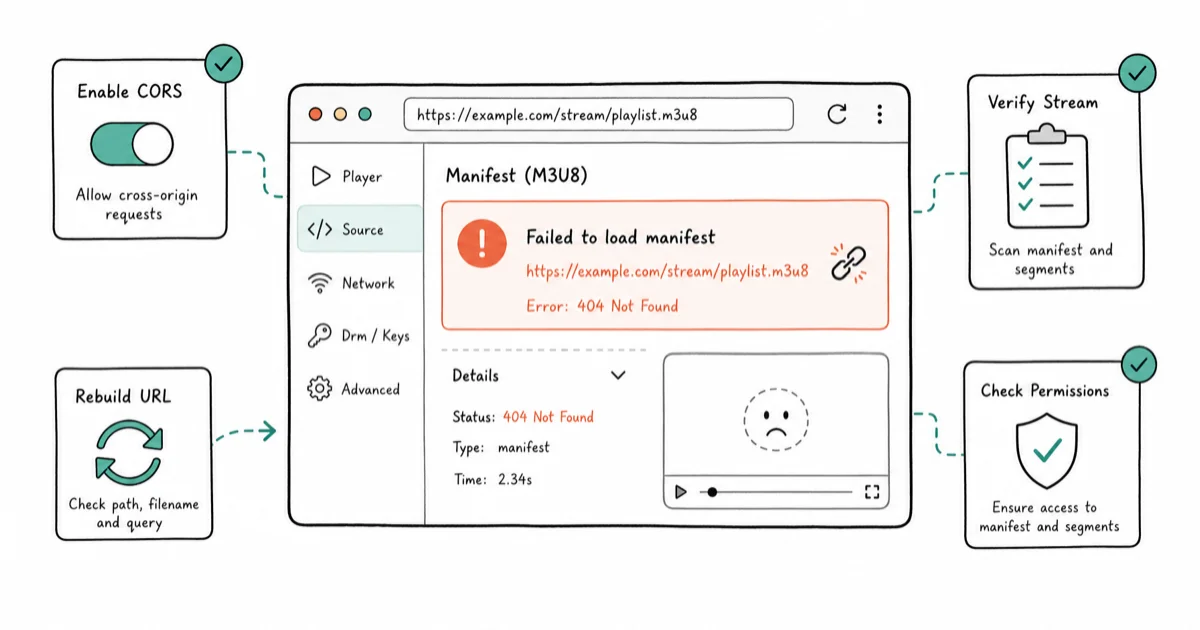
Quick AnswerIf a legitimate m3u8 you control won't load, the cause is almost always CORS, a wrong manifest URL, or an expired token. Check the browser console first, then verify the manifest with FFmpeg or hls.js.
If you can’t load an m3u8 stream that you own or have the right to access, the problem is rarely random. M3U8 not loading errors usually trace back to four specific causes: a missing CORS header on the manifest, the wrong relative path to media segments, an expired signed URL, or a CDN-level block. This guide is for developers, IPTV subscribers, and OTT engineers debugging their own HLS streams, not for bypassing copyright protections.
- Open your browser’s DevTools Network tab first. The exact HTTP status on the .m3u8 request tells you whether it’s a CORS, 403, 404, or token-expiry problem before you change any setting.
- Cross-domain errors in HLS playback are CORS failures. The server hosting the manifest must return
Access-Control-Allow-Originon every .m3u8 and .ts segment, not just the first request. - Streams you only have the right to view inside an authorized app are off-limits to side-load into a browser or VLC. Doing so usually violates the provider’s Terms of Service and may violate DMCA Section 1201 in the US.
- VLC, FFmpeg, and hls.js read the same HLS spec but report errors differently. Test the same manifest in two of them to isolate whether the issue is your player or the stream itself.
- Signed CDN URLs for legitimate test streams expire fast, often in 5 to 60 minutes. A working stream that suddenly fails is usually a stale token, not a network problem.
#Understanding the M3U8 Format and Why It Fails to Load
An m3u8 file is the playlist manifest for HTTP Live Streaming. The format is defined by RFC 8216, published by Apple’s HLS working group at the IETF. The manifest itself is plain UTF-8 text. It lists either the available bitrate variants (a master playlist) or the actual .ts or .mp4 segments that make up the stream (a media playlist).
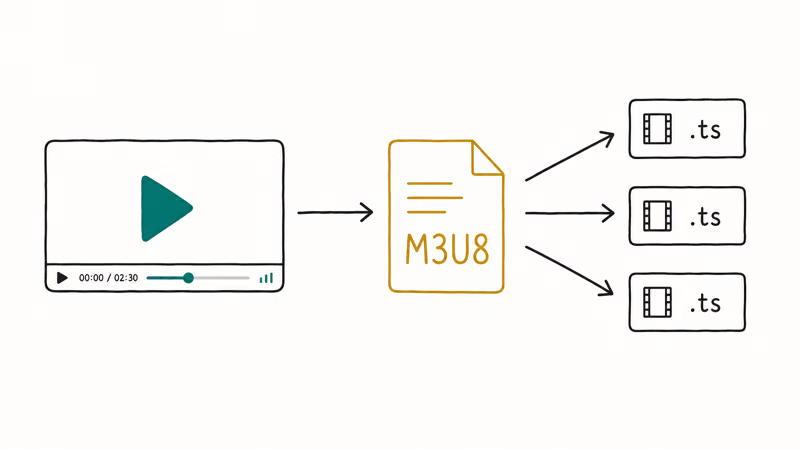
When the manifest won’t load, the failure sits in one of three layers: the network request, the parser, or the segment fetch. The browser shows a generic message while the real cause hides in the Network tab.
#How to Read the Browser DevTools for an HLS Failure
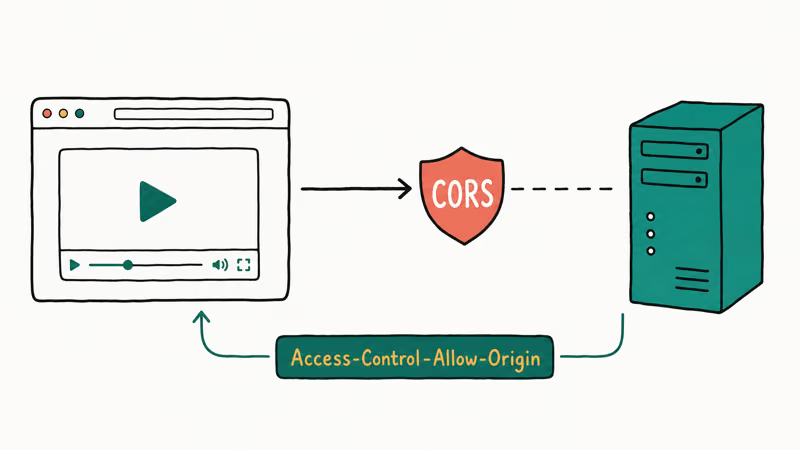
Open DevTools. Switch to the Network tab, filter by m3u8, and reload the page. According to Mozilla’s MDN reference on the CORS Access-Control-Allow-Origin header, any cross-origin fetch from JavaScript requires the server to echo back an allow header that matches the requesting origin, or the wildcard *. If you see the manifest request in red with no response body but a green status code, that mismatch is the cause.
Use a known public sample from the Apple HLS Sample Streams page as a clean comparison point. A working master playlist returns 200 with application/vnd.apple.mpegurl and the allow header.
A CORS failure returns 200 but DevTools shows a red “CORS error” entry. A wrong-path failure returns 404 on the master or on a downstream .ts segment. A token failure returns 403 with a small XML error body from the CDN. Each signature points at a different fix.
#Is the Stream URL You’re Trying to Load Authorized?
Before any technical step, confirm scope. The fixes below apply only to streams you have the right to access.
That includes your own self-hosted HLS, an IPTV subscription you pay for, an OTT testing environment your team operates, or a public test stream like Apple’s official samples. If the m3u8 URL came from extracting a stream out of a streaming service’s authorized app, that is a Terms of Service violation, and ripping DRM-protected streams is restricted under DMCA Section 1201 in the US and similar laws elsewhere.
#What Counts as a Legitimate Use Case
A legitimate use case is one where you control the source, hold a license, or are using a published test asset. Self-hosted HLS from your own server passes. IPTV providers that publish a .m3u portal URL for use in third-party players also pass, as long as you stay within the provider’s stated player policy.
Not sure? Ask the provider’s support team directly. According to the Wowza guide on HLS streaming protocol, most support tickets are about expired tokens and CORS, not about bypass attempts, so providers usually answer fast.
#How Do You Fix a Cross-Domain (CORS) Error on Your Own M3U8?
For a stream you control, the fix is server-side, not browser-side. The CDN or origin server hosting the manifest must send Access-Control-Allow-Origin on every HLS asset. Not just the manifest. Browsers re-check the header on each .ts segment as well.
#Configure CORS on the Origin Server
On Nginx, add the following inside the location block that serves your HLS directory:
location ~ \.(m3u8|ts|m4s|mp4)$ {
    add_header Access-Control-Allow-Origin "*" always;
    add_header Access-Control-Allow-Methods "GET, OPTIONS" always;
    add_header Access-Control-Expose-Headers "Content-Length" always;
}
Apache uses a similar Header set Access-Control-Allow-Origin "*" directive inside the matching <FilesMatch> block. Cloud CDNs like Cloudflare, AWS CloudFront, and Fastly all expose the same header configuration in their dashboards, usually under a “Response Headers” or “CORS policy” section. The official RFC 8216 HLS spec doesn’t mandate CORS, but every browser-based player needs it to work.
#Verify the Header Actually Reaches the Browser
Use curl -I against the manifest URL and look for the allow header in the response. If it’s missing, the origin is fine but the CDN edge is stripping it. That happens when caching layers cache the response from before you added the header. Purge the CDN cache for that path and reload.
#Diagnosing Manifest Path and Token Errors
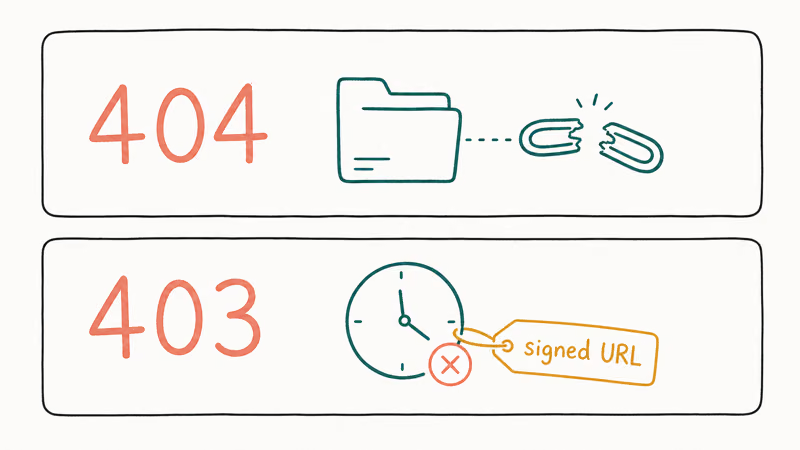
Path errors and token expiry produce 404 or 403 responses, not CORS warnings. The fix differs depending on the response code.
#Fix Relative Path Errors in the Master Playlist
An HLS master playlist lists variants by relative URL. If you serve the master at https://example.com/streams/main.m3u8 and it references 720p/index.m3u8, the player fetches https://example.com/streams/720p/index.m3u8. A wrong directory level or a missing trailing slash breaks every variant.
When a relative path is broken, FFmpeg can return HTTP error 404 Not Found and name the missing segment. The FFmpeg HLS documentation recommends using absolute URLs in the master playlist when the origin and CDN domains differ, which removes the path-resolution problem.
If a stream that worked yesterday breaks today, the manifest probably moved.
#Refresh Expired Signed URLs
Signed CDN URLs include a query string with an expiry timestamp and a signature, often valid for 5 to 60 minutes. A working stream that suddenly fails mid-session is usually a token that expired during playback.
If you control the stream, regenerate the signed URL. If you subscribe through a provider, log out and back in to refresh the session token they hand to your player. Apple’s HLS Authoring Specification recommends 6-second segments for VOD and 2 to 6 seconds for live, so session tokens often need to refresh more often than developers expect. The spec is published at Apple’s HLS Authoring Specification and confirms that 6 seconds is the default target duration.
#Player-Side Fixes for VLC, Hls.js, and Browser Extensions
Once you’ve ruled out server-side problems, the remaining failures are inside the player. Different players surface errors in different ways.
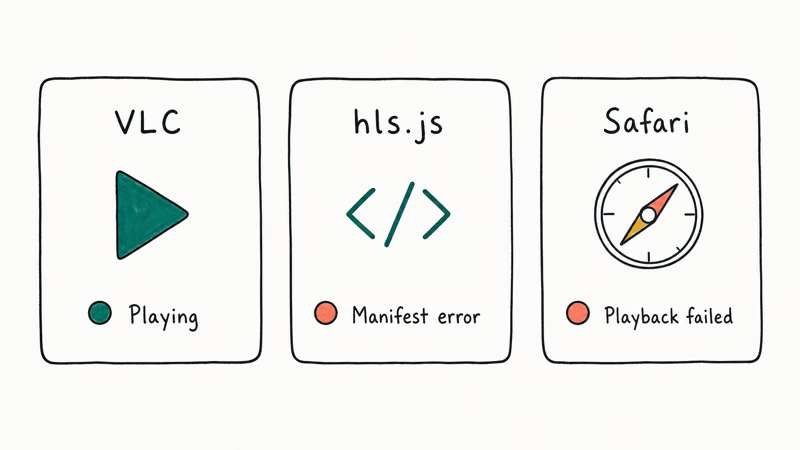
#VLC Media Player
For a legitimate stream URL, open VLC, go to Media > Open Network Stream, paste the m3u8 URL, and click Play. If VLC shows “Your input can’t be opened”, open Tools > Messages and set verbosity to 2 to see the actual HTTP error.
The Apple BipBop sample stream is a useful VLC baseline because it uses standard 6-second segments and a well-formed master playlist. If BipBop plays without configuration changes, compare its headers and manifest structure against your stream.
If BipBop plays but yours does not, the server is the suspect.
Related walkthroughs: merging audio and video in VLC and audio codec not supported for codec errors.
#Hls.js in the Browser
For developers, hls.js is the reference open-source library for playing HLS in browsers that lack native support. It emits typed error events. A MANIFEST_LOAD_ERROR is a network or CORS problem; a MANIFEST_PARSING_ERROR means the file loaded but isn’t valid HLS syntax. The hls.js documentation has a complete error type table.
Hook into the Hls.Events.ERROR event and log the data.type and data.details fields. That’s the fastest path to the real cause.
#Browser Extensions and Native Playback
Safari and most iOS browsers play HLS natively because Apple created the format. Chrome and Firefox need either hls.js, a video element source pointed at a polyfilled URL, or a browser extension. If a stream plays in Safari but not in Chrome, the issue is almost always missing native support, not a server problem. For desktop playback alternatives beyond VLC, see our best video players roundup.
Kodi users hitting similar HLS issues can check our fix Kodi playback failed guide, and Instagram playback failures get their own walkthrough in how to fix Instagram videos not playing.
#Network and Firewall Causes
Network-layer issues are less common than CORS or token problems but still happen. A corporate firewall that blocks port 443 to a CDN domain, an aggressive ad-blocker extension, or a VPN routing HLS traffic through a high-latency exit can all break playback. For container-related playback troubleshooting, our m2ts VLC guide covers a related case.
#Diagnose Network-Layer Blocks
Disable browser extensions one at a time and reload. Ad-blockers like uBlock Origin can flag CDN domains used by both ads and legitimate streams. If disabling all extensions fixes playback, re-enable them one by one to find the culprit. For VPNs, switch to a closer exit node and retest before assuming the stream itself is broken.
#Bottom Line
Start with CORS.
For nine out of ten “m3u8 not loading” cases on streams you own or have the right to access, the cause is a missing or wrong Access-Control-Allow-Origin header on the origin or CDN. Open DevTools Network tab, look at the actual HTTP status and response headers on the .m3u8 request, and only move on to player settings or firewall changes after you’ve confirmed the server is returning the manifest correctly with CORS headers.
Don’t edit browser security settings or install bypass extensions until you’ve ruled out the server-side fix. Loosening browser security creates real risk without addressing the actual cause.
#Frequently Asked Questions
Why does the same m3u8 work in Safari but not Chrome?
Safari plays HLS natively because Apple created the format. Chrome needs hls.js or an extension to do the same job.
Is it legal to extract m3u8 URLs from a streaming service?
Pulling stream URLs out of services like Netflix, Disney+, or a paid sports feed and playing them in a third-party player almost always violates the service’s Terms of Service. If the stream is DRM-protected, breaking the protection is restricted under DMCA Section 1201 in the US. Stick to streams you host, IPTV subscriptions that publish a player-friendly URL, or public test streams.
How long do signed CDN URLs stay valid?
Most expire between 5 and 60 minutes. Live streams sometimes refresh tokens continuously through a session cookie.
Can a VPN cause the can’t load m3u8 error?
Yes, in two ways. A VPN exit node that the CDN has rate-limited or geo-blocked returns a 403 on the manifest. A VPN with high latency or packet loss can also cause segment fetches to time out, which the player reports as a load failure. Test without the VPN to isolate the cause.
Does the crossdomain access denied error on m3u8 streams mean my browser is broken?
No. The browser is doing its job by refusing a CORS-protected fetch. The fix is on the server.
What tools should I use to test an m3u8 stream outside a browser?
FFmpeg’s ffprobe command reads an m3u8 URL and reports the variants, codecs, and any HTTP errors it encounters. Apple’s mediastreamvalidator tool, distributed in the HLS Tools download, runs a full RFC 8216 conformance check on a manifest and produces a detailed report on every variant, segment, and tag. The two tools complement each other: ffprobe catches transport issues, while mediastreamvalidator catches spec-level errors that a player might silently ignore. Run both before you blame your player.
Are HLS Player browser extensions safe to install?
It depends on the publisher. Extensions that only add MediaSource support are fine. Ones that promise to play any stream regardless of restrictions usually inject ad code, track browsing, or both.
What is the difference between a manifest error and a segment error?
A manifest error means the .m3u8 file itself failed to load or parse, while a segment error means the manifest loaded fine but one of the .ts or .m4s media chunks failed mid-session. Manifest errors are usually CORS or path problems. Segment errors are usually CDN edge problems, expired tokens partway through a session, or transient origin-server hiccups that recover on retry.

Best Laptop for Running LLMs in 2026: Memory Comes First
The best laptop for running LLMs is a memory purchase first. Compare MacBook unified memory against NVIDIA laptop VRAM, and see what each tier really runs.

How to Run a Local LLM on Windows: A 2026 Setup Guide
Run a local LLM on Windows with LM Studio or Ollama. Pick a model that fits your GPU memory, keep every prompt offline, and skip the monthly bill.
Bluetooth Not Working on Snapdragon X? Fixes for 2026
Bluetooth not working on your Snapdragon X Copilot+ PC? Generic audio, mice, and keyboards work, but vendor apps often lack an ARM build. Fixes inside.
Docker Desktop and WSL2 Not Working on Snapdragon X? Fix It
WSL2 runs fine on Snapdragon X, but Docker Desktop ARM is Early Access and throws WSL errors. Use WSL2 plus native ARM64 Ubuntu and Docker Engine.