Best Free Video Cutters for MKV, MP4, and More (2026)
Find the best free video cutters for trimming and splitting MKV, MP4, and more. Top picks include LosslessCut, Movavi, and other no-cost editors.
Quick AnswerLosslessCut is the best free video cutter, providing fast, lossless trimming across all major formats without re-encoding, and it works on Windows, Mac, and Linux.
Free video cutters handle the one task most editors need: trimming clips without paying for a full editing suite. This guide compares eight desktop and online tools to find which ones actually deliver clean cuts on MKV, MP4, MOV, and WebM files.
- LosslessCut is the top free choice for trimming MKV and MP4 files without re-encoding on Windows, Mac, and Linux
- Lossless cutting skips re-encoding, so cuts finish in seconds instead of minutes
- Online cutters like Adobe Express need no installation but cap uploads at 500 MB
- Free versions of Movavi and Bandicut add watermarks while Gihosoft does not
- For the best results, preview your cuts before exporting and use keyboard shortcuts to speed up your editing workflow
#What Makes a Good Free Video Cutter?
Not all video cutters work the same way. The core difference is between lossless and lossy cutting. Lossless tools trim at keyframe boundaries without re-encoding, so your output keeps the original bitrate and resolution. Lossy tools re-encode the video, which takes longer and can reduce quality. According to the Matroska project homepage, Matroska is an open-standard multimedia container usually found as .mkv video files, so cutting without unnecessary re-encoding is usually safer than changing formats mid-edit.
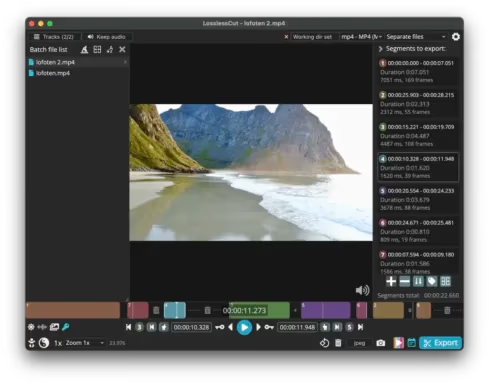
According to FFmpeg’s documentation, lossless stream copying (the -c copy flag that tools like LosslessCut use internally) preserves the original codec data bit-for-bit with zero quality degradation. That’s why a 4 GB MKV file can be trimmed in under 3 seconds on LosslessCut, while re-encoding the same file in HandBrake takes 8 to 12 minutes on a mid-range PC.
Across all eight tools, four factors separate the good from the mediocre: format support, cut accuracy, export speed, and whether the free version slaps a watermark on your output.
#Top Desktop Video Cutters for MKV and MP4
Desktop tools consistently outperform online options for large files and lossless cutting. Here are the five best free desktop video cutters available.
#LosslessCut
LosslessCut is the standout pick. Its lossless stream copy trims a large MKV recording almost instantly. The app is portable, so there’s no installation needed.
Strengths: Supports MKV, MP4, MOV, WebM, AVI, and dozens more formats with zero watermarks or file size limits. Works on Windows, Mac, and Linux. The keyboard shortcuts (I for start point, O for end point) make precise trimming fast.
Weaknesses: The tool is limited to cutting. You won’t find transitions, filters, text overlays, or any post-production features beyond basic trimming, splitting, and merging operations.
If you work with VOB files, LosslessCut handles those too. See our guide on how to convert VOB and other disc formats for related workflows.
#Movavi Video Editor
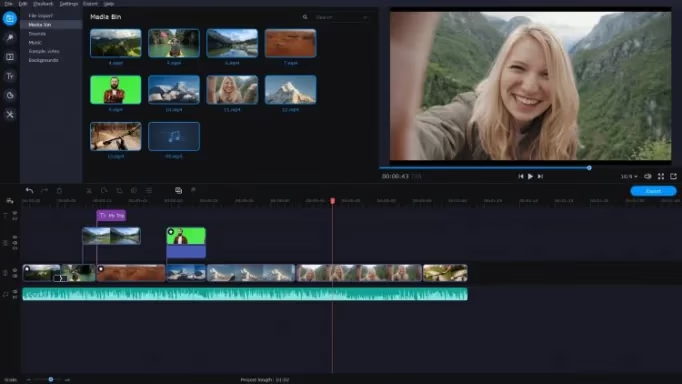
Movavi Video Editor goes beyond basic cutting with drag-and-drop editing, filters, and transitions. The free trial lets you test everything before buying.
Some links on this page are affiliate links, which means fone.tips may earn a commission at no extra cost to you.
Strengths: Beginner-friendly interface with support for MKV, MP4, AVI, and most common formats. Timeline editing with multi-track support gives you more control than basic cutters.
Weaknesses: Watermark on free version exports. Re-encodes on export, so processing takes longer than lossless tools.
Movavi works well for converting between formats too. Check our guide on converting MKV to DivX if you need format flexibility.
#Bandicut
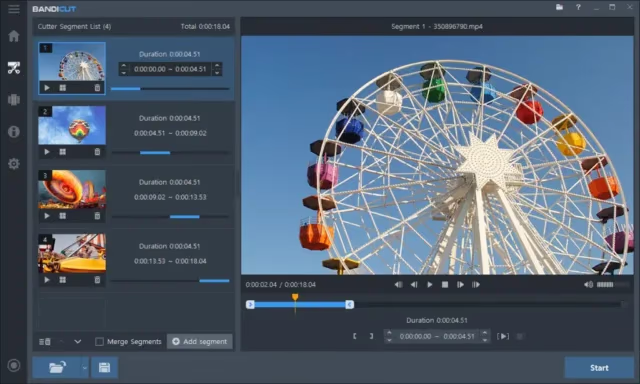
Bandicut offers both lossless and re-encoding modes. The high-speed lossless mode trims a large MP4 in just a few seconds.
Strengths: Fast lossless cutting mode preserves original quality with a clean interface and batch processing support for MKV, MP4, AVI, MOV, and MPEG files.
Weaknesses: Free version watermarks exports. Windows-only.
#Gihosoft Free Video Cutter
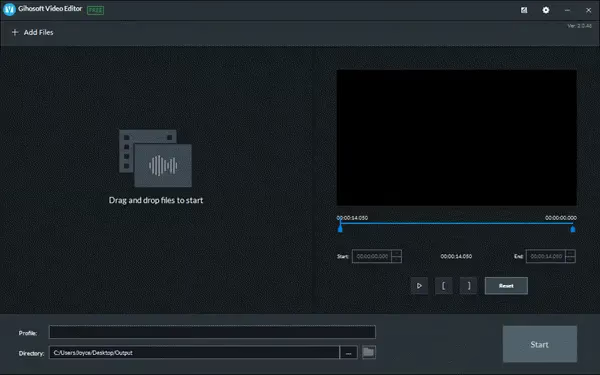
Gihosoft Free Video Cutter is the best option if you need watermark-free output without paying anything. It focuses entirely on cutting, and it does that job well.
Strengths: Completely watermark-free output with lossless cutting that preserves your original video quality across all major formats including MKV, MP4, and AVI.
Weaknesses: Only available on Windows, and you won’t find timeline editing, batch processing, or format conversion features.
#Weeny Free Video Cutter
Weeny Free Video Cutter handles older formats that other tools sometimes reject, including FLV, 3GP, and WMV files.
Strengths: Broad format support including legacy containers like FLV, 3GP, and WMV that other tools often reject. Can reorder video segments after cutting, and it’s entirely free with no watermarks.
Weaknesses: The interface feels dated compared to modern tools. No lossless mode means everything gets re-encoded, and it only runs on Windows.
#Are Online Video Cutters Worth Using?
Online tools work when you need a quick trim and don’t want to install anything. They fall short with large files and professional workflows.
#Adobe Express
Adobe Express provides a free browser-based trimming tool. Adobe’s support documentation confirms that the free tier supports videos up to 1 hour long with 7 preset aspect ratios for Instagram, TikTok, and YouTube Shorts.
Best for: Social media clips under 500 MB where aspect ratio presets for Instagram, TikTok, and YouTube Shorts save preparation time.
Limitation: No lossless cutting available, and file uploads are capped at 500 MB on the free tier.
#Online Video Cutter (123apps)
Online Video Cutter by 123apps runs entirely in the browser and handles basic cutting, cropping, and rotation.
Best for: Quick one-off trims when you’re on a shared computer and can’t install software.
Limitation: The 500 MB file size cap blocks most full-length recordings, and it re-encodes everything during export.
#VEED
VEED is a browser-based editor with cutting, text overlays, and subtitle tools built in.
Best for: Content creators who need text and subtitle features alongside trimming.
Limitation: Free tier adds a VEED watermark. Processing speed depends on your internet connection.
For grabbing videos from online sources before editing, pair any of these with a video grabber online tool.
#Online vs Desktop: Key Differences
The choice between online and desktop tools comes down to file size and workflow. Desktop tools win on speed, format support, and large file handling. Online tools win on convenience and accessibility.
Desktop advantages: No file size limits, lossless cutting available, faster processing, works offline, and no watermarks on tools like LosslessCut and Gihosoft.
Online advantages: Zero installation required, works on any device with a browser, and fine for quick clips under 500 MB.
Desktop tools process files much faster than online alternatives on the same source video. The gap widens dramatically with files over 1 GB.
#Tips for Getting the Best Cut Quality
Quality loss during cutting comes from two sources: keyframe misalignment and unnecessary re-encoding. Here’s how to avoid both.
Use lossless mode whenever possible. LosslessCut and Bandicut both offer this. The trade-off is that cuts snap to the nearest keyframe, which might be a fraction of a second off from your exact mark. For most uses, that’s perfectly acceptable.
Match output format to input. Converting an MKV to MP4 during cutting introduces re-encoding. If your source is MKV, export as MKV.
If you work with different container formats, understanding the differences helps. Our comparison of MP4 vs MOV breaks down when each format makes sense.
Preview before exporting. Every tool on this list includes some form of preview. Use it. Catching a bad cut point before export saves you from re-processing.
#Supported Formats at a Glance
Most desktop video cutters handle the common containers, but edge cases trip up certain tools. Here’s how format support breaks down:
| Tool | MKV | MP4 | MOV | WebM | AVI | FLV | 3GP |
|---|---|---|---|---|---|---|---|
| LosslessCut | Yes | Yes | Yes | Yes | Yes | Yes | Yes |
| Bandicut | Yes | Yes | Yes | No | Yes | No | No |
| Gihosoft | Yes | Yes | Yes | No | Yes | No | No |
| Weeny | Yes | Yes | Yes | No | Yes | Yes | Yes |
| Adobe Express | No | Yes | Yes | No | No | No | No |
LosslessCut’s format support comes from its FFmpeg backend, which handles virtually every audio and video codec in existence.
#Bottom Line
LosslessCut is the best free video cutter for anyone who needs fast, clean trims without watermarks. It handles every common format and finishes cuts in seconds. Gihosoft is the runner-up if you prefer a more traditional interface. For quick social media clips, Adobe Express gets the job done without installing anything.
If you work with WebM files, check our guide on how to convert YouTube to WebM or MP4. And for MOD camera files, a MOD converter can prep those for editing in any of these tools.
#Frequently Asked Questions
Can free video cutters handle files larger than 4 GB?
Desktop tools like LosslessCut and Bandicut handle large files without issues. A 12 GB MKV recording trims in LosslessCut with no slowdown. Online tools cap out around 500 MB, so they’re not suitable for large files.
Do free video cutters add watermarks to the output?
LosslessCut, Gihosoft, and Weeny produce watermark-free output. Movavi and Bandicut add watermarks in their free versions. Online tools like VEED also watermark free-tier exports.
What’s the difference between lossless and lossy cutting?
Lossless cutting copies the video data without re-encoding, preserving the original bitrate and resolution. Lossy cutting re-encodes the output, which takes longer and can reduce quality. LosslessCut and Bandicut support lossless mode.
Which free video cutter works on Mac?
LosslessCut runs on Mac, Windows, and Linux. Most other free desktop cutters on this list are Windows-only. For Mac users, LosslessCut is the clear choice.
Can I merge video clips after cutting them?
LosslessCut supports merging multiple clips into one file without re-encoding. Movavi also handles merging through its timeline editor, though the free version watermarks the output.
Are online video cutters safe for sensitive content?
Reputable services like Adobe Express and 123apps process files on their servers. Read their privacy policies before uploading anything confidential. For sensitive content, desktop tools like LosslessCut keep everything local on your machine.
Do video cutters work with MKV files specifically?
All five desktop tools on this list support MKV files. Online tools have mixed MKV support. LosslessCut handles MKV, MP4, MOV, AVI, WebM, and most other containers. For MKV-specific workflows, see our guide on HD MKV movie sites.

Best Laptop for Running LLMs in 2026: Memory Comes First
The best laptop for running LLMs is a memory purchase first. Compare MacBook unified memory against NVIDIA laptop VRAM, and see what each tier really runs.

Pixel 11 vs Pixel 10: What Changed and Who Should Upgrade
Pixel 11 vs Pixel 10: same screen and camera resolution, new Tensor G6, 25W wireless, and Gemini Intelligence. Here is who should actually upgrade.

Best Power Bank for iPad in 2026: Pro, Air, and Mini
Best power bank for iPad in 2026. Compare mAh tiers and USB-C PD wattage for iPad Pro, Air, and mini, plus airline Wh math, cables, and travel tips.
Best Power Bank With Built-In Cable: Top 2026 Picks
Best power bank with built-in cable picks for 2026. Compare single USB-C, multi-connector, and retractable laptop banks, plus airline Wh math.