Best Power Bank for Camping Trips and Trail Backups
Find the best power bank for camping trips. Compare USB-C PD output, Wh limits, waterproofing, solar charging, and lightweight trail picks now.
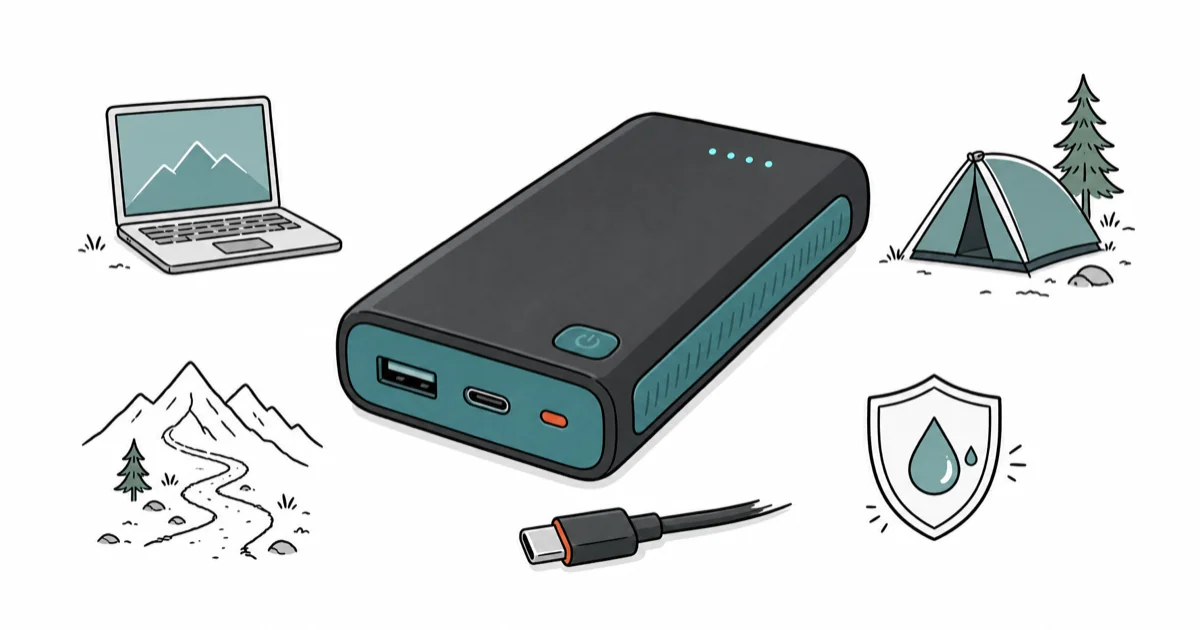
Quick AnswerThe BioLite Charge 100 Max is the best power bank for camping if you need laptop-class USB-C output, while the Nitecore NB10000 Gen3 is better for light packs.
The best power bank for camping depends on whether you’re charging phones and headlamps or keeping a laptop alive at camp. This guide ranks camping-style packs by weight, USB-C output, and how well each one shrugs off damp gear.
- Check watt-hours, not only mAh, because airlines and larger packs use Wh limits
- BioLite Charge 100 Max is the best camp power bank for USB-C laptops and multi-device kits
- Nitecore NB10000 Gen3 is the light-pack pick at 150 g with IPX5 resistance
- Most high-output banks are not waterproof, so pack a dry bag even if the campsite looks calm
- Solar works best as a slow refill plan, not as your only charging plan for a weekend
#How Big Should a Camping Power Bank Be?
Pick capacity by trip length and device type. A phone-and-headlamp weekend needs far less battery than a camp work setup with a laptop, camera, and hotspot.
For everyday charging context, our best power bank hub covers the general picks.
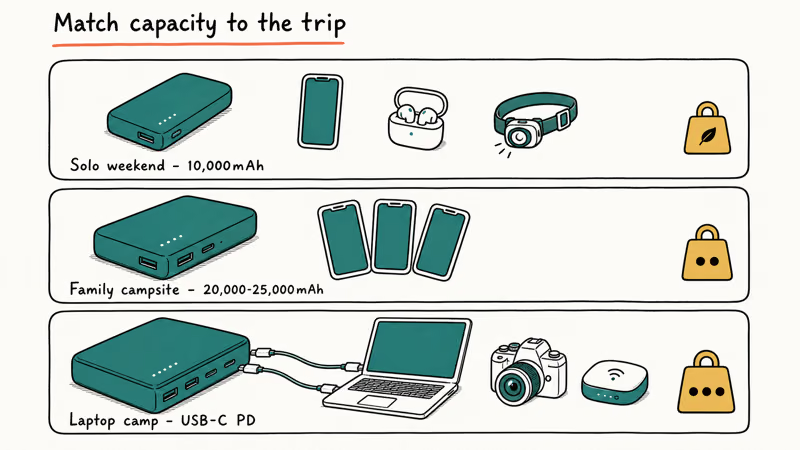
Weight decides what you carry.
For one phone, 10,000mAh is the clean starting point. That size handles a phone, earbuds, and a headlamp top-up without turning the pack into dead weight. For a family campsite, jump to the 20,000mAh to 25,000mAh range so one pack can handle several phones.
Laptop charging changes the math. Capacity alone is not enough; the bank also needs USB-C Power Delivery at a wattage your laptop accepts. For MacBook-focused picks, our best power bank for MacBook Pro guide goes deeper on 65W, 100W, and 140W charging.
Wattage changes the tier.
#Do Airline Battery Rules Matter for Camping?
Airline rules matter if you fly to the trailhead. According to the FAA PackSafe battery guidance, power banks count as spare batteries, lithium-ion spare batteries are carry-on only, and the standard limit is 100 Wh per battery.
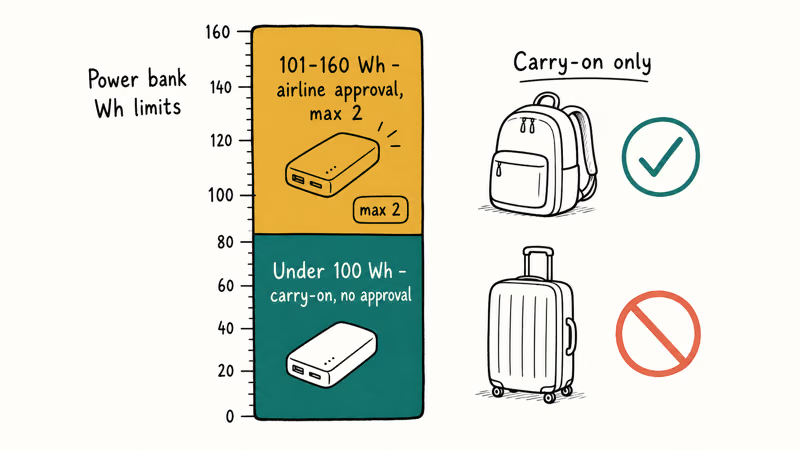
Flights add rules.
The same FAA page states that batteries from 101 Wh to 160 Wh require airline approval and are limited to two spare batteries. That is why many travel-friendly camp banks sit just below 100Wh. It keeps them useful for camping without turning every flight into a policy check.
Don’t pack a power bank in checked luggage. Keep it where you can reach it, cover exposed ports, and verify the Wh label before you leave home. For international trips, our best power bank for international travel guide covers the airport angle in more detail.
The label matters.
#Best Overall: BioLite Charge 100 Max
The BioLite Charge 100 Max is the camp pick when you need one bank for phones, tablets, cameras, and a USB-C laptop. BioLite’s Charge 100 Max specs state that it has 25,000 mAh, 91.3 Wh, two USB-C PD 100W ports, and 120W total output.
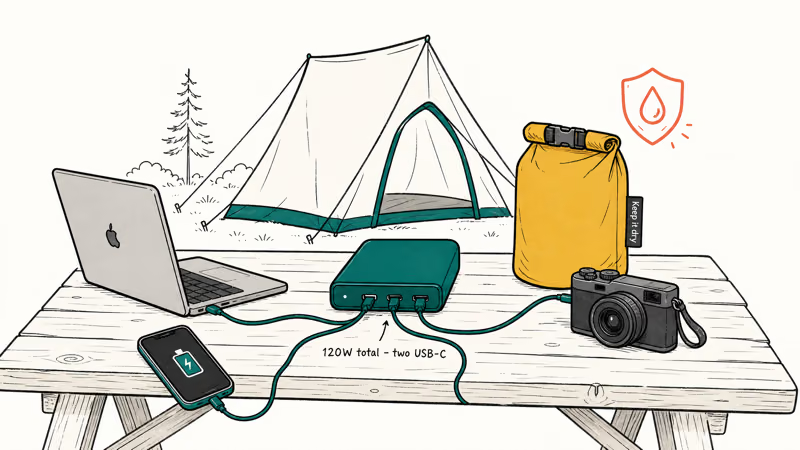
This is the basecamp pick.
That mix is why it works for car camping and cabin weekends. It stays under the 100Wh airline line while still charging laptop-class gear, and the two USB-C ports make it easier to share power at camp.
The trade-off is weather protection. BioLite’s water-resistance FAQ states that the Charge 100 Max is not designed for water exposure. Pack it in a dry bag or keep it inside the tent, especially if you’re charging overnight.
Dry storage is not optional.
#Best Lightweight Pick: Nitecore NB10000 Gen3
The Nitecore NB10000 Gen3 is the right choice when pack weight matters more than laptop output. Nitecore’s NB10000 Gen3 specs state that it has 10,000 mAh, 38.5 Wh, 150 g weight, 22.5W fast charging, and IPX5 resistance.
Trail packs punish ounces.
A 10,000mAh pack is the size that stays comfortable in a daypack. It handles a phone top-up and headlamp recharge without making the pack feel lopsided.
The NB10000 Gen3 is not the family-campsite pick. It’s the hiker’s backup. If you need to charge three phones, a tablet, and a camera battery, choose a higher-capacity bank and accept the weight.
#Best Solar-Friendly Camp Pick: Goal Zero Sherpa 100PD
The Goal Zero Sherpa 100PD is the pick if you already use Goal Zero solar panels or want several refill paths. Goal Zero’s Sherpa 100PD specs state that it has 94.7 Wh, 100W USB-C output, 60W USB-C input, 15W wireless charging, and support for USB solar panel charging.
Solar is not magic. A panel can help on a long sunny trip, but clouds, shade, and panel angle all slow charging. Treat solar as a backup refill, not the core plan.
For most campers, the Sherpa makes sense when you already own compatible Goal Zero gear. If you’re starting from scratch and only need phones, the BioLite or Nitecore route is easier to justify.
Treat solar as backup.
#Best High-Wattage Backup: Anker 737 PowerCore
The Anker 737 PowerCore 24K is the high-output pick for laptop users who still want a backpack-sized bank. Anker’s 737 PowerCore specs state that it has 24,000 mAh, 86.4 Wh, up to 140W output, and two USB-C ports plus one USB-A port.
High output stays useful.
Buy this for output, not ruggedness. It’s useful for a MacBook, USB-C camera charger, or portable monitor setup, but it isn’t a wet-weather camping accessory. Treat it like camera gear and keep it dry.
Keep it dry.
If you mostly camp from a car and need AC outlets, you may need a power station instead of a power bank. A pocketable bank stays better for phones, tablets, and USB-C laptops.
#Camping Features Worth Paying For
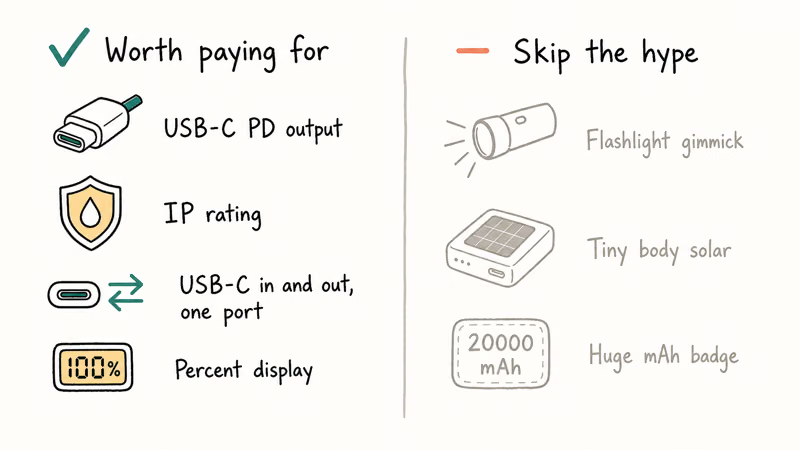
USB-C PD output, weather handling, and port count matter most. Flashlight gimmicks, tiny solar panels on the bank body, and huge mAh labels matter less.
Ports beat gimmicks.
Look for USB-C input and output on the same port, because you can use one cable for your wall charger, car charger, and laptop. A percentage display is helpful if you’re managing family devices. An IP rating matters if the bank rides in a damp pack.
Consumer Reports’ portable charger guide recommends separating phone chargers from laptop-capable packs, which is the right split at camp. Two short USB-C cables and one charger do more for camp order than any extra feature on the bank itself.
Our best USB-C cable and best GaN charger guides cover the cable and wall-charger side.
#Bottom Line
Buy the BioLite Charge 100 Max if you want one camping power bank that can handle laptops and several smaller devices. It has the right Wh size for travel and enough USB-C output for serious camp charging, but you need to keep it dry.
Choose the Nitecore NB10000 Gen3 if you hike light. Pick the Sherpa 100PD if solar-panel compatibility matters. Pick the Anker 737 if your main concern is high-wattage USB-C output.
Match the pack to the trip.
#Frequently Asked Questions
How many mAh do I need for a weekend camping trip?
For one phone, 10,000mAh is enough for a weekend. For two or more people, move to 20,000mAh or 25,000mAh.
Can I bring a camping power bank on a plane?
Yes, if it meets airline rules and rides in your carry-on. The common limit is 100Wh per power bank without airline approval. Check the Wh label on the battery, not only the mAh number.
Is a solar power bank worth it for camping?
Usually not as your only charger. Small built-in panels refill too slowly for weekend use. Leave home with the bank charged.
Are camping power banks waterproof?
Some are water-resistant, but many high-output banks are not. Look for an IP rating before trusting it near rain, then still use a dry bag. Ports and cables are weak points.
What wattage do I need to charge a laptop at camp?
Many small laptops can charge from 45W to 65W, while larger models prefer 100W or more. Match the bank’s USB-C PD output to your laptop charger. If the bank is lower, it may charge slowly or only when the laptop sleeps.
Should I buy a power bank or a power station?
Buy a power bank for phones, tablets, cameras, and USB-C laptops. Buy a power station if you need AC outlets or multi-day car camping power.
How do I store a power bank at camp?
Keep it out of direct sun, off wet ground, and away from loose metal items. Charge inside a tent only when you can check the setup. A dry bag plus short cables is the least fussy setup.

Best Laptop for Running LLMs in 2026: Memory Comes First
The best laptop for running LLMs is a memory purchase first. Compare MacBook unified memory against NVIDIA laptop VRAM, and see what each tier really runs.
Pixel 11 vs Pixel 10: What Changed and Who Should Upgrade
Pixel 11 vs Pixel 10: same screen and camera resolution, new Tensor G6, 25W wireless, and Gemini Intelligence. Here is who should actually upgrade.
Best Power Bank for iPad in 2026: Pro, Air, and Mini
Best power bank for iPad in 2026. Compare mAh tiers and USB-C PD wattage for iPad Pro, Air, and mini, plus airline Wh math, cables, and travel tips.
Best Power Bank With Built-In Cable: Top 2026 Picks
Best power bank with built-in cable picks for 2026. Compare single USB-C, multi-connector, and retractable laptop banks, plus airline Wh math.