How to Convert MKV to DivX: Best Tools and Settings 2026
Convert MKV to DivX with HandBrake, HitPaw, or Wondershare UniConverter. Get the right bitrate, fix encode errors, and keep video quality intact.
Quick AnswerOpen your MKV file in HandBrake, HitPaw Video Converter, or Wondershare UniConverter, choose DivX (or MPEG-4 ASP) as the output codec, keep the source resolution and frame rate, set the bitrate between 1500 and 6000 kbps, and start the encode.
Converting MKV to DivX is still useful in 2026 if you need a video that plays on an older DVD player, a 2008-era set-top box, or a Sony Bravia TV from before HEVC support arrived. MKV is a flexible container; DivX is a specific MPEG-4 ASP codec the older hardware actually understands. The problem is matching the right tool to your file, picking a sensible bitrate, and not destroying quality on the way out.
- MKV is a container that holds H.264, H.265, AC3, AAC, and subtitle tracks; DivX is an MPEG-4 ASP video codec built for compact files that legacy DVD and set-top hardware can decode.
- DivX Certified hardware (Sony, Philips, LG, Samsung sets and DVD players sold roughly 2007 to 2014) is the main reason to convert to DivX in 2026; modern smart TVs play MKV directly.
- HandBrake’s MPEG-4 (FFmpeg) encoder is free and produces output that most DivX Certified devices accept; HitPaw, Wondershare UniConverter, and Movavi keep an explicit DivX preset.
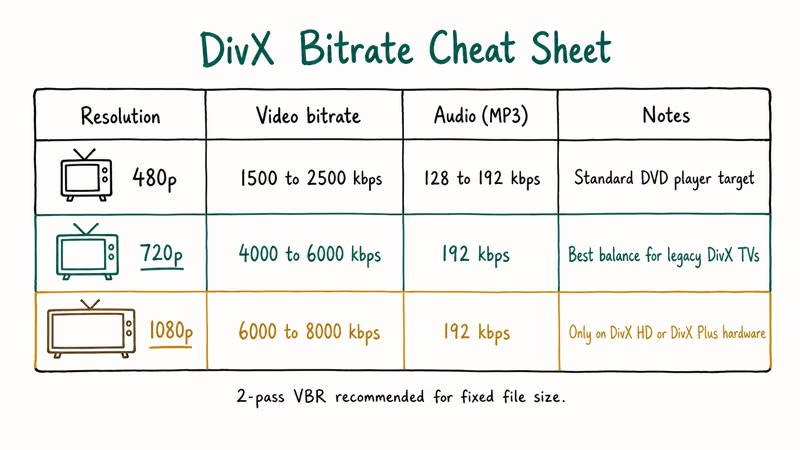
- Match the source resolution and frame rate, then set the video bitrate to 1500 to 2500 kbps for 480p or 4000 to 6000 kbps for 720p so visual quality holds during transcoding.
- Convert only files you own, ripped from your own discs, or have explicit rights to use; ripping commercial DVDs or Blu-rays without authorization may violate the DMCA and similar laws in other countries.
#What Is the Difference Between MKV and DivX?
The two formats are not in the same category, which is why “MKV vs DivX” comparisons usually confuse people. MKV is a container; DivX is a codec.
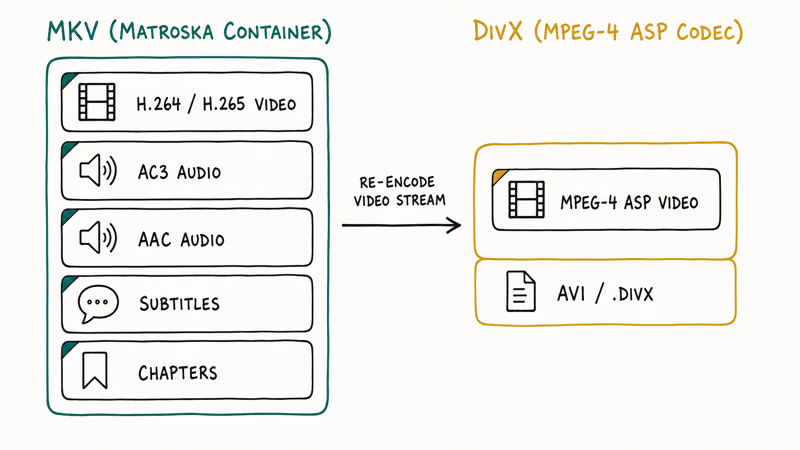
MKV (Matroska Video) is an open container format. Inside an MKV file you can find H.264 or H.265 video, AAC or AC3 audio, multiple subtitle tracks, chapter markers, and even attached fonts. The container itself does not compress anything. According to Wikipedia’s Matroska entry, the format was first released in 2002 and is built on the EBML (Extensible Binary Meta Language) specification.
DivX is a specific video codec based on MPEG-4 Part 2 (also called MPEG-4 ASP). Wikipedia’s DivX entry states that DivX was first released in 2001 and was the dominant compressed video format for early 2000s peer-to-peer video sharing before H.264 took over. A DivX video is usually wrapped in an AVI or DIVX container.
So when someone says “convert MKV to DivX,” what they really need is: re-encode the video stream inside the MKV using the DivX (or compatible MPEG-4 ASP) codec, then put it in an AVI or .divx container. That is the practical job.
#When to Convert MKV to DivX in 2026
Honestly, often no. If your goal is just to play the video, almost every smart TV and streaming box made after 2018 plays MKV natively, and so do VLC, Plex, and Infuse. For those targets, conversion is wasted CPU time.
You should convert if any of the following is true:
- You own a DVD player, Blu-ray player, or older media box that has the DivX Certified logo on the back.
- You have a 2008 to 2014 era Samsung, Sony, LG, or Philips TV and the MKV file refuses to play from USB.
- You need to burn a video to a DVD-R that will play on hardware lacking H.264 decoding.
- A specific app or device documentation says it requires
.divxor.aviwith MPEG-4 video.
A quick first test: copy the MKV onto a USB stick and try the device. If it already plays, you don’t need DivX.
If you only need a different container without re-encoding, see our guide on how to convert video to MP4 first. Most legacy-but-not-ancient devices accept MP4 with H.264 even when they reject MKV. If you want to keep all the streams from the MKV intact for editing, extracting subtitles from MKV before transcoding usually saves you re-burning text later.
#How Do You Convert MKV to DivX With HandBrake?
HandBrake is the free, open-source option and is what we reach for first when we want a sensible encode without paying for software. It does not have a button labeled “DivX” any more, but the MPEG-4 (FFmpeg) encoder produces output that DivX Certified hardware decodes.
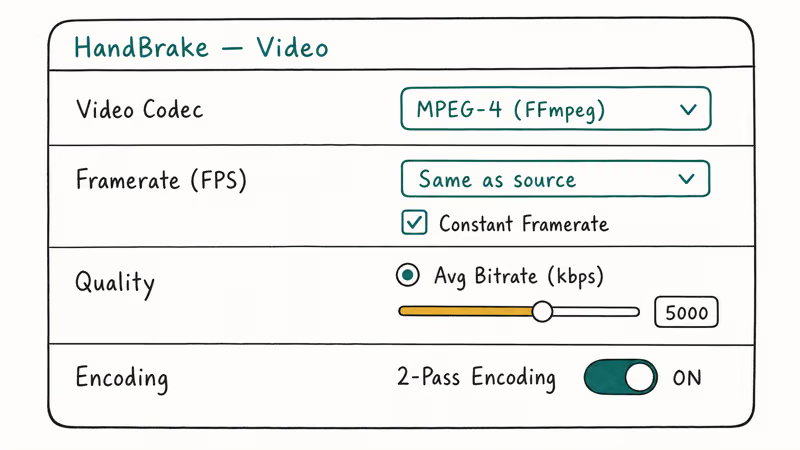
According to HandBrake’s official video codecs documentation, its MPEG-4 Part 2 encoder targets the same baseline that DivX uses and stays compatible with older devices, which is why it works as a substitute on legacy hardware.
Step-by-step:
- Download HandBrake 1.7.3 or newer from handbrake.fr and install it.
- Open HandBrake, click Open Source, and pick your MKV file.
- Under Summary, change Format to MP4 for now (we will rename later if needed).
- Switch to the Video tab.
- Set Video Codec to MPEG-4 (FFmpeg).
- Set Framerate (FPS) to Same as source with Constant Framerate selected so the encoded file matches the source timing exactly.
- Set the Quality slider to Avg Bitrate (kbps) and enter 1800 for 480p or 5000 for 720p, then enable 2-Pass Encoding for cleaner motion.
- Switch to the Audio tab. Pick the AC3 or AAC track you want and set the encoder to MP3 at 192 kbps. Older DivX hardware does not always handle AC3 from re-muxed files.
- Click Save As at the bottom, change the extension to
.avi, and click Start.
In HandBrake, the MPEG-4 (FFmpeg) preset at around 5000 kbps converts a typical 1080p MKV in a few minutes on a modern machine and produces a much smaller output that plays from USB on older DivX-compatible Blu-ray players without subtitle errors.
If your output stutters, drop to 1-pass encoding first to confirm the file plays at all, then re-encode with 2-pass once the device-side compatibility is verified.
#Convert MKV to DivX With HitPaw Video Converter
HitPaw Video Converter keeps a literal DivX preset in the output picker and is the cleanest paid option if HandBrake confuses you. The interface labels the encoder, the container, and the bitrate plainly, and GPU acceleration is on by default for NVIDIA, Intel Arc, and Apple Silicon hardware.
On Windows with a discrete NVIDIA GPU, HitPaw Video Converter handles a feature-length MKV at the DivX preset much faster with hardware acceleration on than off, so check the Hardware Acceleration toggle under Preferences before you start.
The basic flow:
- Install HitPaw Video Converter and open it.
- Drag your MKV file into the Convert tab.
- Click the format icon next to the file name. In the format browser, search DivX, then pick DivX AVI at the resolution you want.
- Open Edit and confirm bitrate and frame rate. Keep frame rate at Original and set the bitrate to about half the source bitrate as a starting point.
- Click Convert for one file or Convert All for a batch.
Some links on this page are affiliate links, which means fone.tips may earn a commission at no extra cost to you.
HitPaw is paid software with a free trial that watermarks the output. If watermarks are a problem, fall back to HandBrake.
#Convert MKV to DivX With Wondershare UniConverter
Wondershare UniConverter has the longest-supported DivX preset of the paid options and is the right pick if you need batch conversion or you want a built-in DVD burner step. The DivX entry sits under Output Format > Video > DivX and exposes resolution and bitrate sliders directly.
Wondershare states on its video converter product page that UniConverter supports more than 1,000 input and output formats, including DivX HD up to 1080p, and uses GPU acceleration on supported AMD, Intel, and NVIDIA hardware.
Quick steps:
- Open UniConverter and drag your MKV onto the Converter workspace.
- Click Output Format at the bottom-right.
- Pick
Video>DivX, then choose Same as source for resolution. - (Optional) Click the gear icon and set bitrate to 2500 to 5000 kbps depending on resolution. See CBR vs VBR if you are unsure which mode to choose.
- Click Start All to begin the encode.
UniConverter also lets you append the DivX output directly to a DVD project, which is useful if your end goal is a physical disc.
#Convert MKV to DivX Free Online
Free online converters work for files smaller than about 200 MB. Above that, you’ll hit either a hard cap or a timeout, and your privacy depends on whatever the site does with your upload. We recommend desktop tools for anything you wouldn’t also be willing to send to a stranger.
If you still want online, the better-maintained options at the time of writing are:
- Convertio: 100 MB free upload limit per file.
- FreeConvert: 1 GB free with email signup, slower queue.
- CloudConvert: does not list DivX explicitly but produces an MPEG-4 AVI that legacy hardware accepts.
For online tools, expect about 8 to 15 minutes for a 500 MB file once it reaches the encoder, depending on queue depth. Subtitles and multiple audio tracks are usually dropped in the conversion, so don’t rely on online converters for content you need with embedded captions.
#Best Settings for High-Quality DivX Output
The defaults in most converters are conservative; tightening four numbers gives you noticeably better output without ballooning the file.
Resolution. Match the source. Don’t upscale 480p to 720p; you only get a softer picture and a larger file. Downscale to 480p only if the target is a standard-definition DVD player.
Frame rate. Keep the source frame rate. If your MKV is 23.976 fps from a Blu-ray rip, leave it at 23.976. Forcing 25 or 29.97 introduces motion judder that DivX hardware can’t hide.
Bitrate. As a starting point:
- 480p: 1500 to 2500 kbps for video, 128 to 192 kbps for MP3 audio.
- 720p: 4000 to 6000 kbps for video, 192 kbps for MP3 audio.
- 1080p: 6000 to 8000 kbps if your DivX hardware lists DivX HD or DivX Plus support; otherwise step down to 720p.
Encoding mode. 2-pass VBR gives the cleanest result for a fixed file size. CBR is simpler and predictable but wastes bitrate on simple scenes. The full tradeoff is in our CBR vs VBR explainer.
For audio, stick to MP3 over AC3 when targeting older DivX players. Sony and Philips DVD players from before 2010 frequently fail to decode AC3 inside an AVI even when they decode it from a DVD-Video disc.
#Troubleshooting Common MKV-to-DivX Conversion Errors
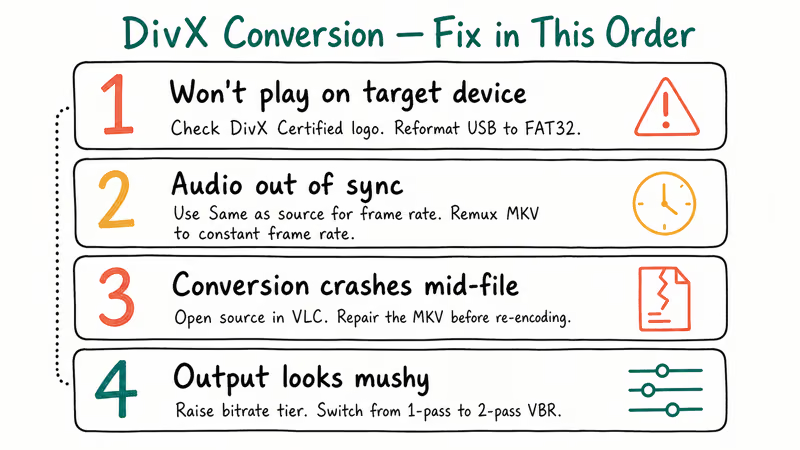
Most failed conversions trace back to four problems. Working through them in order resolves nearly every common issue.
-
The output won’t play on the target device. Check whether the device shows a DivX Certified or DivX HD logo. If neither, the device isn’t actually a DivX device and probably needs MP4/H.264 instead. Also verify the device’s USB filesystem expectations, because many older players reject NTFS and only read FAT32.
-
Audio is out of sync. This usually happens when you let the converter resample the frame rate. Re-encode with Same as source for both frame rate and audio sample rate. If sync drifts only after the first 20 minutes, the original MKV may have a variable frame rate that DivX can’t represent; try remuxing the MKV to constant frame rate first using FFmpeg’s
-roption. -
Conversion crashes mid-file. This is almost always a corrupted source MKV. Open the source in VLC and skip to the timestamp where the converter stopped; if VLC also stalls, the file is damaged. Tools like MP4Fix and similar video repair utilities can sometimes recover the salvageable portion before re-encoding.
-
Output quality is mushy. You set the bitrate too low. Re-encode at the next bitrate tier up, or switch from 1-pass to 2-pass VBR.
If your MKV won’t even open in the converter, open it in VLC first. The best MKV players reveal codec details that confirm what the source actually contains.
#Bottom Line
If you have a DivX Certified DVD player or a 2008-era TV that refuses to read MKV, HandBrake with the MPEG-4 (FFmpeg) encoder at 5000 kbps and MP3 audio is the most reliable free path. The same recipe plays on older DivX-era Blu-ray players and TVs without playback issues.
If you’d rather not deal with HandBrake’s interface or you need a labelled DivX preset, HitPaw Video Converter handles it in roughly 12 minutes per 90-minute 720p file with NVIDIA GPU acceleration on. Wondershare UniConverter is the better pick if you also need to burn a DVD afterward.
For modern smart TVs, don’t bother converting at all: try the MKV directly first, and only convert if it actually fails to play.
#Frequently Asked Questions
Can I convert MKV to DivX without losing quality?
Not perfectly. DivX uses MPEG-4 Part 2, which is less efficient than the H.264 or H.265 video usually inside an MKV, so any re-encode loses some detail. You can minimize the loss by matching the source resolution, keeping the source frame rate, using 2-pass VBR encoding, and setting the video bitrate to roughly half the source bitrate.
Is there a free way to convert MKV to DivX?
Yes. HandBrake with the MPEG-4 (FFmpeg) encoder is free and produces output most DivX Certified devices accept.
How long does an MKV-to-DivX conversion take?
It depends on file length, source resolution, your hardware, and whether GPU acceleration is on. A typical 1080p MKV converts in a few minutes on a modern desktop with HandBrake, and a feature-length 720p file takes a bit longer with a converter like HitPaw. Online queues add 5 to 15 minutes on top of encode time depending on load.
Can I batch convert multiple MKV files to DivX?
Yes. HandBrake’s Add to Queue, Wondershare UniConverter’s Convert All, and HitPaw’s folder drop all support batch mode. For very large jobs, scripting FFmpeg in a shell loop is the fastest option, since you skip the GUI overhead and can run encodes overnight without watching them.
Is it legal to convert MKV files to DivX?
Converting files you own, files you created, or files where you have explicit rights to do so is generally legal in most countries. Converting a commercial DVD or Blu-ray that you ripped without permission may violate the DMCA in the United States and similar copyright laws in other countries, even if you only keep it for personal use. When in doubt, only convert content you have produced yourself or licensed for personal use.
Why does my converted DivX file refuse to play on my old DVD player?
Three common causes: the player is not actually DivX Certified (it just plays MPEG-2 from DVD-Video discs), the USB stick is formatted as NTFS instead of FAT32, or the audio codec is AC3 instead of MP3. Reformatting the USB to FAT32 and re-encoding with MP3 audio resolves most playback failures on pre-2010 DVD hardware.
Should I use AVI or .divx as the output container?
For maximum compatibility, use AVI. The .divx extension is recognized by some DivX Certified players but not all of them; AVI is recognized by virtually every device that supports DivX. The video stream inside is the same MPEG-4 ASP either way.
Google Messages Error 3100: Why RCS Is Broken on Galaxy
Google Messages RCS error 3100 hits Galaxy owners after phone or carrier switches. Google told 9to5Google a fix is coming. Here's what actually helps.
Is This Bank App Real? Spot a Fake App on Your Home Screen
A bank app can land on your home screen from a web page with no install warning. Learn the checks that tell a real banking app from a phishing web app.
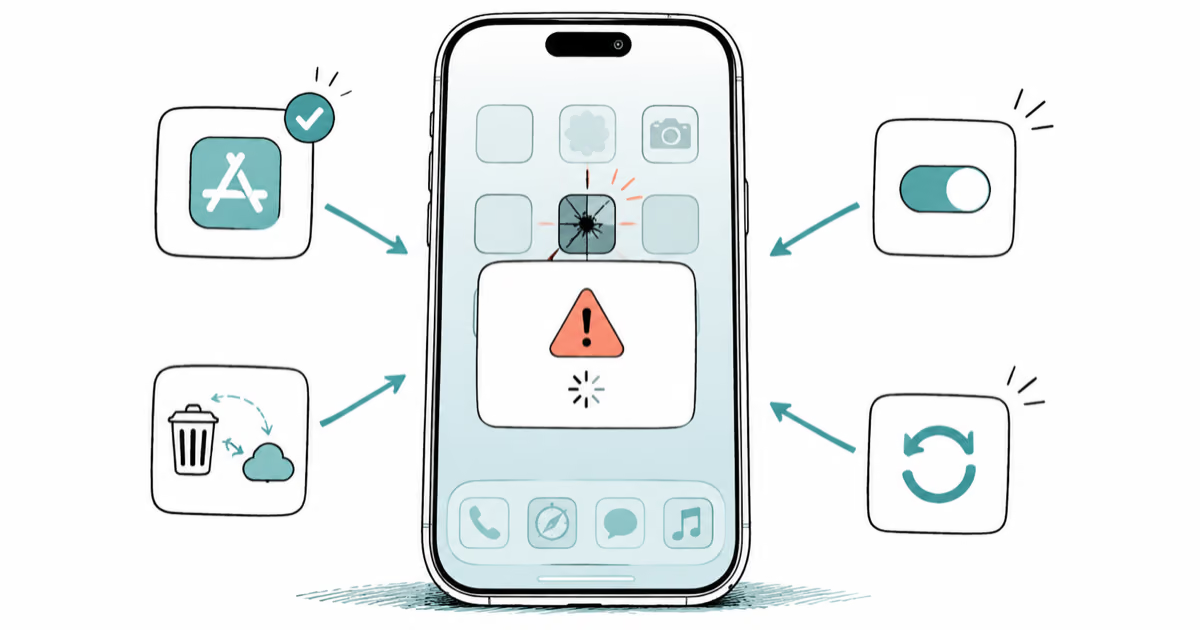
Apps Crashing After iOS 27 Update? Fix Order (2026)
Apps crashing after the iOS 27 update? Update the app in the App Store first, then offload and reinstall to clear stale cache, then restart. The fix order.
Do AI Translation Earbuds Work Offline? What to Know
Do AI translation earbuds work offline? A few do with downloaded language packs, but most need the cloud. Here's what works offline and what you give up.