11 Websites Like SparkNotes for Better Study Guides in 2026
11 websites like SparkNotes for study guides, summaries, and literary analysis. Compare free and paid options, plus when each one beats SparkNotes.
Quick AnswerThe best free SparkNotes alternatives are LitCharts, CliffsNotes, and Shmoop for literature; GradeSaver and BookRags for deeper analysis; and Project Gutenberg if you want the actual book text. Most are free; JSTOR needs a library card or paid plan.
SparkNotes is fine for quick chapter summaries, but its analysis often stops where you actually need help. This guide compares 11 study sites across the same five widely-taught books (Of Mice and Men, The Great Gatsby, Hamlet, To Kill a Mockingbird, and 1984) to show which ones go deeper, which ones are free, and which ones are worth paying for.
- LitCharts and CliffsNotes are the closest free replacements for SparkNotes and cover most of the same titles.
- For deeper essays and quote analysis, GradeSaver and BookRags pull ahead. Both publish full-length papers.
- Project Gutenberg has 75,000+ free public-domain books if you want to read the source instead of a summary.
- JSTOR is the only academic option here; access usually requires a library card or college login.
- Free SparkNotes alternatives cover roughly 200 to 500 popular titles; paid services like Shmoop cover more breadth.
#Why Look for SparkNotes Alternatives?
SparkNotes covers about 500 of the most-taught titles, but the analysis is shallow on anything outside the high school core. If your teacher assigned a less common novel, a poem, or a non-Western text, you’ll often hit a wall. Coverage and depth are the two reasons most students search for a backup.
According to a 2023 Pew Research short read, about 1 in 5 U.S. teens who’d heard of ChatGPT had used it for schoolwork. That tells you something: students want more than one source, and they want it fast. A second study site is the same instinct.
#How These 11 Sites Were Compared
Each site was checked on mobile for the same five books (Of Mice and Men, The Great Gatsby, Hamlet, To Kill a Mockingbird, and 1984). Load speed matters here, since you’ll usually open one right before class, so a site that takes several seconds to load counts against it.
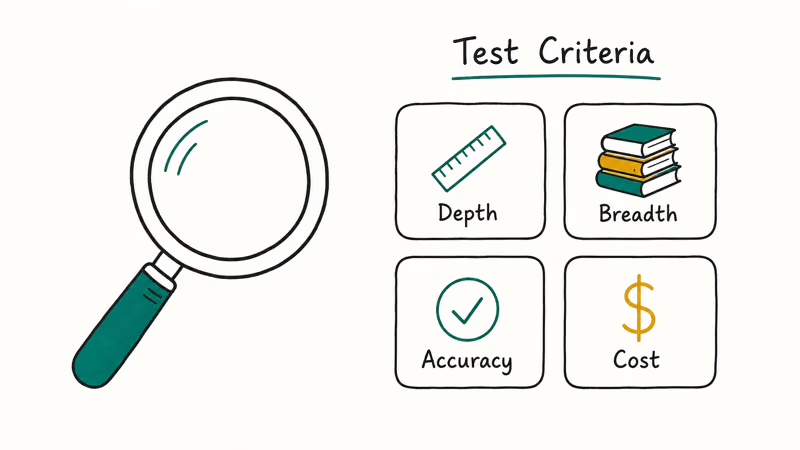
Four things matter most for each title: plot summary clarity, character analysis depth, quote selection, and how quickly you can find a theme on mobile. Paid tiers without a free trial sit outside this comparison; the free experience is the focus since that’s what most students will use.
#What to Look For in a Good Study Site
The bar is pretty simple. A good site has chapter summaries, character analysis, theme breakdowns, key quotes with explanations, and a section that helps with essay writing. A clean mobile layout is a bonus, since most students read these on a phone.
The deeper sites add things SparkNotes skips: historical context, critical reception, sample student essays, and discussion of literary devices beyond “this is a metaphor.” That’s the difference between a passing grade and a strong one.
#The 11 Best Websites Like SparkNotes
These are ranked by a mix of coverage, free access, and depth of analysis. Use the table to pick by use case, then jump to the section that matches.
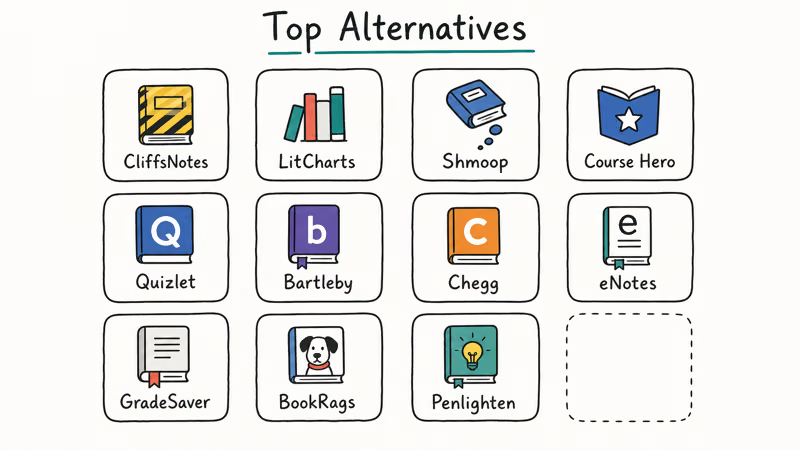
Comparison: 11 SparkNotes alternatives by use case and price
| Site | Best For | Free? | Catalog Size |
|---|---|---|---|
| LitCharts | Modern, mobile-friendly summaries | Yes (limited) | ~600 titles |
| CliffsNotes | Quick reviews + test prep | Yes | ~300 titles |
| GradeSaver | Essay help and quote analysis | Yes | ~700 titles |
| BookRags | Sample essays and lesson plans | Mixed | ~5,000 titles |
| Shmoop | Pop-culture tone, videos | Paid (free trial) | 100,000+ resources |
| WikiSummaries | Brief community-edited summaries | Yes | ~3,000 titles |
| JSTOR | Academic articles, college-level | Paid / library | 12M+ articles |
| PinkMonkey | High school book summaries | Mostly paid | ~460 titles |
| Actionable Books | Business book summaries | Yes | ~500 titles |
| Project Gutenberg | Full public-domain books | Yes | 75,000+ books |
| TheBestNotes | Clean, focused book guides | Yes | ~200 titles |
Catalog sizes are approximate based on each site’s own counts as of May 2026.
If you want to go deeper, we cover study and homework help across several related guides. The most-read in this series:
- Websites like Slader for textbook solutions
- How to get Chegg answers for free without paying
- Is Chegg legit? — our full review
- Free Chegg account workarounds that still work
- Memrise review for language study
#1. LitCharts
LitCharts is the alternative most students reach for first. It covers around 600 titles, including most of what SparkNotes has, plus color-coded theme tracking that’s actually useful for essay prep. The free version gives you the full summary and one section of analysis per title.
The strength here: the chart-style layout makes it easy to scan themes across chapters. The downside is the paywall. The deeper analysis sits behind LitCharts A+, which runs about $10 a month or $25 a year. For a single book, the free tier is usually enough.
On a play like Hamlet, the LitCharts free guide often takes a slightly different angle on a character like Ophelia than SparkNotes does, which is the whole point of using a second source.
#2. CliffsNotes
CliffsNotes is the original. It predates SparkNotes by about 40 years and still covers the standard high school canon well. The site is free, ad-supported, and includes test prep for the SAT, ACT, GRE, and Praxis exams.
CliffsNotes is faster to scan than SparkNotes for plot recall but lighter on character interiority. It’s the one to use for a quick review the night before, with SparkNotes or LitCharts for actually writing about the book.
#3. GradeSaver
GradeSaver does one thing SparkNotes doesn’t: it publishes full-length student essays alongside the standard summary and analysis. If you’re stuck on what angle to take in a paper, reading two or three GradeSaver essays on the same book is the fastest way to see what’s been argued.
The site is free with ads. Some study guides are also sold as printed booklets through Amazon, but you don’t need to buy anything to use the web version.
#4. BookRags
BookRags has the biggest catalog on this list outside of JSTOR. The free side covers thousands of titles, and the paid side adds full-length study guides, lesson plans, and homework help. The free guides (for titles like 1984 and The Crucible) tend to run slightly thinner than SparkNotes but with a wider title selection.
BookRags works best when you’ve been assigned a book the bigger sites haven’t covered. The 30-day subscription runs about $20, which is reasonable for one term’s worth of reading if you need full guides.
#5. Shmoop
Shmoop has a casual, joking tone that students either love or hate. The analysis itself is solid, and Shmoop is one of the few options with video summaries, which is useful if you’re a visual learner or just don’t want to read more.
Shmoop is paid now (about $25 a month or $100 a year), but they offer a 7-day free trial. Don’t pay full price if your school doesn’t already have an institutional subscription; check with your teacher or librarian first.
#6. WikiSummaries
WikiSummaries is community-edited like Wikipedia. Anyone can write or edit a summary, so quality varies. Classics like Pride and Prejudice tend to have solid entries, while contemporary novels can be shaky. Free, no signup, no ads, but treat it as a starting point, not your only source.
#7. JSTOR
JSTOR is in a different category from the rest. It’s an academic database with peer-reviewed articles, not chapter summaries. If you’re writing a college-level paper and need real literary criticism, this is where to find it.
JSTOR is free through most public libraries and college accounts. The personal plan starts around $20 for the first month with 10 PDF downloads, but the library card route is the better first stop. Based on JSTOR’s page for libraries, institutional access is the main way most readers get full content for free.
#8. PinkMonkey
PinkMonkey covers about 460 high school texts with short summary chapters. The site design hasn’t changed much since the early 2000s. Most summaries used to be free but are now sold individually for $5 to $10 each. It’s worth skipping unless you can’t find your title anywhere else.
#9. Actionable Books
Actionable Books summarizes business and self-help titles, not literature. It’s a useful site if you’re studying for an MBA case or a business reading list, but it won’t help with a high school English class. Free with a community-driven contribution model.
#10. Project Gutenberg
Project Gutenberg is not a summary site. It’s the actual books, free, full text. They have over 75,000 public-domain titles, which covers basically everything written before 1928 and a lot beyond that. According to Project Gutenberg’s about page, the project has been running since 1971 and is the oldest digital library still operating.
If a book is old enough to be on SparkNotes, it’s probably on Project Gutenberg too. Reading the original passage is often faster than hunting for the right summary line, and it’s the only way to get exact quotes for citations.
#11. TheBestNotes
TheBestNotes has a clean, no-ads design that’s a relief after some of the busier sites. The catalog is smaller (around 200 titles), but the guides themselves are well organized: a short summary up top, then character notes, themes, and a study questions section. Free.
#Which One Should You Actually Use?
The fastest answer: pair LitCharts with CliffsNotes. Free, modern, and they cover slightly different things. If you need a paper-specific angle, add GradeSaver. If you’re past high school and writing real research, JSTOR is the only one that holds up.
Across the five books mentioned above, three sources together give better coverage than any single one. SparkNotes covers the basics, LitCharts adds theme depth, and GradeSaver supplies essay angles that are easy to miss with one source. That stack is free and takes about 15 minutes per chapter to work through.
#Academic Integrity and Study Guides
Most schools allow study guides as a supplement to reading the book. Most schools don’t allow copying from them. The line is usually whether you’re using a guide to understand the book or to skip reading it entirely. Purdue OWL’s overview of plagiarism states that paraphrasing without citation still counts as plagiarism, even when the source is a study site.
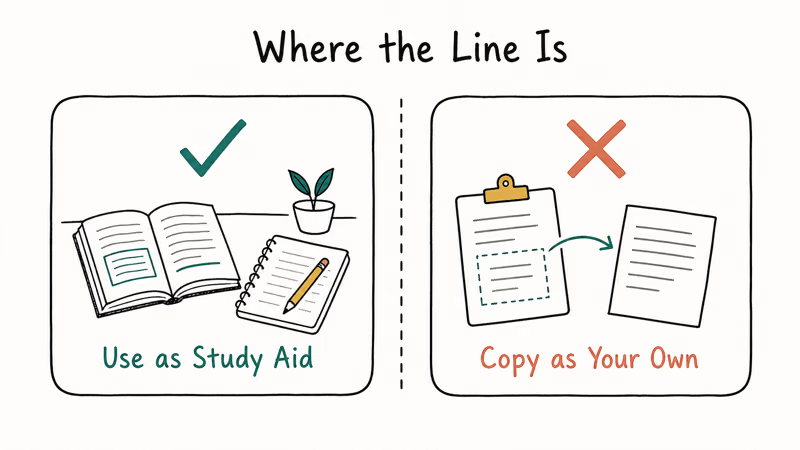
Read the book. Use the guides for the parts that don’t click. Cite anything you quote directly.
#Bottom Line
For most students, start with LitCharts plus CliffsNotes for free coverage. Add GradeSaver only when you need help with essay angles. Skip the paid sites unless your school provides institutional access.
Shmoop is the only paid one worth the trial, and only for video learners. Project Gutenberg belongs in your bookmarks regardless; it’s the cheapest way to read the actual source text.
If you’re studying for college-level work, your university library probably gives you free JSTOR access, which beats every other option on this list for real criticism.
#Frequently Asked Questions
Is SparkNotes still free?
Yes, the main SparkNotes site is still free and ad-supported. SparkNotes Plus is a paid tier with no ads and offline access, but the standard summaries and analysis are free.
Which SparkNotes alternative has the most books?
BookRags has the largest free catalog at around 5,000 titles, though many are short summaries rather than full guides. Project Gutenberg has 75,000+ full books but no analysis or summaries.
Are sites like SparkNotes considered cheating?
Using a study guide to understand a book is generally fine. Copying analysis directly into a paper without citation is plagiarism. Most schools treat the line that way. When in doubt, check your course syllabus or ask your teacher.
What’s the best free alternative to SparkNotes for high school?
LitCharts is the closest free replacement. It covers about 600 titles, has a clean mobile design, and the free tier includes full summaries plus one section of analysis per book. CliffsNotes is a close second for older classics.
Does CliffsNotes cover the same books as SparkNotes?
There’s heavy overlap on the standard high school canon, including books like To Kill a Mockingbird, Hamlet, The Great Gatsby, and Of Mice and Men. CliffsNotes has slightly broader coverage of older texts; SparkNotes is stronger on YA and contemporary fiction.
Can I get free JSTOR access?
Yes, through most U.S. public libraries with a library card and through every accredited college or university account. JSTOR also has a free personal account tier that gives limited reading access without downloads.
Are study guides on these sites accurate?
The major ones (LitCharts, CliffsNotes, SparkNotes, GradeSaver, Shmoop) are professionally edited and reliable. Community sites like WikiSummaries vary in quality and should be cross-checked against another source before you cite anything.
Which alternative has video summaries?
Shmoop has the best video catalog among paid options. CliffsNotes also offers some free video content, mostly for test prep rather than book summaries. YouTube channels like CrashCourse Literature cover many classics for free, though they aren’t a full study guide.
Google Messages Error 3100: Why RCS Is Broken on Galaxy
Google Messages RCS error 3100 hits Galaxy owners after phone or carrier switches. Google told 9to5Google a fix is coming. Here's what actually helps.

Is This Bank App Real? Spot a Fake App on Your Home Screen
A bank app can land on your home screen from a web page with no install warning. Learn the checks that tell a real banking app from a phishing web app.
Apps Crashing After iOS 27 Update? Fix Order (2026)
Apps crashing after the iOS 27 update? Update the app in the App Store first, then offload and reinstall to clear stale cache, then restart. The fix order.
Do AI Translation Earbuds Work Offline? What to Know
Do AI translation earbuds work offline? A few do with downloaded language packs, but most need the cloud. Here's what works offline and what you give up.