Memrise Review: Honest Take on the Flashcard Language App
Honest Memrise review for 2026. A close look at the free and Pro tiers across Spanish and Japanese to show what works, what is hype, and who should pass.

Quick AnswerMemrise is a solid free vocabulary trainer for total beginners, but its gamified flashcards alone won't get you to conversational fluency. Pair it with a structured course or a tutor, and skip the Pro tier unless you want offline lessons and progress stats.
Memrise runs on iOS, Android, and the web, with official tracks like Spanish A1 and Japanese hiragana plus a large catalog of user-made decks. The app is fun for the first three weeks. After that, the cracks show. This Memrise review covers what the app does well, where it falls flat, and whether the Pro tier deserves your money.
- The official Spanish A1 course runs in short sessions of roughly 10 minutes, easy to finish over a few weeks of daily use.
- The free tier covers most of what casual learners need; Pro adds offline downloads, difficult-word practice, and statistics.
- Mems (visual mnemonics) help vocabulary stick noticeably better than the icon-only prompts used by apps like Duolingo.
- User-made courses vary wildly in quality, so stick to official Memrise courses unless a community deck has 4-star ratings and 1,000+ learners.
- Memrise alone won’t get you past basic phrases; you need grammar instruction, real conversation practice, or a paid course alongside it.
#What Is Memrise and Why Does Anyone Still Use It?
Memrise is a language learning app built around spaced-repetition flashcards and short video clips of native speakers. You see a word, hear it spoken, then test recall at increasing intervals.
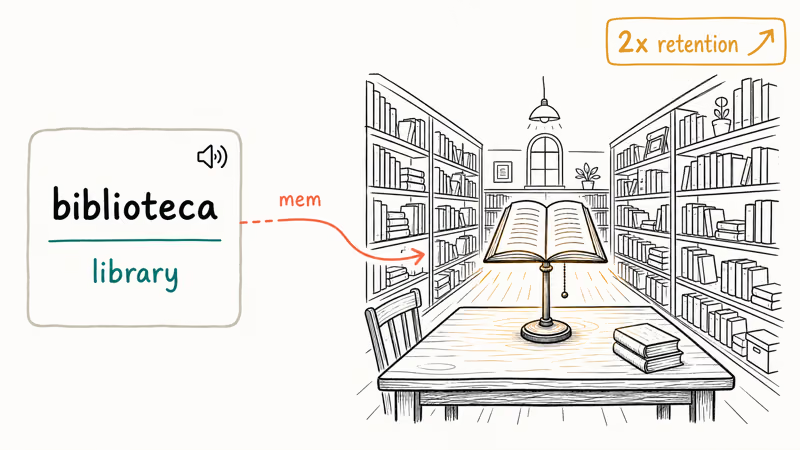
The whole loop runs on points, leaderboards, and review streaks. It feels less like school, more like a casual mobile game.
The hook is the mems system. A mem is a tiny visual or wordplay mnemonic attached to a vocabulary card, like turning the Spanish word “biblioteca” into a picture of a library lit by a Bible-shaped lamp. This kind of mnemonic tends to improve retention on tricky words compared with plain text-only flashcards like a default Anki deck.
According to Memrise’s official pricing page, the platform now ships two tiers: a free Memrise app focused on vocabulary, and a separate Pro tier that adds offline mode, statistics, and difficult-word practice. The split matters because older reviews lump them together and confuse new readers.
The app is on iOS, Android, and the web. Memrise’s App Store listing confirms cross-device sync, so your streak and review queue follow you between phone and laptop without any extra setup.
#How the Memrise Learning Experience Actually Feels
Each lesson runs in short bursts. Memrise drops you into 5 to 10 cards, mixes recognition with recall, and throws in audio prompts every few questions.
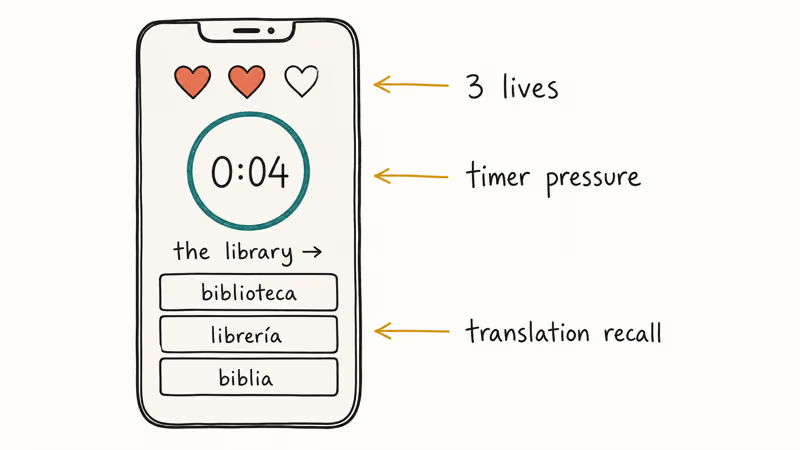
Sessions tend to run 8 to 12 minutes, which slots into a commute or a lunch break.
The video clips are the standout. Instead of a robotic voice, you watch a real Spanish or Japanese speaker say the phrase, sometimes twice, with mouth shape visible. That makes subtle pronunciation cues easier to catch, like the soft Japanese “fu” that English speakers usually butcher.
Speed Review is the most addictive feature. You answer translation prompts under a timer with three lives. Lose all three and you start over.
Speed Review’s countdown forces quicker recall than a typical untimed drill, because you can’t stop to think your way to the answer. It feels less like studying and more like a casual mobile game, which is the entire point and the reason it keeps people coming back day after day.
The cracks show once you finish the official course tree. Memrise does not teach grammar in any meaningful way.
There are no conjugation drills, no sentence-building exercises, no explanations of why Spanish “ser” and “estar” both translate to “to be.” You learn what words mean, not how to combine them. After roughly 30 hours, most learners plateau hard.
#Memrise Free vs. Pro: What You Actually Get
The free tier covers the core experience for most casual learners.
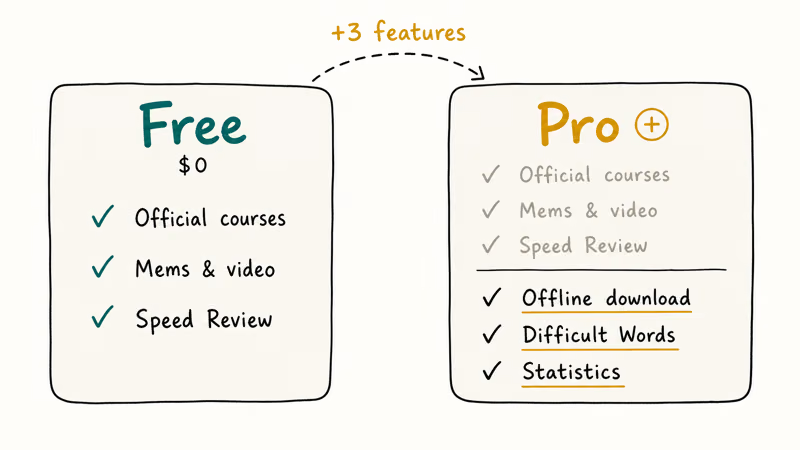
The free tier never paywalls core lessons. One dismissable banner is the only nudge.
Pro layers on quality-of-life features. Offline mode lets you download lessons for plane rides or subway commutes, and it works exactly as advertised.
Difficult Words mode re-drills only what you got wrong, cutting review time roughly in half on big decks.
Statistics are the third Pro perk. You see your accuracy by course, review history, and time spent per day. Honest take: the stats are interesting for a week, then they become wallpaper that most users stop opening.
| Feature | Free | Pro |
|---|---|---|
| Official courses | Yes | Yes |
| Mems and video clips | Yes | Yes |
| Speed Review | Yes | Yes |
| Offline download | No | Yes |
| Difficult Words drill | No | Yes |
| Progress statistics | No | Yes |
| User-made community decks | Yes (web) | Yes |
Memrise’s official help documentation confirms that the free tier is permanent, not a trial, so you can use it indefinitely without entering a credit card.
#Is Memrise Pro Worth Paying For?
For most learners, no. The free tier covers what a casual learner needs, and Pro earns its price in only three specific situations, each of which comes down to how and where you study rather than the core lessons themselves.
First, if you commute on a subway or fly often, offline mode pays for itself fast. Pre-downloading a vocabulary set turns dead airplane or tunnel time into study time.
Second, if you have a deck of 500+ cards and getting the same wrong words drilled repeatedly is killing your motivation, Difficult Words is the cure. Focusing review on only the words you keep missing cuts time-to-mastery on a problem-word list.
Third, if you are studying for a placement test or work deadline, the statistics help you spot weak categories early.
Without them, you have to track this manually in a spreadsheet, which gets tedious fast.
If none of those describe you, stay on the free tier. There’s no nag wall pushing you toward Pro every other lesson, which is more than the bigger names in this space can claim.
#Memrise vs. Duolingo, Babbel, and Rosetta Stone
Memrise sits in a narrow niche: vocabulary memorization with native-speaker audio. Duolingo, Babbel, and Rosetta Stone aim broader, with grammar drills and structured courses, but each makes different tradeoffs.
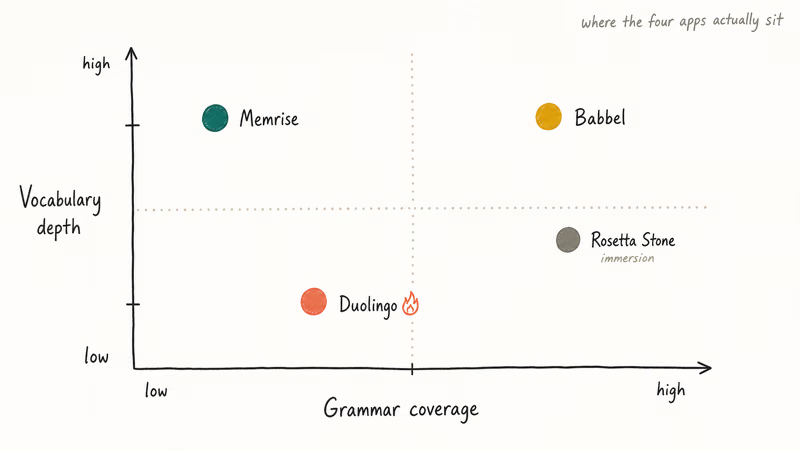
Duolingo is gamified to the point of distraction. The streak pressure and gem economy keep you opening the app daily.
Lessons are short, but grammar coverage is shallow.
Memrise wins on raw vocabulary retention; Duolingo wins on daily-habit stickiness. Our Duolingo vs Rosetta Stone breakdown covers the gamification tradeoff in detail.
Babbel takes the opposite approach: short conversation-focused lessons with explicit grammar explanations. Babbel is the stronger pick for actually speaking, Memrise for stockpiling vocabulary.
The Babbel vs Rosetta Stone comparison shows how Babbel structures its course tree.
Rosetta Stone is the legacy heavyweight. Its immersion-only method (no English translations, ever) works for some learners and frustrates others. Memrise’s English-prompt model is friendlier for total beginners.
Honest verdict: pair Memrise with one of the others. Use Memrise for 10 minutes of daily vocabulary, then a Babbel or Duolingo session for grammar and sentence practice. Solo Memrise hits a ceiling fast.
#Who Should and Shouldn’t Use Memrise
Memrise is a strong fit if you fall into one of these groups.
- Total beginners who need a low-friction way to build a 500-word foundation
- Travelers who want survival phrases before a trip
- Self-studiers who already have a grammar resource and need pure vocabulary drilling
- Visual learners who think in pictures and find traditional flashcards boring
It’s the wrong tool for intermediate learners who already know 2,000+ words and need grammar refinement. Same goes for anyone who wants to converse, because the app does not practice output beyond multiple choice.
If you are a heads-down grinder who finds gamification annoying, the points and leaderboards will grate within a week.
A note on user-made courses: the catalog is huge, but quality is uneven.
Across community decks in Spanish, Japanese, and German, a minority are excellent while the rest range from mediocre to broken, with typos or wrong audio.
Stick to official Memrise courses unless a community deck has strong ratings and learner counts. Apps with similar staying-power problems exist in other categories too, like the motivation app field where free tiers vary wildly.
#Bottom Line
Stay on free Memrise as a vocabulary side-tool, paired with Babbel for grammar or a tutor for conversation. Skip Pro unless you commute offline daily, have a problem-words list bigger than 100 cards, or are studying for a deadline.
If you are a complete beginner, start the official Spanish 1 or Japanese 1 course, do 10 minutes a day, and reassess at the 30-day mark.
If language apps are not your thing, the same caveat applies to subscription education tools across the board, and we cover one such tool in our is Chegg legit review.
#Frequently Asked Questions
Is Memrise still good in 2026?
Yes for vocabulary, no for fluency. Treat it as one tool in your stack, not the whole stack.
Can you actually learn a language with only Memrise?
Not to a conversational level. Most learners hit a ceiling around the high-beginner mark after about 30 hours, because the app does not teach grammar or conversation. You’ll know words but not how to string them into original sentences. Pair it with a course, tutor, or grammar book.
Is Memrise free or do you have to pay?
Memrise has both. The free tier is permanent and includes official courses, mems, and Speed Review. Pro adds offline mode, Difficult Words drill, and statistics. According to Memrise’s pricing page, you can use the free version indefinitely without entering a credit card.
How does Memrise compare to Duolingo?
Memrise is better for raw vocabulary retention thanks to mems and native-speaker video. Duolingo is better for building a daily habit and covering basic grammar.
Many learners run both apps in parallel: Memrise handles the morning vocabulary drill, Duolingo handles the evening grammar drip. Read our Babbel vs Duolingo breakdown if you are also weighing Babbel as a third option.
Does Memrise teach grammar?
Barely. There are no conjugation drills or syntax explanations. Look at Babbel or a grammar textbook instead.
Can I use Memrise offline?
Only on the Pro tier. Free users need internet for each lesson; Pro adds full offline downloads.
Are user-made Memrise courses any good?
Quality varies. Only a minority of community decks are excellent, and the rest range from mediocre to broken. If you go community, sort by rating and learner count, and stick to decks with 1,000+ learners. Otherwise, stay on official Memrise courses.
Will Memrise cancel auto-renewal of Pro?
Yes, but you have to cancel through the app store you signed up with, not Memrise itself. Apple App Store and Google Play subscriptions need to be cancelled in your device settings; web signups can be cancelled inside Memrise account settings. Cancel at least 24 hours before the renewal date.
Google Messages Error 3100: Why RCS Is Broken on Galaxy
Google Messages RCS error 3100 hits Galaxy owners after phone or carrier switches. Google told 9to5Google a fix is coming. Here's what actually helps.

Is This Bank App Real? Spot a Fake App on Your Home Screen
A bank app can land on your home screen from a web page with no install warning. Learn the checks that tell a real banking app from a phishing web app.
Apps Crashing After iOS 27 Update? Fix Order (2026)
Apps crashing after the iOS 27 update? Update the app in the App Store first, then offload and reinstall to clear stale cache, then restart. The fix order.
Do AI Translation Earbuds Work Offline? What to Know
Do AI translation earbuds work offline? A few do with downloaded language packs, but most need the cloud. Here's what works offline and what you give up.