Free Chegg Account: Legitimate Ways to Access Study Help
Access Chegg study help the safe, legal way in 2026: official free trial, library databases, Khan Academy, MIT OpenCourseWare. Skip credential-dump sites.
Quick AnswerYou can access Chegg study content legally with Chegg's own 4-week free trial, the Refer-a-Friend credit program, library partnerships, or free alternatives like Khan Academy and MIT OpenCourseWare. Account-sharing sites and leaked credential lists break Chegg's terms, risk malware, and can violate federal computer-access law.
Searching for a free Chegg account usually pulls up two kinds of pages: credential-dump sites promising “working logins” and Discord servers trading screenshots. Both are bad ideas. The credentials are almost always stolen, the download links frequently carry malware, and using someone else’s paid login violates Chegg’s terms of service along with most school academic integrity policies. Use legitimate access routes instead.
- Chegg offers an official 4-week free trial on new accounts, covering textbook solutions and 30 minutes of tutoring at no cost if you cancel before renewal
- Using leaked or shared Chegg credentials violates Chegg’s terms of service and, under the U.S. Computer Fraud and Abuse Act, trafficking in passwords is a federal offense
- Many U.S. public and university libraries already pay for Chegg Study, Pearson+, or Course Hero access through their digital databases
- Khan Academy, MIT OpenCourseWare, and OpenStax cover high school and undergraduate STEM at zero cost with full teaching materials
- A Chegg Refer-a-Friend referral credits $10 to both accounts, which can offset one month of Chegg Study when stacked with a student discount
#Why “Free Chegg Account” Sites Are a Bad Deal
Search results for this query often look nearly identical: a fake login list, a “free generator” button, and a banner ad. Those pages commonly push phishing flows, malware downloads, or browser extensions that ask for far more access than a study-help site should need.
The logins themselves rarely work.
Chegg rotates device fingerprints, flags logins from new IP ranges, and now uses one-time email codes for unrecognized devices. A 2024 writeup by BleepingComputer found that 40 million Chegg accounts leaked in a 2018 breach, and those stolen credentials keep resurfacing on combo lists years later. The same password an attacker bought on a forum is the same one your “free account” site is handing out.
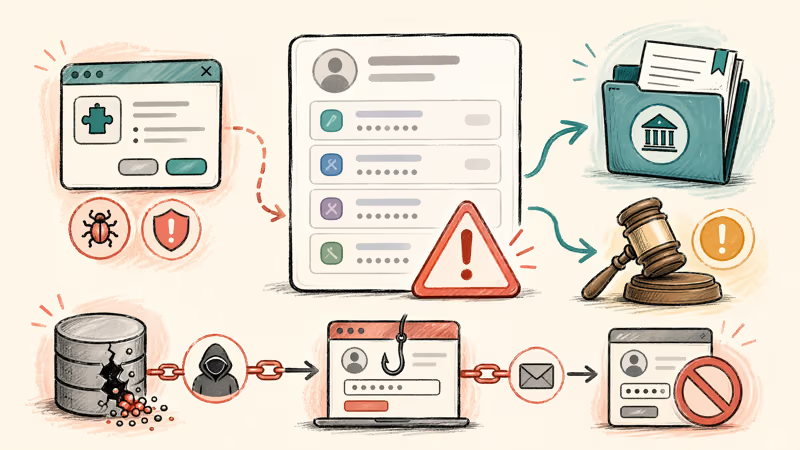
There is a legal layer too. Under the Computer Fraud and Abuse Act (18 U.S.C. § 1030), knowingly trafficking in passwords or accessing a protected computer “without authorization” is a federal offense. The Wikipedia overview of the CFAA states that the statute now covers most internet-connected services, not just government systems.
Using somebody else’s paid Chegg login without their permission isn’t just a contract violation. It can qualify as unauthorized access under federal law. Prosecution against individual students is rare, but expulsion and academic-integrity hearings are not.
#How Can You Use Chegg Legally Without Paying?
The simplest path is also the best. Chegg publishes a 4-week free trial, and for most students one well-timed trial covers the hardest stretch of a semester.
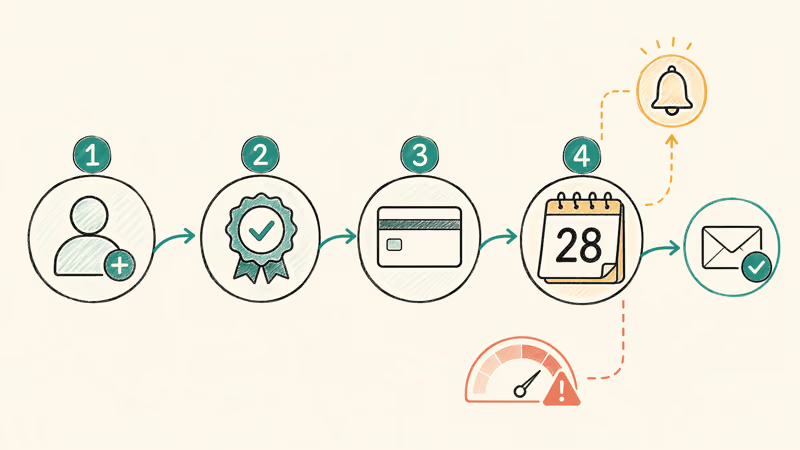
Sign up for the official Chegg Study trial:
- Go to chegg.com while signed out, click Get Started or Join Now
- Create a fresh account with a school email you actually check
- Pick the Chegg Study plan (the Chegg Study Pack bundles more tools but costs more)
- Enter a valid payment method, since the trial captures billing details
- Set a calendar reminder 24 hours before day 28 to cancel if you don’t want to keep it
During the trial you get full textbook solutions, expert Q&A with up to 20 questions per billing period, and 30 minutes of online tutoring. Set that calendar reminder.
If you forget to cancel, Chegg’s auto-renewal is aggressive. The FTC’s 2024 press release announced that Chegg charged subscribers even after they attempted to cancel, which is exactly why a calendar reminder matters. If you think you’re still being billed after cancellation, follow the same dispute process we documented in our guide to canceling a free trial with Adobe. The screenshot-every-step approach applies to any subscription service.
Chegg’s Refer-a-Friend program is the other legitimate discount stack. When a friend signs up through your link, both accounts receive a $10 credit. Two roommates referring each other can cover one month of Chegg Study Pack at current pricing. Chegg’s own referral page lays out the exact terms.
#Library Access: The Forgotten Free Option
Before you pay for anything, check your library. Many U.S. public libraries and virtually all college libraries pay for academic databases that overlap with Chegg’s catalog. The practical test takes five minutes.
Public library route (your city or county):
- Sign into your library’s online portal with your card number and PIN
- Look under “Research Databases” or “Digital Resources”
- Scan for Gale OneFile, EBSCO Academic Search, JSTOR, or Pearson’s online platform
- Some library systems also subscribe directly to Chegg Study through resource-sharing programs
College library route:
- Check your school’s library site under “eTextbooks” or “Course Reserves”
- Many universities have bulk Chegg, Course Hero, or Pearson+ licenses that you can use with your student ID
- Your student ID usually grants access without a separate login
Library portals vary, but common substitutes include Pearson+, JSTOR, EBSCO, Gale, and textbook-reserve scan services. None of this costs you anything beyond the library card you already have. Ask the reference librarian if you can’t find it on the portal; they usually know the exact menu path.
#Free Alternatives That Cover the Same Ground
Chegg’s strength is textbook solutions for intro-level college courses. Three free services cover most of what students use Chegg for, and none require a credit card.
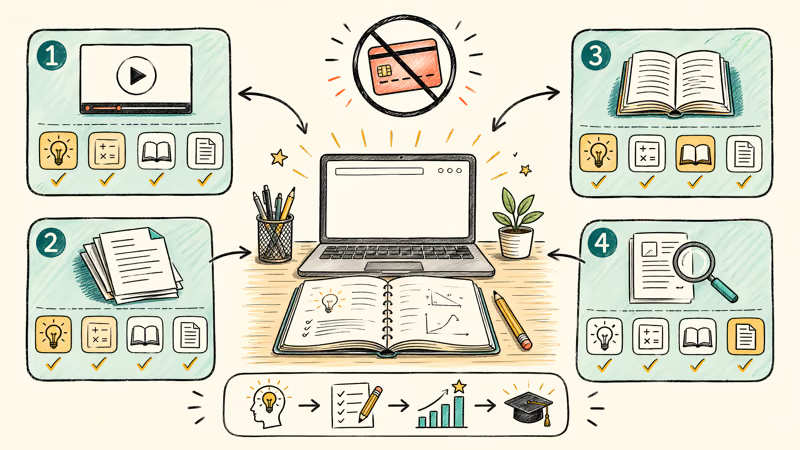
Khan Academy covers K-12 math, algebra, calculus, statistics, biology, chemistry, physics, economics, and computer science with full video lessons and practice problems. Khan Academy states that its content is free forever with no ads and no login required. For math up through first-year calculus it’s frankly better than Chegg’s step-by-step solutions because the teaching is built into every problem.
MIT OpenCourseWare posts course materials from more than 2,500 MIT courses. Download the exact problem sets, lecture notes, and past exams MIT students used.
OpenStax is Rice University’s free, peer-reviewed textbook project. OpenStax reports that its textbooks have been adopted at thousands of institutions. Many general-ed courses (intro economics, biology, psychology, college algebra) now use OpenStax books as their primary text, which means the “official” solutions and worked examples are already free for you.
Between these three, most freshman and sophomore STEM and social-science work is fully covered without touching Chegg. The gap shows up later. For upper-division courses where Chegg’s question bank actually matters, the realistic play is Khan Academy and OpenStax for ongoing concept work, your library’s database for scholarly articles and reserved e-textbooks, and then a single targeted 4-week Chegg Study trial dropped into whichever week has the worst problem-set load.
#Account-Sharing Discord Servers and Chegg Unlockers Are Traps
This is the category that gets students in the most trouble. “Chegg unlocker” bots, answer-scraping Discord servers, and sites that use a pooled paid account to resell answers all sit in the same gray zone as the credential-dump pages, and they come with three concrete risks:
-
Chegg has Honor Shield. Chegg cooperates with universities on cheating investigations. A ProPublica report states that more than 250 universities used Chegg’s Honor Shield tool to pre-submit exam questions so Chegg could flag matching answers. The screenshot you got from a Discord server is not as anonymous as it looks.
-
The answer pipelines are often scams. Many “free Chegg answer” sites gate results behind fake “human verification” surveys that install adware or harvest Discord logins for reselling.
-
Academic integrity policies don’t care how you got it. Stanford, Texas A&M, Boston University, and many state universities explicitly list Chegg-sourced answers as academic dishonesty, regardless of whether you paid for them or got them from a third party.
If your school uses Proctorio, Honorlock, or LockDown Browser, assume any Chegg-sourced answer has a meaningful chance of being flagged. A failed integrity hearing stays on your transcript far longer than a $15.95 month of Chegg did.
#Is Chegg Even Worth Paying For at All?
Whether Chegg is worth paying for after the free trial depends heavily on your major and how you use the service. Our full Chegg review covers pricing, the FTC complaint history, and cancellation friction in detail. The short version: Chegg is real, most students overestimate how much they will use it, and annual billing trades flexibility for a cheaper monthly rate.
On a tight budget and want to skip the account-sharing gamble? Stack these instead:
- One official 4-week free trial timed for midterms or finals
- Khan Academy plus OpenStax for concepts and worked examples
- Library database access for scholarly articles and e-textbook scans
- A study group with classmates who legitimately share a Chegg subscription (check your school’s integrity policy on shared paid accounts first, since some allow it and some don’t)
- A Refer-a-Friend credit swap with a roommate to offset one month
For nursing students in particular, pair Khan Academy’s biology and chemistry with the clinical-specific tools in our nursing laptop guide to cover hardware and software in one shot. For students who read widely outside coursework, the is-zlibrary-safe analysis walks through why “free textbook” torrent sites carry the same category of risks as free-Chegg sites.
#How to Cancel a Chegg Subscription Cleanly
If you started a trial and want to avoid the auto-renewal charge, cancel at least 24 hours before the trial ends. Chegg’s own help page has the canonical steps, but the short version is straightforward.
- Sign in at chegg.com and go to My Account → Orders → Manage Subscription
- Click Cancel Subscription, then confirm through the retention screens
- Screenshot the confirmation email Chegg sends within a few minutes
- Add a calendar entry for 30 days later to double-check no charge appeared
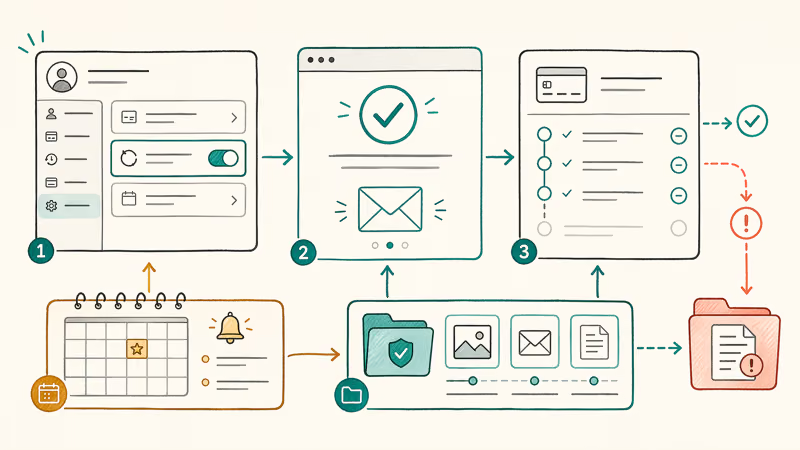
If a charge appears after cancellation, dispute it with your card issuer and keep the screenshot as proof.
#Protecting Yourself From Credential-Related Scams
The same defenses that protect you from email-based scams apply here. If a “free Chegg account” site asks you to install a browser extension, run a downloader, or complete a “human verification” survey, close the tab immediately.
These are common delivery mechanisms for credential stealers and keyloggers, the same type of threat we dissect in our FileRepMalware detection guide and Atlas Earth scam writeup.
Never reuse a password across study services, and turn on two-factor authentication on Chegg if you do pay for it. If you want a fresh email just for trials, a second Gmail account paired with a virtual card from your bank is enough separation for most people.
#Bottom Line
The realistic answer for 2026: the only truly free, risk-free way to use Chegg is the official 4-week trial, once, timed for when you need it most.
Everything else labeled “free Chegg account” is either stolen credentials, a malware delivery page, or an academic-integrity violation waiting to surface. The smart stack is a trial timed for finals, Khan Academy and OpenStax for day-to-day concept work, and your library’s databases for the scholarly-article layer Chegg never covered anyway. Pay for one deliberate month if you still need more, cancel within 28 days, and save the confirmation email.
#Frequently Asked Questions
Is it illegal to use a free Chegg account from a sharing website?
Using credentials that were stolen, leaked, or shared without the account owner’s permission can violate the Computer Fraud and Abuse Act, which prohibits trafficking in passwords and unauthorized access. It also violates Chegg’s terms of service and most college academic-integrity policies. Enforcement against individual students is uncommon, but the university consequences are real and frequent.
Does Chegg offer a truly free trial in 2026?
Yes, Chegg runs a 4-week free trial on new Chegg Study accounts. It requires a payment method and auto-renews unless you cancel. Set a reminder the moment you sign up.
Can my public library give me free Chegg access?
Some do. Many U.S. public libraries and most college libraries subscribe to Chegg Study, Pearson+, or comparable platforms. Sign into your library portal, look under research databases or digital resources, and check for Chegg, Pearson, or EBSCO (if yours lacks Chegg specifically, it probably has something equivalent).
Are sites like Creative Savants or CheggAnswers legal?
The legal picture is mixed. Services that answer questions by routing them through their own paid Chegg account are reselling access, which violates Chegg’s terms even though it’s one step removed from credential sharing. Sites that scrape Chegg’s database and republish answers risk copyright claims. Academic-integrity policies almost always treat answers from these services the same as answers from a shared login, so the risk sits with you either way.
How does Chegg’s Refer-a-Friend program work?
Each referral credits $10 to both the referrer and the new subscriber. Two friends referring each other covers roughly one month of Chegg Study at current pricing.
Do Khan Academy and MIT OpenCourseWare really replace Chegg?
For most students in K-12 through introductory college courses, yes. Khan Academy teaches the concepts with adaptive video practice, and MIT OpenCourseWare hands you the same problem sets MIT students solved. Neither gives you a human to answer a random homework question at 2 a.m., which is Chegg Study’s main niche.
Can my school detect if I used Chegg?
Often, yes. Chegg’s Honor Shield lets instructors pre-submit exam questions, and Chegg flags when those questions get asked during a testing window. Chegg also responds to university subpoenas with account and usage data, and tools like Proctorio and Honorlock add a second detection layer. Assume any Chegg-sourced answer during an exam has a meaningful chance of being caught.
Google Messages Error 3100: Why RCS Is Broken on Galaxy
Google Messages RCS error 3100 hits Galaxy owners after phone or carrier switches. Google told 9to5Google a fix is coming. Here's what actually helps.
Is This Bank App Real? Spot a Fake App on Your Home Screen
A bank app can land on your home screen from a web page with no install warning. Learn the checks that tell a real banking app from a phishing web app.
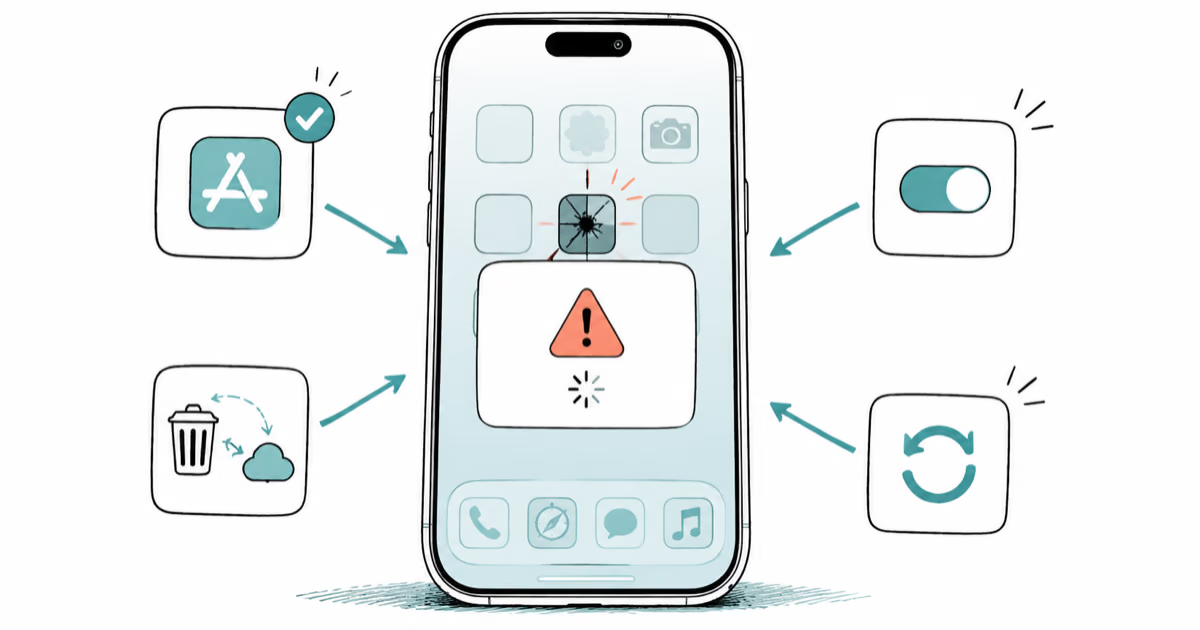
Apps Crashing After iOS 27 Update? Fix Order (2026)
Apps crashing after the iOS 27 update? Update the app in the App Store first, then offload and reinstall to clear stale cache, then restart. The fix order.
Do AI Translation Earbuds Work Offline? What to Know
Do AI translation earbuds work offline? A few do with downloaded language packs, but most need the cloud. Here's what works offline and what you give up.