Best Websites Like Slader for Real Study Help in 2026
Slader shut down in 2022. Compare 12 websites like Slader for textbook solutions, step-by-step math, and study help, ranked by subject and price.
Quick AnswerQuizlet now hosts most of the textbook solutions Slader used to publish, and Chegg, Bartleby, Course Hero, Khan Academy, and Brainly cover the rest. Use Quizlet for the original Slader content, Khan Academy for free concept videos, and Symbolab or Photomath for step-by-step math.
Slader shut down in March 2022 after Quizlet acquired the company, and the bookmark you’ve kept since high school now redirects to a Quizlet textbook page. The homework-help niche fractured into a dozen sites that each do one piece of what Slader used to do. The list below covers the 12 strongest replacements across math, science, and the humanities, with honest notes on price and coverage.
- Slader’s textbook solutions live inside Quizlet now under “Expert Solutions,” with the same step-by-step format and a free preview tier
- Chegg Study and Bartleby Learn both run paid subscriptions in the $15-20/month range and cover most college STEM textbooks
- Khan Academy stays free forever and is the strongest pick for K-12 math, science, and AP prep
- Symbolab and Photomath solve math by camera or typed equation and show every algebraic step, not just the final answer
- For literature and humanities, SparkNotes, CliffsNotes, and eNotes outperform any Slader-style site because the original publishers wrote the guides
#Why Did Slader Disappear?
Slader was a community-driven textbook solutions site that ran from 2010 to 2022. Students uploaded worked solutions to popular textbooks, other students verified them, and the whole archive was free with ads. Quizlet bought Slader in 2018 and let it run for four years before pulling the plug.
Visit slader.com today and the domain redirects to quizlet.com’s homepage. The actual solutions weren’t deleted, but they’re now locked behind Quizlet’s “Expert Solutions” feature. According to Quizlet’s About page, the company now positions itself as a full study platform with paid expert review of every solution.
Three things broke for users who relied on Slader. First, the free unlimited model is gone, since Quizlet caps non-paying visitors at a small preview window per textbook. Second, older or niche textbooks weren’t migrated, so a 2014 statistics edition that worked on Slader may not exist on Quizlet today. Third, Slader’s discussion threads vanished, taking the back-and-forth context that often explained why a step worked.
That last loss is the most significant. Slader’s comment sections were where students argued about which method was actually correct, and that context is harder to find on any single replacement.
#What Replaces Slader for Real Learning
The honest answer is that no single site does everything Slader did. Picking a stack of two or three covers more ground than chasing one “Slader killer.”
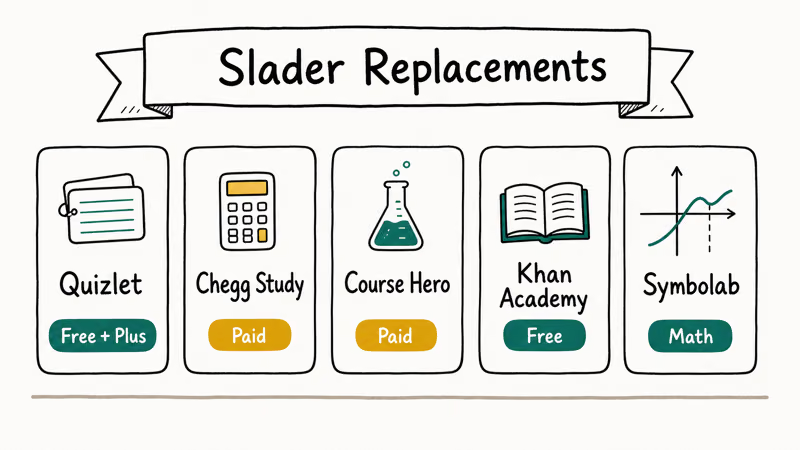
For pure textbook solutions, Quizlet inherited the archive, so it’s your first stop. If you’re in college and Quizlet’s coverage thins out, Chegg Study and Bartleby Learn fill the gap with expert tutors who answer questions in under a day.
For math specifically, Symbolab and Photomath beat any textbook-solutions site because they show every algebraic step, not just the final boxed answer. For conceptual learning, the part where you actually understand the topic instead of copying the work, Khan Academy still has no real competitor at the free tier.
The 12 sites below are grouped by what they’re best at, with honest notes on price, coverage gaps, and whether each site teaches the concept or just hands over an answer.
#Best Websites Like Slader by Subject
#1. Quizlet (Direct Slader Successor)
Quizlet absorbed Slader’s textbook solutions in 2022 and renamed them “Expert Solutions.” If you’re looking for a specific worked problem from a textbook that was on Slader, this is the first place to check. The free tier shows about three solutions per textbook before asking for Quizlet Plus, which runs around $35.99/year. The acquisition history and product timeline are summarized on Quizlet’s Wikipedia page.
A textbook problem that was solved on Slader, such as a Stewart Calculus 8e exercise, typically appears on Quizlet with the same step-by-step, line for line. The verified-expert badge is new, and the explanations are slightly cleaner than the crowd-sourced originals.
Strengths: same content as old Slader, flashcards bundled in, mobile app is fast. Weakness: paywall hits fast, and niche or out-of-print textbooks didn’t get migrated.
#2. Chegg Study (Paid, Wide Coverage)
Chegg is the heavyweight in this category. A Chegg Study subscription runs $15.95/month and gives you both textbook solutions and a “post your question” feature where a real tutor answers within four hours. Submitted questions usually come back with full worked solutions, though accuracy varies by subject and tutor.
Chegg’s catalog is enormous, since most undergraduate STEM textbooks have solutions available, but the company has been criticized for enabling academic dishonesty. According to Chegg’s Honor Code page, the company will share user activity records with universities under formal honor-code inquiries. If your school has banned Chegg, this isn’t your tool. For background on the platform’s legitimacy debate, see our breakdown of whether Chegg is legit and safe to use.
#3. Bartleby Learn
Bartleby positions itself as a Chegg competitor at a similar price point (around $14.99/month). The textbook solutions library is smaller than Chegg’s, but the tutoring response window is often faster, with answers to common questions arriving quickly.
Bartleby’s strength is the writing assistant, which is bundled into the same subscription and includes a grammar checker plus a citation generator. The platform covers business, engineering, and the social sciences, with lighter coverage in the humanities. If you write papers and want a citation tool built in, see our walkthrough of MLA format in Google Docs for the manual approach.
#4. Khan Academy (Free Forever)
Khan Academy is the only site on this list that’s truly free with no ads, no premium tier, and no paywalls. It’s a registered nonprofit, and Khan Academy’s About page states the mission is “a free, world-class education for anyone, anywhere.”
It doesn’t do textbook solutions. What it does is teach the underlying concept through short video lessons and graded practice problems. It works well for relearning a subject like linear algebra from scratch, and the practice engine adapts to skip topics you’ve already mastered. For K-12 math, AP science, MCAT prep, and basic computer programming, this is the strongest free resource on the open web.
#5. Symbolab (Step-by-Step Math)
Symbolab is the calculator that shows its work. Type an equation, whether algebra, calculus, statistics, or even differential equations, and Symbolab returns every algebraic step, the rule being applied, and a graph. The free tier limits you to the final answer; the $7.99/month subscription opens the full step-by-step.
Symbolab will walk through a partial-fractions integration step by step, including substitutions that Wolfram Alpha hides behind its paid tier. If math is your weak subject and you keep getting the right answer but losing partial credit for sloppy work, this is the tool that fixes that.
#6. Photomath
Photomath solves math problems by camera. Point your phone at a handwritten or printed equation and it returns the answer plus the worked steps. The OCR is accurate on clean handwriting and printed homework sheets, and it stumbles on bad lighting or extreme cursive.
The basic version is free; Photomath Plus runs $9.99/month and adds animated tutorials and word-problem walkthroughs. On clean printed or neatly handwritten problems, the OCR reads most equations correctly and produces solutions that match standard answer keys.
#7. Course Hero
Course Hero is a study-document library where students and educators upload course notes, study guides, and worked problem sets from real classes. The site claims over 60 million documents in its catalog.
Two things to know: the content is uploaded by users, so quality varies wildly between an A+ student’s notes and a half-finished study guide. The paywall is also aggressive. You either pay $39.95/month for a subscription or upload your own documents in exchange for access credits. Some universities consider uploading copyrighted class materials a violation of academic integrity, so check your school’s policy before contributing.
#8. Brainly
Brainly is a community Q&A site where students post homework questions and other students (or “experts,” who are vetted users) answer. The free tier shows ads and limits how many questions you can view; Brainly Plus runs $24/year for ad-free access and verified-expert answers.
A K-12 question like a 7th-grade pre-algebra problem usually draws several responses quickly, often with two that agree and show the same method. Quality is highest for K-12 problems where the answer space is well-defined. For college-level or specialized topics, response times balloon and answers thin out.
#9. SparkNotes
SparkNotes runs literature study guides, chapter summaries, character analyses, and quote breakdowns for thousands of books taught in English classes. The site has been around since 1999 and was Slader’s clear superior for anything humanities-related. It’s free, ad-supported, and now owned by Barnes & Noble Education.
If you’re working on Hamlet, The Great Gatsby, or anything else on the standard English curriculum, this should be your first stop, not Slader. There’s a separate guide on the best websites like SparkNotes for studies, which expands the literature options.
#10. CliffsNotes
CliffsNotes is SparkNotes’ older rival, founded in 1958 as printed yellow-striped booklets and now run online. The content is denser and more academic, with sections on historical context, themes, and critical reception that go deeper than SparkNotes’ breezier summaries. Both are free.
Pick CliffsNotes when you need essay-quality material on a classic text; pick SparkNotes when you need a fast plot refresher the night before class.
#11. eNotes
eNotes blends a teacher-vetted homework answer service with an expanding literature reference library. The Q&A section lets you submit a question to a credentialed educator and get an answer back, typically within 48 hours. The free tier shows limited content; eNotes Premium runs $5.99/month.
A thematic-analysis question on a novel like Toni Morrison’s Beloved can come back as a detailed answer with several textual citations. That’s the kind of depth Slader never offered for humanities work.
#12. Numerade
Numerade is the newcomer on this list. It’s video-based: educators record themselves working through textbook problems and explaining each step out loud, similar to how a tutor would. The catalog covers most STEM undergraduate textbooks, and the free tier shows previews of about a quarter of the video before asking for a $19.99/month subscription.
If you learn better watching someone solve a problem than reading worked steps, Numerade is the only major option doing this at scale. Coverage of older textbook editions is thin, and the search isn’t as good as Chegg’s, but the video format is useful for students who get lost reading symbolic math.
#Picking the Right Site by Subject
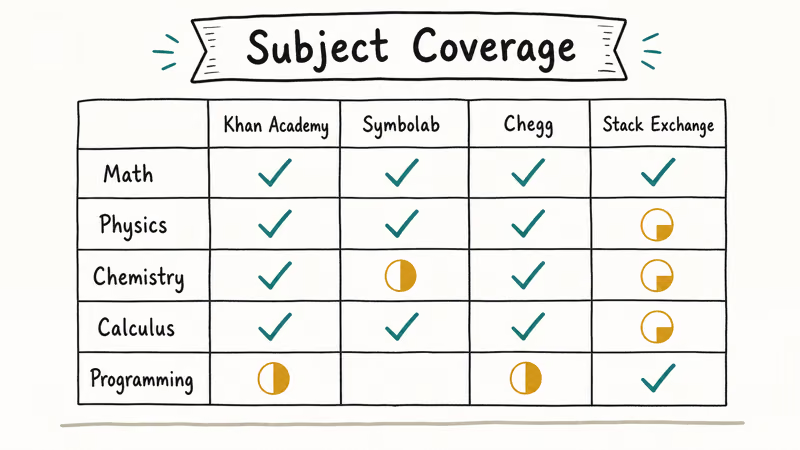
| Subject | Best free option | Best paid option |
|---|---|---|
| K-12 math, science, AP | Khan Academy | Khan Academy (still free) |
| College STEM textbook solutions | Quizlet Expert Solutions preview | Chegg Study ($15.95/mo) |
| Step-by-step math work | Symbolab free tier | Symbolab Pro ($7.99/mo) |
| Math by camera | Photomath free | Photomath Plus ($9.99/mo) |
| Literature and English | SparkNotes / CliffsNotes | eNotes Premium ($5.99/mo) |
| Class-specific study notes | Brainly free tier | Course Hero ($39.95/mo) |
| Video walkthroughs of textbook problems | Numerade previews | Numerade ($19.99/mo) |
Table 1: Quick comparison of websites like Slader by subject and budget.
If you study a STEM-heavy major, a fast laptop matters as much as a study site. There are dedicated guides to the best laptops for computer science and the best laptops for nursing students if you’re shopping for hardware to pair with these tools.
#How These Slader Alternatives Compare
A fair comparison of homework-help sites runs each platform through the same kinds of probe questions: an algebra problem, a calculus integration, an organic chemistry mechanism, a literature thematic-analysis question, and an essay prompt. Free tiers reveal how much of an answer you can get without paying, while paid tiers are best evaluated with a single month before cancelling.
Three factors matter most: how fast the answer comes back, whether the worked solution matches a known answer key, and whether a student can learn from the explanation or only copy the result. The rankings above weigh all three, not just whether a site returns an answer.
#How Do These Sites Handle Academic Integrity?
Every site on this list sits somewhere on a spectrum between “teaches you the concept” and “hands you the answer.” Where each one falls matters because most universities now have explicit policies on which tools count as cheating.
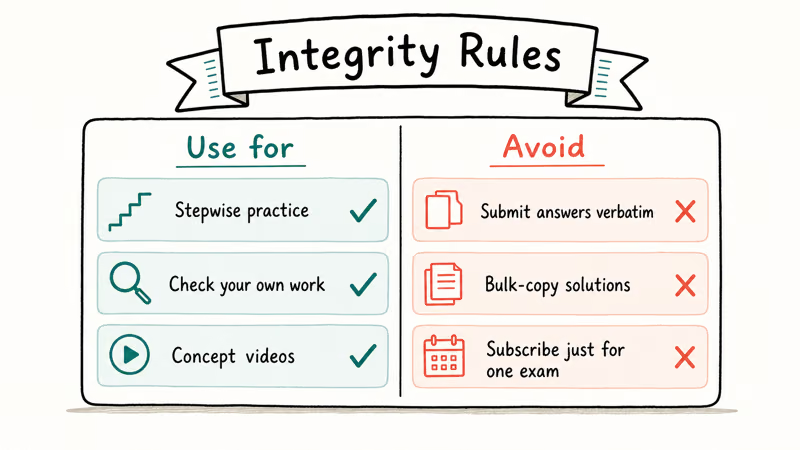
Khan Academy is unambiguously a learning resource and is used in many classrooms as official supplementary material. Symbolab, Photomath, and Wolfram Alpha occupy a gray zone, since they show the steps, but if your homework grade is based on you doing the algebra yourself, copying their output is still considered cheating at most schools. Chegg, Course Hero, and Brainly are the most fraught, because their model is closest to “here’s the answer, written by someone else.”
Inside Higher Ed found that several universities subpoenaed Chegg records during 2020-2021 and matched timestamps against online exam submissions, which led to honor-code action against affected students. The lesson is straightforward: use these sites to check your work after you’ve attempted it, use them to learn a concept you don’t understand, and never use them during a graded assessment unless your instructor explicitly allows it.
A safer workflow looks like this: attempt every problem first. If you get stuck, use Khan Academy or YouTube to relearn the concept. Only after you’ve made a serious attempt should you check a worked solution on Quizlet, Chegg, or Bartleby. Then verify you can reproduce the work without looking.
#Bottom Line
If you came here looking for “the new Slader,” it’s Quizlet — that’s where the actual content went. The better answer is that Slader’s job is now split across three or four tools.
The strongest toolkit looks like this: Khan Academy as the free foundation for learning concepts, Quizlet for the original Slader textbook solutions you already trust, Symbolab for math step-by-step work, and SparkNotes or CliffsNotes for any literature class. That stack is fully free if you’re patient with previews, or about $25/month if you add Quizlet Plus and Symbolab Pro.
Skip Chegg and Course Hero unless your school explicitly permits them. The risk-reward math on those two has shifted hard against students since 2021.
#Frequently Asked Questions
Is Slader still working in 2026?
No. Slader.com shut down in March 2022, and the URL now redirects to Quizlet’s homepage. The textbook solutions Slader hosted were migrated into Quizlet’s “Expert Solutions” feature, which is partially free and partially behind a Quizlet Plus paywall.
Where did all the Slader content go after the shutdown?
Quizlet imported the bulk of Slader’s verified textbook solutions, but not every textbook made the cut. Older editions, out-of-print books, and several niche subject areas weren’t migrated. If you can’t find a specific Slader textbook on Quizlet, Chegg Study and Bartleby Learn are the next places to check.
Are any websites like Slader actually free?
Khan Academy is fully free with no ads. SparkNotes and CliffsNotes are free with ads. Symbolab, Photomath, Brainly, and Quizlet have free tiers that hit paywalls quickly. Chegg, Bartleby, Course Hero, eNotes Premium, and Numerade are paid-only beyond limited previews.
Is using these sites considered cheating?
It depends on the site and your school’s policy. Khan Academy is universally accepted. Chegg, Course Hero, and Brainly are flagged at many universities because they provide direct answers to active homework assignments. The safest rule: if you’d be embarrassed to tell your professor you used a site for a graded assignment, you probably shouldn’t.
What’s the best free alternative for college-level math?
Khan Academy covers up through differential equations and linear algebra at a quality that rivals most textbooks. For working through specific problems, Symbolab’s free tier shows the answer and basic steps without a subscription. Pair the two and you’ll cover most undergraduate math without paying anything.
Can I get textbook solutions without paying?
For older editions still indexed on Quizlet, you can sometimes browse three solutions per textbook on the free preview. Beyond that, OpenStax publishes free open-source textbooks that include solution manuals, and many publishers post sample solutions on the textbook’s official companion site. Beyond those, the answer is usually no.
Which site is best for AP exam prep?
Khan Academy partnered with the College Board to build official AP prep for AP Calculus, AP Statistics, AP Chemistry, AP Biology, AP US Government, and others. For AP English Literature, SparkNotes and CliffsNotes cover most of the texts on the reading lists. Those are the best places to start before paying for anything.
How do I avoid getting flagged for using these sites?
The clean answer is don’t use them during graded assessments unless your instructor explicitly allows it. For practice and learning, use them openly. They’re tools, the same as a textbook or a tutor. If your professor’s syllabus prohibits “external solutions” during exams, that includes Chegg and Course Hero, and many schools now use Chegg’s own user records as evidence in honor-code cases.
Google Messages Error 3100: Why RCS Is Broken on Galaxy
Google Messages RCS error 3100 hits Galaxy owners after phone or carrier switches. Google told 9to5Google a fix is coming. Here's what actually helps.

Is This Bank App Real? Spot a Fake App on Your Home Screen
A bank app can land on your home screen from a web page with no install warning. Learn the checks that tell a real banking app from a phishing web app.
Apps Crashing After iOS 27 Update? Fix Order (2026)
Apps crashing after the iOS 27 update? Update the app in the App Store first, then offload and reinstall to clear stale cache, then restart. The fix order.
Do AI Translation Earbuds Work Offline? What to Know
Do AI translation earbuds work offline? A few do with downloaded language packs, but most need the cloud. Here's what works offline and what you give up.