How to Fix the VLC Unable to Open the MRL File Error
Fix the VLC unable to open the MRL error by allowing VLC through Windows Defender or the macOS firewall, claiming file ownership, and updating VLC.
Quick AnswerThe VLC unable to open the MRL error usually means VLC can't reach the source path. Allow VLC through your firewall, verify the file or stream URL, and update VLC 3.0 to the latest point release.
VLC’s “unable to open the MRL” error pops up when the player can’t reach the source you handed it. The MRL (Media Resource Locator) string is VLC’s internal address for a file, disc, or network stream, and any broken link in that chain stops playback cold.
This can happen with local files, network streams, webcams, and discs, and the cause is rarely VLC itself. According to VideoLAN’s documentation, MRLs cover everything from local files to RTSP camera feeds, so the fault almost always sits in firewalls, path typos, or permission rules.
The fixes below work without disabling antivirus and without reinstalling the operating system. Start with the least invasive checks, then move to permissions and updates.
- The MRL error blocks playback when VLC can’t resolve the file path, DVD drive, or stream URL VLC was asked to load.
- Allowing VLC through Windows Defender Firewall fixes the bulk of cases, and it’s safer than turning the firewall off entirely.
- Claiming ownership in the file’s Security tab gives VLC the access rights it needs without touching firewall settings.
- The YouTube variant of the error usually means VLC’s bundled youtube.luac script is out of date; replacing it from VideoLAN’s repo restores playback.
- Updating to the current VLC 3.0 point release on the official VideoLAN site resolves errors tied to protocol or codec changes since 2018.
#What Is an MRL and Why Does VLC Fail to Open It?
MRL stands for Media Resource Locator, which is VLC’s name for the URI-like string it builds for every source you open. File paths, optical discs, network streams, and capture devices all get an MRL behind the scenes.
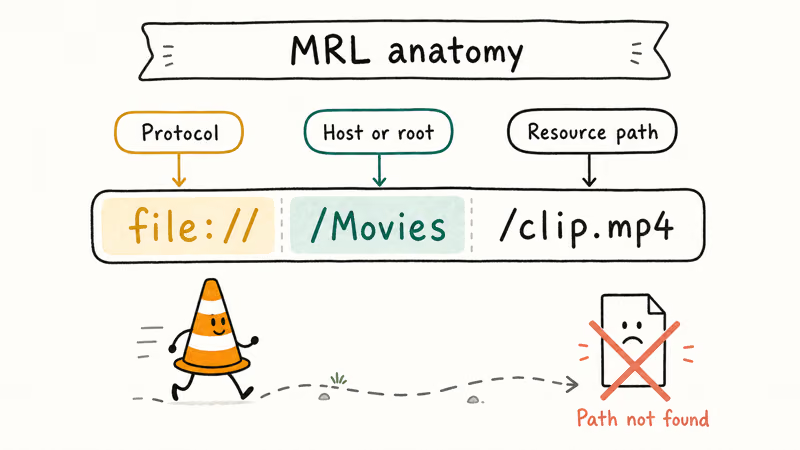
According to VideoLAN’s wiki, the MRL syntax is modelled on standard URIs and supports protocols like file://, dvd://, rtsp://, and http://. When VLC says it can’t open the MRL, it means the player parsed the string but failed to reach the resource the string points to.
Three blockers come up over and over: a firewall rule that drops VLC’s request, a permission boundary on the source file or folder, and a typo or stale path inside a saved playlist. Firewall blocks are common after a Windows feature update, since Defender can lose an existing VLC exception, and a single bad share path can break a queued playlist.
External captures and DVD drives add a fourth blocker: the codec or region mismatch. A region-locked disc or an unsupported codec returns a generic MRL error rather than a specific message, which makes the cause easy to miss.
#How to Fix the MRL Error on Windows
Windows-side fixes run from safest to most invasive. Start at the top and stop once playback works again.
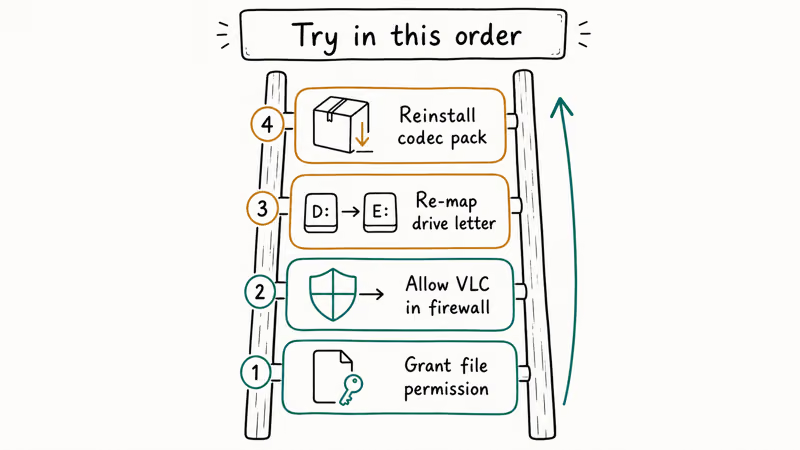
#Allow VLC Through Windows Defender Firewall
Microsoft’s firewall guidance recommends adding apps as exceptions instead of disabling the firewall outright. Go to Settings → Privacy & security → Windows Security → Firewall & network protection → Allow an app through firewall, click Change settings, find VLC, and tick both Private and Public.
If VLC isn’t already on the list, hit Allow another app, browse to C:\Program Files\VideoLAN\VLC\vlc.exe, and add it manually. Retry the file, stream, or disc after the exception is saved.
#Claim Ownership of the Source File
If VLC chokes on a single local file, Windows is probably refusing the read.
Right-click the file, pick Properties → Security → Advanced, click Change next to the owner field, type Administrators, then Check Names → OK, and tick Replace owner on subcontainers and objects.
Microsoft Learn confirms that file ACLs override application-level permissions, so this step beats anything you can change inside VLC itself.
#Update VLC to the Current 3.0 Point Release
The VLC 3.0 branch launched in 2018, and VideoLAN has shipped many point releases since. Older 2.x builds can’t handle modern streaming protocols or HEVC streams, which produces the MRL error on perfectly valid URLs.
According to VideoLAN’s release page, the 3.0 branch has shipped multiple point updates since 2018 that patched DVD navigation bugs producing the MRL error. Download the current installer from the official VideoLAN site, uninstall the old copy first via Apps & features, then run the new installer.
If you’d rather try a different player, our roundup of the best video players covers MPC-HC, PotPlayer, and other lightweight options.
#How to Fix the MRL Error on macOS
The macOS path mirrors the Windows one, but the menus differ. On macOS Ventura and later, Apple’s firewall guide walks through the toggle in System Settings → Network → Firewall → Options, where you can either turn the firewall off or add VLC as an allowed app.
Add VLC as a firewall exception first for network shares and remote streams.
On older macOS Monterey machines, the same controls sit under System Preferences → Security & Privacy → Firewall.
Disk Utility is the next stop when an external DVD drive returns the MRL error on Mac. Eject the drive, open Disk Utility, run First Aid on the disc, and remount it before retrying. If the drive sits behind a USB-C hub, connect it directly to the Mac before testing again.
If macOS playback still misbehaves, a different player can save the session. Our VLC alternative post lists IINA, Movist, and others that handle the same files without the firewall dance.
#Fixing MRL Errors When Streaming YouTube or Network URLs
VLC’s YouTube support relies on a bundled Lua script called youtube.luac. When Google changes the YouTube page format, that script breaks and every YouTube URL throws the MRL error.
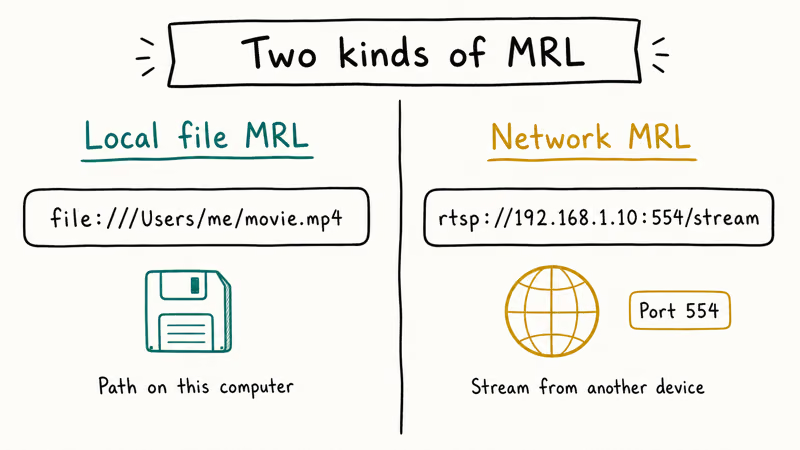
The fix is to refresh those bundled Lua scripts. VideoLAN maintains them in its VLC source repository, and the simplest path is to install the latest VLC build, which ships updated playlist parsers. If you prefer a manual swap, replace the older script in C:\Program Files\VideoLAN\VLC\lua\playlist\ on Windows or /Applications/VLC.app/Contents/MacOS/share/lua/playlist/ on macOS with the current version from that repository, then restart VLC.
For RTSP, RTMP, and HTTP streams, double-check the URL in a browser first.
Network MRLs fail silently when the host responds with a redirect or a captive portal page, and VLC just reports the generic MRL error.
For Chromecast routing, our cast VLC to Chromecast walkthrough covers the encoder settings.
#Common File and Path Issues That Trigger MRL Errors
Path typos cause more MRL errors than firewalls.
Trailing spaces, stale mapped drives, and cloud placeholders can all leave VLC pointing at a source that no longer resolves. Use this short checklist:
- Trailing spaces or non-ASCII characters in the folder name break VLC’s path parser. Rename the folder to plain ASCII, or move the file to a shorter path like
C:\Media\. - Mapped drives that disconnect after sleep silently invalidate the saved MRL. Reconnect the drive, then re-add the file to VLC’s playlist.
- OneDrive and iCloud can replace a real file with a placeholder. Force a download on the file before opening it in VLC.
- Read-only network shares sometimes need the share remounted with write access for VLC’s metadata cache to work.
Strange containers can mimic path problems. Our guides on the best MKV player and on M2TS playback in VLC cover the typical fixes for those formats.
#Are Codec or DVD Region Locks Behind Your MRL Error?
According to Wikipedia’s article on DVD regions, every commercial disc is locked to 1 of 6 regional codes, and most retail drives ship with a region counter that allows only a handful of changes before the drive locks itself.
When the region mismatch hits, VLC reports the MRL error instead of a region-specific message.
Check the drive’s region on Windows by opening Device Manager → DVD/CD-ROM drives → Properties → DVD Region, or on macOS by using DVD Player → Disc Info.
A codec mismatch behaves the same way. If a file’s audio stream uses something your build of VLC doesn’t include, the player throws the MRL error rather than naming the missing codec. Our audio codec not supported guide walks through the codec-pack swap that usually resolves it.
For projects that combine clips from different sources, the merge audio and video in VLC tutorial helps you re-encode everything to a format VLC handles cleanly the first time.
#Bottom Line
The “VLC is unable to open the MRL” message is almost always a permissions or path problem, not a VLC bug. Allowing VLC through Windows Defender or the macOS firewall clears the bulk of cases; ownership changes and a path sanity check cover the rest.
If the error follows a Windows feature update or a VLC version that’s more than a year old, install the current VLC 3.0 build from VideoLAN before trying anything else.
#Frequently Asked Questions
Can reinstalling VLC fix the unable to open MRL error?
Reinstalling helps when the error follows a Windows or macOS update, since the new installer rewrites the firewall exception and refreshes the bundled Lua scripts. Pull the installer from VideoLAN directly, not a mirror site, so the binary signature matches what Windows and Gatekeeper expect.
Why does the MRL error persist after I update VLC?
A current VLC build still depends on the host firewall, file permissions, and the path you typed. If the path is wrong or Defender hasn’t been re-prompted, the error sticks. Run through the three Windows steps above (firewall, ownership, reinstall) in that order before assuming VLC is broken.
Can VLC play files on a local network or external drive?
Yes. VLC handles SMB and NFS shares as well as USB and Thunderbolt drives, and the MRL syntax for a share starts with smb://server/share/path. If a share works in Finder or File Explorer but not in VLC, the firewall is the most likely culprit.
Can MRL files be converted to another format?
An MRL isn’t a media file, it’s a URI that points at one, so there’s nothing to convert. What you can convert is the source the MRL references. If the underlying file uses an exotic container, re-encoding to MP4 or MKV with HandBrake or VLC’s own Media → Convert/Save dialog usually lets every player open it.
Where can I download alternative players to VLC?
Pick the installer straight from each vendor: MPC-HC from its GitHub project page, IINA from iina.io, PotPlayer from daum.net, and Kodi from kodi.tv. If Kodi itself throws an error after install, our Kodi playback failed fix guide walks through the cache and add-on resets that usually clear it.
Does turning off the firewall really fix the MRL error?
It often does, because the firewall is a common blocker. Don’t leave it off, though. Adding VLC as an exception in Defender or the macOS firewall gives you the same result with a fraction of the security risk.
What does the MRL error look like when streaming RTSP cameras?
For an RTSP feed, VLC opens a small dialog that reads “Your input can’t be opened: VLC is unable to open the MRL” with the full RTSP URL underneath. Copy the URL into a browser or ffplay first; if either of those can fetch the stream, the issue is local to VLC and one of the firewall or codec fixes above will resolve it.

Best Laptop for Running LLMs in 2026: Memory Comes First
The best laptop for running LLMs is a memory purchase first. Compare MacBook unified memory against NVIDIA laptop VRAM, and see what each tier really runs.
How to Run a Local LLM on Windows: A 2026 Setup Guide
Run a local LLM on Windows with LM Studio or Ollama. Pick a model that fits your GPU memory, keep every prompt offline, and skip the monthly bill.
Bluetooth Not Working on Snapdragon X? Fixes for 2026
Bluetooth not working on your Snapdragon X Copilot+ PC? Generic audio, mice, and keyboards work, but vendor apps often lack an ARM build. Fixes inside.
Docker Desktop and WSL2 Not Working on Snapdragon X? Fix It
WSL2 runs fine on Snapdragon X, but Docker Desktop ARM is Early Access and throws WSL errors. Use WSL2 plus native ARM64 Ubuntu and Docker Engine.