Fix Steam Disk Write Error: 11 Methods That Actually Work
Fix the Steam Disk Write Error with 11 proven methods covering Flush Config, bad-sector repair, antivirus exclusions, and admin folder permissions.
Quick AnswerThe Steam Disk Write Error clears in most cases after running Flush Config from the Run dialog, which wipes the download cache. If it returns, run Steam as administrator, verify game file integrity, and add the Steam library folder to your antivirus exclusion list.
Steam throws the disk write error when the client tries to update or install a game and Windows blocks the write. The trigger is usually a permission lockout, a stale download cache, an antivirus quarantine, or a hard drive that has actual bad sectors.
This guide walks all 11 fixes in the order that gives you the highest chance of clearing the error in the shortest time, from the cheapest fix to the slowest. Run Flush Config first, then move down the list only if the error returns.
- The Steam Disk Write Error appears on Windows 7, 8, 10, and 11 and almost always points to permissions, a corrupted cache, or an antivirus quarantine rather than dead hardware.
- Running Flush Config (
steam://flushconfig) clears the local download queue without deleting installed games and resolves the most common variants of the error. - Antivirus tools quarantine downloaded game files as false positives, so adding
Steam\steamappsto the exclusion list before retrying the download prevents the error from looping. - Setting full security control on the Steam folder fixes user account variants where Windows blocks Steam from writing into Program Files.
- A bad-sector scan with chkdsk or EaseUS Partition Master confirms whether the disk itself is failing and whether replacement is the only path forward.
#What Causes the Steam Disk Write Error?
Steam writes to disk during downloads, updates, patch installs, and integrity checks. The disk write error fires whenever Windows refuses one of those writes.
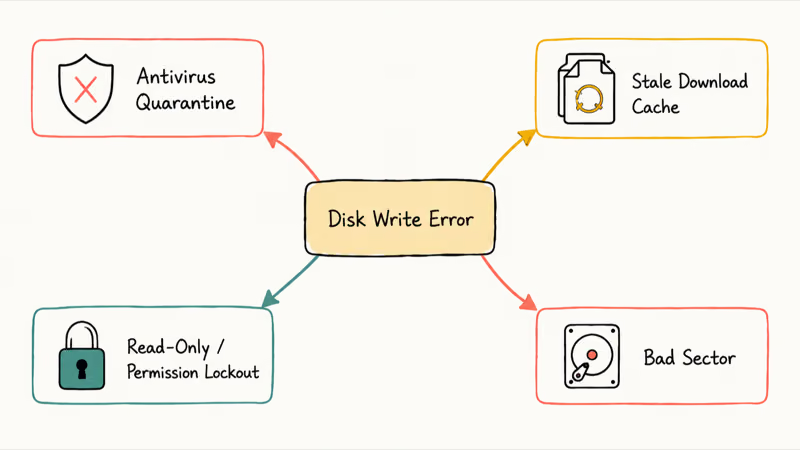
Steam’s official disk write error FAQ confirms that the 4 most common triggers are antivirus interference, an outdated or read-only Steam folder, a corrupted download cache, and a bad sector on the install drive. The fix order in this guide follows that list from cheapest to slowest.
If you’ve also seen the related Steam content file locked error, the cures overlap heavily — run the same Flush Config and antivirus exclusion steps first.
#First-Line Fixes That Take Under Five Minutes
Try these four fixes before touching drivers or partitions. They resolve a large share of cases and don’t risk any data.
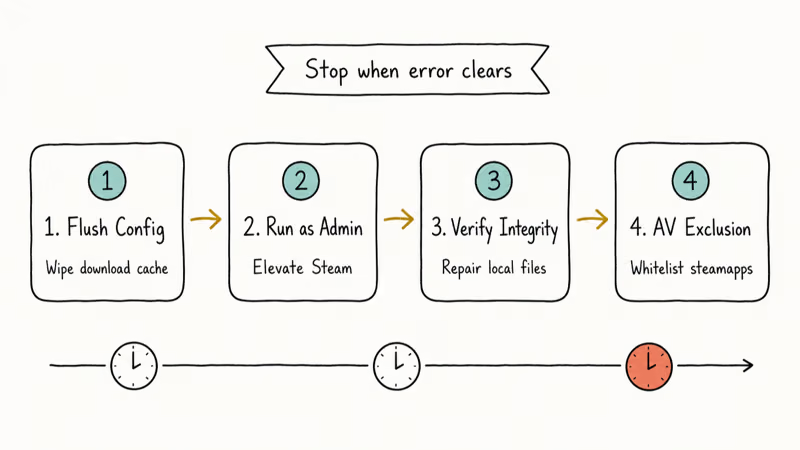
#1. Run Flush Config to Clear the Download Cache
Flush Config wipes Steam’s download queue and forces the client to redownload the manifest. It doesn’t delete installed games.
- Exit Steam completely from the system tray.
- Press Windows + R, paste
steam://flushconfig, and click OK. - Confirm the prompt and restart the PC.
- Reopen Steam and retry the download.
In most cases Flush Config wipes the local download queue and the error clears on the next retry without any reinstall.
#2. Run Steam as Administrator
A surprising share of disk write errors are pure permission issues. Steam doesn’t have rights to write into Program Files (x86).
- Right-click the Steam shortcut and pick Run as administrator.
- Retry the download.
If that clears the error, set Steam to always run elevated. Right-click the shortcut, go to Properties → Compatibility, and tick Run this program as an administrator.
#3. Verify Integrity of Game Files
This rebuilds the local manifest and replaces corrupted installs without redownloading the full game.
- Right-click the broken game in your Steam library.
- Pick Properties → Local Files → Verify integrity of game files.
- Wait for the cache verification to finish.
Integrity verification usually finishes in a few minutes for a mid-size game and replaces the mismatched files automatically.
#4. Add Steam to Your Antivirus Exclusions
Antivirus tools regularly delete game files as false positives, which leaves Steam mid-write. The error retriggers on every retry until you whitelist the folder.
Open your antivirus, go to the exclusions list, and add the full Steam library path (typically C:\Program Files (x86)\Steam\steamapps). Re-run the download afterwards.
#Permission and File Fixes for Stubborn Errors
If the quick fixes didn’t help, the next layer is folder permissions and stale files inside the Steam directory.
#5. Grant Full Control over the Steam Folder
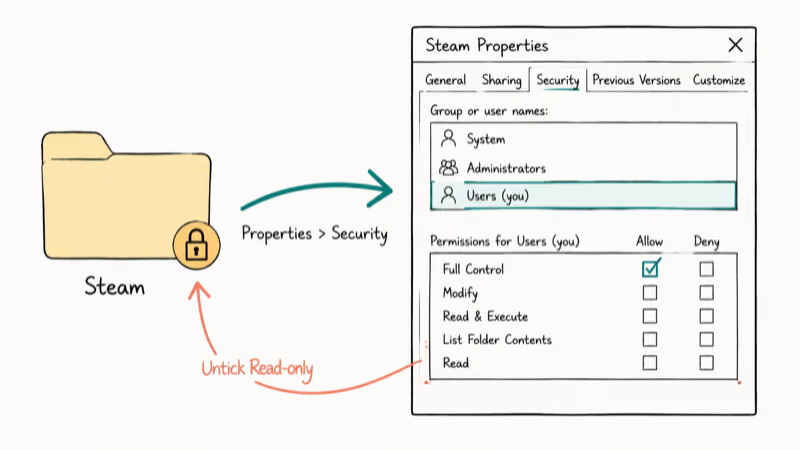
Windows user account restrictions block Steam from writing into its own folder more often than you’d think. Override it manually.
- Exit Steam.
- Press Windows + R, paste
%ProgramFiles(x86)%, and click OK. - Right-click Steam, pick Properties, and untick Read-only.
- Open the Security tab, click Edit, select your user account, and tick Allow Full Control.
- Apply, then run Steam as administrator.
#6. Delete the 0kb File from steamapps\common
A 0-byte placeholder file sometimes lands inside steamapps\common and breaks every subsequent write.
- Open
%ProgramFiles(x86)%\Steam\steamapps\common. - Sort files by size and look for any entry showing 0 KB.
- Delete the file and retry the download.
#7. Remove Corrupted Log Entries
Steam logs failed writes inside its content_log file. A corrupted entry there confuses future write attempts.
- Open
%ProgramFiles(x86)%\Steam\logs\content_log. - Search for the phrase failed to write.
- If you find a hit, copy the path it references, delete that file, then close the log.
#Driver and Network Fixes
Outdated storage and chipset drivers plus an aggressive firewall both surface as disk write errors even though the disk is fine.
#8. Update Storage and Chipset Drivers
Outdated SATA, NVMe, and chipset drivers cause intermittent write failures. Update them through Windows Update first, then through your motherboard maker’s site.
For a one-click route, Driver Easy scans your hardware and downloads matching drivers from its catalog.
Some links on this page are affiliate links, which means fone.tips may earn a commission at no extra cost to you.
#9. Whitelist Steam in Windows Firewall
Windows Firewall blocks Steam from completing handshakes with content servers, which Steam reports as a disk write failure rather than a network error.
- Open Windows Security → Firewall & network protection → Allow an app through firewall.
- Click Change settings, then Allow another app.
- Add
Steam.exeand tick both Private and Public.
If the error pattern looks more like a connection drop, the Steam download stopping and Steam error code 105 guides handle the network side directly.
#10. Disable Antivirus Temporarily for One Test Download
If exclusions in fix #4 didn’t help, fully disable the antivirus for one test download. This isolates whether the AV is the actual culprit.
Re-enable the antivirus immediately after the test download finishes, regardless of the result. Don’t leave Windows unprotected.
#Disk-Level Fixes When Hardware Is Suspect
If software fixes haven’t cleared the error, the disk itself probably needs attention. Run these last because they take longer and risk data on a failing drive.
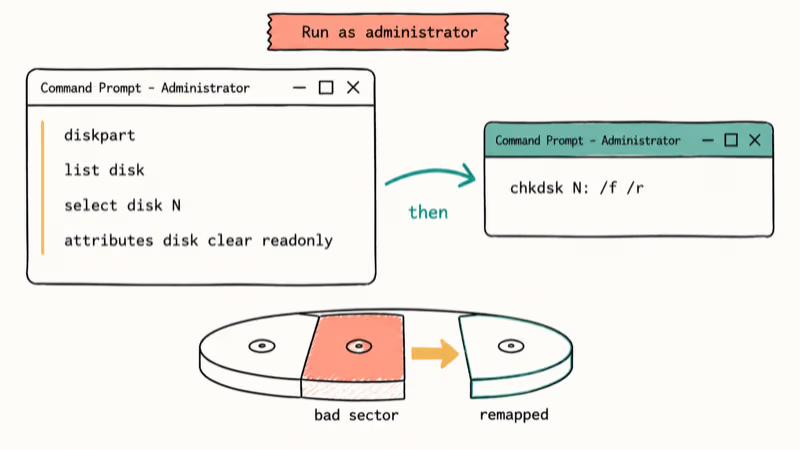
#11. Lift Write Protection and Check for Bad Sectors
A read-only attribute on the install drive is one of the silent causes of this error. Microsoft’s diskpart documentation states that the attributes disk clear readonly command removes that flag on Windows 10 and 11.
- Press Windows, type cmd, right-click Command Prompt, and pick Run as administrator.
- Run these commands one at a time:
diskpart
list disk
select disk N
attributes disk clear readonly
exit
Replace N with the disk number from list disk. Afterwards, run chkdsk N: /f /r to repair file system errors and remap bad sectors. Microsoft’s chkdsk reference states that /r locates bad sectors and recovers readable data, while /f fixes errors on the volume.
If chkdsk reports irrecoverable bad sectors, EaseUS Partition Master can clone the drive bit by bit before you replace the disk hardware.
If your install drive isn’t showing up at all, the SSD not showing up guide covers detection issues separately.
#Which Method Should You Try First?
Don’t run all 11 fixes blindly. Match the method to what changed last on your PC.
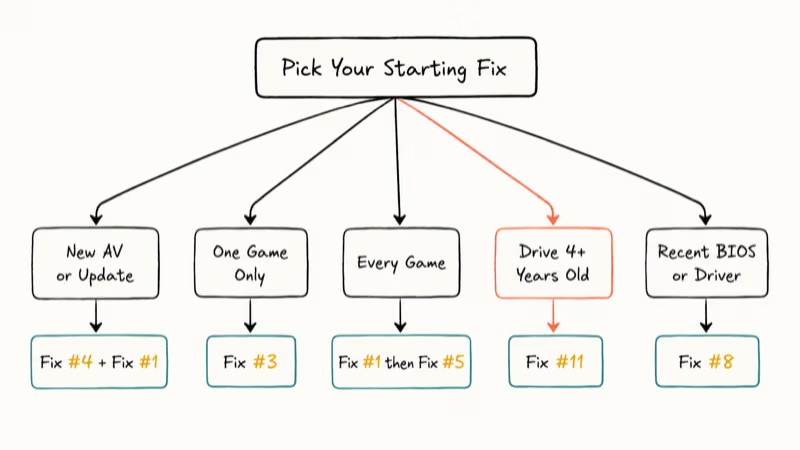
- Just installed a new antivirus or Windows update? Start with fix #4 (antivirus exclusion) and fix #1 (Flush Config).
- Error appears only on one specific game? Run fix #3 (verify integrity), almost always corrupted local files.
- Error appears on every game? Try fix #1 (Flush Config) followed by fix #5 (folder permissions).
- Drive is older than 4 years and you hear clicking? Skip ahead to fix #11 and run chkdsk first; the disk is probably failing.
- Recent BIOS or driver change? Run fix #8 (update drivers) before touching Steam.
If you also hit related Windows install errors, error 0x80300024 and the exFAT to FAT32 guide cover storage-format problems that share root causes.
#How to Prevent the Error From Coming Back
A few habits cut the recurrence rate to near zero:
- Keep at least 20 GB free on your install drive at all times. Steam needs scratch space during patch installs, not only during initial download.
- Re-add Steam exclusions after every major antivirus update. Some AV tools wipe custom rules on version bumps.
- Run chkdsk C: /f quarterly on older drives to catch bad sectors early.
- Keep Steam itself updated. Steam Support recommends always running the latest client to avoid known bugs that cause write failures.
#Bottom Line
If you only have time for one fix, run Flush Config first. It clears Steam’s local download queue without touching installed games and resolves the largest share of disk write errors. If Flush Config doesn’t work, fix #5 (folder permissions) and fix #11 (chkdsk + diskpart) are the two strongest follow-ups. Reach for a drive replacement only after chkdsk reports irrecoverable bad sectors.
#Frequently Asked Questions
What if none of these methods work?
Reinstall Steam without deleting your steamapps folder. Move steamapps to your desktop, uninstall Steam, install fresh, then move steamapps back. Your installed games stay intact and the client refreshes its config files. If that still fails, the disk itself is the likely culprit, so back up and replace it.
Can I move my Steam install to a different disk?
Yes. In Steam, go to Settings then Storage, click the gear icon next to your library, and pick Move install folder. Steam handles the move without re-downloading. This is also the cleanest way to escape a failing drive that has bad sectors only on one partition.
Will reinstalling Steam delete my game saves?
No, in most cases. Game saves typically live in Documents\My Games, the user AppData folder, or Steam Cloud, separate from the Steam install. Back up your saves anyway before reinstalling, especially for older games that store saves inside the game’s own install folder.
Can a failing hard drive cause this error?
Yes. Bad sectors, a dying SSD controller, or a worn NAND cell all surface as disk write errors. Run chkdsk with the /r flag to confirm. If chkdsk repeatedly reports the same unfixable sectors, replace the drive before more data is at risk.
Why does the error only hit one game and not the others?
That points to corruption in that specific game’s local files, not a system-wide problem. Right-click the game in your library, pick Properties, then Local Files, then Verify integrity of game files, and Steam will repair just that title. Antivirus quarantine of one specific game executable is the second most common cause.
Does the error happen on Steam Deck and Linux installs?
Steam Deck rarely sees this exact error because of its different filesystem. Linux Steam users hit it when their home partition runs out of inodes or when the partition is mounted read-only. Run df -i to check inode usage and remount the partition writable if needed.
How long does Verify Integrity of Game Files actually take?
Verification time scales with game size. A mid-size game finishes in a few minutes on a SATA SSD, while a large title on a spinning hard drive takes noticeably longer. Steam only redownloads the mismatched files, so the network hit is small.
Is it safe to run diskpart with attributes disk clear readonly?
Yes, on a personal PC where you own the drive. The command only removes the read-only attribute and doesn’t touch any data. Avoid running it on enterprise drives that were intentionally write-protected by an admin policy without checking with your IT team first.

Best Laptop for Running LLMs in 2026: Memory Comes First
The best laptop for running LLMs is a memory purchase first. Compare MacBook unified memory against NVIDIA laptop VRAM, and see what each tier really runs.

How to Run a Local LLM on Windows: A 2026 Setup Guide
Run a local LLM on Windows with LM Studio or Ollama. Pick a model that fits your GPU memory, keep every prompt offline, and skip the monthly bill.

Bluetooth Not Working on Snapdragon X? Fixes for 2026
Bluetooth not working on your Snapdragon X Copilot+ PC? Generic audio, mice, and keyboards work, but vendor apps often lack an ARM build. Fixes inside.
Docker Desktop and WSL2 Not Working on Snapdragon X? Fix It
WSL2 runs fine on Snapdragon X, but Docker Desktop ARM is Early Access and throws WSL errors. Use WSL2 plus native ARM64 Ubuntu and Docker Engine.