Steam Error Code 105: 9 Fixes for No Server Connection
Fix Steam Error Code 105 with 9 proven methods covering DNS flush, public DNS servers, firewall whitelisting, port forwarding, and router resets.
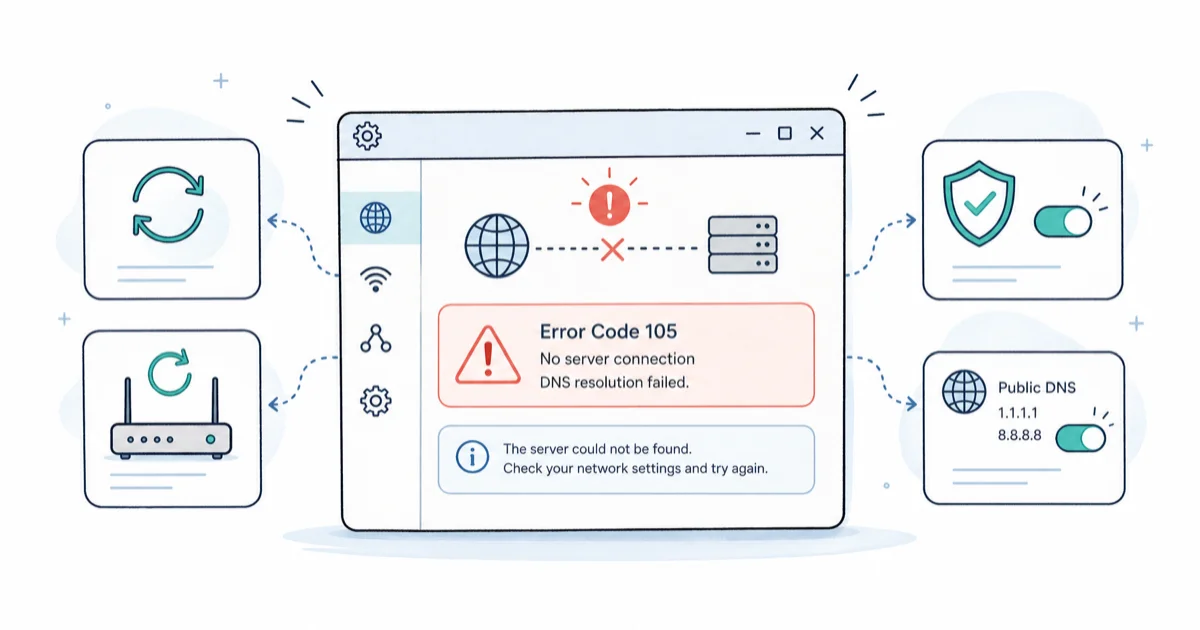
Quick AnswerSteam Error Code 105 is a DNS resolution failure. Fix it by flushing your DNS cache with ipconfig /flushdns, switching to Google DNS (8.8.8.8), and restarting your router.
Steam Error Code 105 is the client telling you it can’t reach Steam’s servers, and nine times out of ten the break is in DNS resolution rather than your actual internet link. The browser still loads pages because it caches recent lookups; Steam, with its larger pool of CDN hostnames, hits a stale or blocked entry first.
The fixes below run in priority order, from a quick DNS cache flush to a full router and Winsock reset. Start with DNS before touching firewall rules or port forwarding.
- Error 105 means “no connection to server” with DNS resolution as the dominant root cause; the browser keeps working because it cached lookups Steam has not.
- Running
ipconfig /flushdnsand switching to Google’s public DNS (8.8.8.8 and 8.8.4.4) clears many 105 cases before deeper network changes. - Steam’s CDN expects UDP 27000-27100 and TCP 27015-27030 to be reachable; a corporate or ISP firewall closing those ports surfaces as a permanent 105.
- Reinstalling the Steam client never deletes your library, since games and saves live under your account on Valve’s servers and redownload after login.
- Always confirm Steam’s own status at steamstat.us before deep troubleshooting; Valve outages produce identical 105 messages that no local fix will solve.
#What Is Steam Error Code 105 and Why Does It Happen?
Error 105 is the connectivity error code Steam returns when the client tries to resolve a Steam hostname like store.steampowered.com or steamcommunity.com and gets no usable IP back. The Steam client treats that as a “server unreachable” event and surfaces the same message regardless of whether the failure happened at your DNS resolver, your router, your ISP, or Valve’s edge.
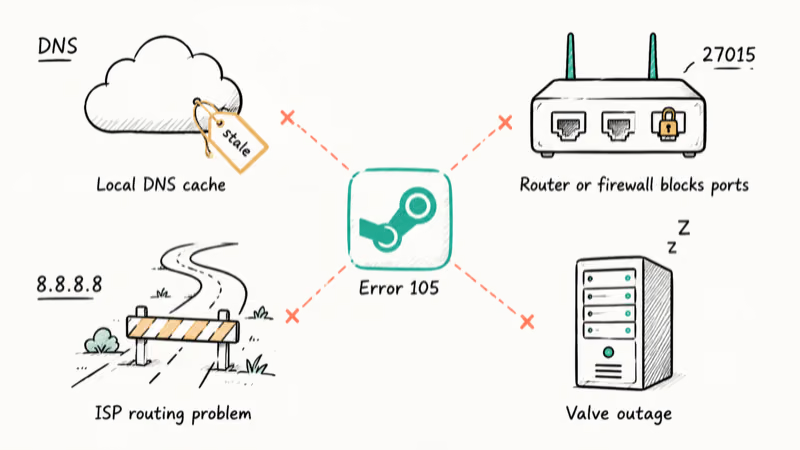
According to Steam Support’s connection troubleshooting page, most “connection to Steam servers” failures fall into four buckets: a stale local DNS cache, a router or firewall blocking outbound game ports, a regional ISP routing problem, and an actual Valve outage. The page recommends checking the public Steam status feed before changing any local settings.
Typical 105 causes fall into DNS cache failures, public-DNS routing problems, Valve outages, and router firmware or firewall blocks. Work through those in that order before contacting Steam Support.
The error pattern is a useful first signal. A 105 that hits all clients on the same network at once is almost always upstream (router, ISP, or Valve). A 105 that only affects one PC while phones and a second laptop reach Steam fine points at local DNS, host file changes, or the security stack on that single machine.
#First-Line Fixes That Take Under Five Minutes
These three are the safest first-line fixes. Run them in order before touching firewall rules or port forwarding.
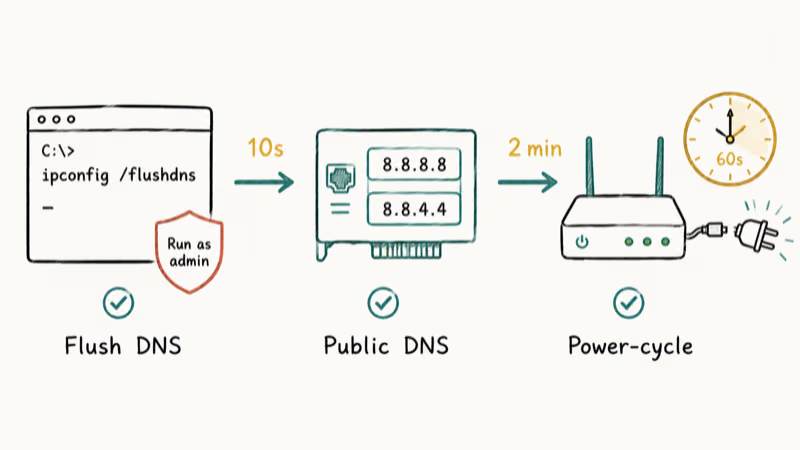
#1. Flush the DNS Cache
A bad cache entry from a recent network blip will keep returning the same dead IP for hours.
- Press
Windows + R, typecmd, press Ctrl+Shift+Enter to open Command Prompt as administrator. - Run
ipconfig /flushdnsand wait for the “Successfully flushed the DNS Resolver Cache” line. - Close the Steam client completely and relaunch it.
Microsoft’s ipconfig command reference confirms that /flushdns purges the resolver cache without changing any TCP/IP setting, so your other apps stay connected throughout. The flush itself takes about a second.
#2. Switch to Google or Cloudflare Public DNS
ISP-supplied DNS servers in some regions throttle gaming and CDN hostnames, or they sit behind cheap forwarding hardware that gets stuck on cached failures.
- Open Settings → Network & Internet → Advanced network settings.
- Click your active adapter, then Edit next to DNS server assignment.
- Switch from Automatic to Manual, enable IPv4, and enter
8.8.8.8and8.8.4.4. - Save and relaunch Steam.
Google’s Public DNS documentation states that 8.8.8.8 and 8.8.4.4 are anycast resolvers backed by global edge nodes designed for high availability. Cloudflare’s 1.1.1.1 is another common public resolver if Google traffic is restricted in your region.
#3. Power-Cycle the Router and Modem
A 60-second power cycle clears stale DHCP leases, refreshes the WAN handshake, and rebuilds the router’s NAT table.
- Unplug both the modem and the router from power.
- Wait 60 seconds. The cooldown lets ISP-side equipment release the old lease.
- Plug the modem back in first and let it fully sync (usually a solid online light).
- Plug the router back in and wait until Wi-Fi clients reconnect.
If your router has a separate firmware update menu, check for one while you are in the admin panel. Stuck NAT translations on outdated firmware are a recurring cause of intermittent 105 errors.
#How Do You Fix DNS-Related Steam Connection Errors?
When the basic flush plus public DNS does not stick, the issue is deeper in the network stack. The next layer of fixes targets the Windows-side resolver and the route between your PC and Valve’s CDN.
#4. Reset the Windows Network Stack
A corrupted Winsock catalog or a stale TCP/IP entry can block Steam alone while leaving browsers working, because browsers reuse persistent connections that the catalog corruption never touches.
Open Command Prompt as administrator and run these three lines in sequence:
netsh winsock reset
netsh int ip reset
ipconfig /flushdns
Reboot afterwards. The reset itself takes about 5 seconds, but Windows requires a restart to apply the new network configuration. After the reboot, retest Steam before re-installing any VPN client or third-party firewall, since those reinstall their own Winsock LSPs that could re-introduce the same break.
#5. Disable VPN, Proxy, and Browser Tunnels
VPN clients install a virtual network adapter that often outranks your real adapter on the routing table, and a half-disconnected VPN session can route Steam traffic into a black hole.
- Right-click any active VPN tray icon and choose Disconnect or Quit.
- In Windows Settings → Network & Internet → Proxy, turn off both Automatically detect settings and Use a proxy server.
- Disable any browser-level VPN extensions (Chrome and Firefox treat these as system-wide on some builds).
If you need a VPN for region-locked content, reconnect it after Steam loads and keep an eye on whether 105 returns. Some VPN providers route gaming traffic through congested transit, which surfaces as a 105 even with the VPN visibly online.
#Network and Router Configurations for Persistent 105 Errors
If 105 still appears after the DNS-side fixes, the firewall or router is closing ports that Steam’s CDN needs.
#6. Whitelist Steam in Windows Defender Firewall
Windows Defender sometimes drops Steam’s outbound handshakes after a major Steam client update because the executable’s signature changes.
- Open Windows Security → Firewall & network protection.
- Click Allow an app through firewall, then Change settings, then Allow another app.
- Browse to
C:\Program Files (x86)\Steam\steam.exeand tick both Private and Public. - Repeat for
steamservice.exein the same folder if it’s listed separately.
If your security suite installs its own firewall (Bitdefender, ESET, Norton), repeat the whitelist there too. Two firewall layers blocking the same app is a common pattern.
#7. Open Steam’s Required Ports on the Router
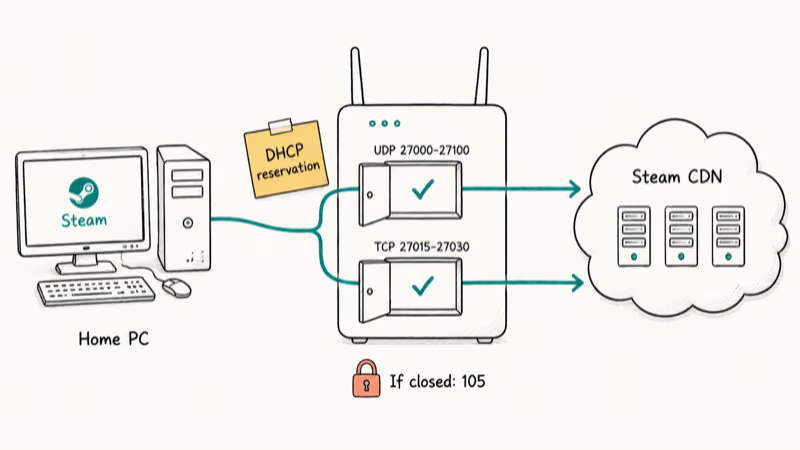
Steam’s CDN documentation recommends keeping UDP 27000-27100 and TCP 27015-27030 reachable from your network. Most consumer routers leave these open on outbound, but corporate, school, and some ISP-rented routers don’t.
- Open the router admin page (typically
192.168.1.1or192.168.0.1). - Find Port Forwarding or Virtual Server.
- Add rules forwarding UDP 27000-27100 and TCP 27015-27030 to your PC’s local IP (set a DHCP reservation first so the IP does not change).
- Save and reboot the router.
If the router has features called SPI Firewall, Application Layer Gateway, or Game Mode, try toggling them off temporarily; on cheap hardware these break Steam more often than they help.
#8. Disable IPv6 on the Active Adapter
Some ISPs roll out broken IPv6 routing for game traffic while their IPv4 path stays clean. Steam tries IPv6 first when both are advertised, hits the dead path, and surfaces 105.
- Open Settings → Network & Internet → Advanced network settings.
- Click your active adapter, then More adapter options to open the legacy panel.
- Right-click the adapter, choose Properties, and untick Internet Protocol Version 6 (TCP/IPv6).
- Click OK and relaunch Steam.
This is a temporary diagnostic, not a permanent fix. If disabling IPv6 resolves 105, contact your ISP about the broken IPv6 route rather than leaving v6 off forever.
#When Antivirus and Ad Blockers Are the Real Culprit
Security tools that work at the network layer can block Steam’s CDN hostnames at DNS or TLS level without showing a clear notification. The block looks identical to a 105 from the user’s side.
#9. Pause the Antivirus and Disable Ad Blocker Extensions
Pause your antivirus for a single test launch only:
- Right-click the antivirus tray icon, choose Pause or Disable for 10 minutes.
- Disable any browser-level ad blockers and privacy extensions (uBlock, AdBlock Plus, AdGuard).
- Launch Steam.
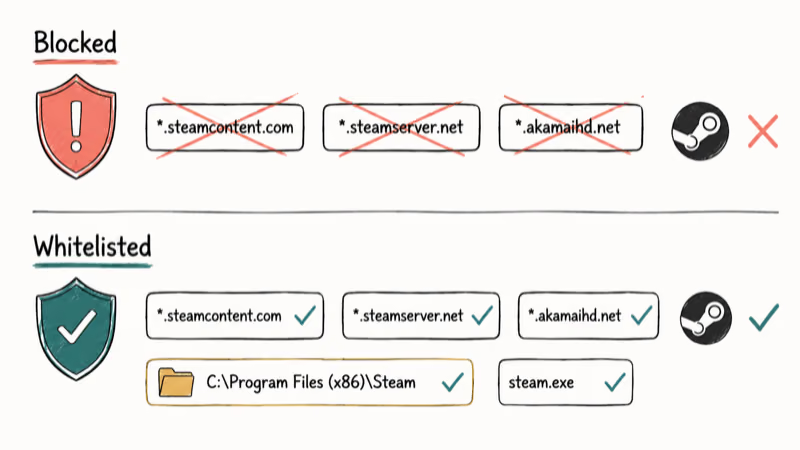
If 105 disappears, re-enable security immediately and add Steam to the exclusion list rather than leaving security off. Most antivirus tools accept a folder exclusion for C:\Program Files (x86)\Steam plus a process exclusion for steam.exe. The Steam Support team also confirms that AdGuard and Pi-hole-style network filters can block Steam CDN domains by mistake; whitelist *.steamcontent.com, *.steamserver.net, and *.akamaihd.net if you run network-wide filtering.
For deeper coverage of the same exclusion pattern, the Steam content file locked and Steam disk write error guides walk through antivirus exclusions for the install path.
#Other Steam Errors That Look Like 105
Several Steam errors share the same symptoms but need different fixes.
A failed VAC verification blocks game launches and sometimes surfaces network-shaped errors when a patch fails to land. The fix is a TCP stack reset (fix #4) plus a check that no antivirus is rewriting Steam’s TLS certificates.
If 105 appears alongside paused downloads, jump to the Steam downloads keep stopping guide, which covers cache clearing and region switching for the throughput side of the same network surface.
If the error mentions an API or SDK initialization failure rather than a generic connection problem, the unable to initialize Steam API walkthrough handles the launch-time variant where the client itself loaded but a game’s networking layer didn’t.
While you are tuning your Steam setup, watch for Steam gift card scams too. Buy gift cards only from authorized retailers and never share login codes with anyone who pressures you to top up an account.
#Bottom Line
Run the DNS flush (fix #1) and the public DNS swap (fix #2) before any deeper troubleshooting; together they address the most common DNS-side causes without rebooting anything. If those don’t stick, the router power-cycle (fix #3) handles a stale NAT table that often hides behind seemingly random reconnects.
Save the Winsock reset (fix #4) for the case where browsers and other network apps are also misbehaving, since it requires a Windows restart. The firewall whitelist plus port forwarding combination (fixes #6 and #7) is worth the effort only after the DNS-side fixes have already failed, because most home setups don’t actually need either change to reach Steam. And always check steamstat.us first; a Valve regional outage will laugh off every local fix on this list.
#Frequently Asked Questions
How long does Steam Error Code 105 usually last?
A local-side 105 can clear as soon as DNS and resolver changes take effect. A 105 caused by a Valve regional outage lasts until Valve fixes the upstream issue. The status pages at steamstat.us and Downdetector are the fastest ways to tell the two apart.
Can a VPN cause Steam Error Code 105?
Yes, more often than people expect. A half-disconnected VPN session leaves a virtual adapter at the top of your routing table even after the tunnel drops, and Steam traffic gets routed into the dead tunnel. Disconnect every VPN client fully, including ones you launched a week ago, before retrying.
Will I lose my games if I reinstall the Steam client to fix 105?
No. Your library, save files, and screenshots are tied to your Steam account on Valve’s servers. After reinstalling and signing back in, every previously installed game shows up in the library ready to redownload. Local installations on disk also survive a client reinstall in most cases, because Steam recognizes the existing steamapps folder on next launch.
How often should I change my DNS server to prevent Steam errors?
You don’t need to keep changing it. Once you’ve switched to a reliable public resolver like Google’s 8.8.8.8 or Cloudflare’s 1.1.1.1, leave it alone unless you notice that resolver itself slowing down. Public resolvers have far better uptime than most ISP DNS, so the fix is usually permanent.
Can my ISP cause Error Code 105 even if other websites work fine?
Yes. ISPs sometimes route gaming traffic through congested or misconfigured peering links while keeping general web traffic on faster paths. If a region change in Steam, a public DNS swap, and a VPN test all fail to fix 105, contact your ISP and ask whether a peering issue with Valve’s CDN partners (Akamai or Steam’s edge) was logged that day.
Does running Steam as administrator fix 105?
Rarely. Error 105 is a connection error, not a permission error, so administrator privileges don’t help unless your firewall or antivirus needs the elevated context to apply rules. Try the network-side fixes first; reach for “run as administrator” only if a firewall whitelist refuses to save without it.
Is Steam Error Code 105 the same as Error 102?
No, but they’re close cousins. Error 102 is “unable to connect to the Steam servers” with a slightly different fingerprint and almost always points at a deeper network outage or proxy problem rather than a DNS cache. The fixes overlap, so working through the 105 list above will often clear a 102 too.

Best Laptop for Running LLMs in 2026: Memory Comes First
The best laptop for running LLMs is a memory purchase first. Compare MacBook unified memory against NVIDIA laptop VRAM, and see what each tier really runs.
How to Run a Local LLM on Windows: A 2026 Setup Guide
Run a local LLM on Windows with LM Studio or Ollama. Pick a model that fits your GPU memory, keep every prompt offline, and skip the monthly bill.
Bluetooth Not Working on Snapdragon X? Fixes for 2026
Bluetooth not working on your Snapdragon X Copilot+ PC? Generic audio, mice, and keyboards work, but vendor apps often lack an ARM build. Fixes inside.
Docker Desktop and WSL2 Not Working on Snapdragon X? Fix It
WSL2 runs fine on Snapdragon X, but Docker Desktop ARM is Early Access and throws WSL errors. Use WSL2 plus native ARM64 Ubuntu and Docker Engine.