Stardew Valley Chicken Coop: Costs, Upgrades, Animals (2026)
Plan a Stardew Valley chicken coop with build costs, upgrade tiers, animal unlocks, feeding rules, friendship math, and door safety tips for income.
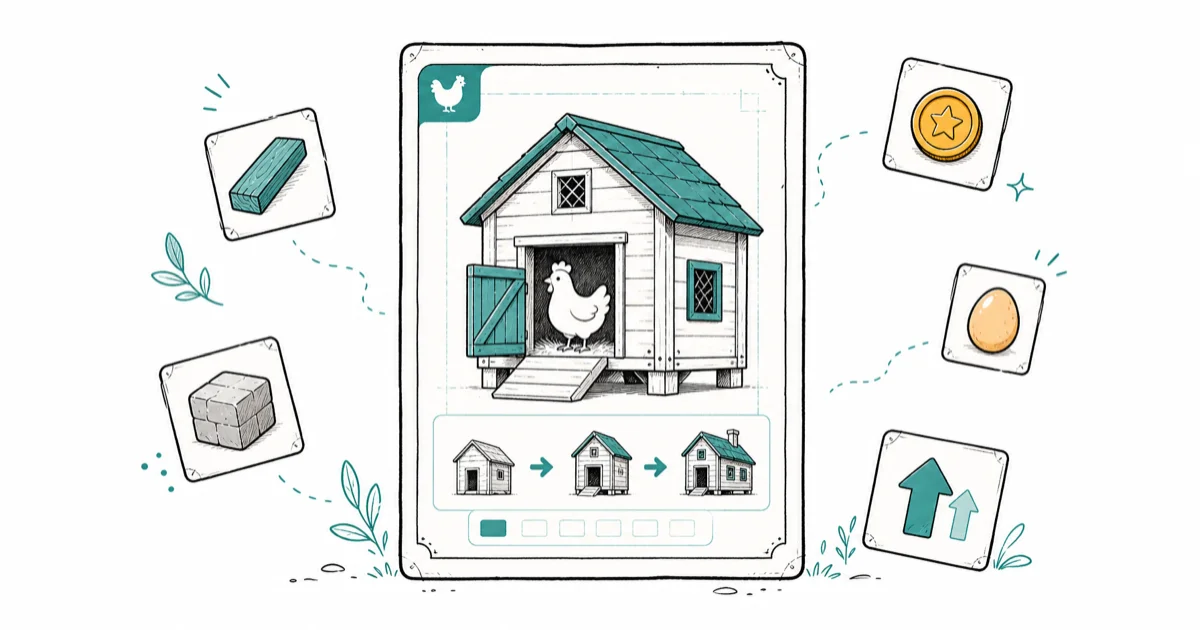
Quick AnswerA standard Stardew Valley chicken coop costs 4,000g, 300 Wood, and 100 Stone, takes 3 days for Robin to build, and houses up to 4 animals. Upgrade to a Big Coop for 10,000g to unlock the Incubator and a Deluxe Coop for 20,000g to add the Autofeed System.
Building your first Stardew Valley chicken coop is the cheapest way to start an animal-based income on the farm. The base coop costs 4,000g and 300 Wood. The game exposes exact costs, animal slots, and friendship math, so you can plan upgrades around your real gold balance instead of guesswork.
Everything here uses the official method available in the in-game build menu and the built-in feature set on your own save on any device that runs Stardew Valley, with no mods required.
- A standard Coop costs 4,000g plus 300 Wood and 100 Stone, houses 4 animals, and takes 3 days for Robin to construct.
- Upgrading to a Big Coop (10,000g, 400 Wood, 150 Stone) unlocks the Incubator, ducks, and void chickens; it takes 2 days.
- The Deluxe Coop (20,000g, 500 Wood, 200 Stone) adds rabbits and the Autofeed System, removing the daily hay-placement chore.
- Petting an animal adds +15 friendship per day, while skipping a feed deducts 20, so consistency is what unlocks large eggs and iridium-quality output.
- Leaving the coop door open at night triggers a wild animal attack roll that can permanently delete one animal, so close it before sleeping.
#How Do You Build Your First Stardew Valley Chicken Coop?
Walk to Robin at the Carpenter’s Shop in the Mountains north of Pelican Town and select Coop from her construction menu. You hand her 4,000g, 300 Wood, and 100 Stone, then pick a flat spot on your farm. Robin starts the next morning, and the finished coop appears 3 in-game days later.
The base coop is a 6 by 3 footprint with a feeding bench along the back wall.
According to the Stardew Valley entry on Wikipedia, the game has sold over 41 million copies since launch in 2016, and animal husbandry through coop and barn buildings is one of the four core income loops alongside crops, fishing, and mining. The official Stardew Valley site maintained by developer ConcernedApe lists chickens as the first animal most players unlock.
Robin can only work on one structure at a time. The Silo costs 100g, 100 Stone, 10 Clay, and 5 Copper Bars and takes 2 days. Build the Silo first if you don’t have one, because chickens that eat from the feeding bench rely on hay you’ve stored from cut grass. Our Stardew Valley sprinkler layout guide covers grass and hay placement around the coop for outdoor grazing, which feeds animals for free during spring, summer, and fall.
The Hay Hopper saves time each morning compared with carrying hay manually from a chest.
#Coop Tier Upgrade Costs and What You Unlock
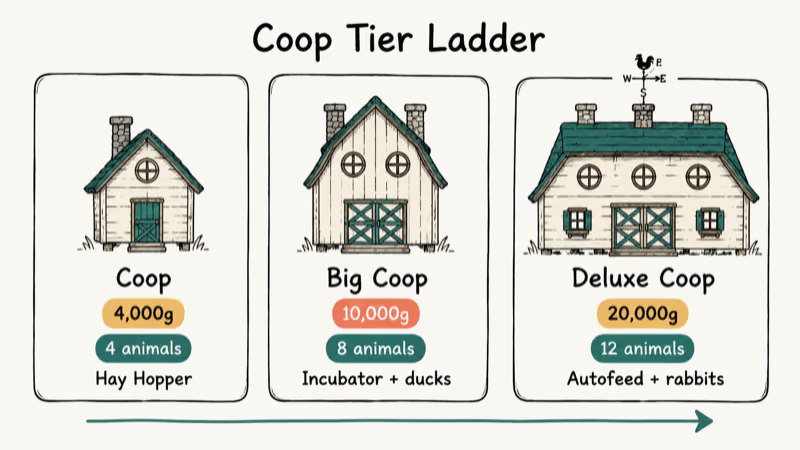
Each upgrade keeps the same 6-by-3 footprint, so you don’t have to clear new ground. What changes is animal capacity, available species, and which automation gadgets sit inside. Here is the full cost ladder:
| Tier | Build cost | Materials | Time | Capacity | New unlocks |
|---|---|---|---|---|---|
| Coop | 4,000g | 300 Wood, 100 Stone | 3 days | 4 | Hay Hopper, Feeding Bench |
| Big Coop | 10,000g | 400 Wood, 150 Stone | 2 days | 8 | Incubator, ducks, void chickens, dinosaurs, golden chickens |
| Deluxe Coop | 20,000g | 500 Wood, 200 Stone | 2 days | 12 | Autofeed System, rabbits |
The jump from Coop to Big Coop usually pays back fastest because eight chickens at iridium quality outsell four chickens by a margin large enough to cover the 10,000g upgrade in roughly 12 in-game days.
The Deluxe Coop’s economics are weaker on raw egg output, but the Autofeed System eliminates a manual chore that costs energy each morning, which is the strongest argument for paying the 20,000g.
If you’re funding upgrades through crops rather than animals, our most profitable Stardew Valley crops breakdown can help you hit the 20,000g Deluxe price faster.
#Animals You Can Raise in Each Coop Tier
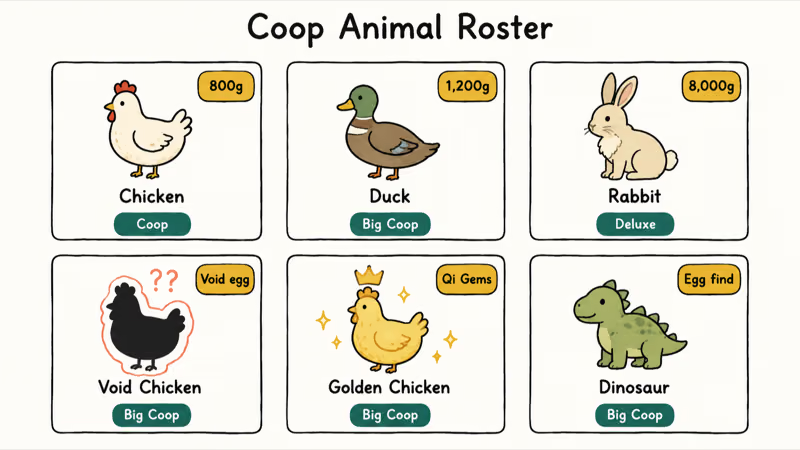
Coop tier dictates which animals you can buy from Marnie at the Ranch and which eggs the Incubator can hatch. The standard Coop only holds chickens. Every other species opens up at the Big Coop or Deluxe tier.
#Chickens
Chickens cost 800g from Marnie’s Ranch and produce one egg per day after the day they arrive.
At max friendship and happiness, they swap to large eggs (sell price 95g normal, 190g iridium). To unlock blue chickens, reach 8 hearts of friendship with Shane and watch his 8-heart event. After that, every chicken you buy from Marnie has a 25 percent chance of being blue. Blue chickens are cosmetic only and lay regular white or brown eggs.
#Ducks
Ducks unlock at Big Coop and cost 1,200g. They lay duck eggs every other day and occasionally drop duck feathers. Duck feathers sell for 250g (normal) up to 500g (iridium), and they’re an input for the in-game Tailoring system. Egg income is steadier than feather income because feathers are occasional drops.
#Rabbits
Rabbits are Deluxe-Coop-only and cost 8,000g, the most expensive coop animal. They produce wool every fourth day and occasionally drop a rabbit’s foot, which sells for up to 1,130g at iridium quality.
Combined with how to have kids in Stardew Valley once you marry, rabbits are the most “set and forget” coop animal because of the long cycle.
#Void Chickens
Void chickens hatch from void eggs you can buy from Krobus in the sewer for 5,000g or earn during the Witch’s late-game event that targets a slime hutch or coop. They lay one void egg per day, and void mayonnaise sells for 275g, which beats regular mayonnaise.
#Golden Chickens
Golden chickens unlock through the Perfection tracker (100 percent completion) or by spending 100 Qi Gems with Mr. Qi. They produce one golden egg per day, which sells for 500g normal and 1,000g iridium. They aren’t required for any quest, so most players treat them as a flex item rather than a meta pick.
#Dinosaurs
Dinosaur eggs come from artifact spots, fishing treasure chests, killing pepper rexes in the Skull Cavern, or the prehistoric movie theater event. The Big Coop or Deluxe Coop can incubate them. They lay one dinosaur egg every 7 days. Sell prices: 350g normal up to 700g iridium, plus dinosaur mayonnaise at 800g, which makes them the second-best mayonnaise income per animal slot behind golden chickens.
#Incubator Hatch Times by Egg Type
The Incubator unlocks with the Big Coop and sits inside the building. Drop an egg in, and the timer counts down only while you’re playing on the farm map.
Hatch times are fixed at:
- White Egg, Brown Egg, Large White Egg, Large Brown Egg, Void Egg, Golden Egg, Duck Egg: 9,000 minutes of in-game time (roughly 6.25 in-game days)
- Dinosaur Egg: 18,000 minutes (roughly 12.5 in-game days)
You can have only one egg incubating per coop, so dinosaurs share the slot with whichever bird you’re trying to multiply. The game states that the Coopmaster profession at level 10 cuts hatch times in half, which is the only meaningful skill investment for animal-focused saves. For background on the studio behind these mechanics, the ConcernedApe Wikipedia page confirms that solo developer Eric Barone designed all coop systems himself.
#How Do You Keep Coop Animals Happy and Friendly?
Stardew Valley tracks two separate stats per animal. Friendship runs 0 to 1,000 and is shown as a 5-heart bar, while Happiness runs 0 to 255. Friendship gates whether chickens lay large eggs at all. Happiness controls daily output quality.
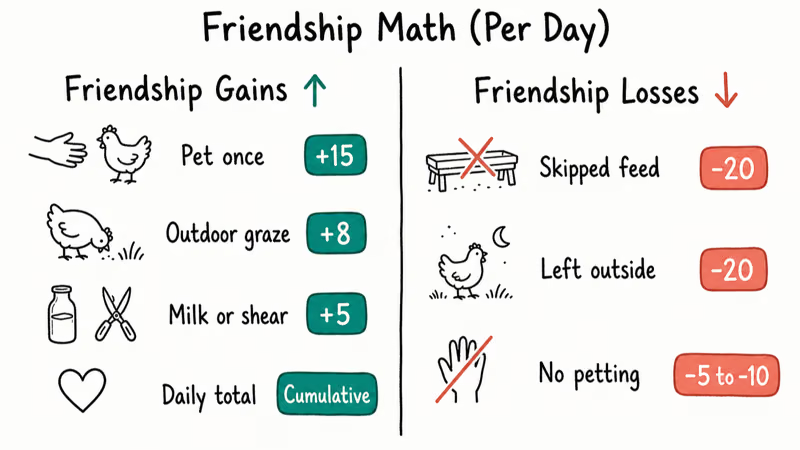
The friendship values are:
- Petting (once per day): +15 friendship
- Letting them eat outdoor grass: +8 friendship
- Milking or shearing (where applicable): +5 friendship
- Skipping a feed entirely: −20 friendship
- Leaving them outdoors overnight: −20 friendship
- Skipping petting: −5 to −10 friendship (depends on weather)
Happiness ranges read as: 200 to 255 is “very happy,” 30 to 200 is “looks okay,” and 0 to 30 means the animal is sad and likely to drop output quality. Heater placement matters here, because animals lose roughly 4 happiness per night during winter unless a Heater (Marnie sells one for 2,000g) sits inside the coop.
Reaching 5 hearts isn’t enough on its own. The game confirms that chickens need full happiness and friendship of at least 200 (2 hearts) before they can roll for a large egg. The chance climbs as both stats rise.
Daily petting and feeding raise friendship quickly; large eggs can appear before the 5-heart bar looks full.
#Feeding Coop Animals Without Wasting Hay
Animals must be fed once per day, period. If they aren’t fed, they don’t produce that day, and their friendship drops by 20.
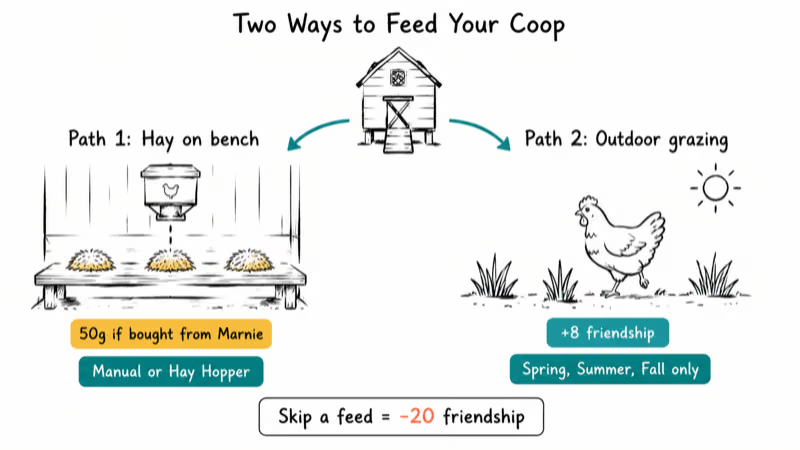
Feeding has two paths:
- Hay on the bench. Place hay manually each morning, or let the Hay Hopper push it out from your silo. Hay costs 50g per piece from Marnie if you don’t grow your own grass.
- Outdoor grazing. Open the coop door, and animals walk out to eat any grass within roughly 5 tiles. Grass is free if you let it spread on the farm, and animals get +8 friendship for grazing instead of eating hay.
Two exceptions: animals don’t need to be fed on the day they arrive, and they auto-fast through any festival day without any friendship penalty.
If you upgrade to the Deluxe Coop, the Autofeed System fills the bench from your silo automatically every morning. This eliminates the daily feeding chore entirely, which is why we recommend it as the upgrade priority once you have stable income from a Big Coop.
For broader farm planning, our Stardew Valley greenhouse layout guide shows how to combine year-round crops with hay production so you never run out of feed.
#Wild Animal Attacks When the Coop Door Is Open at Night
If the coop door is open when you go to bed, the game rolls a small probability that a wild animal (depicted as a wolf in dialogue) attacks the coop overnight. If the roll succeeds, one of your animals is permanently removed from the farm.
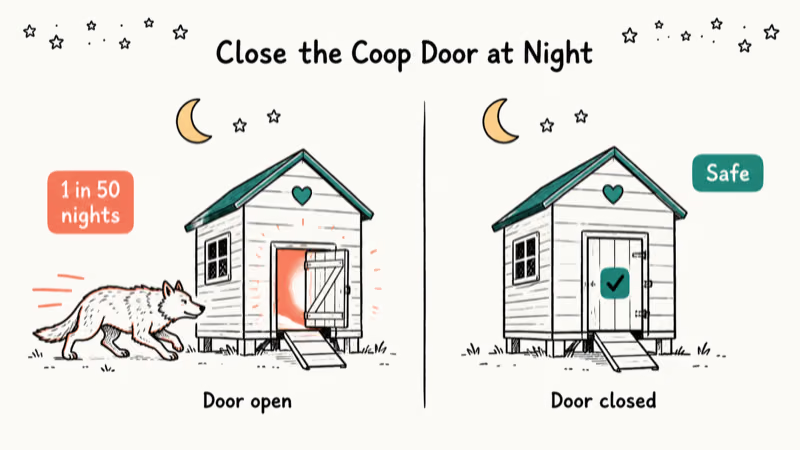
There’s no body, no warning the morning of, and no way to reverse it short of reloading the previous in-game day. The attack chance is roughly 1 in 50 nights with the door open, but the consequence is total, so the rational play is always to close the door before sleeping.
The “Animals” tab in the coop UI lets you close all doors with one click. If you forget, a late-night attack can remove an animal before you notice.
A second pitfall: the door does not auto-close just because you sleep. Don’t rely on edge-case automation; manually close it.
#Bottom Line
Build a standard Coop on day 4 or 5 of Spring, save aggressively for the 10,000g Big Coop upgrade by mid-Summer to unlock ducks and the Incubator, and treat the Deluxe Coop as a Year 2 quality-of-life buy rather than a profit play.
The Autofeed System is the real reason to spend the 20,000g, not the rabbits. If you’re choosing between a Deluxe Coop and a Deluxe Barn first, prioritize the Coop because chickens, ducks, and the Incubator together produce more daily artisan goods than the equivalent barn animal slots, especially once you pair them with a Mayonnaise Machine.
If you’re optimizing your overall farm economy alongside coop income, the Stardew miner or geologist profession choice impacts the gold flow that funds upgrades, and the best farming games list covers similar coop mechanics in adjacent titles if you want a break.
#Frequently Asked Questions
How many animals can a Stardew Valley chicken coop hold?
A standard coop holds 4 animals. Upgrading to a Big Coop increases capacity to 8, and a Deluxe Coop holds up to 12 animals total. Each animal occupies one slot regardless of species, so a rabbit takes the same space as a chicken.
What do chickens eat in Stardew Valley?
Chickens eat hay. You can place hay on the indoor feeding bench or let them graze on grass outside during non-winter seasons. Buy hay from Marnie for 50g each, or grow grass on your farm and harvest it with a scythe. The Hay Hopper pulls stored hay from your silo automatically once you have one built.
How do I get a blue chicken in Stardew Valley?
Reach 8 hearts of friendship with Shane and watch his 8-heart event. After that, every chicken you buy from Marnie has a 25 percent chance of being blue. Blue chickens are cosmetic only, lay normal white or brown eggs, and don’t produce blue eggs themselves.
Should I get a Big Coop or Deluxe Coop first?
Get the Big Coop first. The Big Coop unlocks the Incubator, ducks, void chickens, and golden chickens, which together generate enough income to cover the upgrade in around 12 in-game days. The Deluxe Coop adds rabbits and the Autofeed System, which is mostly a quality-of-life buy rather than a profit upgrade.
Do coop animals need a heater in winter?
Yes. One Heater per coop, 2,000g from Marnie, covers any tier.
How long does it take Robin to build a chicken coop?
Robin takes 3 in-game days to build a brand-new coop and 2 days for each upgrade. She works on only one building at a time, so plan your build queue if you also want a Silo or Barn from the same period.
Can I move my coop after Robin builds it?
Yes. Open Robin’s Construction menu, select “Move Buildings,” then click and drag the coop to a new spot on your farm. The move is free, instant within the same in-game day, and doesn’t disturb your animals, the Incubator queue, or any friendship and happiness progress they’ve built up. This is the safe way to test farm layouts because you can reverse the move within seconds if it doesn’t fit your sprinkler grid or fencing plan.
What happens to coop animals if I forget to close the door?
There’s a small chance overnight that a wild animal attack permanently removes one of your animals. The chance is roughly 1 in 50 nights with the door open, and there’s no way to recover the animal without reloading the previous day. Always close the door before sleeping.
Fortnite Stuck on the Loading Screen? Fix It in 2026
Fortnite stuck on the loading screen? Check server status, fix the Windows N Media Pack and DirectX 11 on PC, clear the console cache, and verify files.
Minecraft Keeps Crashing? Java and Bedrock Fixes (2026)
Minecraft keeps crashing on startup or mid-game? Update your GPU driver, remove mods on Java, and reinstall Gaming Services on Bedrock. Fixes for both.
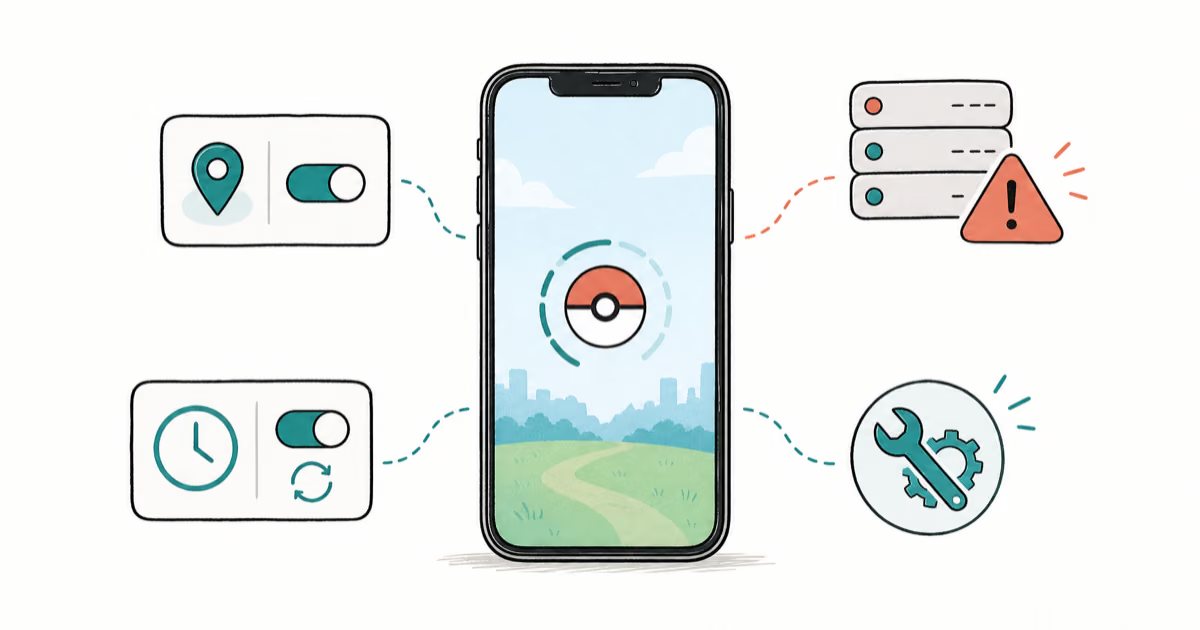
Pokemon GO Not Loading? Fix the Loading Screen 2026
Pokemon GO not loading or stuck on the Pokeball? Check server status, fix automatic date and time, grant location permission, clear the cache, and update.
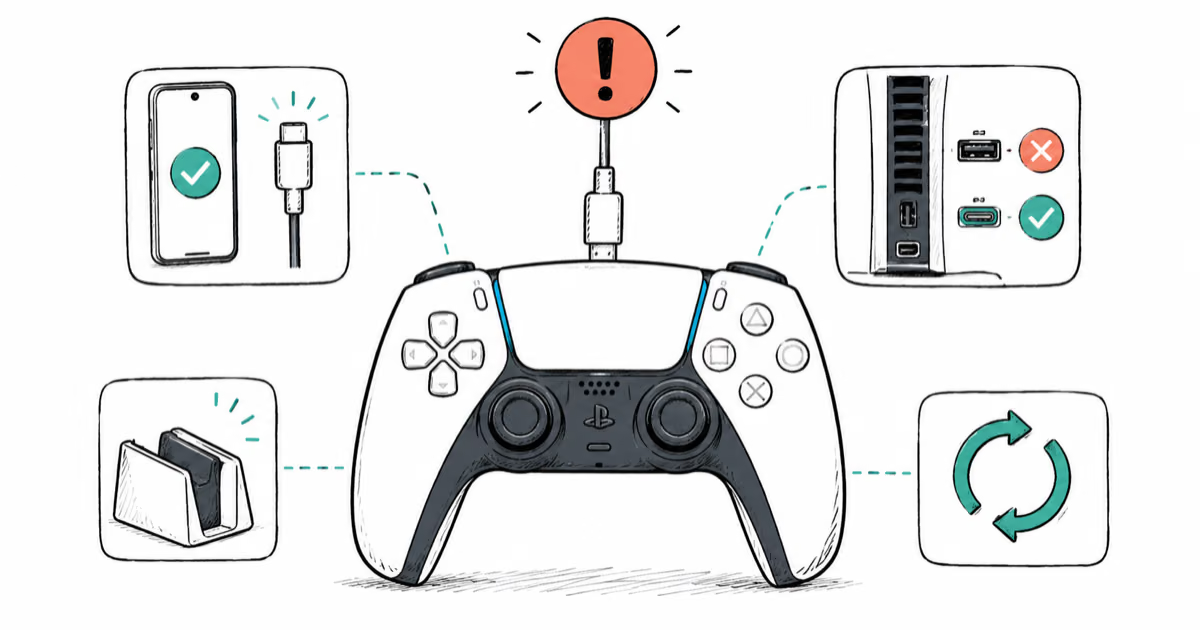
PS5 Controller Not Charging? 9 Fixes That Work (2026)
DualSense not charging? Swap the cable, use a rear port in Rest Mode, clean the USB-C port, and check power settings. 9 fixes for a dead PS5 controller.