SIM Not Provisioned for Voice: 6 Fixes That Work (2026)
Fix the SIM not provisioned for voice error. Six iPhone and Android checks cover SIM reseats, carrier updates, network resets, and carrier escalation.
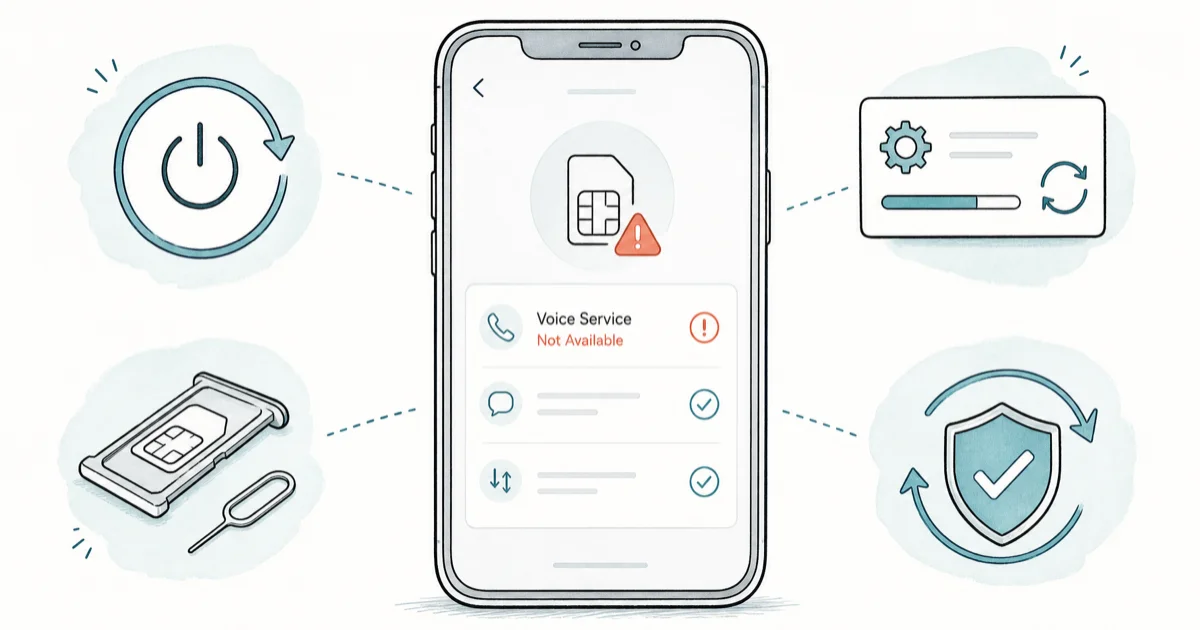
Quick AnswerA SIM not provisioned for voice error means calls aren't active for that SIM or line. Reseat the SIM, check for a carrier-settings update, and contact the carrier if calls remain blocked.
Seeing “SIM not provisioned for voice” means the phone has not obtained voice service for that SIM or line. Data or texts may still work, but that symptom alone doesn’t identify the exact carrier, SIM, or device fault.
The six checks below cover both iPhone and Android. This guide is for your own line or a device you have explicit permission to service; never share an IMEI, ICCID, account PIN, or verification code in a public post or chat.
- The message can reflect line activation, an account restriction, a carrier outage, a settings problem, a damaged physical SIM, or a device issue. The wording alone doesn’t settle which one.
- A full power cycle plus an Airplane Mode toggle reconnects the phone before you move to more disruptive resets.
- For a physical SIM, inspect the card and tray for damage or debris. For an eSIM, skip tray instructions and ask the carrier to confirm the eSIM activation.
- On iPhone, check for a carrier-settings update. On Android, install available system and app updates; Carrier Services is not present on every phone.
- A borrowed-SIM test provides clues only. Carrier lock, compatibility, coverage, and account state can change the result.
#What Does “SIM Not Provisioned for Voice” Actually Mean?
The wording tells you that voice service is unavailable for the SIM or line. It doesn’t expose the carrier’s internal record or prove that one specific provisioning flag is missing. A phone may show the message during activation, after an account or plan change, during an outage, or when the SIM or device can’t register correctly.
Possible triggers include:
- A new or recently transferred line that the carrier has not finished activating.
- An account restriction, service-plan mismatch, local outage, or device block that only the carrier can confirm.
- A damaged, dirty, or incorrectly installed physical SIM.
- Stale carrier settings, mobile-network settings, or device software.
According to Apple’s carrier-settings guide, inserting a new SIM or eSIM can require a download from the new carrier. Apple doesn’t publish a universal voice-provisioning timer on that page. A network-settings reset can refresh the device side, but it can’t confirm whether the carrier has activated voice service for the line. Run the device-side checks below, then contact the carrier if voice remains unavailable.
If cellular data is also failing, see our guide on cellular data not working for additional mobile-network checks.
#Method 1: Restart the Phone
Restarting is a low-risk way to make the phone reconnect before you reset any settings. Apple includes a restart in its current No Service and SOS troubleshooting. According to Google’s mobile-connectivity guide, Pixel phones should be powered off for 30 seconds before being turned on again.
Use the power menu and restart instructions for your model. After the phone reconnects, place one test call. If the error remains, continue; a restart can’t confirm or change the carrier’s account records.
#Method 2: Toggle Airplane Mode
Airplane Mode disconnects the phone from the mobile network and lets it reconnect. On iPhone, Apple says to turn Airplane Mode on for at least 15 seconds, then turn it off. On Android, open Quick Settings, turn Airplane Mode on, wait briefly, and turn it off.
Place another test call after the network indicator returns. This reconnect can clear a device-side connection problem, but it doesn’t activate a line or remove an account restriction.
#Method 3: Reseat the SIM Card and Wipe the Contacts
This method applies only to a removable physical SIM. If the line uses eSIM, skip to Method 4 and ask the carrier to confirm that the correct eSIM is active on the account.
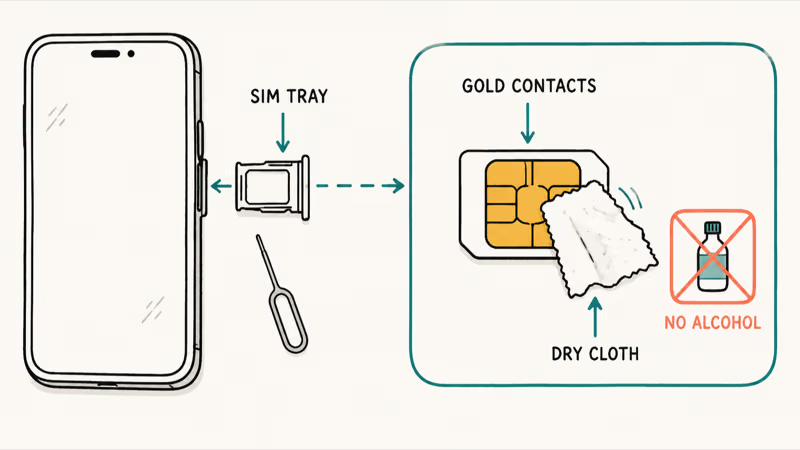
Power the phone off and follow the manufacturer’s instructions for opening the tray. Check the card for damage, bends, dust, or debris. Google recommends wiping a dirty SIM with a clean microfiber cloth and contacting the carrier for a replacement if the card is damaged in its Pixel connectivity guide. Reinsert it in the correct orientation, close the tray fully, and turn the phone on.
If the phone also reports “invalid SIM” or “no SIM card”, include that exact wording when you contact the carrier or device manufacturer.
#Method 4: Check Updates and Carrier Settings
On Android, install available system and app updates through the phone’s normal update screens. If Carrier Services is already installed and Google Play offers an update, install it and restart. Google’s listing describes communication services including RCS; it doesn’t promise that the app is present on every Android phone or that updating it will activate voice service.
On iPhone, open Settings > General > About. If a Carrier Settings Update prompt appears, install it. Apple’s carrier-settings guide says a new SIM or eSIM may require a download from the carrier. The page doesn’t give a universal wait time or activation deadline.
#Method 5: Reset Network Settings
Reset mobile-network settings only after the lower-impact checks. The names and consequences differ by device.
On iPhone, go to Settings > General > Transfer or Reset iPhone > Reset > Reset Network Settings. Apple’s current reset guide says this removes previously used networks and VPN settings that were not installed by a configuration profile or MDM. It also resets Wi-Fi, mobile, VPN, and APN settings, so save any Wi-Fi passwords and custom network details you need first.
On a current Pixel, Google’s guide uses Settings > System > Reset options > Reset mobile network settings. Reset Bluetooth & Wi-Fi is a separate Pixel option. Other Android manufacturers use different labels and may reset different data, so read the confirmation screen before continuing.
After the reset, reconnect saved Wi-Fi networks and restore any required VPN or custom APN details from a trusted carrier or administrator configuration.
#Method 6: Call Your Carrier With the Right Information
Contact the carrier if the line is new or recently transferred, if the account may be restricted, or if the device-side checks don’t restore calling. Apple says the carrier is the party that can confirm whether the account is active and in good standing, whether there is an outage, whether the device is blocked or barred, and whether the account has the correct plan.
Before you call, have these ready:
- Your phone number and account PIN.
- Your SIM or eSIM identifier, if the carrier asks for it.
- Your device IMEI, available in the device’s About screen or through the manufacturer’s documented path.
- The exact wording of the error and the date it started.
Tell the rep: “I’m getting a SIM not provisioned for voice error. Please confirm that this line and SIM or eSIM are active for calls, that the account and IMEI have no service block, and whether you can refresh the activation.” Describe only the checks you actually completed.
Replacement SIM and eSIM policies vary. Ask about identity checks, fees, and timing. Back up before a proposed device reset. A “SIM not supported” message instead calls for carrier-lock or compatibility checks.
#How Do You Tell If It’s the Phone or the Carrier?
With the other person’s permission, a compatible, active physical SIM from the same carrier can provide a clue. If that SIM works in your phone while yours doesn’t, your SIM or line becomes more likely. If both fail in your phone but work in another compatible phone, the phone’s settings, carrier lock, compatibility, or hardware becomes more likely.
Neither result is a verdict. The borrowed line’s activation, plan, coverage, device compatibility, and carrier lock can affect the test, so give the observations to support rather than ordering a repair from the swap alone. Don’t move a work-managed SIM or bypass an account owner’s controls. For eSIM, use the carrier’s supported profile-transfer or reactivation process instead of a physical swap.
After switching carriers, check for a device lock. Our iPhone guide shows Apple’s status screen; the carrier handles unlocking.
#Bottom Line
Restart and reconnect first. Inspect a removable SIM, install relevant updates, and reset mobile-network settings only after saving the network details the reset removes. Contact the carrier sooner when the line is new, transferred, suspended, or affected by an outage.
A borrowed-SIM test is optional and only supplies evidence for support; it doesn’t prove that the card reader or carrier is at fault. For broader iPhone failures that say “No SIM” or “Invalid SIM”, use the device’s SIM-detection checks as well.
#Frequently Asked Questions
How long should a new SIM take to activate for voice?
There is no universal activation window that applies across carriers and account states. Follow the activation status your carrier gives for the line. If the device-side checks don’t clear the error, contact the carrier to confirm that voice service is active and ask it to refresh the line’s provisioning.
Will I lose my contacts or messages if I reset network settings?
It doesn’t erase photos, contacts, or messages. On iPhone, Apple says Reset Network Settings removes previously used networks and resets Wi-Fi, mobile, VPN, and APN settings. On current Pixel phones, the mobile-network reset and the Bluetooth/Wi-Fi reset are separate choices. Read the confirmation screen on other Android models because the scope varies.
Why does data work but calls don’t with this error?
Data can remain available while calls fail, but the symptom doesn’t reveal the carrier’s internal configuration. Ask the carrier to confirm that the line is active for calls and has the correct plan and account status.
Is this error the same as “SIM not provisioned MM2”?
The wording varies by phone and carrier, but both messages point to a SIM or line that has not registered for the requested service. Start with the same restart, SIM, update, and carrier-account checks. Our SIM not provisioned MM#2 walkthrough covers that Android wording without assuming one internal cause.
Can a carrier-locked phone trigger this error?
A carrier lock can block service from another carrier, so it’s one compatibility check after a switch. It doesn’t by itself explain why data or texts behave differently. Confirm the lock status and unlock eligibility with the original carrier.
Does the carrier charge for re-provisioning the SIM?
Policies vary by carrier, account, and whether a replacement SIM or store visit is required. Ask the carrier to state any charge before it changes the line or issues a replacement.
Will a force restart clear this error?
Use a normal restart first. If the phone is frozen, follow the manufacturer’s force-restart instructions for that exact model. A force restart reconnects the device but can’t activate a line or remove a carrier account restriction.

Best Laptop for Running LLMs in 2026: Memory Comes First
The best laptop for running LLMs is a memory purchase first. Compare MacBook unified memory against NVIDIA laptop VRAM, and see what each tier really runs.

How to Run a Local LLM on Windows: A 2026 Setup Guide
Run a local LLM on Windows with LM Studio or Ollama. Pick a model that fits your GPU memory, keep every prompt offline, and skip the monthly bill.
Bluetooth Not Working on Snapdragon X? Fixes for 2026
Bluetooth not working on your Snapdragon X Copilot+ PC? Generic audio, mice, and keyboards work, but vendor apps often lack an ARM build. Fixes inside.
Docker Desktop and WSL2 Not Working on Snapdragon X? Fix It
WSL2 runs fine on Snapdragon X, but Docker Desktop ARM is Early Access and throws WSL errors. Use WSL2 plus native ARM64 Ubuntu and Docker Engine.