How to Fix Sign Out Not Available Due to Restrictions
Sign out blocked by Screen Time on your iPhone, iPad, or Mac? Switch Account Changes to Allow in 90 seconds. Step-by-step fix and recovery options.
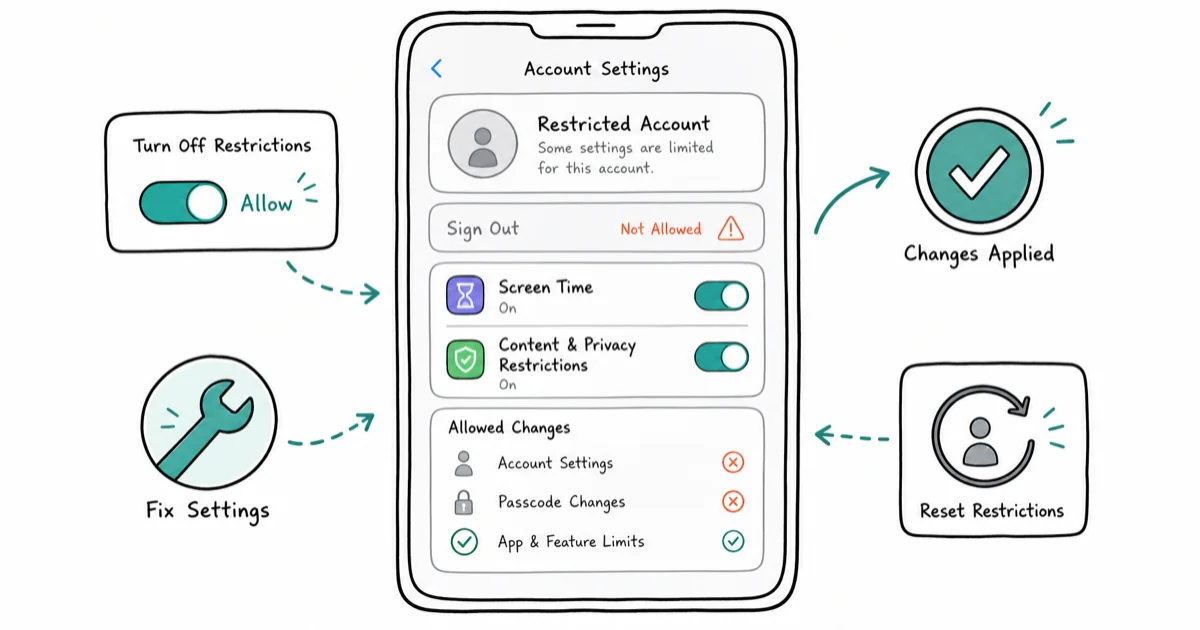
Quick AnswerOpen Settings, tap Screen Time, then Content and Privacy Restrictions; enter your passcode, tap Account Changes, and select Allow. The Sign Out option becomes available immediately.
“Sign out is not available due to restrictions” appears on your iPhone, iPad, or Mac when Screen Time blocks Account Changes for that device. The fix is the same across iPhone, iPad, and Mac. The same toggle controls all three.
These steps are for a device you own.
- The error means Screen Time’s Content and Privacy Restrictions has Account Changes set to Don’t Allow.
- The fix takes about 90 seconds: Settings, Screen Time, Content and Privacy Restrictions, Account Changes, Allow.
- A forgotten Screen Time passcode resets through your Apple ID without erasing the device or losing data.
- On Mac the same toggle lives at System Settings, Screen Time, Content and Privacy, Restrictions, Account Changes.
- Family Sharing organizers and MDM administrators control the setting on devices they manage; ask them or open an IT ticket.
#Why Does Sign Out Show Not Available Due to Restrictions?
Screen Time is Apple’s built-in framework for app limits and parental controls. One of its toggles, Account Changes, decides whether you can sign in or out of an Apple Account on this device. When Account Changes is set to Don’t Allow, the Sign Out button on the Apple ID page goes inactive and that exact wording shows up at the top of Settings.
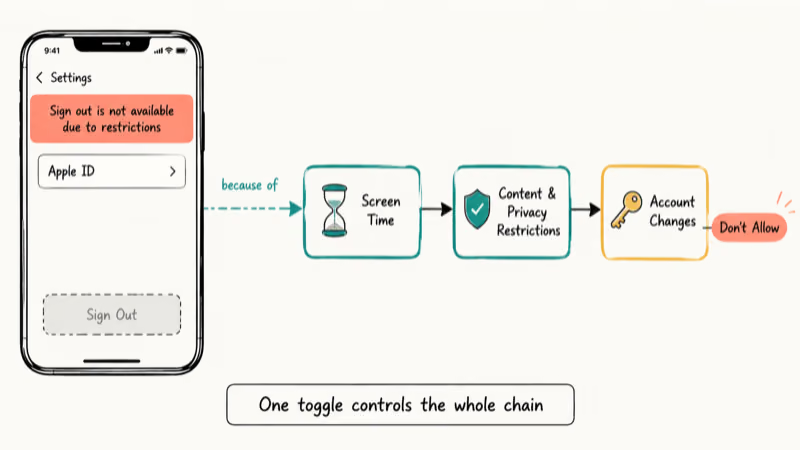
According to Apple’s Screen Time support page, Content and Privacy Restrictions are designed to limit which apps and account actions are available on the device. They sit behind a separate four-digit Screen Time passcode that’s distinct from your unlock code.
Three scenarios usually trigger the message:
- You enabled Screen Time on your own device months ago with Account Changes already locked, and forgot the path back.
- Someone else (a parent, partner, or family organizer) configured Screen Time on a device you share.
- The device is enrolled in a Mobile Device Management (MDM) profile run by your school or employer.
The fix is identical in the first two cases. The third belongs to your administrator.
A privacy and legal reminder before the steps. The instructions below apply only to a device and Apple Account that you own, or that you have documented permission to manage. Removing Screen Time restrictions on a device belonging to someone else, including a partner or adult family member, without their explicit consent can violate state stalking laws, the federal Computer Fraud and Abuse Act, and Apple’s Terms of Service. If the device isn’t yours, talk to the owner.
#How Can I Allow Account Changes on My Own iPhone or iPad?
This is the path that fixes the message for most readers.
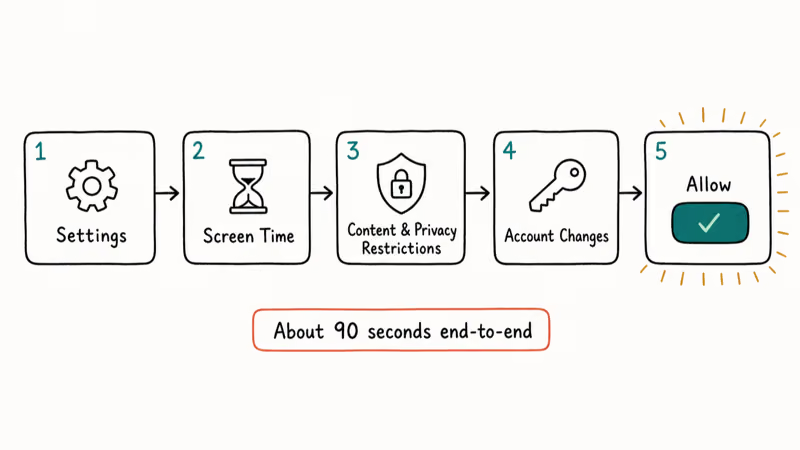
Open Settings on your iPhone or iPad, scroll to Screen Time, and tap it. On the Screen Time dashboard, tap Content & Privacy Restrictions. Apple labels the row with an ampersand on iOS even though their support docs spell out “and.”
The system prompts for your Screen Time passcode.
That’s the four-digit code you set the first time Screen Time was turned on, separate from your device unlock code. Type it in.
If you can’t remember it, jump to the next section before you keep retrying.
Apple’s Forgot Screen Time passcode page confirms that wrong entries trigger a security delay, not data loss, but the cooldown stretches to an hour after roughly ten failures.
Once you’re inside Content & Privacy Restrictions, find the Account Changes row and tap it. Three options appear: Allow, Don’t Allow, and Require Passcode. Tap Allow. The “not available due to restrictions” line at the top of Settings disappears immediately.
Now go to Settings → [your name] and scroll to the bottom. The Sign Out button is no longer grayed out.
Sign Out still grayed out after the change? Another policy is probably in play. The Apple ID grayed out issue often points to MDM enrollment rather than Screen Time, and an account that still won’t sign out after Screen Time is unlocked usually means iCloud Find My or a separate parental setting needs attention.
#Resetting a Forgotten Screen Time Passcode
You don’t have to erase the device.
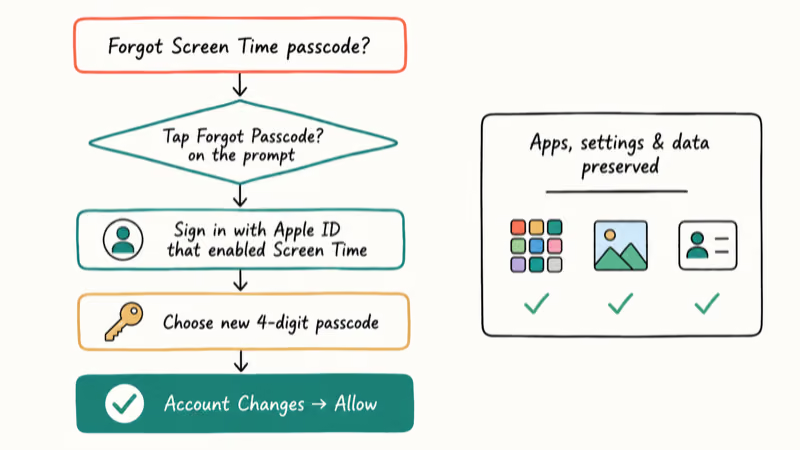
Apple’s Forgot Passcode flow uses your Apple Account for verification and preserves all of your apps, settings, and data.
The recovery link works the same whether you tap it after a few wrong attempts or go straight to it. Either path lands on the Apple ID sign-in screen, and the outcome is identical, so there’s no need to exhaust passcode tries first.
Open Settings → Screen Time → Change Screen Time Passcode. On the prompt that asks for the current passcode, tap Forgot Passcode? at the bottom.
Sign in with the Apple ID and password that originally enabled Screen Time on this device. After verification, choose a new four-digit Screen Time passcode and confirm it. Then return to Content & Privacy Restrictions and switch Account Changes to Allow.
According to Apple, this recovery flow only works when the device is currently signed in to the same Apple Account that was used when Screen Time was first turned on. If the original passcode was set under a Family Sharing child account, only that child’s Apple ID, or the family organizer who manages it, can complete the recovery.
The longer walkthrough at forgot Screen Time passcode covers the Family Sharing variants and the older “Use Screen Time Passcode” toggle that affects the option label on iOS 13 and earlier.
#Fixing the Restriction on Mac
The path is similar, but it lives in System Settings rather than the iOS Settings app.
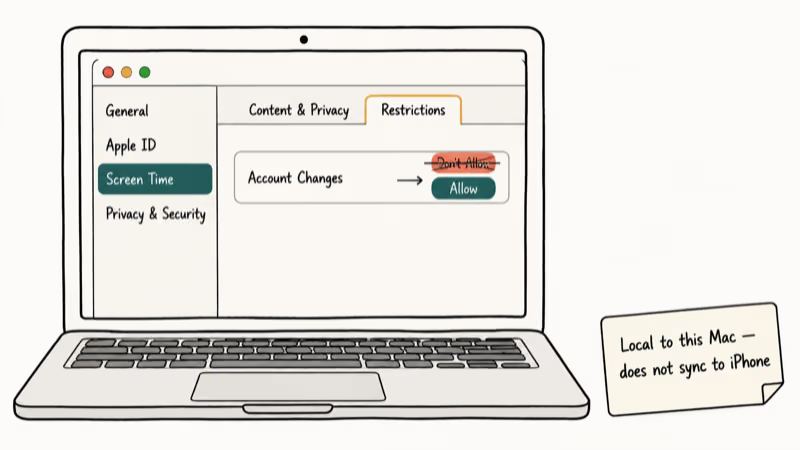
On macOS Sonoma and Sequoia, click the Apple menu and choose System Settings, then click Screen Time in the sidebar. In the Screen Time pane, click Content & Privacy on the right and switch to the Restrictions tab. The first time you open this pane, macOS may ask for the Screen Time passcode. Enter it the same way as on iOS.
Find Account Changes in the Restrictions list and toggle it so that the row reads Allow rather than Don’t Allow. Click Done. The change is local to that Mac and won’t propagate to any iPhone or iPad signed in to the same iCloud account, because Screen Time restrictions are device-local even when usage data syncs across devices.
If Screen Time itself is more of a problem than a help on this Mac, our guide to how to disable Screen Time walks through the full off-switch on iOS and macOS together.
#Family Sharing: When Someone Else Set the Restriction
Family Sharing organizers can lock Account Changes on the devices their family members use. The lock often follows a child account into a hand-me-down iPad or iPhone.
Two paths apply here.
If you’re not the organizer but the device is officially yours, the iOS path above still works once the device is signed in to your own Apple ID.
Don’t recognize the Apple ID currently signed in? That usually means the device was set up under a parent’s organizer account, and the cleaner step is to ask them to remove their Family Sharing supervision before you reset anything.
When you ARE the organizer and need to adjust a child’s device, open Settings → Family on your own iPhone, tap the family member’s name, and tap Screen Time. You can change Content & Privacy Restrictions from your phone without touching theirs. The new policy reaches the child’s device over the network, usually within a few minutes.
According to Apple, up to 6 people can join a single Family Sharing group, and the organizer manages purchases and parental controls for child accounts in that group (Apple’s Family Sharing support page covers the full setup). Organizer access to Screen Time settings is the intended way to adjust a child’s restrictions.
If the device once belonged to a family group, traces of the old configuration sometimes linger. A sign-out cycle usually clears them once Account Changes is set to Allow.
#School and Work Devices With MDM Profiles
Did your iPad come from a school or your iPhone get issued by your employer? Account Changes is almost certainly managed by an MDM profile, not by Screen Time.
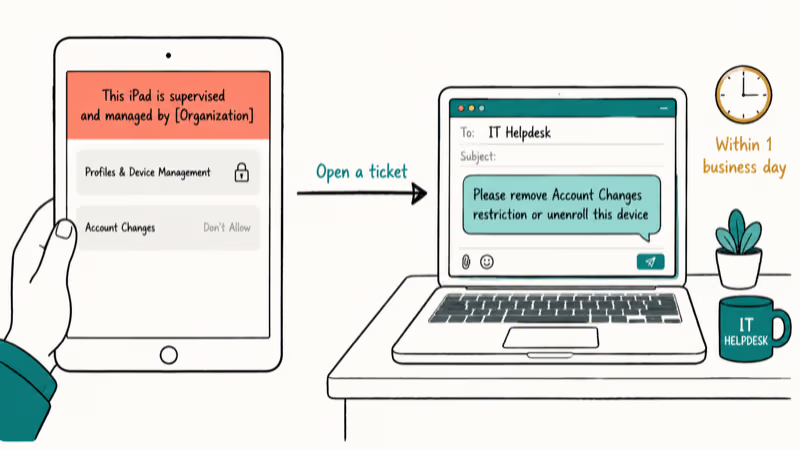
Look for the give-away near the top of Settings: a “This iPhone is supervised and managed by [organization]” banner, plus a Profiles or Device Management entry in Settings → General. You won’t be able to flip Account Changes yourself. Doing so on a managed device would defeat the security model the organization built around it.
Email or open a ticket with your IT contact. Ask them to either remove the restriction or remove the MDM enrollment so you can sign out.
According to Apple’s deployment guide, administrators can apply Account Changes restrictions through a configuration profile to keep enrolled devices tied to the right user identity. IT teams can flip the setting from their console without needing physical access to the device, so a simple ticket is often cleared within a business day.
A locked Apple ID is a different error. The Apple ID locked message comes from too many failed sign-in attempts and unlocks at iforgot.apple.com without involving an admin.
#Bottom Line
If you’re seeing “Sign out is not available due to restrictions,” Screen Time’s Content and Privacy Restrictions has Account Changes locked on this specific device.
On your own iPhone or iPad, switch Settings, then Screen Time, then Content & Privacy Restrictions, then Account Changes to Allow, and the Sign Out button comes back. If you can’t remember the Screen Time passcode, use Forgot Passcode and sign in with the Apple Account that originally enabled Screen Time. The same setting on Mac sits at System Settings, then Screen Time, then Content & Privacy, then Restrictions, then Account Changes.
If the device is supervised by a school or employer, file an IT ticket; the fix is on their side, not yours. And if the device belongs to someone else, ask the owner to make the change instead of attempting it without their consent. Once you can sign out cleanly, removing the Apple ID from your iPad or iPhone finishes the handoff.
#Frequently Asked Questions
Can I unlock this without the Screen Time passcode?
Yes. Use Forgot Passcode and your Apple ID.
Will turning off Screen Time entirely fix this faster?
It does, but it removes more than the sign-out block. Turning Screen Time off disables app limits, downtime, and any communication safety rules you set up. If you don’t use those features, it’s a clean alternative; if you still want app limits but only need to sign out once, switching just the Account Changes setting is the lighter touch.
Does this also unlock changes to my Apple ID password?
Yes. Account Changes covers signing in, signing out, and modifying account-level details like the password and trusted phone number on this device. Once you set Account Changes to Allow, all three actions become available again. You can re-lock the setting after you finish the change if you want account modifications restricted going forward.
What does “Supervised by [organization]” mean for sign out?
MDM controls Account Changes; only IT can lift the lock.
Is the Screen Time passcode the same as my iPhone unlock code?
No, they’re separate codes that Apple stores independently. The Screen Time passcode is a four-digit code that gates Content and Privacy Restrictions and other Screen Time settings, set the first time Screen Time is turned on. The unlock passcode is what you use to wake the device, and it lives under Settings, then Face ID and Passcode. Resetting one through Apple ID doesn’t reset the other.
What if I’m using a child Apple ID under Family Sharing?
The recovery path uses the organizer’s Apple Account, not the child’s. Ask the organizer to walk through Settings, Family, your name, Screen Time on their device.
Will signing out delete my photos and messages from this iPhone?
It depends on what you have set to sync with iCloud. Signing out gives you the option to keep a local copy of contacts, calendars, Safari data, and certain other categories on the device. iCloud Photos and Messages in iCloud are removed from the device but stay safe in iCloud, and re-signing in restores the full set.
Apple recommends running an iCloud backup before you sign out so you have a clean restore point either way. The Apple ID verification page covers the trust dialogs you’ll see during the next sign-in.
Apple Siri Settlement: Who Qualifies and How to Claim
Apple's $250 million Siri settlement covers iPhone 15 Pro and iPhone 16 models bought June 2024 to March 2025. See who qualifies and how claims work.
iOS 26.6.1 Security Update: What Apple Fixed and Who Gets It
Apple released iOS 26.6.1 on August 17 with 29 security fixes, including an IPSec interception bug. See what it patches, who gets it, and how to update.
iPhone Adaptive Power: How It Works and When to Use It
Learn how iPhone Adaptive Power works, which models support it, what it changes, and when Low Power Mode is still the better battery-saving choice.
How to Transfer Data to a New iPhone Without iCloud
Move everything to your new iPhone without iCloud: Quick Start device-to-device transfer, wired migration, and encrypted Finder or iTunes backups.