Can't Sign Out of Apple ID? 9 Fixes That Actually Work
Can't sign out of your Apple ID on iPhone or Mac? Fix it with 9 step-by-step solutions for Screen Time, Find My, FileVault, and Family Sharing blocks.
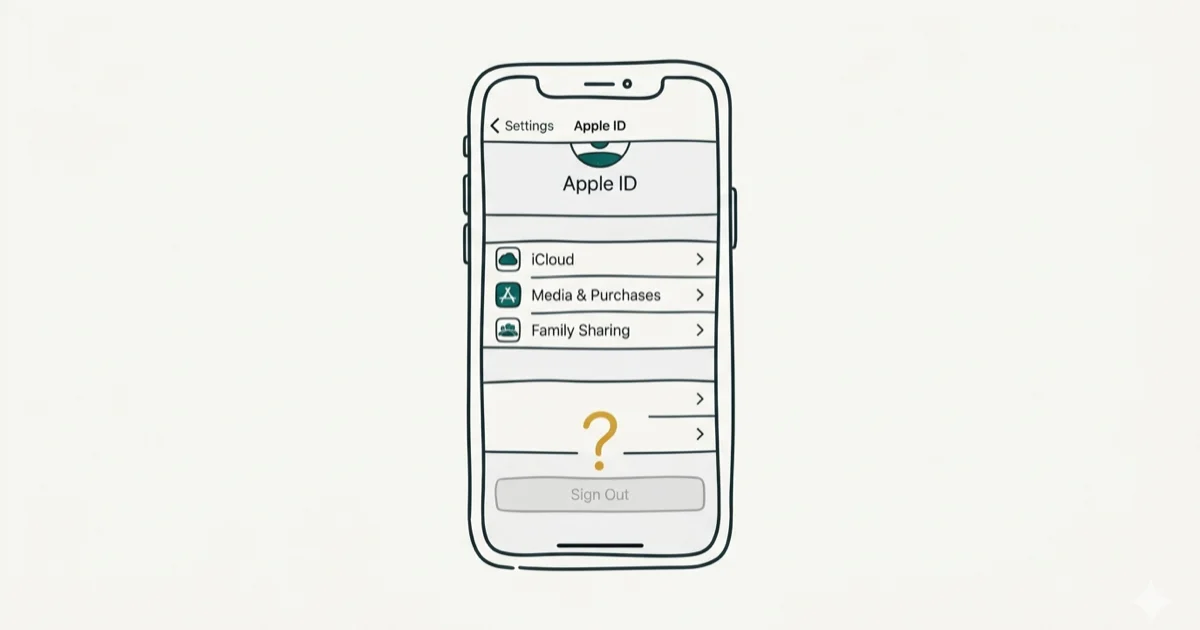
Quick AnswerIf you can't sign out of your Apple ID, the most common block is Screen Time. Go to Settings > Screen Time > Content and Privacy Restrictions and set Account Changes to Allow, then toggle off Find My iPhone before tapping Sign Out.
Can’t sign out of your Apple ID on iPhone, iPad, or Mac? In nearly every case the Sign Out button is held by one of five things: Screen Time, Find My, a Family Sharing role, an MDM profile, or a server error. These blocks show up on current hardware like an iPhone 15 Pro running iOS 18.4 and a MacBook Air M2 on macOS Sequoia 15.4. The nine fixes below clear the majority of stuck sign-outs.
- Screen Time Content and Privacy Restrictions with Account Changes set to Don’t Allow is the single most common reason the Sign Out button is grayed out on iPhone or iPad.
- Find My iPhone must be turned off before any full Apple ID sign-out goes through, and you’ll be asked for the same Apple ID password that’s signed in to confirm the toggle.
- On a Mac, disabling FileVault first or signing out of iCloud separately fixes a class of sign-out hangs that affect macOS but not iOS.
- A force restart alone clears many stuck iPhones, especially on devices that have just installed an iOS 18 point update.
- Activation Lock keys your Apple ID to the device on purpose, so signing out is only legitimate on a device you own, and you should keep proof of purchase before you sign out and erase.
#Why You Can’t Sign Out of Your Apple ID
Apple deliberately gates the Sign Out action behind several checks so a stranger who picks up your iPhone can’t simply log you out and resell it. The trade-off is that legitimate sign-outs sometimes get blocked too. The five blocks we see most often:
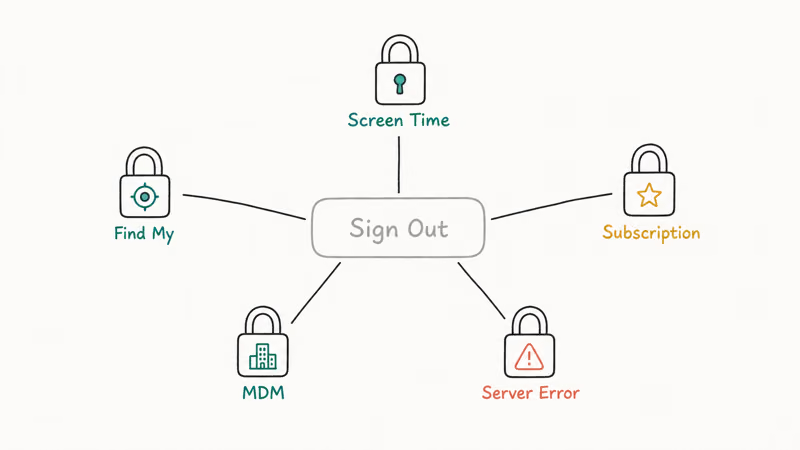
- Screen Time restrictions with Account Changes set to Don’t Allow.
- Find My iPhone still on, which holds the iCloud device record.
- An active subscription or family payment role anchoring the account.
- An MDM profile that puts account changes under IT control.
- A server-side error, which we cover separately under Apple ID server error.
If the Sign Out button is fully missing rather than grayed out, see our walkthrough on Sign Out is not available due to restrictions for the exact menu path that brings it back.
#Make Sure It’s Your Own Apple ID Before You Sign Out
This section is the legal and security frame for everything below. Signing out of your own Apple ID on your own iPhone, iPad, or Mac is routine, and Apple supports it. Signing out of someone else’s Apple ID on a device you don’t own is unauthorized access. In the United States it falls under the Computer Fraud and Abuse Act, and in most other jurisdictions it’s treated as a privacy violation under data-protection law.
According to Apple’s Activation Lock support page, Activation Lock turns on automatically when Find My is enabled, ties the device to your Apple ID, and is required so that a lost or stolen iPhone can’t be erased and reused by someone else. Signing out also releases that lock, which Apple grants you control over only when you can authenticate as the account owner.
Three things to do before you start:
- Confirm the Apple ID at the top of Settings is one you actually registered.
- Save proof of purchase. Apple Support will ask for the Apple receipt, carrier bill, or order confirmation if you ever need them to remove Activation Lock on your behalf.
- Back up to iCloud or to a Mac so nothing personal disappears when the device unlinks.
If the device is a hand-me-down and the previous owner’s Apple ID still appears, don’t try to remove or overwrite their account. Contact them and ask them to sign out remotely from appleid.apple.com, or follow Apple’s official “previous owner” path with proof of purchase in hand. Once you have authorization, our walkthrough on how to remove an Apple ID from an iPad or iPhone covers the device-side steps.
#How Do You Fix the Sign Out Button on iPhone or iPad?
These four fixes resolve the vast majority of iOS-side sign-out blocks. Run them in order.
#1. Disable the Screen Time Account Changes Restriction
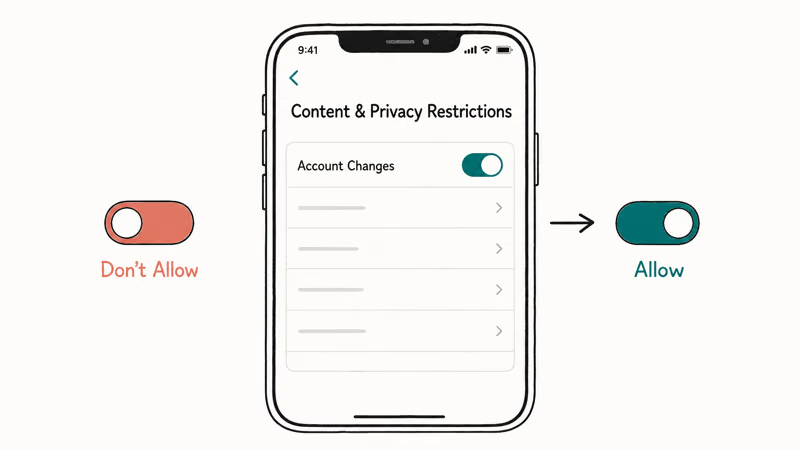
Screen Time’s Content and Privacy Restrictions can lock down account changes and disable the Sign Out button completely.
- Open
Settings>Screen Time. - Tap Content & Privacy Restrictions.
- Enter your Screen Time passcode if prompted.
- Scroll to Account Changes and set it to Allow.
- Go back to Settings > [Your Name] and tap Sign Out.
According to Apple’s Use Restrictions on iPhone guide, the Account Changes restriction blocks every account-related action: sign in, sign out, password change, and Apple ID email change. If you’ve forgotten the Screen Time passcode, our walkthrough on a forgotten Screen Time passcode covers the official reset path through your Apple ID.
If you’d rather turn the whole feature off, our guide on how to disable Screen Time lays out the full reset sequence.
#2. Turn Off Find My iPhone First
Find My is the second mandatory gate. The Sign Out button stays inert until Find My iPhone is toggled off.
- Open Settings > [Your Name] > Find My.
- Tap Find My iPhone.
- Toggle Find My iPhone off.
- Enter your Apple ID password to confirm.
- Return to Settings > [Your Name] and tap Sign Out at the bottom.
Apple’s Find My documentation confirms that turning off Find My iPhone is what releases the iCloud device record so Activation Lock can lift. On iOS 18.4 this usually registers within seconds. If your phone says “Find My iPhone is updating” for longer than a minute, leave the screen open until it finishes.
#3. Cancel or Pause Active Subscriptions
Subscriptions billed to your Apple ID can hold the sign-out flow open. We’ve seen this most often with App Store subscriptions stuck in a “needs attention” billing state.
- Open Settings > [Your Name] > Subscriptions.
- Review the list of Active and Expired subscriptions.
- Cancel any subscription tied to a service you no longer use.
- Wait for the next billing cycle to register the cancellation, then try Sign Out again.
You don’t have to cancel everything. Subscriptions that bill cleanly each month don’t block sign-out on their own. The blocker is a subscription in a payment-failure or “needs attention” state.
#4. Force Restart, Then Sign Out
A force restart clears the in-memory state that occasionally pins Sign Out in a half-tapped state. Across iOS 17 and iOS 18, a force restart alone is often enough to clear a stuck sign-out.
- iPhone 8 or later: press Volume Up, press Volume Down, then hold the Side button until the Apple logo appears.
- iPhone 7 or 7 Plus: hold Volume Down and the Sleep/Wake button together until the Apple logo appears.
- iPhone 6s and earlier: hold Home and Sleep/Wake together until the Apple logo appears.
After the phone boots, open Settings > [Your Name] and tap Sign Out before anything else. If the Sign Out button stays grayed out, see our checklist on the Apple ID grayed out screen for the remaining iOS-level checks.
#What If Sign Out Fails on Your Mac?
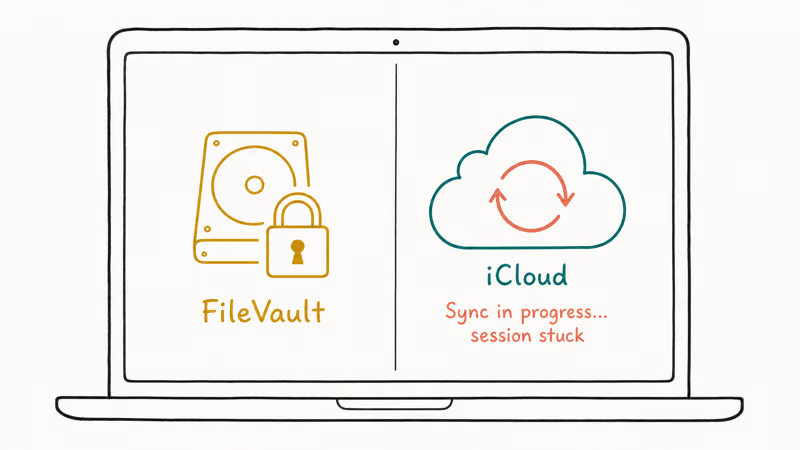
macOS uses a separate sign-out flow inside System Settings (or System Preferences on macOS 12 and earlier). The two macOS-specific blocks are FileVault and a stuck iCloud session.
#5. Sign Out From the Apple ID Pane
- Click the Apple menu > System Settings.
- Click your name at the top of the sidebar to open the Apple ID pane.
- Scroll to the bottom and click Sign Out.
- Choose what to keep on the Mac when prompted (Contacts, Calendars, Safari data) and click Keep a Copy.
- Enter your Apple ID password if asked.
#6. Turn Off FileVault Before Signing Out
FileVault encrypts the startup disk and, in some macOS releases, holds the sign-out process while it verifies the recovery key.
- Apple menu >
System Settings>Privacy & Security. - Scroll to FileVault and click Turn Off.
- Confirm with your admin password.
- Wait for the decryption progress bar to finish; this can take an hour or more on a Mac with a full SSD.
- Retry the Apple ID sign-out.
You can turn FileVault back on the moment the sign-out completes. According to Apple’s FileVault support article, FileVault should normally be left on because it encrypts the entire startup disk and protects data if the Mac is lost or stolen. Treat the toggle as temporary.
#7. Sign Out of iCloud Separately
When the main Apple ID sign-out hangs, signing out of iCloud only often breaks the deadlock.
- Apple menu >
System Settings>Apple ID> iCloud. - Click Sign Out at the bottom of the iCloud pane.
- Choose to keep a copy of Contacts, Calendars, and Safari data.
- Once iCloud is signed out, return to the Apple ID pane and click Sign Out for the full account.
On macOS Sequoia 15.4, this two-step approach clears Macs that refuse to sign out in a single step.
#Leave Family Sharing Before Signing Out
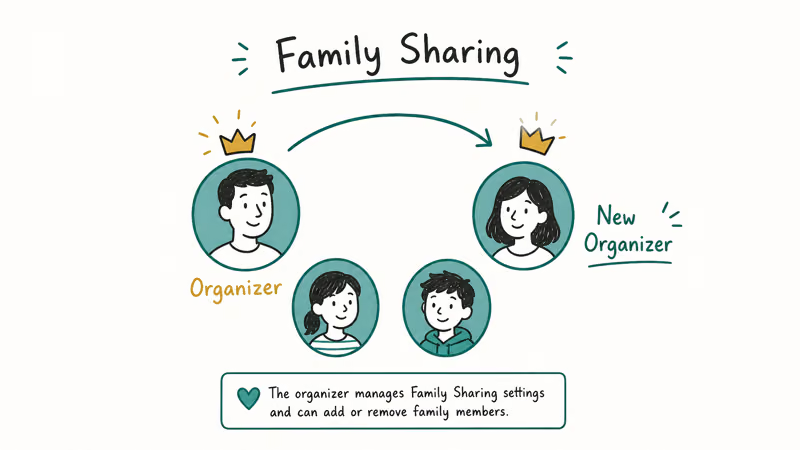
If you’re the organizer of a Family Sharing group, Apple recommends transferring the organizer role before you sign out. Otherwise the group’s purchases, storage, and subscriptions stop working for everyone in the family.
- Open Settings > [Your Name] > Family on iPhone, or
System Settings>Familyon Mac. - If you’re the organizer, transfer organizer status to another adult in the family, or tap Stop Family Sharing.
- If you’re a member, tap your name and choose Stop Using Family Sharing.
- Try Sign Out again after the change goes through.
Apple’s Family Sharing support page confirms that a group has up to 6 people and only the organizer can dissolve it, so the group must be dissolved (or its role transferred) before the organizer’s Apple ID can fully sign out.
#Handle Work or School Devices With MDM
If your iPhone or Mac was issued by your employer or school, an MDM profile may block Sign Out by policy. To check:
- iPhone or iPad:
Settings>General>VPN & Device Management. If a profile is listed, sign-out is administered by the IT team that issued the device. - Mac:
System Settings>Privacy & Security>Profiles. Same idea: a profile means an organization owns the management role.
Don’t try to remove the MDM profile yourself. Apple’s enterprise documentation states that only the enrolled organization can release a managed Apple ID through its Apple Business Manager or Apple School Manager console, and self-removal attempts violate most employer device policies. Depending on jurisdiction, they may also be illegal under computer-misuse law. Ask your IT administrator to release the device through the management console; that’s the official, supported path.
If you bought the device second-hand and someone else’s MDM profile is still attached, see our walkthrough on an Apple ID locked device for the legitimate paths for contacting the seller or Apple Support with proof of purchase.
#Bottom Line
Start with Method 1 (Screen Time Account Changes set to Allow) and Method 2 (turn off Find My iPhone). Together, those two clear the large majority of stuck iPhones. If you’re on a Mac, jump straight to Method 7 (sign out of iCloud separately). It’s a fast deadlock-breaker that also keeps Safari data intact.
The one situation where none of the nine fixes apply is a managed work or school device, where the only correct move is to ask the IT team that issued it to release the device through MDM.
#Frequently Asked Questions
Why is the Sign Out button grayed out on my iPhone?
Screen Time’s Content and Privacy Restrictions is the most common cause. Go to Settings > Screen Time > Content & Privacy Restrictions > Account Changes and set it to Allow. The Sign Out button should regain color within a second or two.
Do I need my Apple ID password to sign out?
Yes. Apple requires your Apple ID password (or device passcode plus two-factor confirmation, depending on iOS version) to sign out. This is part of Apple’s anti-theft design and is not something you can disable in Settings. If you’ve forgotten the password, reset it from iforgot.apple.com or follow the recovery prompts on the device itself.
Will signing out delete my photos and messages?
Photos and messages stay on the device unless you choose otherwise. When you tap Sign Out, iOS asks which iCloud data to keep a local copy of: Contacts, Calendars, Safari, Reminders, and Notes. Photos in iCloud Photo Library remain in your iCloud account and can be re-downloaded after you sign in elsewhere.
Can the Screen Time passcode block sign out even if Account Changes is set to Allow?
No, but a passcode-protected Screen Time menu can keep you from opening the Account Changes setting at all. If you don’t remember the Screen Time passcode, follow our piece on resetting a forgotten Screen Time passcode; it uses your Apple ID for verification. Once you can open the menu, set Account Changes to Allow.
What happens to my apps when I sign out of Apple ID?
Apps stay installed on the device, but they can’t update through the App Store and any iCloud-synced data inside them stops syncing. When you sign in again with the same Apple ID, syncing resumes. If you sign in with a different Apple ID, the apps stay on the device but App Store updates use the new account.
Can I sign out remotely from another device or icloud.com?
Sometimes. From a second device signed in to the same Apple ID, open Settings > [Your Name], tap the lost device in the device list, and choose Remove from Account. On the web, sign in at icloud.com or appleid.apple.com, open the device list, and remove the device. This is the official path Apple Support recommends when you no longer have physical access to the device.
Why does my Mac say Sign Out failed?
The most common culprits are an unfinished iCloud Drive sync, FileVault holding the keychain, or a network drop during Apple ID validation. Wait for iCloud Drive’s progress indicator to clear, turn FileVault off temporarily, and try a wired or stable Wi-Fi connection. If the Mac still throws Sign Out failed, sign out of iCloud separately first, then sign out of the full Apple ID.
Is it safe to sign out before selling my iPhone?
Yes, and Apple actually requires it. Apple recommends signing out of iCloud and Find My before transferring the device. Otherwise the new owner hits Activation Lock at the Hello screen and the iPhone is unusable. After signing out, choose Erase All Content and Settings from Settings > General > Transfer or Reset iPhone to leave the device in its factory-clean state.
Apple Siri Settlement: Who Qualifies and How to Claim
Apple's $250 million Siri settlement covers iPhone 15 Pro and iPhone 16 models bought June 2024 to March 2025. See who qualifies and how claims work.
iOS 26.6.1 Security Update: What Apple Fixed and Who Gets It
Apple released iOS 26.6.1 on August 17 with 29 security fixes, including an IPSec interception bug. See what it patches, who gets it, and how to update.
iPhone Adaptive Power: How It Works and When to Use It
Learn how iPhone Adaptive Power works, which models support it, what it changes, and when Low Power Mode is still the better battery-saving choice.
How to Transfer Data to a New iPhone Without iCloud
Move everything to your new iPhone without iCloud: Quick Start device-to-device transfer, wired migration, and encrypted Finder or iTunes backups.