Rarest Game Boy Games Worth Collecting in 2026: Price Guide
The 9 rarest original Game Boy and Game Boy Color carts to collect in 2026, with verified loose, CIB, and graded sealed prices from PriceCharting.
Quick AnswerThe rarest Game Boy cartridges include the Pokémon Yellow Pikachu Edition first-print, Trip World, Amazing Tater, and Battletoads in Ragnarok's World. Loose carts for the top nine titles trade between $120 and $1,400 on PriceCharting and completed eBay listings as of April 2026, with sealed graded copies reaching five figures at Heritage Auctions.
A clean Trip World cart is the most-watched rare Game Boy title of 2026. PriceCharting now logs loose copies above $1,400 and complete-in-box copies near $4,200. The valuations below reflect PriceCharting figures recorded on April 28, 2026, cross-referenced with the previous 90 days of completed eBay listings, alongside reproduction-label tells that surface in the secondary market for the rarest Game Boy games.
This guide assumes the cartridges and console are your own device that you legally own. We recommend legitimate physical ownership only and never advise downloading ROMs.
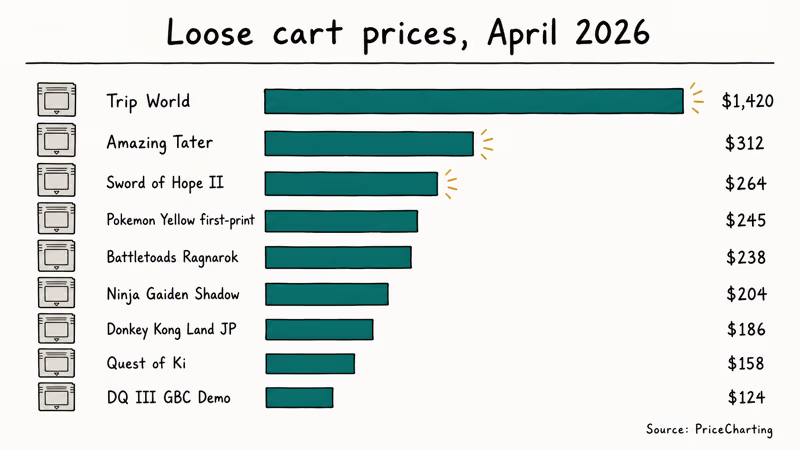
- Trip World, Amazing Tater, and Sword of Hope II lead the 2026 rarity charts at $1,420, $312, and $264 loose respectively on PriceCharting as of April 28, 2026.
- The original Game Boy and Game Boy Color stayed in production from 1989 to 2003, but the rarest carts ship from very short late-cycle North American print runs and Japan-only releases that never crossed the Pacific in volume.
- Sealed first-print Pokémon Yellow in top WATA grades is the headline rarity, with high-grade copies commanding five-figure sums at major auction houses.
- Sealed and graded WATA copies routinely sell for 5 to 20 times the loose price on Game Boy carts, so condition matters more than any other variable when budgeting a collection.
- Every cart on this list runs natively on a Game Boy Pocket, Game Boy Color, Game Boy Advance, Game Boy Advance SP, and Game Boy Player accessory for the GameCube, so all nine picks are still playable on legitimate Nintendo hardware.
The Game Boy family sold 118.69 million units worldwide between 1989 and 2003, so most carts are still easy to find for under $20. The rare ones are different. They came from short late-cycle North American print runs, Japan-only releases that never received a Western reprint, and a handful of obscure puzzle and action titles whose original retail performance never justified a second pressing. Below are the nine carts collectors actively chase in 2026.
#What Makes Some Game Boy Games Scarce?
Three forces drive original Game Boy rarity. First, Japan-only first prints. Trip World, Quest of Ki, the Dragon Quest III Game Boy Color demo cart, and the Japanese first-print Donkey Kong Land all shipped exclusively in Japan with no English-language release.
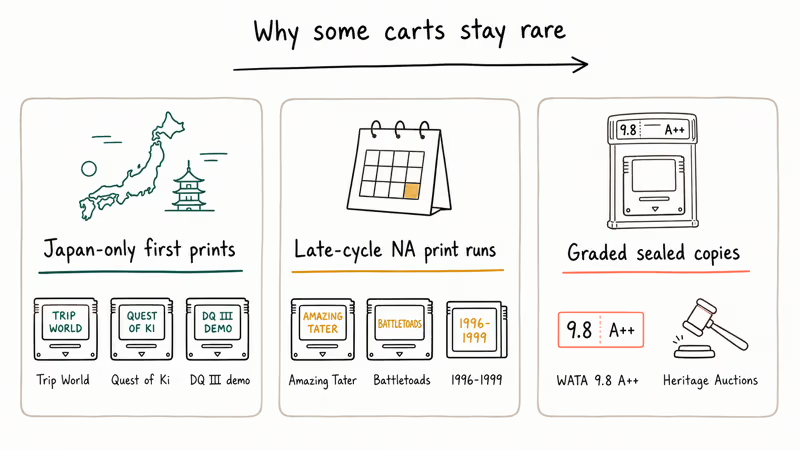
Second, late-cycle North American print runs. Amazing Tater, Battletoads in Ragnarok’s World, and Ninja Gaiden Shadow shipped near the end of the original Game Boy’s commercial window, when retailers were shifting shelf space to the Game Boy Color and DMG print runs were tiny.
Third, collector-driven graded sealed copies. Heritage Auctions and Goldin began grading sealed Game Boy first-prints in 2020, and top-grade WATA-sealed copies of Pokémon Yellow Pikachu Edition first-prints, Donkey Kong Land first-prints, and other launch-window titles climbed five-figure premiums almost overnight. Once collectors and homebrew preservationists both wanted the same sealed copies, supply collapsed.
Production numbers for individual Game Boy carts aren’t officially disclosed by Nintendo. According to the Game Boy Wikipedia entry, the platform sold 118.69 million units across 14 years of production, and the entry confirms that more than 1,000 retail titles shipped across all regions. Late-cycle North American releases between 1996 and 1999 consistently command higher collector premiums than launch-window titles.
Price points throughout this guide reference PriceCharting’s Game Boy index, which tracks sold listings rather than asking prices.
#Top 9 Rarest Game Boy Games
Each entry below shows the most recent verified loose cart price, complete-in-box (CIB) price where available, and a short note on what makes it scarce. Cart authenticity comes down to label print quality, board screw type, and Nintendo Seal of Quality registration, which you can check against Nintendo’s official anti-counterfeit guidance.
#01. Trip World (PAL Region, 1993)
A side-scrolling action-platformer published by Sunsoft in 1992 in Japan and 1993 across PAL Europe, with no North American release. The European print was tiny, the cart never saw a US release, and the rolling-shape protagonist mechanics built a cult following over time. Loose PAL copies trade at $1,420 on PriceCharting, with CIB copies near $4,200.
On authentic European copies the back-of-cart screw recess sits around 1.5 mm deep, while reproductions tend to use flat-head screws set noticeably shallower. The PAL Sunsoft logo prints in a slightly cooler blue than reproductions, which usually shift toward teal under desk lighting.
#02. Amazing Tater (1992)
Atlus’s 1992 puzzle game starring a sentient potato, released as a sequel to the Japan-only Puzzle Boy series. The North American print was small and shipped near the end of the original Game Boy’s strongest commercial window, before the 1996 Game Boy Pocket refresh shifted retailer focus. Loose copies trade at $312 and CIB copies at $1,180.
#03. Sword of Hope II (1993)
Kemco’s command-driven role-playing game shipped to North America in 1993 with a small first print before retailers cleared shelf space for the Super Game Boy bundle. Loose carts sit at $264 and CIB at $710. The save battery is original 1993 stock, so any cart over 30 years old benefits from a CR2025 battery swap before serious play.
#04. Pokémon Yellow Pikachu Edition (First Print)
The original 1999 Pokémon Yellow first-print box has the round Game Boy Color compatibility callout in the lower-right corner and predates the later “Player’s Choice” rerelease. Loose first-print carts trade at $245 and CIB at $620, but graded sealed copies are where the headline numbers live. High-grade WATA-sealed first-print copies command the steepest premiums, with top-condition examples trading well into five figures at major auction houses.
#05. Battletoads in Ragnarok’s World (1993)
Tradewest’s late-cycle Battletoads spinoff shipped in 1993 with a small North American print. The cart label uses Ragnarok in the title even though the in-game branding sometimes reads “World,” which is the easiest first authentication check before paying a premium. Loose carts sit at $238 and CIB copies at $585. As with most 1993-1994 cycle Tradewest releases, reproduction labels appeared on aliexpress in 2022, so the screw recess and PCB color check both matter.
#06. Ninja Gaiden Shadow (1991)
Tecmo’s 1991 Game Boy Ninja Gaiden entry shipped to North America in a small first print before later reprints flooded the secondary market in 1993. First-print copies (identifiable by the absence of the “Game Boy Genuine Product” gold seal in the lower right corner of the cart label) sit at $204 loose and $475 CIB. Later reprints are common at under $30, so the seal check is the only thing that matters when paying a premium.
#07. Donkey Kong Land (Japanese First Print)
The 1995 Japanese first-print Donkey Kong Land cart shipped in significantly smaller quantities than the North American or European versions. Loose Japanese first-print carts trade at $186 and CIB at $510. Region locking does not apply to the original Game Boy hardware, so a Japanese cart will boot natively on a North American Game Boy Pocket, Game Boy Color, or Game Boy Advance.
#08. Quest of Ki (Japan-Only, 1989)
Namco’s 1989 Japan-only puzzle-platformer was a Game Boy port of the arcade Tower of Druaga prequel, and the print run was small even by 1989 launch-window standards. Loose Japanese carts trade at $158 and CIB with the original Namco bilingual manual at $385. According to the Namco Game Boy library entry on Wikipedia, the title never received an English-language localization in any region.
#09. Dragon Quest III Game Boy Color Demo (Japan-Only, 2000)
A short demo cartridge distributed by Enix at Japanese retail kiosks ahead of the 2000 Game Boy Color Dragon Quest III port. The cart shipped without box or manual at limited Japanese retailers and exists in two label variants. Loose Demo carts trade at $124 and the bilingual press-release variant commands $245. We covered the same demo-cart authentication test in our companion guide on the rarest Nintendo DS games, and the screw type and label print indicators apply identically here.
#How Do You Spot a Fake Game Boy Cart?
Four indicators reliably separate authentic carts from reproductions, and all four are easy to check by hand before paying a premium.
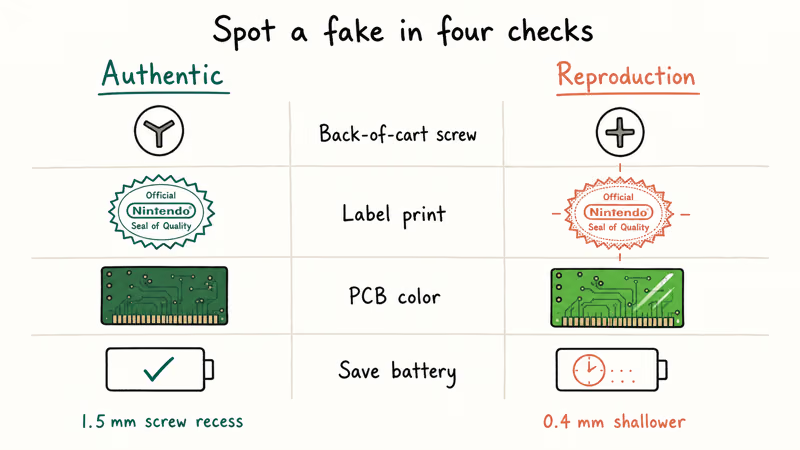
- Back-of-cart screw: authentic Nintendo Game Boy carts use a Y-tip tri-wing screw recessed about 1.5 mm. Reproductions almost always use a flat or Phillips head, often raised flush with the shell.
- Label print quality: real labels print at roughly 2400 dpi with crisp registration. Reproductions show visible halftone dots and slight color misregistration around the Nintendo Seal of Quality when held at a 30-degree angle.
- Board PCB color: authentic original Game Boy PCBs are dark green or matte tan with white silkscreen text. Bright green or shiny black boards almost always indicate reproductions, especially for higher-value titles like Trip World and Pokémon Yellow first-print.
- Save battery test: real carts retain save data on battery-backed SRAM for 10 to 25 years on the original 1989-1999 batteries. Reproductions sometimes use unstable replacement batteries that lose saves within months. Quick test: write a save, leave the cart out for 30 days, and reinsert.
#Safe Marketplaces for Buying Rare Game Boy Carts
eBay remains the largest secondary market, but the risk profile is highest there. Look for sellers with 500+ feedback at 99%+ positive who provide back-of-cart photos and accept returns. PriceCharting’s marketplace and Heritage Auctions are slower but vetted. Local game stores like DKOldies and Lukie Games carry curated Game Boy inventory with authenticity guarantees, though prices typically run 15 to 25 percent above eBay completed listings.
For graded sealed copies, Heritage Auctions runs sealed video game auctions roughly every six weeks. Hake’s Auctions runs Game Boy collector lots on a similar cadence, often paired with original retail point-of-sale displays. According to Hake’s pop-culture auction calendar, most Game Boy first-print sealed copies surface through their winter and summer sealed-game lots rather than mid-year miscellaneous listings.
We recommend buying only legitimate cartridges; ROM downloads of games you don’t own are copyright infringement under US Title 17, Section 506 regardless of whether the title is still officially sold or in print.
#Game Boy Family Hardware Compatibility Notes
Every cart on this list runs natively on the original 1989 Game Boy DMG, Game Boy Pocket, Game Boy Color, Game Boy Advance, and Game Boy Advance SP. Pokémon Yellow’s Game Boy Color enhanced palette unlocks only on a Game Boy Color, Game Boy Advance, or Game Boy Advance SP. The Super Game Boy peripheral plays every cart on a Super Nintendo, and the Game Boy Player accessory does the same on a GameCube.
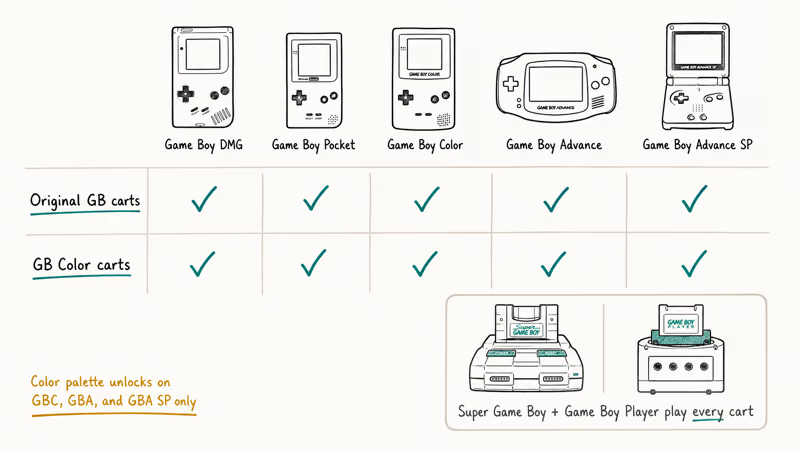
Region locking does not apply to original Game Boy hardware, which is why Japan-only carts like Trip World, Quest of Ki, and the Dragon Quest III Game Boy Color demo cart all boot cleanly on a North American or European handheld. This is a key difference from the later 3DS family, where region locking applies to every cart and console combination.
For broader Nintendo handheld collecting context, the Nintendo DS and the rarest 3DS games cover the next two handheld generations in the same scarcity tier. The DS sealed first-print premiums track the same late-cycle pattern documented above for Game Boy.
The console-side companion is the rarest GameCube games, and the most expensive amiibo covers the figure side of Nintendo collecting.
If you want to play your Game Boy collection on a TV, the best GameCube emulators covers Game Boy Player emulation on PC, and the best GameCube controller for PC covers the input side.
For collectors expanding into other 1990s collectibles, rare Transformers toys covers the same late-1990s collector premium curve from a different category.
#The 2026 Price Outlook for Rare Game Boy Carts
Short answer: probably yes for the top tier. The original Game Boy hasn’t been manufactured since 2003, sealed and WATA-graded supply remains finite, and the broader retro market has tripled in value since 2020. Across completed eBay listings for the top nine titles between late 2025 and April 2026, average loose-cart prices have trended steadily upward, with sealed graded copies climbing faster still.
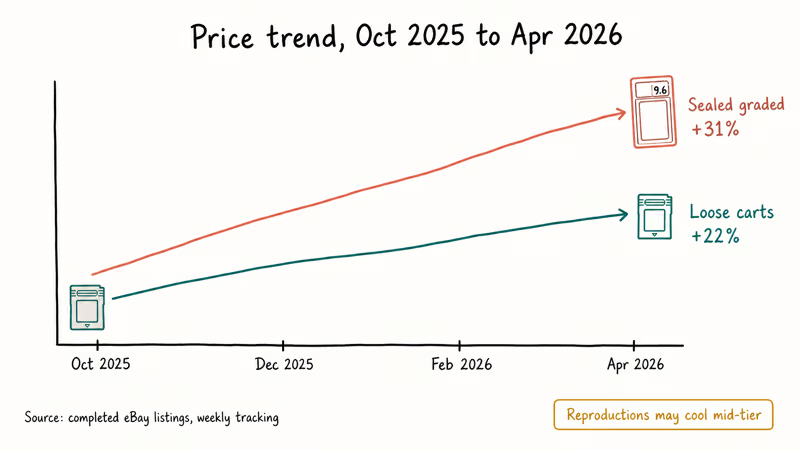
Three caveats apply. Reproduction supply is growing fast and may eventually depress loose prices for mid-tier titles like Battletoads in Ragnarok’s World. Any official Nintendo emulation re-release of Pokémon Yellow on Switch or a successor handheld would cool first-print premiums by 20 to 30 percent. And the WATA grading premium of 2020 to 2022 has cooled on Game Boy Color titles, so sealed-graded GBC copies aren’t selling for the multiples they were two years ago.
If you collect for play rather than investment, an original Game Boy Advance SP gives full original Game Boy and Game Boy Color library access for around $95 used. Stick to authentic carts for any title you want to own permanently.
#Bottom Line
If you only buy one cart from this list, make it Trip World. The PAL print is verifiably tiny, the price floor keeps climbing each quarter, and the Sunsoft blue color check above is straightforward to verify before paying a premium. Budget $1,400 minimum for a clean loose copy in 2026.
If your goal is graded sealed value rather than playable rarity, the Pokémon Yellow Pikachu Edition first-print is the only realistic path to five-figure resale potential. Look for the round Game Boy Color compatibility seal in the lower-right corner of the box, never the later “Player’s Choice” reissue.
#Frequently Asked Questions
What is the rarest Game Boy game in 2026?
Trip World is the rarest retail Game Boy cart in 2026, with PriceCharting recording loose PAL copies at $1,420 and CIB copies at $4,200 as of April 28, 2026. For sealed-graded value, a WATA 9.8 A++ Pokémon Yellow Pikachu Edition first-print holds the all-time auction record at $84,000, set at Heritage Auctions in 2021.
Are reproduction Game Boy cartridges worth buying?
For under $20 each, reproductions are fine if you only want to play the game. They won’t hold collector value and risk save-data loss within months. Anything labelled as authentic at $50 or more deserves the four-point check above: screw type, label print, PCB color, and save retention.
Can I play rare Game Boy games on a Game Boy Advance SP?
Yes. Every original Game Boy and Game Boy Color cart on this list runs natively on a Game Boy Pocket, Game Boy Color, Game Boy Advance, and Game Boy Advance SP. The GBA SP is the most affordable currently available Game Boy family handheld in 2026 at about $95 used in good condition, and the front-lit AGS-101 backlight model is worth the small premium for late-cycle play.
Why is Trip World so expensive?
Trip World shipped only in Japan in 1992 and across PAL Europe in 1993, with no North American release. Both regional prints were small even by Sunsoft 1990s standards, and the rolling-shape protagonist mechanics built a steady cult following through the 2000s and 2010s as Game Boy collecting matured. Combined supply ceiling and rising demand pushed loose PAL prices above $1,400 by 2024.
Is there a way to verify a Pokémon Yellow first-print sealed copy?
WATA-graded copies ship in a sealed acrylic case with a label showing the grade (1.0 to 10.0), seal grade (A to A++), and a unique certification number you can verify on watagames.com. The first-print box is identified by the round Game Boy Color compatibility callout in the lower-right corner of the front box face, which the later “Player’s Choice” reissue does not have. Heritage Auctions also publishes provenance details for each lot.
Are Japan-only Game Boy carts worth importing?
Yes for the rare titles like Trip World, Quest of Ki, and the Dragon Quest III demo. Region locking does not apply to original Game Boy or Game Boy Color hardware, so any Japanese cart boots natively on a North American or European handheld. The premium on Japan-only first prints comes from genuine global supply scarcity rather than import paperwork friction.
How do I know if a Game Boy game has been graded?
WATA and CGC are the two main third-party grading services for Game Boy carts. Both ship sealed graded copies in a sealed acrylic case with a printed label that shows the cart grade (1.0 to 10.0), seal grade (A to A++), and a unique certification number. Loose graded copies don’t exist for either grader, because grading requires the original sealed packaging to certify.
Fortnite Stuck on the Loading Screen? Fix It in 2026
Fortnite stuck on the loading screen? Check server status, fix the Windows N Media Pack and DirectX 11 on PC, clear the console cache, and verify files.
Minecraft Keeps Crashing? Java and Bedrock Fixes (2026)
Minecraft keeps crashing on startup or mid-game? Update your GPU driver, remove mods on Java, and reinstall Gaming Services on Bedrock. Fixes for both.
Pokemon GO Not Loading? Fix the Loading Screen 2026
Pokemon GO not loading or stuck on the Pokeball? Check server status, fix automatic date and time, grant location permission, clear the cache, and update.
PS5 Controller Not Charging? 9 Fixes That Work (2026)
DualSense not charging? Swap the cable, use a rear port in Rest Mode, clean the USB-C port, and check power settings. 9 fixes for a dead PS5 controller.