Private Internet Access Not Working? Fix It in 9 Steps
Fix Private Internet Access not connecting with 9 practical steps for protocol switches, MTU tweaks, TAP resets, DNS leaks, and billing checks.
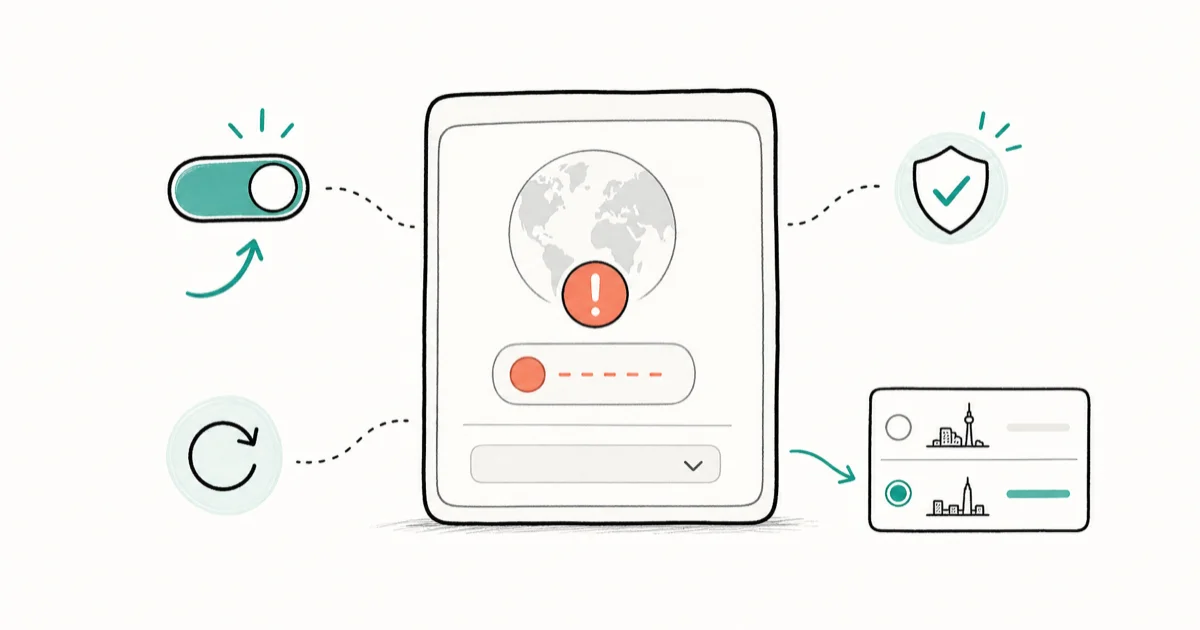
Quick AnswerSwitch the protocol to WireGuard, pick a different city in the same region, then toggle the kill switch off and on. That sequence clears most PIA stalls in under two minutes.
Private Internet Access not working usually points to a stuck handshake, a mismatched protocol, or a Windows TAP adapter that never recovered from sleep. The nine fixes below move from the fastest checks to the heavier driver and account steps.
- Switching protocol between OpenVPN and WireGuard inside the PIA app is the fastest first fix for stuck handshakes
- A failing connection on the same city server almost always recovers when you pick a sibling city such as Atlanta to Dallas, not US to UK
- Windows TAP adapter errors (return code -2) are fixed by reinstalling the TAP driver from the PIA install folder, not by Device Manager guesses
- Kill switch leaks during reconnect are normal: toggle it off, reconnect, then turn it back on once the tunnel is up
- ISP-level VPN blocking shows up as instant disconnects under WireGuard but slow handshakes under OpenVPN; switching to TCP port 443 is the standard workaround
#Why Is PIA Stuck on “Connecting”?
Most PIA stalls trace back to a server-side handshake timeout, not your machine. The client retries the connection a few times before flagging a gateway as failed. The debug.log file inside the PIA install folder records every handshake attempt and is the fastest way to confirm whether the server or your network is at fault.
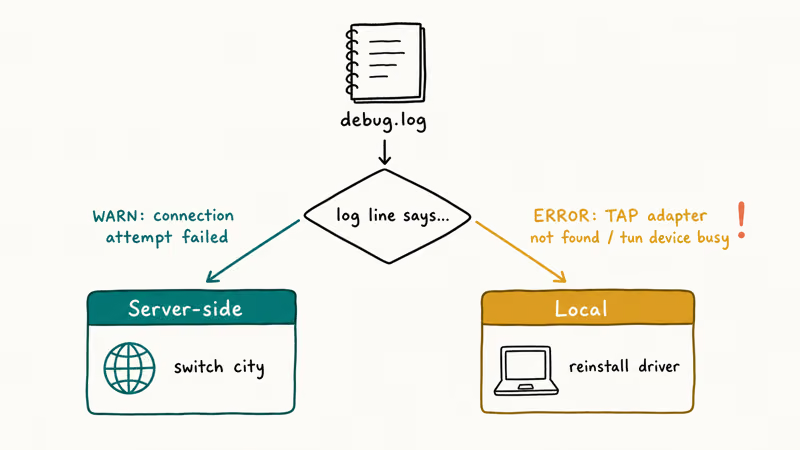
Open the tray icon, click the gear, then Help, then “Submit Debug Logs.” Read the most recent entries before you submit anything. If the line reads WARN: connection attempt failed next to a server hostname, the gateway is the suspect. If you instead see ERROR: TAP adapter not found or ERROR: tun device busy, the problem is local to your machine.
The log keeps you from running the wrong fixes: gateway failures point to a server switch, while TAP adapter errors point to Step 6.
#Switch Servers Before Anything Else
Server selection is the cheapest fix and resolves many stalls. PIA runs hundreds of gateways but routes you to the lowest-latency one by default, which sometimes lands you on an overloaded box.
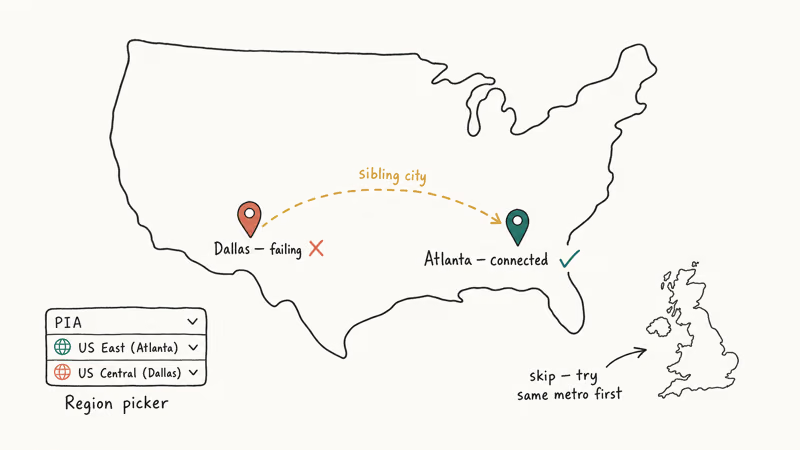
Swapping a failing gateway for a sibling city in the same region is usually the quickest way to rule out an overloaded endpoint.
- Open the PIA app and click the region name above the connect button.
- Pick a different city in the same country, such as Atlanta if you were on Dallas.
- Click connect. Wait 15 seconds.
- If it still fails, jump one country over (US East to US Central, or UK to Netherlands).
Stay regional unless you’re testing for geo-blocking.
#Toggle Between WireGuard and OpenVPN
PIA ships both protocols, and they fail in different ways. WireGuard reconnects faster but breaks hard when ISPs throttle UDP. OpenVPN survives messy networks but takes 5-15 seconds to negotiate the tunnel.
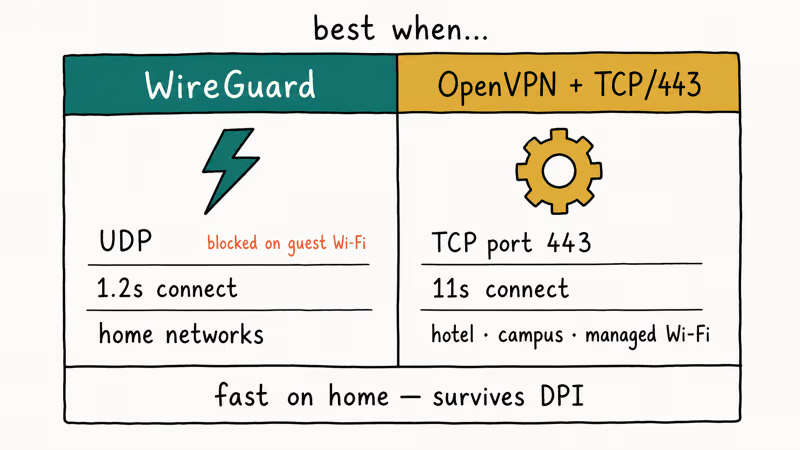
Open Settings, then Protocols. If you’re on OpenVPN, switch to WireGuard. The opposite swap also works: drop to OpenVPN and set Transport to TCP, Remote Port to 443.
The TCP/443 combo looks like normal HTTPS traffic to deep-packet-inspection systems, which is what makes it the fallback when WireGuard fails on hotel or campus Wi-Fi. According to Microsoft, port 443 is the reserved HTTPS port and is rarely filtered by enterprise networks, per Microsoft’s TCP and UDP port reference.
Managed networks often block or throttle UDP traffic, which can break WireGuard while leaving OpenVPN over TCP/443 usable. Home networks usually fail for different reasons, but the protocol switch is still the quickest way to separate protocol trouble from account or driver trouble.
#How Do I Fix the PIA Kill Switch Blocking Internet?
The kill switch cuts internet on tunnel drops to prevent leaks. If reconnect also fails, you stay offline.
Open Settings, click Privacy, set Kill Switch to “Off.” Reconnect to PIA normally. Once the tunnel shows green, set Kill Switch back to “Auto” or “Always.”
This is also the recovery sequence after laptop sleep. Windows sometimes reassigns network adapter handles on wake, which the kill switch interprets as a leak.
Auto-connect plus laptop sleep can leave the VPN in a stuck offline state. If you depend on the kill switch for sensitive work, leave it on but expect to reconnect manually after wake cycles on either Windows or macOS.
#Reinstall the Windows TAP Adapter
OpenVPN on Windows uses a TAP virtual network adapter. When PIA logs ERROR: TAP adapter not found or you see the connection fail with return code -2, the driver is the suspect. Device Manager’s “Update Driver” usually doesn’t help because Windows can’t find a newer version, so you need PIA’s bundled installer.
- Disconnect from PIA and quit the app from the tray.
- Open File Explorer and go to
C:\Program Files\Private Internet Access\tap. - Right-click
tap-windows.exeand run as administrator. - Click “Install” and accept any driver-signing prompts.
- Reboot. Reopen PIA. Connect.
WireGuard doesn’t use the TAP adapter, so if you’ve already switched protocols and the issue is gone, you can skip this step.
Reinstalling a virtual adapter often clears cases where Device Manager shows the device but no traffic flows. Microsoft’s network adapter troubleshooting page walks through the same reinstall steps.
#Adjust MTU for Stubborn Connections
A wrong Maximum Transmission Unit value causes the tunnel to come up but fail to pass real traffic. Pages hang, DNS queries time out, but the PIA app shows “Connected.” The default 1500 works on most networks; mobile hotspots and some fiber lines need 1400 or lower.
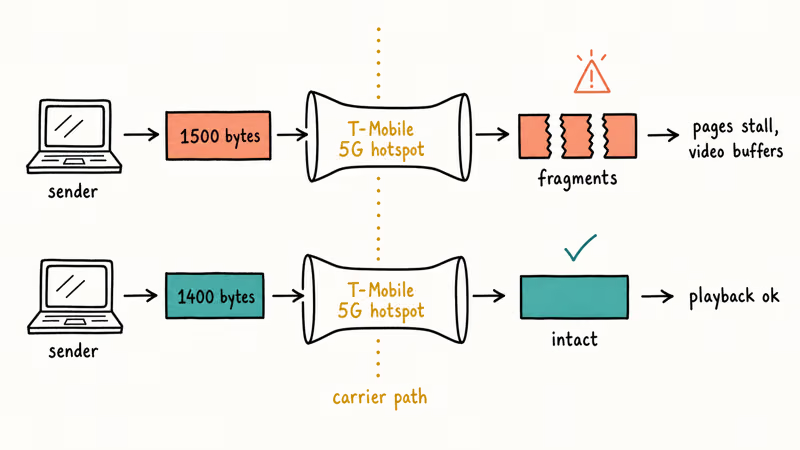
Open Settings, then Network. Find MTU and set it to 1400. Disconnect and reconnect. Test by loading a page.
If it works, you can fine-tune to 1420 or 1380 in 20-byte steps. If it doesn’t, set MTU back to “Auto” and look elsewhere.
The wrong MTU manifests as half-loaded pages and stalled video, not full disconnects.
MTU only matters when the underlying carrier is fragmenting packets midway through your connection path. If lower MTU values don’t change page loads or video playback, set MTU back to Auto and move on.
#Stop DNS Leaks With PIA’s Built-In Resolver
DNS leaks aren’t a “PIA not working” symptom by themselves, but they often appear alongside connection issues because the same network configuration affects both. Open the PIA app, click Settings, then Network. Set “Use PIA DNS” to enabled and turn off “Allow LAN Traffic” if you don’t need printer or NAS access during the VPN session.
Visit DNSLeakTest and run the standard test.
You should see PIA’s resolver IP, not your ISP’s. If you still see your ISP, your operating system is bypassing the VPN’s DNS.
The fix is OS-specific. On Windows, run ipconfig /flushdns in an admin Command Prompt. On macOS, run sudo dscacheutil -flushcache; sudo killall -HUP mDNSResponder in Terminal.
If your Wi-Fi connection itself is unstable underneath the VPN, the DNS test will be noisy. Sort the underlying connection first. Our Wi-Fi authentication error guide covers the most common router-level failures, and the failed to obtain IP address fix handles DHCP-side problems that look identical to VPN failures from inside the PIA log.
#Check Your Subscription and Account State
A surprising number of “PIA not working” reports trace back to a lapsed or unverified subscription, especially after a renewal billing failure. PIA disables tunnel creation about 24 hours after the renewal date if payment doesn’t clear. The app still opens and lets you click Connect, but the handshake is rejected by the auth server.
Log in to the PIA account portal in a browser. Check the “Plan & Billing” section for an active end date in the future. If you see “Account Inactive” or “Renewal Failed,” update payment.
The tunnel becomes available again within 5-10 minutes of a successful charge.
If you bought PIA through the Apple App Store or Google Play, billing is managed by the platform, not by PIA directly. According to Apple, in-app subscriptions can take up to 24 hours to renew after a failed payment, even after the new card is added (see Apple’s subscription support page).
Open the App Store subscription manager (or Play Store equivalent) to confirm the subscription is active.
PIA’s own status checks confirm that auth error code AUTH-001 always maps to a billing problem, not a network one.
#Bypass ISP VPN Blocking
This section assumes you’re troubleshooting your own device on a network where you have authorization to use a VPN. Some ISPs throttle or block recognizable VPN traffic. The symptom is consistent: WireGuard times out at every gateway, OpenVPN connects but speeds drop to dial-up levels. Public Wi-Fi at airports, hotels, and many universities falls into this category, and heavy-handed national-level filtering is rarer but produces the same disconnect pattern.
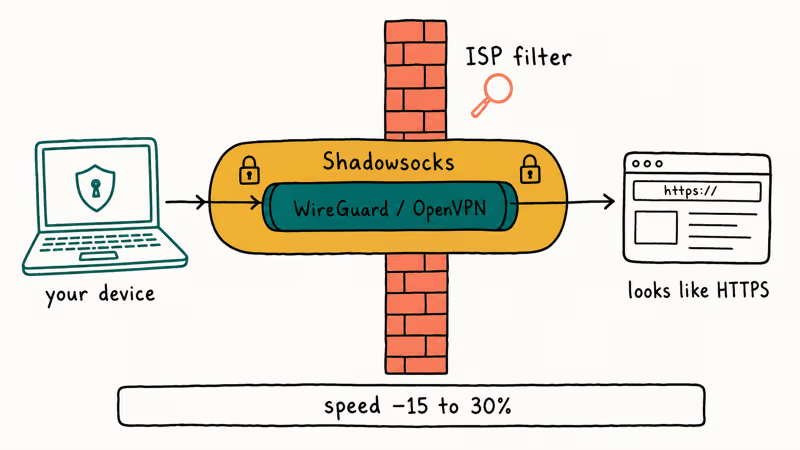
PIA’s official workaround uses the Shadowsocks proxy bundled in the app. Open Settings, click Network, scroll to “Multi-Hop.” Enable Shadowsocks and pick a region close to your VPN exit. Shadowsocks wraps the tunnel in traffic that looks like generic encrypted web traffic, which defeats most signature-based VPN blockers.
Speed drops 15-30% versus a direct connection. You regain reachability though, which is the trade.
If your ISP also throttles HTTPS based on SNI, neither WireGuard nor OpenVPN will help on their own. You need the obfuscation layer.
PIA recommends Shadowsocks specifically because it doesn’t add a third-party tool to the stack. Avoid separate “stealth” clients from forums. They often bypass PIA’s kill switch and create the leaks the VPN is supposed to prevent. According to Wikipedia, the Shadowsocks protocol was designed in 2012 specifically to defeat the kind of stateful packet inspection that breaks plain WireGuard and OpenVPN connections (see Wikipedia’s Shadowsocks article).
For comparison, slow speeds without the disconnect pattern usually mean the VPN is working but your underlying ISP link is congested. Related troubleshooting flows we’ve covered:
- Verizon Wi-Fi troubleshooting flow for residential lines
- Samsung hotspot fix for tethering setups
- SSL connection error fix for browsers that fight the VPN’s certificate handling
#Bottom Line
Switch protocol to WireGuard first. If that fails inside 30 seconds, switch to OpenVPN over TCP/443 and pick a different city in the same region. That two-minute sequence clears most PIA failures without touching drivers or settings.
If you’ve worked through every step and PIA still won’t connect, the issue is either an account billing problem or aggressive ISP-level blocking. Open the PIA debug log, copy the last 50 lines, and submit them through the app’s Help menu. Their support team can identify auth errors versus network errors faster than guessing from symptoms.
#Frequently Asked Questions
Why does PIA disconnect every few minutes?
Frequent disconnects under WireGuard usually mean your network drops UDP packets, which is common on guest Wi-Fi and some mobile carriers. Switch to OpenVPN over TCP port 443 and the disconnects should stop within one reconnect cycle. If they continue, the underlying Wi-Fi link is unstable, not the VPN. Run a quick speed test outside the tunnel to confirm before changing more PIA settings.
Does PIA work on all operating systems?
Yes. PIA ships clients for Windows 8.1 and later, macOS 10.13 and later, Linux (Ubuntu, Mint, Fedora, Arch), iOS 13+, and Android 6+. Router firmware support is available for DD-WRT, Tomato, and pfSense.
Can I use PIA on multiple devices at once?
Up to 10.
PIA allows up to 10 simultaneous connections per account, which covers most households. Each device counts even if it’s only running in the background, so log out of devices you’re not actively using.
Is PIA blocked in any countries?
PIA is blocked or restricted in China, Russia, Iran, UAE, and a handful of others. The Shadowsocks obfuscation feature inside the PIA app is the official workaround for those regions. Performance varies week-to-week as the filtering systems update their detection signatures, so a method that works one month may stop working the next. If your region has aggressive filtering, plan to test before you travel rather than after.
Why does PIA drop my internet when it disconnects?
That’s the kill switch.
It cuts your internet on tunnel failure to prevent leaking your real IP. If you don’t want this behavior, open Settings, then Privacy, and set Kill Switch to “Off.” We don’t recommend disabling it for sensitive work, since the whole point of running a VPN is the assumption that traffic stops if the tunnel drops.
Does PIA keep logs of my activity?
No. PIA’s privacy policy states that the company does not log connection times, traffic, or DNS queries. The policy has been tested in US court subpoenas, where PIA could produce no user records.
How do I cancel a PIA subscription?
Go to the PIA account portal. Click Plan & Billing, then “Cancel Subscription.” Refunds are available within 30 days of purchase. If you bought through Apple or Google’s stores, cancel inside that platform’s subscription manager instead.

Best Laptop for Running LLMs in 2026: Memory Comes First
The best laptop for running LLMs is a memory purchase first. Compare MacBook unified memory against NVIDIA laptop VRAM, and see what each tier really runs.

How to Run a Local LLM on Windows: A 2026 Setup Guide
Run a local LLM on Windows with LM Studio or Ollama. Pick a model that fits your GPU memory, keep every prompt offline, and skip the monthly bill.
Bluetooth Not Working on Snapdragon X? Fixes for 2026
Bluetooth not working on your Snapdragon X Copilot+ PC? Generic audio, mice, and keyboards work, but vendor apps often lack an ARM build. Fixes inside.
Docker Desktop and WSL2 Not Working on Snapdragon X? Fix It
WSL2 runs fine on Snapdragon X, but Docker Desktop ARM is Early Access and throws WSL errors. Use WSL2 plus native ARM64 Ubuntu and Docker Engine.