ICCID Numbers Explained: How to Find Yours in 2026
Find your ICCID in iPhone Settings or on the SIM tray, learn what each digit means, and see when carriers legitimately issue a new ICCID number.
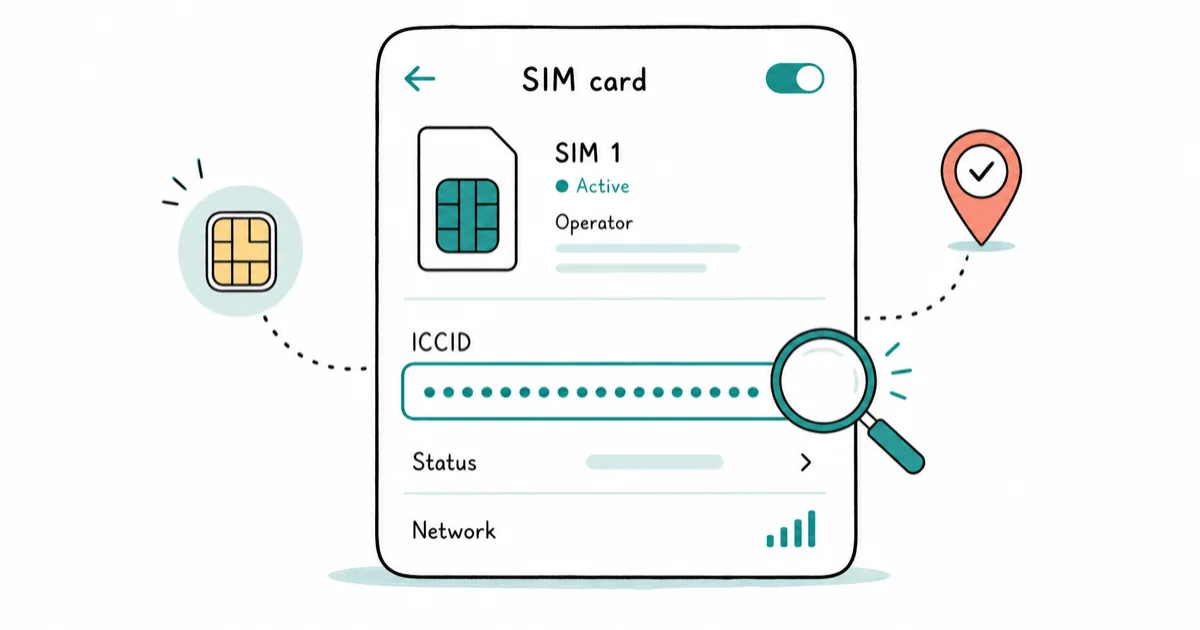
Quick AnswerAn ICCID is the 18-22 digit serial number that uniquely identifies your SIM card. On iPhone, you'll find it under Settings > General > About; on Android it's under Settings > About phone > SIM status. A new ICCID is issued when your carrier ships a replacement SIM, activates an eSIM, or starts a new line.
If you’re looking up your new ICCID number, it’s usually because your carrier just issued a replacement SIM, activated an eSIM, or asked you to read the digits off the tray during activation. This guide covers what the number is, where it lives on your phone, and when a fresh one gets assigned.
The screenshots and menu paths below reflect SIM and eSIM activation on the major US carriers (T-Mobile, Verizon, and AT&T) and match what you’ll see today on iOS 18 and Android 14.
A quick scope note. This article covers finding, reading, and verifying the ICCID on your own SIM card or eSIM. It doesn’t cover unauthorized SIM swapping, carrier-lock bypass, or anything that violates your carrier’s terms of service. Those routes are illegal in most regions and almost always end with the account holder losing service.
- An ICCID is 18-22 digits long and always begins with
89, the industry identifier the ITU assigns to every SIM card and eSIM profile worldwide. - The ICCID identifies the physical SIM (or eSIM profile), while the IMSI identifies the subscription on your carrier’s network. They aren’t interchangeable.
- On iPhone you’ll find it under
Settings>General>About; on Android openSettings>Aboutphone > SIM status and scroll to “ICCID”. - A new ICCID gets issued when your carrier ships a replacement SIM, activates an eSIM, or opens a brand-new line. It isn’t something you can or should generate yourself.
- US carriers verify ICCID changes against your account to protect you from SIM-swap fraud, which the FCC flags in its consumer guidance.
#What an ICCID Actually Means
ICCID stands for Integrated Circuit Card Identifier. It’s the serial number etched into the chip on every SIM card and burned into every eSIM profile, and it’s how the global mobile network tells one card apart from billions of others in circulation.
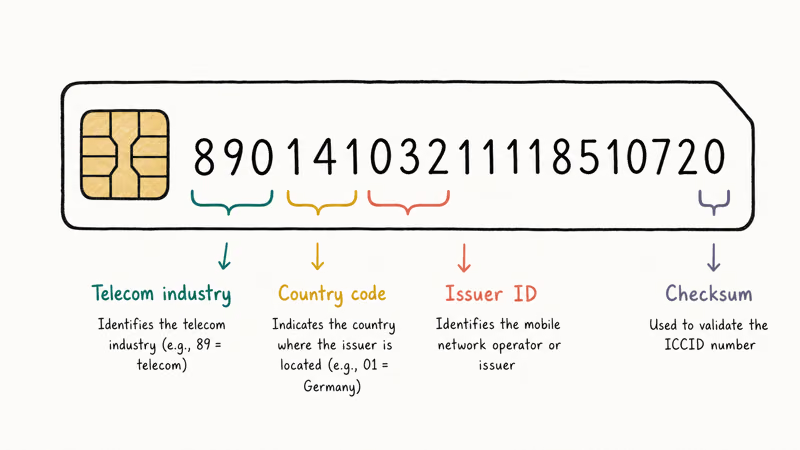
The number is 18-22 digits long, printed in small text on the back of physical SIMs, and exposed in your phone’s settings.
Each ICCID is built from four parts in a fixed order.
- Digits 1-2: Major industry identifier. Always
89for telecom SIMs, set by the ITU-T E.118 standard. - Digits 3-5: Country code (for example,
01for the US,49for Germany). - Digits 6-8 or 6-9: Issuer identifier, meaning the carrier or MVNO that activated the SIM. Verizon Wireless, for instance, uses
004in this slot. - Remaining digits: The individual account identifier plus a Luhn check digit at the end.
According to the ITU-T E.118 recommendation, every issuer that wants to mint SIMs has to register with the ITU and use only the numbering range it’s been assigned. The standard caps the number at 19 digits plus a 1-digit Luhn checksum, which is where the 18-22 digit range comes from. That’s why ICCIDs are globally unique: the system is registry-controlled, not free-for-all.
#How Is ICCID Different From IMSI and IMEI?
People mix up these three numbers constantly, but each one identifies a different thing.
| Identifier | Identifies | Length | Lives in |
|---|---|---|---|
| ICCID | The SIM card or eSIM profile itself | 18-22 digits | The SIM chip / eSIM |
| IMSI | Your subscription on a carrier’s network | 14-15 digits | The SIM chip / eSIM |
| IMEI | The physical phone hardware | 15 digits | The device |
The ICCID is hardware. The IMSI is your subscription record on the carrier side. It’s what tells the network “this is line 555-123-4567 on the Verizon plan.” A single SIM can actually carry multiple IMSIs, which is how multi-IMSI travel SIMs (Google Fi, Truphone) hop between partner networks without you ever swapping cards.
The IMEI is completely separate. It belongs to the phone, not the SIM, and it’s what carriers and law-enforcement databases use to blocklist stolen devices.
If you ever need to look yours up, dial *#06# from any phone’s keypad and it’ll pop on screen. Apple documents the same shortcut in its official iPhone IMEI guide. For a step-by-step walkthrough on iOS, see our guide to running an iPhone IMEI check.
When you activate a phone on a carrier line, the rep typically asks for the ICCID (to bind the new SIM) and the IMEI (to register the device against the line). They never ask for the IMSI, because the IMSI is internal to the carrier and they look it up themselves.
#Where Do You Find Your ICCID on iPhone and Android?
The fastest way is the settings app on whichever phone you’re holding. The whole lookup takes under a minute.
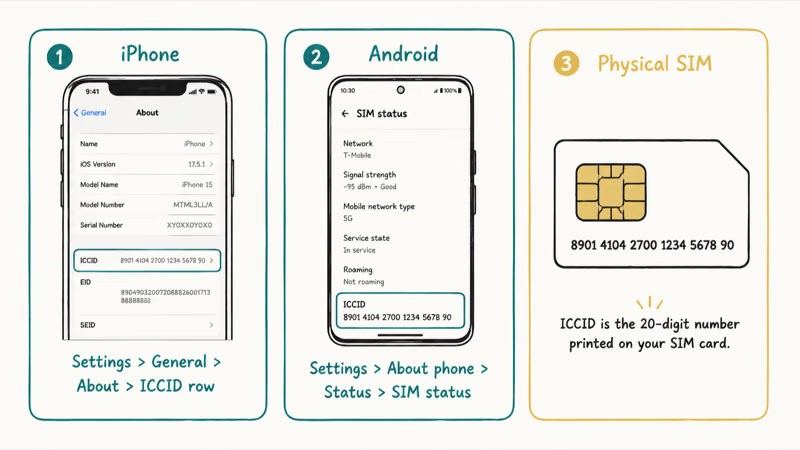
#Finding ICCID on iPhone
- Open Settings.
- Tap General.
- Tap About.
- Scroll down until you see the ICCID row. Long-press the value to copy it.
If you’ve got an eSIM, you’ll see one ICCID per active eSIM line. They’re listed under each plan’s “Network Provider” section further down the same About page. Apple’s official iPhone Settings guide confirms that the ICCID row sits in the About screen for every iPhone running iOS 13 or later. The same About page hosts other device IDs as well, including the UDID developers use for testing.
#Finding ICCID on Android
The path varies slightly by manufacturer, but the core flow is:
- Open Settings.
- Tap About phone (Samsung calls it About device).
- Tap SIM status or Status information.
- Scroll to ICCID or IMS-IC-CID.
On a Pixel, the value appears immediately in SIM status. On older Samsung Galaxy firmware, the row is sometimes labeled “ICCID Number” instead. Same digits.
#Finding ICCID on the Physical SIM
Flip the plastic carrier card the SIM came punched into. You’ll see a long barcode and an 18-22 digit number printed under it, and that’s the ICCID. It matches what your phone displays once activated. The same digits are also laser-etched in tiny text on the metal contact pad of the SIM chip itself, though you’ll likely need a magnifier to read them.
For eSIMs there’s no plastic card; the ICCID only exists in software, which is why the in-Settings lookup is the only path.
#When Carriers Issue a New ICCID
A “new ICCID” isn’t something you generate. It’s what your carrier assigns when one of these legitimate events happens.
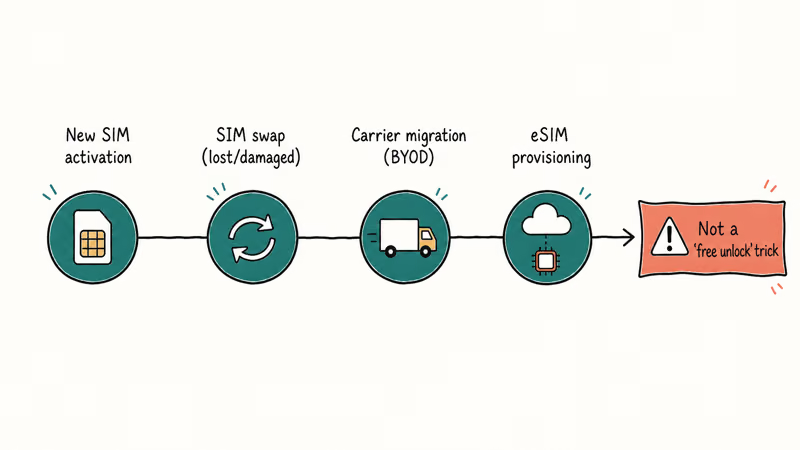
Replacement SIM after loss, damage, or upgrade. If your old SIM is bent or cracked, or you’ve moved to a phone with a different SIM size, your carrier ships a new physical SIM with a new ICCID. T-Mobile’s SIM card replacement page explains the process for ordering a replacement.
eSIM activation or transfer. When you switch from a physical SIM to an eSIM, or transfer an eSIM between iPhones using Apple’s Quick Transfer, your carrier provisions a new eSIM profile with its own ICCID. Apple’s eSIM transfer documentation describes the Bluetooth-based transfer when both phones share an Apple ID. If your SIM stops working entirely, see our walkthrough on diagnosing SIM failure on iPhone before contacting support.
Opening a new line or porting in a number. Every newly activated subscription gets a fresh SIM or eSIM with a fresh ICCID, and the phone number you port in is independent: the ICCID changes, the number stays.
Carrier swap. Switching carriers always means a new SIM.
If your ICCID has changed without you requesting any of the above, that’s a red flag for SIM-swap fraud. According to the FCC’s consumer alert on SIM swapping, unauthorized SIM swaps are a reported wireless fraud category. Carriers are required to verify your identity before re-issuing service to a new SIM.
Call your carrier’s support line immediately if you suspect this happened. Never use an “unlock” service to manipulate the number yourself, since that’s a violation of your terms of service and won’t stop the attacker anyway.
If your SIM is being rejected with the wrong-carrier error, the official fix isn’t an ICCID trick. Start with our guide to the “SIM card is not from Verizon Wireless” error.
#How Carriers Use the ICCID Under the Hood
When you insert a SIM or activate an eSIM, your phone broadcasts the ICCID to the nearest cell tower. The tower forwards it to the carrier’s Home Location Register (HLR), which looks up which subscription (IMSI) is bound to that ICCID, what plan tier, what roaming permissions, and whether the device IMEI matches the one registered against the line.
If everything checks out, the network authorizes voice, SMS, and data service.
This is also why a SIM from one carrier won’t work on another carrier’s network even if the phone is unlocked. The carrier’s HLR doesn’t have a record for that ICCID and rejects the authentication. The fix isn’t to spoof the ICCID; it’s to get a SIM from the new carrier through their official onboarding flow.
This plays out any time you swap a phone between two carriers’ SIMs: each carrier issues its own ICCID, and the phone simply reads whichever card is inserted. AT&T’s bring your own device support page recommends always activating the new SIM through their official portal so the ICCID-to-line binding is recorded correctly from the start.
#Common Mistakes When Reading ICCID Numbers
The number is long, and people miscopy it constantly. A few patterns come up again and again:
- Confusing the IMEI with the ICCID. Both appear on the same iPhone About screen, but the IMEI is exactly 15 digits and the ICCID is 18-22. If your number is 15 long, it’s the IMEI.
- Trusting a third-party “ICCID generator” site. These sites don’t have access to the ITU registry; the numbers they produce won’t authenticate on any real network. A few even ship malware. Skip them.
- Sharing the full ICCID publicly. It’s not as sensitive as your account password, but combined with your phone number it gives an attacker enough to social-engineer a SIM swap. Treat it like an account number.
- Recording the check digit wrong. The very last digit is a Luhn checksum. If you transcribe one digit wrong anywhere in the number, the check digit no longer validates and the carrier will reject the activation.
During a fresh SIM activation, reps often have you read the ICCID back twice precisely to avoid the check-digit issue. It’s standard practice across carriers.
#Bottom Line
If you just need to read or report your ICCID, the iPhone path is Settings > General > About and the Android path is Settings > About phone > SIM status. If your carrier said you’d get a “new ICCID,” that’s expected behavior for a replacement SIM, eSIM activation, or carrier switch. There’s nothing for you to do beyond following the activation instructions they sent.
If you’re worried the number changed unexpectedly, call your carrier on a different phone (not a number from a random website) and ask them to audit recent account activity for SIM-swap requests.
For the broader context on what a SIM lock means and how to verify your iPhone’s status, see our guide to checking if your iPhone is unlocked or locked. If a carrier-issued unlock is what you’re really after (not an ICCID workaround), the official AT&T unlock process is the legitimate route.
#Frequently Asked Questions
Is changing the ICCID on a locked iPhone legal?
No. Modifying an ICCID to bypass a carrier lock violates your carrier’s terms of service in the US and is unauthorized circumvention under the DMCA in many cases. The legitimate route is requesting an official unlock from the carrier after you’ve met their eligibility rules (typically the device is paid off and the account is in good standing).
Why does my iPhone show two ICCIDs?
Two active SIM lines, each with its own ICCID.
Can I look up my ICCID without unlocking my phone?
Yes, but only on physical SIMs. Pop the SIM tray, slide out the card, and read the 18-22 digit number printed under the barcode on the carrier card it came in. eSIMs have no physical form, so you’d need access to the phone to read theirs.
What’s the difference between SIM ICCID and EID?
Two different scopes. The EID (Embedded Identifier) is the unique ID of the eSIM chip itself, the hardware soldered into the phone. The ICCID is the unique ID of an eSIM profile loaded onto that chip, which is software you can install or switch. That’s how dual-eSIM iPhones let you carry separate work and personal lines on one chip.
Will my ICCID change if I update iOS or Android?
No. Software updates don’t touch the SIM hardware or the eSIM profile data.
Should I block my ICCID in screenshots I share online?
Yes. While the ICCID alone won’t let an attacker take over your account, it’s one more data point that helps in SIM-swap social engineering attacks. Blur or crop it out before posting any screenshot of your Settings > About page, and treat it with the same caution you’d give your account number.
What do I do if my replacement SIM has the wrong ICCID printed on it?
Contact the carrier support line and have the rep verify what ICCID is bound to your line in their system versus what’s printed on your card. Mismatches are rare but they do happen during shipping label mistakes. Don’t try to “fix” it yourself: the carrier has to re-bind the number on the back end.
Apple Siri Settlement: Who Qualifies and How to Claim
Apple's $250 million Siri settlement covers iPhone 15 Pro and iPhone 16 models bought June 2024 to March 2025. See who qualifies and how claims work.
iOS 26.6.1 Security Update: What Apple Fixed and Who Gets It
Apple released iOS 26.6.1 on August 17 with 29 security fixes, including an IPSec interception bug. See what it patches, who gets it, and how to update.
iPhone Adaptive Power: How It Works and When to Use It
Learn how iPhone Adaptive Power works, which models support it, what it changes, and when Low Power Mode is still the better battery-saving choice.
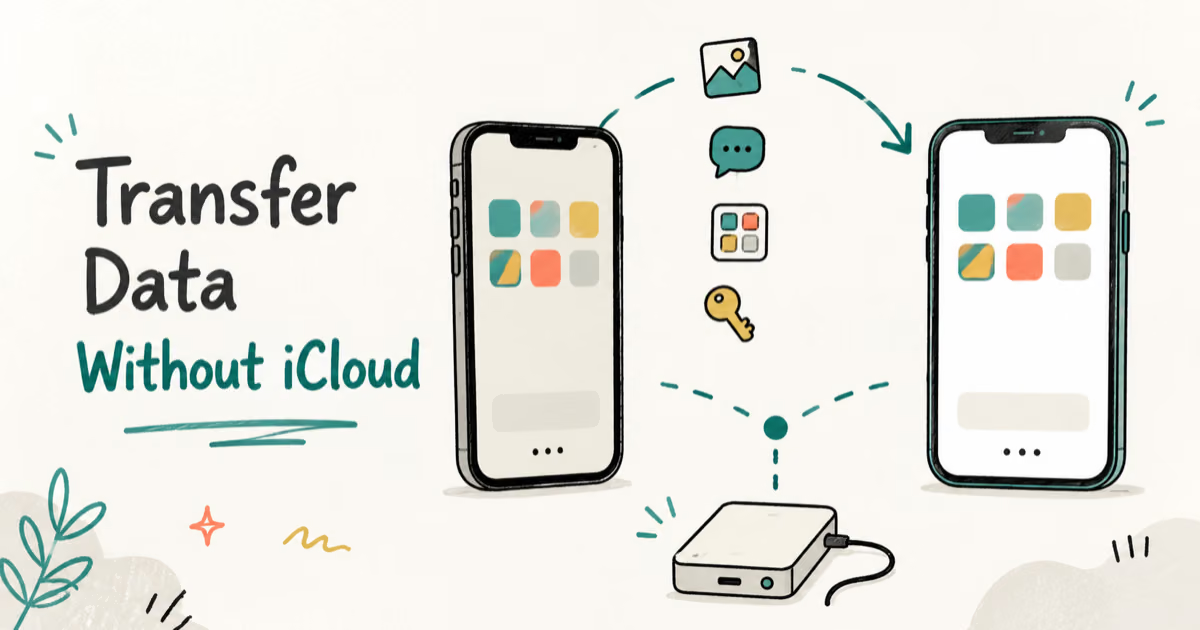
How to Transfer Data to a New iPhone Without iCloud
Move everything to your new iPhone without iCloud: Quick Start device-to-device transfer, wired migration, and encrypted Finder or iTunes backups.