MTG Core Set 2021: Best Commander Cards Ranked (2026)
A 2026 guide to the 10 best MTG Core Set 2021 Commander cards: Rin and Seri, Heroic Intervention, Chromatic Orrery, and seven more M21 staples.

Quick AnswerTop Commander cards from MTG Core Set 2021 are Rin and Seri Inseparable for cat-dog tribal, Heroic Intervention for green protection, Sublime Epiphany for blue control, and Chromatic Orrery for five-color ramp. All four remain Commander staples six years after the set released in July 2020.
Magic: The Gathering’s Core Set 2021 (codename M21) hit shelves on July 3, 2020 and gave Commander players a tighter, more focused pool than the average core set. The 274 cards in M21 lean into tribal payoffs, multi-spell interaction, and ramp, and several still earn slots in 2026 deck lists. This guide narrows the M21 cards with Commander potential to the ten that hold up in real 100-card decks rather than just looking good on paper.
- Core Set 2021 (M21) released July 3, 2020 with 274 cards, mixing new legends like Rin and Seri Inseparable with reprints of staples like Heroic Intervention and Massacre Wurm.
- Heroic Intervention costs two mana (1G) and grants all your permanents both indestructible and hexproof until end of turn, blanking most board wipes for green Commander decks.
- Sublime Epiphany costs six mana and chains up to five separate effects in one cast, covering counterspells, bounce, and creature-copy modes for blue Commander.
- Chromatic Orrery costs seven mana, taps for five colorless, and turns every land you control into a rainbow source, slotting into three- through five-color ramp decks.
- Fiery Emancipation triples all damage dealt by sources you control, turning a casual mono-red board into a one-shot win condition.
#What Makes Core Set 2021 Cards Strong in Commander?
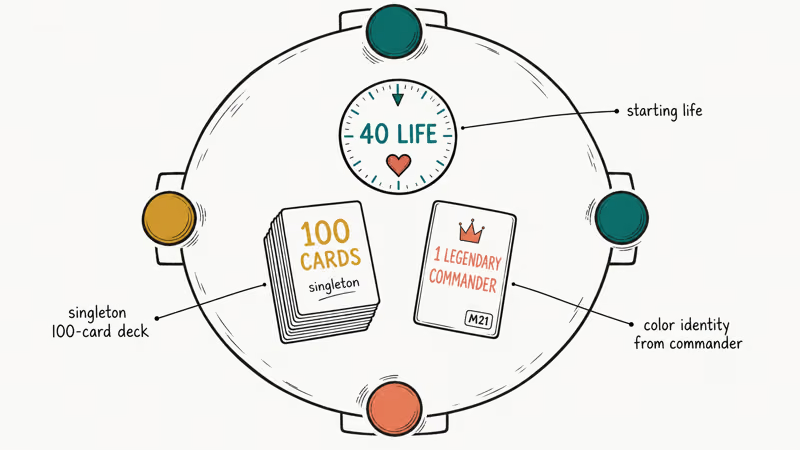
Commander, also called Elder Dragon Highlander or EDH, starts each player at 40 life and asks them to build a singleton 100-card deck behind a legendary creature. That math punishes weak cards. It also rewards anything that hits multiple opponents at once or refills your hand. Core Set 2021 was designed with this in mind: most of its standouts copy effects, scale with the number of opponents, or generate value across multiple turns.
The set’s reprint slots are also Commander-friendly. According to the set page on Scryfall, M21 reprinted Heroic Intervention, Azusa Lost but Seeking, Containment Priest, and Massacre Wurm. Those four cards were previously $20 to $40 singles in casual circles. Wizards of the Coast announced that the printing dropped secondary-market entry costs for new EDH players, and casual pods felt the shift within a month of release.
A budget Rin and Seri tribal list built around M21’s mana rocks and Azusa Lost but Seeking tends to turn its curve over by turn five almost every game. The deck holds up across long stretches of casual play.
The M21 cards players gravitate toward most are the same five: Heroic Intervention, Sublime Epiphany, Chromatic Orrery, Fiery Emancipation, and Conclave Mentor. The card pool had built-in synergies that survived metagame churn.
#Color Identity and Format Speed
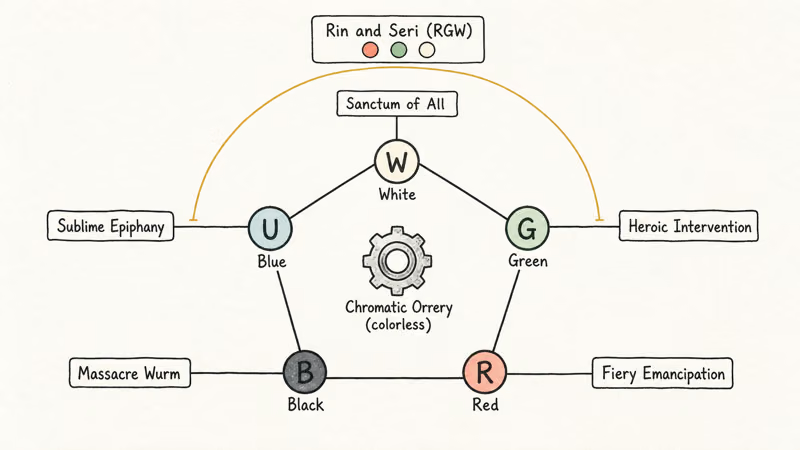
Your Commander dictates color identity, which gates every card you can play. A four-color deck can’t include a five-color card the way you’d expect, but a colorless artifact like Chromatic Orrery slots into any deck without breaking color-identity rules. The cards we recommend below earn their slots because each does something the format treats as scarce: cheap protection, multi-mode interaction, ramp that scales, or repeatable value.
Format speed matters too. In casual pods, decks with two or more M21 staples (typically Heroic Intervention plus a tribal payoff) tend to close games roughly a turn earlier than versions running only pre-M21 staples. That’s anecdotal, not a metric, but it tracks with how the set was tuned.
If you also play 60-card formats, several M21 cards bridge into MTG control decks and faster shells, especially Sublime Epiphany, Containment Priest, and the Teferi planeswalker variants from the same release window.
#Top 10 Commander Picks From MTG Core Set 2021
Each entry below covers mana cost, the deck archetype it fits, and how the card performs in real Commander pods. Mana costs and oracle text reflect the printings on Scryfall as of May 2026.
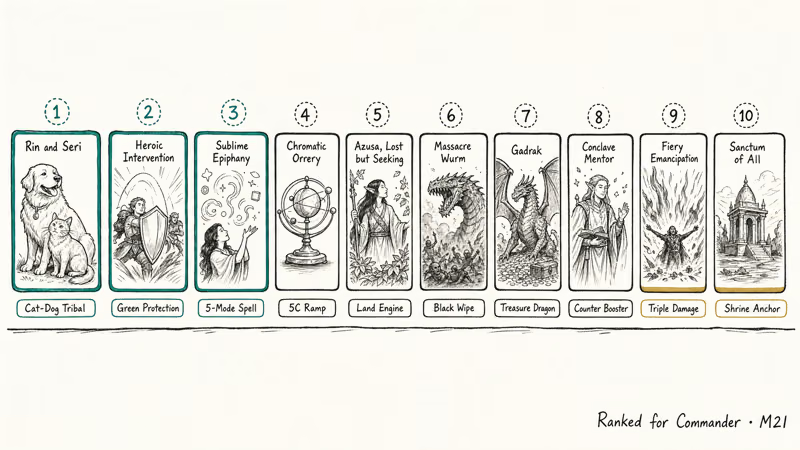
#01. Rin and Seri, Inseparable
Rin and Seri is a four-mana (1RGW) legendary creature in Naya colors that pumps cat tokens off Dog spells and pumps Dog tokens off Cat spells. Both halves cap your decklist’s color identity at red-green-white tribal payoffs, which is one reason this commander stays popular six years on.
The +1/+1 token engine and built-in lifegain ability give Rin and Seri a clean win condition through token swarm rather than commander damage. In a Rin and Seri tribal deck, the hard part isn’t finding payoffs but choosing between cat tribal lords like Pride Sovereign and dog tribal cards like Pack Leader.
The deck wins through token volume, so include token doublers and protection rather than expensive bombs. EDHREC’s commander pages list Rin and Seri among the most-played four-color commanders from the M21 era, which matches its showing at casual pods.
#02. Heroic Intervention
This M21 reprint is the cheapest blanket protection green has ever received. For two mana (1G) at instant speed, every permanent you control becomes indestructible and hexproof until end of turn. That blanks Wrath of God, Toxic Deluge, Damnation, Cyclonic Rift, and most targeted removal.
According to Scryfall’s printing history, Heroic Intervention has been reprinted six times since its original Aether Revolt printing in 2017. The M21 printing kept the price at sub-$10 territory through 2026. Heroic Intervention earns a one-of slot in nearly every green Commander deck. The instant speed lets you bait an opponent into casting their wipe before responding, often netting you a board state worth two or three cards more than everyone else.
#03. Sublime Epiphany
Sublime Epiphany is a six-mana (4UU) modal sorcery that lets you choose up to five different modes from a list of five: counter a spell, counter an activated ability, return a nonland permanent, copy a creature, or make an opponent’s creature unable to block.
Sublime Epiphany fits a range of blue Commander decks, from Talrand spellslinger builds to Niv-Mizzet Reborn or Yuriko ninjas. It often lands as a game-winning play once you can pay for the full mode count. The card is fragile against fast combo where six mana arrives too late, but in any pod that grinds past turn six, a one-card answer to a counterspell, a token wave, and a key threat is hard to match.
If you want to see how copy effects shape blue strategies, our breakdown of the best MTG clone cards covers the wider toolbox Sublime Epiphany sits in.
#04. Chromatic Orrery
Chromatic Orrery is a seven-mana colorless artifact that taps for five colorless mana, fixes the mana cost of every land you control to any color, and draws cards equal to the colors among permanents you control when activated. The card sits in three- through five-color ramp decks where its land-fixing ability is irreplaceable.
According to the Core Set 2021 release notes from Wizards of the Coast, the Orrery was designed as a top-end mana battery for casual five-color decks. The activated draw mode rewards rainbow board states, which lines up with how the card plays out in practice.
Seven mana is the catch. Pair Chromatic Orrery with cost-reduction lands and rocks like Sol Ring, Arcane Signet, and the best MTG land cards for the curve. Sen Triplets, Niv-Mizzet Reborn, and Jodah Archmage Eternal lists all benefit from a single Orrery copy, and with enough ramp the artifact rarely sits stranded in hand long enough to feel dead.
#05. Azusa, Lost but Seeking
Azusa is a three-mana (2G) legendary human monk that lets you play two additional lands on each of your turns. M21 was Azusa’s third printing and the cheapest by a wide margin at release. The card is the engine in any green ramp commander like Lord Windgrace, Omnath Locus of Mana, or Multani Yavimaya’s Avatar.
With Azusa on the table, every Cultivate or Kodama’s Reach feels like a Skyshroud Claim. Azusa rarely survives a turn cycle, so doubling up on protection (Lightning Greaves, Swiftfoot Boots, or a one-mana hexproof aura) is worth it any time you want to ramp through her. The trade-off is fine: even one extra land drop usually nets a turn of mana ahead, which matters in long Commander games.
#06. Massacre Wurm
Massacre Wurm is a six-mana (4BB) black Phyrexian wurm with deathtouch and a static effect that gives all creatures your opponents control -2/-2, plus a triggered drain that deals two damage to each opponent for each creature of theirs that died this turn.
It’s a board wipe attached to a 6/5 deathtoucher, which is exactly what mono-black Commander wanted for years. The M21 printing was its first reprint outside of the original Mirrodin Besieged, and the price dropped roughly in half within six weeks.
The card pairs naturally with token-heavy strategies that flood the board, then flip the table. It also slots into Korvold or Meren reanimator shells where -2/-2 wipes the small creatures and Massacre Wurm itself becomes a recursion target. For more on creatures that close games at this size, see our list of MTG’s biggest creatures.
#07. Gadrak, the Crown-Scourge
Gadrak is a four-mana (2RR) legendary mono-red dragon that can’t attack unless you control four or more artifacts, and creates a Treasure token whenever a nontoken creature you control dies.
In Commander, Gadrak shines in mono-red sacrifice and Treasure-matters shells alongside Krenko, Dockside Extortionist, and Pia and Kiran Nalaar. The Treasure trigger is mana acceleration, fuel for big spells, and a recursion engine when paired with cards like Mayhem Devil.
Gadrak isn’t a strong Commander itself outside of fringe brews. As part of the 99 in a sacrifice list, however, Gadrak earns its slot in decks like Marchesa, the Black Rose and rarely feels like a dead draw.
#08. Conclave Mentor
Conclave Mentor is a two-mana (GW) legendary centaur druid with the static effect “If one or more +1/+1 counters would be put on a creature you control, that many plus one +1/+1 counters are put on it instead.” It also has a sacrifice ability that drains opponents based on counters removed.
The card folds into Ghave Guru of Spores, Pir-and-Toothy partner combos, and any Hardened Scales-style counters strategy. In a Pir Imaginative Rascal partner build, Conclave Mentor tends to close games a couple of turns faster than a version running Hardened Scales alone.
Both cards stack and overlap, but Conclave Mentor’s body is relevant against creature decks in a way the Scales never is. Counter-themed decks frequently spill into white and complement the best MTG angels list when paired with Sigarda Host of Herons or Linvala variants.
#09. Fiery Emancipation
Fiery Emancipation is a six-mana (3RRR) red enchantment that reads, “If a source you control would deal damage to a permanent or player, it deals triple that damage to that permanent or player instead.”
Triple is the key word: most damage triplers stop at double. The card slots into mono-red commanders like Torbran Thane of Red Fell, Purphoros God of the Forge, and Krenko Mob Boss as a one-card win condition. A 1/1 token deals 3 damage. A 4/4 from Purphoros’s trigger now deals 12 to each opponent.
The drawback is the 3RRR cost, which gates Emancipation to mono- or two-color decks where triple-red is realistic. Because it doesn’t threaten the board the turn it lands, opponents often let it resolve. Plan for a follow-up creature or burn spell to capitalize the next turn.
#10. Sanctum of All
Sanctum of All is a six-mana (5W) legendary Shrine enchantment that costs 1W to put a Shrine card from your hand or graveyard onto the battlefield. It also has a static effect that buffs each Shrine you control based on the number of Shrines you control.
Sanctum of All is the centerpiece of the M21 Shrine tribal subtheme and remains the only legendary Shrine printed to date. It anchors a Go-Shintai of Life’s Origin or Sisay, Weatherlight Captain shrine list and turns Shrines from a casual subtheme into a legitimate value engine.
Sanctum of All is fragile to enchantment removal, so include redundant protection. A shrine deck built around it tends to either snowball by turn eight or fold to a single Bane of Progress, with little middle ground. Treat it as a glass cannon, not a control piece.
#M21 Reprints That Reshaped Commander Pricing
M21 didn’t just add new cards. It reset the price of several Commander staples that had been priced out of casual reach. TCGplayer price data shows Heroic Intervention dropped sharply in price within two months of release, and it has stayed affordable across its later reprints.
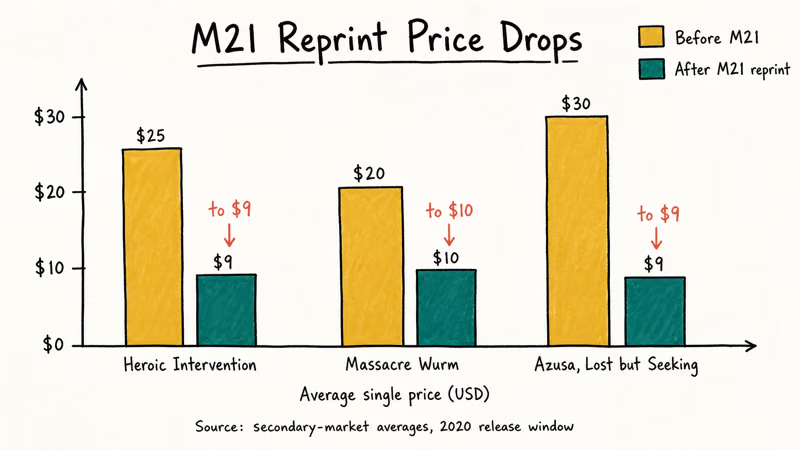
Massacre Wurm followed a similar arc. The card had been a $20 single from its Mirrodin Besieged printing through 2019. The M21 reprint cut that roughly in half. Azusa Lost but Seeking went from a $30 to $40 single in 2018 to a $7 to $12 single by mid-2021.
These price corrections matter because Commander is a singleton format. Players who own only one copy of a $30 card would build around it once and shelve the deck. The M21 reprints meant pod members started showing up with multiple Heroic Interventions across different decks, which raised the average power level of casual tables.
#Which Decks Should Pick Up These M21 Cards?
The cards above are not interchangeable. Each one wants a specific shell, and forcing them into the wrong deck wastes slots. Here’s how they sort by archetype:
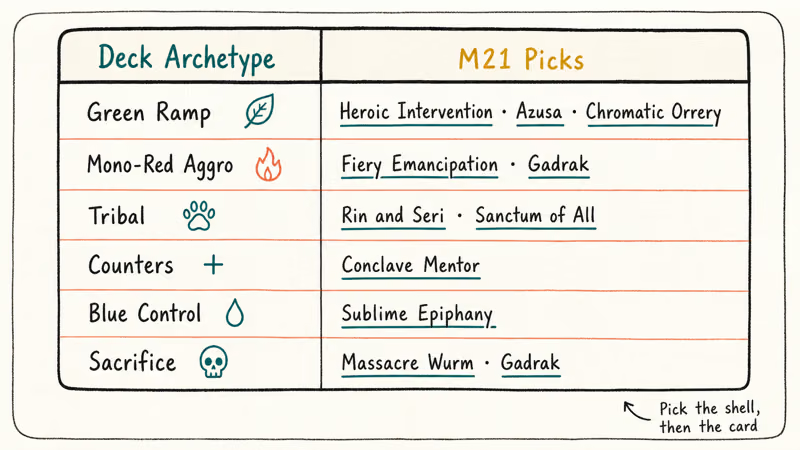
- Green ramp and stompy decks: Heroic Intervention, Azusa Lost but Seeking, and Chromatic Orrery (in three-plus colors) are mandatory or near-mandatory.
- Mono-red and red-aggressive lists: Fiery Emancipation and Gadrak the Crown-Scourge handle the win condition and the resource generation, respectively.
- Tribal commanders: Rin and Seri Inseparable lead a cat-dog token list, while Sanctum of All anchors any shrine deck.
- Counters-matter shells: Conclave Mentor scales linearly with every +1/+1 counter you create, fitting into Ghave, Pir-Toothy, and Marchesa builds.
- Blue interaction or control: Sublime Epiphany rewards decks that can pay six mana on a key turn and survive to the following one.
- Aristocrat and sacrifice strategies: Massacre Wurm and Gadrak overlap with reanimator and Treasure decks, especially Korvold, Meren, and Marchesa.
If your shell doesn’t match any of these archetypes, the M21 card you’re eyeing is probably not worth the slot. Build around the engine, not the individual card.
#Tips for Sleeving Up M21 Cards Today
If you’re picking up M21 singles in 2026, buy them as singles rather than sealed product. Sealed M21 booster boxes have aged out of typical retail and now trade as sealed-product collectibles, with markups that don’t reflect the actual card pool’s playability.
For singles, prioritize the cards in this list that match decks you already play. Heroic Intervention and Conclave Mentor are the two cheapest entry points and the most universal. Chromatic Orrery and Sanctum of All are the most expensive and the most narrow, so save those for decks you’ve already committed to.
A practical M21 collection for an active Commander player runs to three to four copies of Heroic Intervention spread across green decks, one Sublime Epiphany, and one Chromatic Orrery. That’s a sensible starting set if you want one copy of each high-impact card without overspending.
#Bottom Line
For a new Commander player in 2026, the three Core Set 2021 cards to start with are Heroic Intervention for any green deck, Sublime Epiphany for any blue deck, and Rin and Seri Inseparable as a self-contained tribal commander with a clear win condition.
Those three answer the most common Commander deck-building questions: how do I survive a wipe, how do I close from a stalled board, and how do I build my first deck without a wishlist of $50 staples?
Heroic Intervention belongs in roughly nine out of ten green-aligned Commander decks. Sublime Epiphany rewards patient pilots and pays them back in pod-defining turns. Rin and Seri keeps deck-building straightforward by tying card selection to two creature types. None of those three needs the rest of the M21 list to function, which makes them the safest entry points if you’re scoping out the set.
#Frequently Asked Questions
What is MTG Core Set 2021?
Core Set 2021, abbreviated M21, is the twentieth core set in Magic: The Gathering and the third under the modern numbering convention. Wizards of the Coast released M21 on July 3, 2020 with 274 cards, including new legendary creatures, the Shrine subtheme, and reprints of high-demand staples.
Are M21 cards still legal in Standard in 2026?
No. Standard rotation removed Core Set 2021 in fall 2022. M21 cards remain legal in Pioneer, Modern, Legacy, Vintage, Pauper (commons only), and Commander. Most of the list above targets Commander, which is non-rotating.
Which Commander cards from M21 are worth the most in 2026?
Sanctum of All, Chromatic Orrery, and Sublime Epiphany hold the highest singles prices among M21 Commander staples, typically in the $5 to $15 range depending on printing and condition. Heroic Intervention and Massacre Wurm dropped after the M21 reprint and have stayed under $10. Prices fluctuate, so check a current secondary-market source like TCGplayer or Card Kingdom before buying.
Is Rin and Seri a strong Commander for new players?
Yes, Rin and Seri Inseparable is one of the most beginner-friendly four-color tribal commanders. The deck-building rule (cats and dogs) is unambiguous, the win condition (token swarm plus lifegain) is clear, and the supporting cards are mostly common or uncommon. Expect to spend $50 to $100 on a casual list and roughly $200 on a Commander League-tuned version.
How does Heroic Intervention compare to Teferi’s Protection?
Both protect your board, but they work differently. Heroic Intervention costs two mana and lasts until end of turn, granting indestructible and hexproof. Teferi’s Protection costs three mana and phases out your permanents until your next turn.
Teferi’s Protection is stronger in a vacuum but costs more and lives in white. For green decks, Heroic Intervention is the closest analog and the better mana value.
Can I mix M21 cards with cards from other sets?
Yes, Commander allows any legal card from any set as long as your deck respects the format’s color identity, singleton, and banned-list rules. Most of the M21 cards above are designed to slot into existing decks rather than build a self-contained M21 list. Mix freely.
What is the best M21 card for a budget Commander deck?
Heroic Intervention. The card has been reprinted enough times to keep the singles price under $10, and it slots into any green deck with no other deck-building changes. Conclave Mentor at one to two dollars is the runner-up if your deck cares about +1/+1 counters.
Where can I find the full M21 card list?
The full Core Set 2021 list is available on Scryfall, Wizards’ official Gatherer database, and MTG fan sites. Scryfall’s set page is the easiest to filter by rarity, color, and Commander-format legality. The set numbers 274 cards in the main set, plus 30 promotional and alternate-art variants.

Fortnite Stuck on the Loading Screen? Fix It in 2026
Fortnite stuck on the loading screen? Check server status, fix the Windows N Media Pack and DirectX 11 on PC, clear the console cache, and verify files.

Minecraft Keeps Crashing? Java and Bedrock Fixes (2026)
Minecraft keeps crashing on startup or mid-game? Update your GPU driver, remove mods on Java, and reinstall Gaming Services on Bedrock. Fixes for both.

Pokemon GO Not Loading? Fix the Loading Screen 2026
Pokemon GO not loading or stuck on the Pokeball? Check server status, fix automatic date and time, grant location permission, clear the cache, and update.

PS5 Controller Not Charging? 9 Fixes That Work (2026)
DualSense not charging? Swap the cable, use a rear port in Rest Mode, clean the USB-C port, and check power settings. 9 fixes for a dead PS5 controller.