Grindr Fake GPS for Privacy: Safe Methods on iOS and Android
Use Grindr fake GPS for your own privacy and travel planning on iOS and Android, with safety, legal, and account-ban warnings you should know first.
Quick AnswerGrindr fake GPS lets you mask your real location on your own device using a GPS spoofing tool like Dr.Fone Virtual Location on iOS or developer mock locations on Android, but it can violate Grindr terms and trigger a ban, so use it only on your own account for privacy or pre-travel browsing.
Grindr fake GPS is a privacy tactic some people use on their own devices to keep precise home coordinates out of a dating app that logs frequent locations. The risk is concrete in regions where outing yourself can cost a job, a tenancy, or worse. Grindr needs location access to surface nearby profiles, but that same signal can expose where you live, work, or sleep if your phone is lost or another user screenshots your distance.
This guide has one purpose. We will help you reduce location exposure on your own Grindr account, using methods that match the threat level you actually face rather than the worst-case scenario shouted by every “spy app” landing page. We won’t help with tracking, deceiving, or harassing other users, since the same techniques that protect you can cause real harm pointed the wrong way.
- Grindr’s privacy notice confirms the app collects precise location plus profile photos, chats, and self-reported health details, so masking GPS is one of several levers you should pull to harden your account.
- On iOS, no built-in setting fakes GPS, so people use a desktop spoofer like Dr.Fone Virtual Location connected to a trusted PC and the iPhone they own.
- On Android, mock locations require tapping Build Number 7 times in About Phone, then enabling a mock app from Developer Options.
- Spoofing GPS to harass, stalk, or impersonate another person can violate federal law in the United States, including 18 U.S.C. 2261A on cyberstalking, plus state harassment statutes.
- Grindr’s terms of service allow account suspension for falsifying location data, so even legitimate privacy use can cost you the account if it triggers anti-fraud signals.
#Is Faking GPS on Grindr Legal or Safe?
Spoofing your own GPS on your own phone for your own Grindr account is, in most places, a personal privacy choice. The legal line moves quickly once a second person is involved.
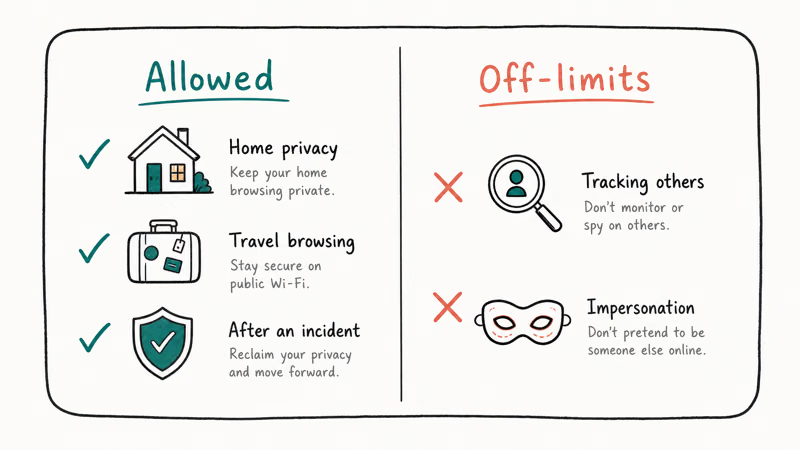
Using a fake location to stalk, impersonate, defraud, or harass another user can run into federal cyberstalking law in the United States (18 U.S.C. 2261A) and state-level harassment statutes. Platform-fraud rules in dozens of countries also apply.
Both Dr.Fone Virtual Location on iOS and the Android Developer Options method change the displayed distance almost instantly. The catch is that Grindr’s anti-spoofing checks can flag a new profile after a few sessions and force a phone-number reverification, so an instant distance change does not mean the account is safe long term.
The Electronic Frontier Foundation’s LGBTQ digital security playbook recommends that LGBTQ users in hostile regions treat any dating-app location as effectively public. Precise distance plus a profile photo can identify someone in minutes.
According to Apple’s Location Services support page, turning off Precise Location restricts an app to an approximate area instead of your exact coordinate. With this enabled, Grindr’s nearby grid widens to a broader neighborhood area, which is often enough for everyday privacy needs without any spoofing tool at all.
#Legitimate Privacy Use Cases
Use Grindr fake GPS only for your own account and your own device, and only for reasons like these:
- Hardening privacy at home by feeding the app a coarser neighborhood location instead of your exact apartment block.
- Browsing the community in a city you’re about to travel to, so you can read profiles and message ahead without exposing your current city.
- Testing the app safely from home before traveling to a country where outing yourself could be physically dangerous.
- Separating your real neighborhood from your dating profile after an incident like a stalking attempt or doxxing.
#Off-Limits Behavior We Won’t Cover
We don’t cover, and won’t help with: tracking another person’s movements, impersonating someone in a different city, catfishing, locating a user’s home or workplace, or evading legal protective orders. Those uses can cause real harm to real people and, depending on your jurisdiction, can carry criminal penalties.
#How Does Grindr Detect Spoofed Locations?
Grindr’s anti-fraud system looks at more than the GPS coordinate your phone sends. Per Grindr’s Help Center entry on banned accounts, the platform combines device fingerprint, IP address, account age, and movement patterns. Accounts that teleport thousands of miles between sessions get flagged.
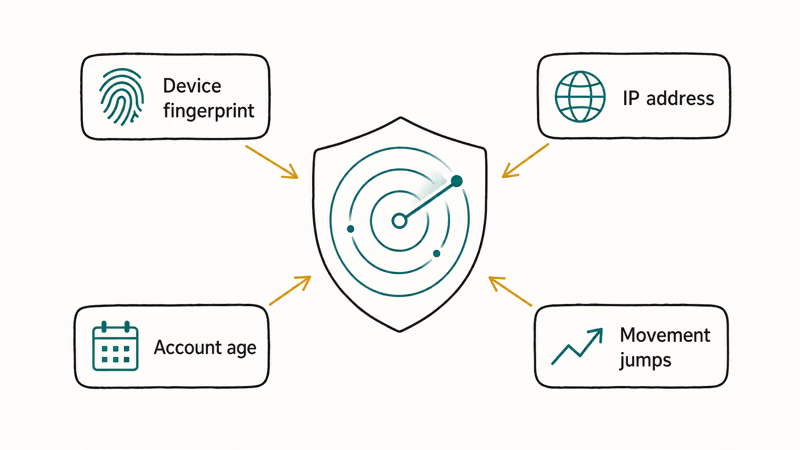
A large jump, such as moving from a U.S. coordinate to a European one in a single session, is exactly the kind of impossible movement that can trigger a flag and an SMS reverification before you can message anyone. Per Grindr’s Community Guidelines, repeated violations can result in a permanent ban tied to your phone number, which is harder to escape than a simple account reset.
If you want to test spoofing without burning your main account, create a separate Grindr account on a different phone number that you control. Don’t use a friend’s number, a stranger’s number, or a temporary service that other people can claim.
#How to Use Grindr Fake GPS on iOS (Your Own Device)
iOS has no built-in mock-location toggle and no jailbreak-free system setting that fakes GPS for a single app. The standard workaround is a desktop spoofer that talks to your iPhone over a USB or Wi-Fi pairing.
#Use Dr.Fone Virtual Location on Your Own iPhone
Dr.Fone Virtual Location for iOS runs on a Mac or Windows PC, pairs with your iPhone, and feeds a chosen coordinate to every location-aware app on the device, including Grindr.
Some links on this page are affiliate links, which means fone.tips may earn a commission at no extra cost to you.
- Pair the iPhone you own with the trusted PC where you installed Dr.Fone. Tap Trust when the prompt appears on the iPhone.
- Open the Dr.Fone app, click Virtual Location, then choose Get Started.
- The map opens at your real location. Click the Teleport Mode button in the top-right corner.
- Type the destination in the search box and confirm. Drag the pin if you want to fine-tune.
- Click Move Here. The new coordinate now feeds every location-aware app on the iPhone, including Grindr, Maps, and weather apps.
- To stop spoofing, close Dr.Fone or restart your iPhone. Real GPS returns on the next session.
If you also need to change location for another dating app like Bumble, our Bumble location change guide walks through the same Dr.Fone Virtual Location flow plus Bumble’s built-in Travel Mode. The desktop pairing experience is nearly identical when you reuse Dr.Fone Virtual Location across apps.
#Privacy Settings to Try Before Any GPS Spoofing
If you don’t want to install a desktop spoofer at all, Grindr’s own settings already let you hide distance and use a discreet app icon. Go to Settings > Profile > Show Distance and toggle it off. Then turn off Precise Location for Grindr in your phone’s system settings. On iOS this lives under Privacy & Security > Location Services > Grindr, and on Android it sits under Apps > Grindr > Permissions > Location > Approximate.
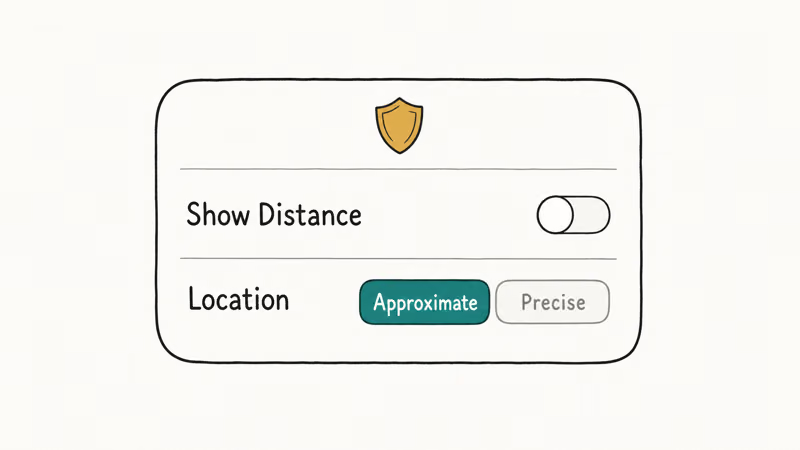
This stack alone solves the most common worry, which is a stranger pinning your home from a 1-meter distance read. For most users it’s enough on its own. Spoofing is the second layer you reach for only when distance hiding alone doesn’t cover the threat.
#How to Enable Mock Locations on Android (Your Own Phone)
Android exposes a developer-mode toggle that lets a chosen app feed a fake coordinate to other apps. This is the same path Google uses for app testing. It’s the cleanest way to spoof Grindr on Android without third-party hardware.
#Step 1: Unlock Developer Options
- Open Settings, then About Phone.
- Tap Build Number seven times in a row. Your phone confirms Developer Options are now enabled.
- On Samsung devices the path is
Settings>About Phone>Software Information>Build Number.
#Step 2: Pick a Mock Location App
Install a single mock-location app from the Play Store. A well-regarded choice is Fake GPS Location by Lexa, which is ad-light and respects Android’s stricter location permissions. Other options exist. Pick one with recent updates within the last 90 days, a developer with a real website outside the Play Store listing, and a transparent privacy policy that names what data the app collects beyond the mock coordinate itself.
#Step 3: Set the App as Your Mock Provider
- Return to
Settings>System>Developer Options. - Scroll to Select mock location app and pick the app you installed.
- Open the mock app, drop the pin where you want Grindr to think you are, and tap Play.
Once the mock provider is set, the new coordinate typically appears in Grindr shortly after you open the app. Google’s Developer Options reference confirms mock locations work on all current Android versions when developer mode is unlocked.
For a deeper Android-side primer on how the GPS chip itself behaves, our explainer on whether airplane mode actually disables GPS clears up a common misconception.
#Using a VPN Alongside or Instead of GPS Spoofing
A VPN changes the public IP address your phone reports. It does not change the GPS coordinate Grindr reads from your device sensors. Grindr primarily uses GPS, so a VPN alone will rarely move your apparent location on the map.
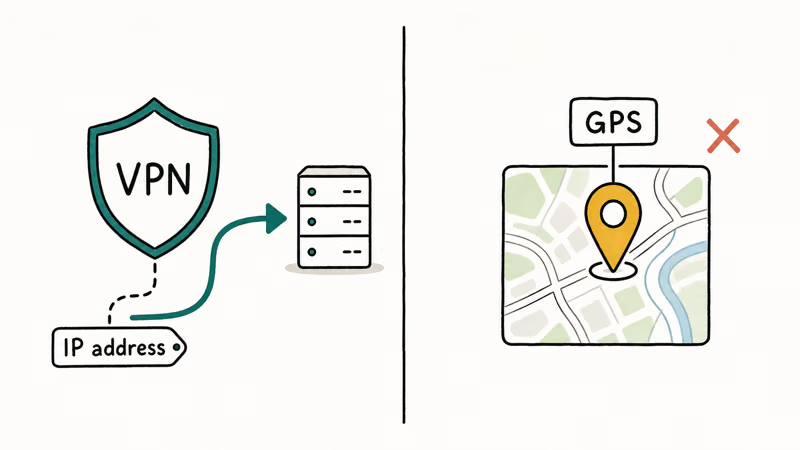
It still helps with privacy for two reasons. It hides your IP from network observers. It can also prevent Grindr’s anti-fraud system from correlating your IP with your real city.
A no-log service like NordVPN illustrates the split clearly. Connect the VPN to a London server while GPS still reports a coordinate in coastal California, and Grindr’s nearby grid follows the spoofed California location and ignores the London IP entirely. Pair a VPN with GPS spoofing only when you specifically need to mask both signals at once.
Per the Mozilla Foundation’s Privacy Not Included review of dating apps, Grindr is flagged for broad data collection alongside other major dating platforms. That report recommends choosing a no-log VPN and reading each app’s privacy notice as the two highest-leverage moves users can make.
#Bottom Line
If you only need to lower how much precise location data Grindr stores about your home, start with the no-spoof path. Turn distance off in your profile, disable Precise Location for Grindr in iOS or Android system settings, and consider pairing the app with a no-log VPN.
Reach for full GPS spoofing only for narrow cases: testing the app safely before traveling to a risky region, separating your dating profile from your home neighborhood after an incident, or browsing a destination city you’ll soon visit. Use Dr.Fone Virtual Location on iOS or a single reputable mock-location app on Android, on your own device and your own account. Don’t aim spoofing at another user.
For a tighter privacy walkthrough across multiple dating apps, see our guide to changing iPhone location without jailbreak or our Tinder fake GPS guide, which goes deeper on dating-app-specific anti-spoofing.
#Frequently Asked Questions
Can I get banned from Grindr for using fake GPS?
Yes, Grindr’s terms of service allow account suspension for falsifying location data, and their anti-fraud system looks for impossible jumps between sessions. A single large hop, such as a U.S. coordinate to a European one, can trigger SMS reverification within a few sessions. Repeat offenders can earn a permanent ban tied to the phone number on the account.
Is GPS spoofing legal in the United States?
Spoofing your own location on your own device for personal privacy is generally legal. It crosses into illegal territory when used to harass, stalk, defraud, or impersonate another person. Federal cyberstalking law (18 U.S.C. 2261A) and state harassment statutes both apply.
Will a VPN alone fake my location on Grindr?
Usually not. Grindr relies primarily on the GPS coordinate your phone reports, not your IP address. A VPN changes the IP that Grindr’s servers log but rarely moves the dot on the map. Pair a VPN with GPS spoofing only when you need to mask both signals, such as when traveling through a country that monitors dating-app traffic.
Does spoofing affect other apps on my phone?
Yes. Both the iOS Dr.Fone method and the Android mock-location method feed the fake coordinate to every location-aware app on the device, including Maps and any banking app that geo-checks logins. Close the spoofer or restart your phone to restore real GPS.
What’s the safest privacy alternative to spoofing?
Start inside Grindr itself. Turn off Show Distance in your profile and switch to the discreet app icon. Then turn off Precise Location for Grindr in your phone settings, optionally paired with a no-log VPN.
Can someone find my home address from my Grindr profile?
Distance numbers combined with multiple sessions can let a determined person triangulate a rough area, especially if your distance reading hovers near the same value every evening. Hiding distance and using a coarser system-level location are the two biggest defenses, plus varying your in-app routine across nearby cafes. Never share home photos, exact street names, or workplace details in chats with strangers, and report any user who pressures you for that.
What should I do if I’m being stalked through Grindr?
Stop sharing location with the app immediately by toggling Location Services off for Grindr in your phone settings, block the user inside the app, and report the account through Grindr’s in-app report flow. Save screenshots before blocking, since they may be useful evidence later if the threat escalates offline. Our guide on how to stop sharing your location covers the system-level steps for both iOS and Android.
Apple Siri Settlement: Who Qualifies and How to Claim
Apple's $250 million Siri settlement covers iPhone 15 Pro and iPhone 16 models bought June 2024 to March 2025. See who qualifies and how claims work.
iOS 26.6.1 Security Update: What Apple Fixed and Who Gets It
Apple released iOS 26.6.1 on August 17 with 29 security fixes, including an IPSec interception bug. See what it patches, who gets it, and how to update.
iPhone Adaptive Power: How It Works and When to Use It
Learn how iPhone Adaptive Power works, which models support it, what it changes, and when Low Power Mode is still the better battery-saving choice.
How to Transfer Data to a New iPhone Without iCloud
Move everything to your new iPhone without iCloud: Quick Start device-to-device transfer, wired migration, and encrypted Finder or iTunes backups.