How to Stop Sharing Location Without Them Knowing?
Stop sharing your iPhone location without sending any notification, using Airplane Mode, Share My Location, and the Find My settings on iOS.
Quick AnswerThe easiest way to stop sharing your iPhone location without them knowing is to enable Airplane Mode, which silently disables all location sharing. You can also turn off Share My Location in Settings > Privacy > Location Services without triggering a notification to the other person.
If you want to know how to stop sharing your iPhone location without them knowing, you’re not alone. Plenty of iPhone owners want a quiet way to pause Find My or Share My Location without an alert popping up on the other person’s screen. This guide covers only legitimate privacy use on your own iPhone and your own Apple ID, on devices and accounts you control.
The short version: it’s doable, and iOS gives you four built-in ways to do it.
All four methods work the same way across recent iOS versions, on both the sharing device and the one watching the receiving end.
None of the methods triggers a banner notification, an email, or a system alert on the receiving device. The contact’s Find My view simply switches to “Location Not Available” on the next refresh, identical to how it would look if your phone had run out of battery, dropped off the cell network, or been turned off entirely.
- Airplane Mode is the fastest way to silently cut all location sharing, since it disables cellular, Wi-Fi, and GPS at the same time without notifying anyone.
- Turning off Share My Location in Settings stops sharing your position without alerting the other person, because iOS doesn’t send a notification for that change.
- The Find My app lets you stop sharing with one specific contact, so everyone else on your list keeps seeing your location normally.
- A second iOS device signed into your Apple ID can pose as your live location while your main phone stays private.
- Tenorshare 4uKey helps you get back into a locked iPhone you own when a forgotten passcode blocks you from changing location settings.
#How Can You Stop Sharing Location Without a Notification?
There are four reliable ways to do this inside iOS, each suited to a different situation. According to Apple’s iPhone User Guide on sharing your location, Share My Location can be toggled at the Apple ID level or per individual contact, and Apple confirms that neither change pushes a banner alert to your contacts.
Pick by situation:
- Disappear completely: Airplane Mode.
- Quiet, reversible pause: turn off Share My Location.
- Drop one specific person: Find My’s per-contact toggle.
- Look like you’re still at home: a second iOS device as your broadcast source.
Each section below covers one method.
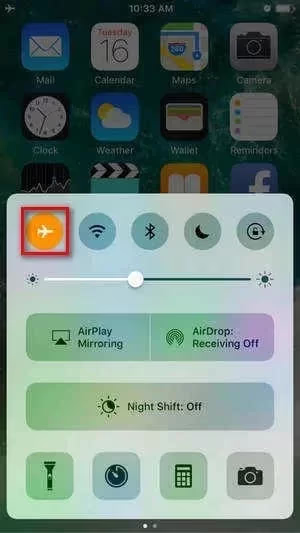
#Method 1: Put Your Device in Airplane Mode
Airplane Mode is the simplest option. Once it’s on, every active location share drops almost immediately.
The contact’s Find My screen then shows “No Location Found,” with no banner and no buzz. It’s silent because Airplane Mode kills cellular, Wi-Fi, and GPS at the same instant, and Apple’s iPhone User Guide states the feature is intended to suspend all wireless signals at once. For a deeper dive into the GPS specifics, see does Airplane Mode turn off GPS.
Turn it on from Control Center:
- Swipe down from the top-right corner on Face ID iPhones, or swipe up from the bottom on Touch ID iPhones.
- Tap the airplane icon. It turns orange when Airplane Mode is on.
Turn it on from Settings:
- Open the Settings app.
- Toggle Airplane Mode on at the top of the menu.
The trade-off: incoming calls and texts also stop. For more on hiding your whereabouts without going fully dark, see our guide to how to hide your location on iPhone. If you’d rather keep your phone usable while pausing sharing, jump to Method 2 below.
#Method 2: Turn Off Share My Location in Settings
This is the cleanest option for everyday privacy.
Apple’s documentation states that disabling Share My Location at the Apple ID level removes you from every Find My share at once, with no separate notification sent to your contacts. The change takes effect almost immediately, and the contact’s Find My app shows “Location Not Available” on the next refresh, identical to what they’d see if your phone were off, in a dead zone, or out of battery.
- Open Settings.
- Tap your Apple ID name at the top.
- Tap Find My.
- Tap Share My Location and toggle the switch off.
You can flip it back on later without sending any announcement. That reversibility is what makes Method 2 the everyday choice.
#Method 3: Stop Sharing in the Find My App
Want to keep sharing with most people but quietly drop one? The Find My app handles that on a per-contact basis.
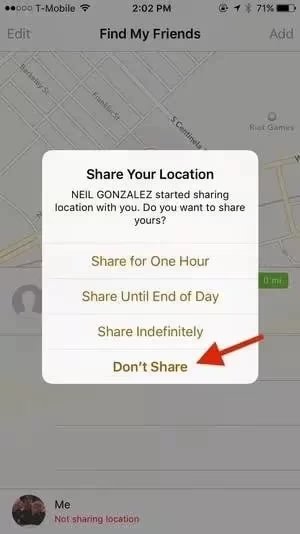
Steps:
- Open the Find My app.
- Tap the People tab at the bottom.
- Select the contact you want to stop sharing with.
- Scroll down and tap Stop Sharing My Location.
Apple’s Find My support documentation confirms that the removed contact stops receiving your updates without an explicit alert. They’ll see “Location Not Available” on their next check.
It looks identical to you being offline.
#Method 4: Use a Second iOS Device to Reroute Your Location
If you own a second iPhone or iPad signed into the same Apple ID, you can pick that device as the source of your shared location. The first device stays private. The second one broadcasts.
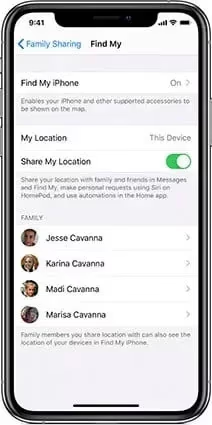
Steps:
- On the second iOS device, go to
Settings>Apple ID>Find My>Share My Locationand toggle it on. - Tap Use This iPhone (or Use This iPad) as My Location.
- Leave the second device at your chosen “home” spot.
With an iPad left at home, for example, a contact sees the iPad’s location whenever they check the Find My profile, while your iPhone out and about stays completely invisible on their map. The trick only works while both devices are powered on and signed into the same Apple ID, so battery life on the parked device matters.
#What the Other Person Actually Sees on Their Device
This is the part most people care about most.
Apple announced Find My, released as a unified app with iOS 13 in September 2019, with the explicit design goal that absence of data looks the same no matter the cause.
Whether you’re offline, out of range, low on battery, or simply not sharing, the contact’s Find My app shows the same “Location Not Available” line. According to Apple’s Find My support documentation, none of the four methods covered here push an explicit “stopped sharing” notification to the people you removed. There’s no banner, email, or alert on the receiving end.
One edge case is worth a flag: if the other person set up a Find My notification rule (for example, “alert me when this person arrives home”), that rule keeps polling silently. They won’t see a “you stopped sharing” alert. They might, however, notice that the expected arrival alerts have gone quiet for a while.
For unrelated location bugs, see why your iPhone location is wrong. And if Find My shows “No Location Found” for someone else, that’s usually their device going offline rather than them blocking you.
#Which Method Should You Choose?
For everyday privacy, we’d recommend Method 2: turn off Share My Location in Settings. It’s silent, reversible, and doesn’t break any other phone functionality.
Airplane Mode is faster but cuts off calls and texts too, which is overkill for most situations. Pick the per-person Find My toggle (Method 3) when you’re sharing with several people but only need to drop one. The second-device trick (Method 4) is the right call when you’d rather appear to be at a specific spot than appear offline; it’s handy for cases like leaving the second device at home while you go out for the afternoon.
#How to Unlock Your iPhone Screen Without Using Find My
Sometimes the reason you can’t change Share My Location is simpler than software. You can’t get into your own iPhone because the passcode was forgotten. This section is for your own device only.
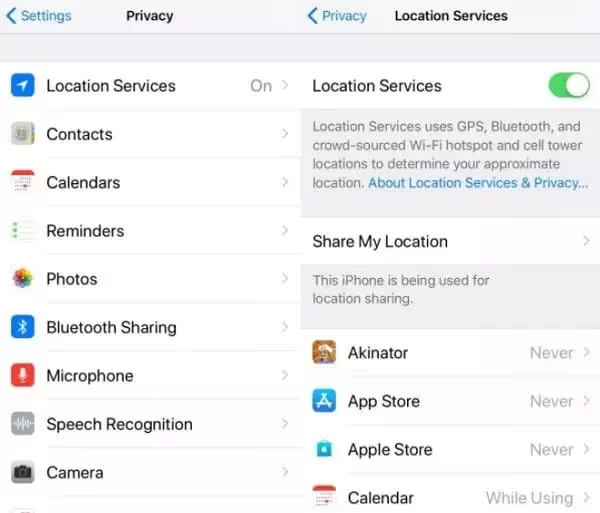
If Find My iPhone is enabled, Apple recommends erasing the device remotely from iCloud.com and setting it up fresh. If Find My is off and the passcode is lost, Apple’s official path is to put the iPhone into Recovery Mode and restore through Finder or iTunes, which wipes everything on the device.
For users who want a guided desktop tool instead of running Recovery Mode by hand, Tenorshare 4uKey automates the screen-passcode removal flow on iPhones you own. The walkthrough is straightforward on both Windows and macOS, and the process usually takes around 10 to 15 minutes on a recent iPhone, longer if your computer is slow to pull the firmware bundle. You can read our full 4uKey review for the details.
Some links on this page are affiliate links, which means fone.tips may earn a commission at no extra cost to you.
#Steps to Use Tenorshare 4uKey on Your Own Device
- Download Tenorshare 4uKey to your PC or Mac and install it. Choose Unlock Lock Screen Passcode.
- Connect your locked iPhone with a USB cable, then press Start.
- The tool downloads matching firmware to your computer. Pick a save path, then click Download.
- Click Start Unlock after the firmware finishes.
- The iPhone reboots without the passcode in roughly 10 minutes.
Sign back into Settings and adjust Share My Location normally. One safety note: only use this on a device you own and have the legal right to access. Bypassing a passcode on someone else’s iPhone is illegal in most jurisdictions and violates Apple’s terms of service.
#Bottom Line
For everyday privacy, turn off Share My Location in Settings > Apple ID > Find My. That’s the cleanest answer for almost every iPhone owner: silent, reversible, and it leaves everything else on your phone working normally.
Use Airplane Mode for short windows when you also want to be unreachable. Pick the per-person Find My toggle when you’re sharing with several people but only need to drop one. Park a second iOS device at home when you’d rather appear stationary than offline. For locked iPhones you own and can’t get into, Tenorshare 4uKey handles the screen-passcode reset so you can get back in.
#Frequently Asked Questions
Does turning off location services stop all apps from accessing my location?
Yes. Disabling Settings > Privacy & Security > Location Services blocks every app, including Maps, Find My, and Weather. The system still allows cell tower data for emergency calls regardless of your toggle state.
Will the other person get a notification when I stop sharing in Find My?
No.
None of the four methods (Airplane Mode, Share My Location off, per-person stop, or second-device routing) sends an explicit alert to the receiving device. The contact’s Find My app just shows “Location Not Available” on their next refresh, which looks identical to your phone being offline, in a dead zone, or out of battery. Apple’s Find My is designed so absence of data is indistinguishable across causes.
Is there a way to allow specific apps to access my location while blocking others?
Yes. Go to Settings > Privacy & Security > Location Services, scroll to the app list, and pick Never, Ask Next Time, While Using the App, or Always for each app individually.
Does turning off location services affect emergency services?
Even with location services off, emergency responders may still locate you using cell tower triangulation. Apple’s privacy documentation states iPhones share location data with emergency services during an active 911 call regardless of your Location Services setting.
Will turning off location services affect my mobile data?
No. They’re independent on iOS.
Can I be tracked if I turn off location services?
It’s much harder, but not impossible. Cell tower logs, Wi-Fi triangulation, and apps with their own SDK-based location tracking can still estimate your position to a rough neighborhood level. For tighter privacy, pair Airplane Mode with Location Services disabled, and avoid using accounts tied to your real identity over Wi-Fi networks you don’t control.
What’s the difference between Airplane Mode and turning off Share My Location?
Airplane Mode cuts every wireless connection at once. Cellular, Wi-Fi, Bluetooth, and GPS all stop, which means calls, texts, and data also stop until you disable it. Turning off Share My Location only stops Find My from broadcasting your position, leaving every other function on your iPhone working as usual.
Apple Siri Settlement: Who Qualifies and How to Claim
Apple's $250 million Siri settlement covers iPhone 15 Pro and iPhone 16 models bought June 2024 to March 2025. See who qualifies and how claims work.
iOS 26.6.1 Security Update: What Apple Fixed and Who Gets It
Apple released iOS 26.6.1 on August 17 with 29 security fixes, including an IPSec interception bug. See what it patches, who gets it, and how to update.
iPhone Adaptive Power: How It Works and When to Use It
Learn how iPhone Adaptive Power works, which models support it, what it changes, and when Low Power Mode is still the better battery-saving choice.
How to Transfer Data to a New iPhone Without iCloud
Move everything to your new iPhone without iCloud: Quick Start device-to-device transfer, wired migration, and encrypted Finder or iTunes backups.