Gaming Laptops Under $600: Used-Buying Guide (2026)
Shop for a gaming laptop under $600 without mistaking discontinued models for current picks. Compare used Nitro 5, IdeaPad Gaming 3, TUF F15, and G15.
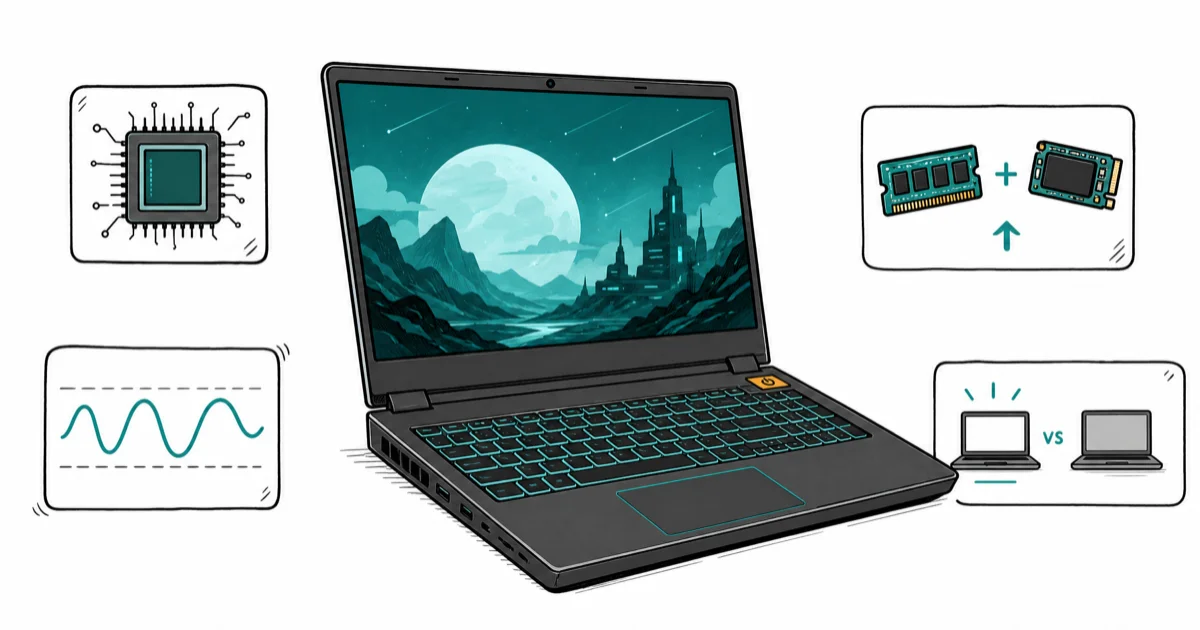
Quick AnswerFour models previously recommended here are discontinued, so none is a safe default buy in 2026. Treat them as used-only candidates and compare any deal with current Acer Nitro V or Lenovo LOQ listings.
Most gaming laptops below $600 in 2026 are used, refurbished, or clearance units. Four former picks on this page are discontinued; use this guide to judge an old listing, not as a current-model ranking.
- The Acer Nitro 5 AN515-55, Lenovo IdeaPad Gaming 3, ASUS TUF F15 FX506LH-AS51, and Dell G15 5511 are discontinued
- None of those four models belongs in a current “best laptop” buying slot, even when a marketplace seller still has stock
- Treat every listing as a used-machine inspection: verify the exact model number, battery health, warranty, RAM layout, storage health, and return window
- A low price doesn’t offset a damaged hinge, swollen battery, locked firmware, or a seller who won’t provide the serial number
- Compare the total cost with current Acer Nitro V and Lenovo LOQ families, but don’t assume either current line will stay under $600
#What Changed With These Under-$600 Picks?
The old version of this page ranked four discontinued products as if they were current 2026 buys. It also linked to marketplace listings whose seller, condition, and configuration could change while the model name stayed the same.
Affected products:
- Acer Nitro 5 (AN515-55)
- Lenovo IdeaPad Gaming 3 (15.6-inch)
- ASUS TUF Gaming F15 (FX506LH-AS51)
- Dell G15 5511
The HP Pavilion Gaming laptop also remains below as historical buying context, not as a current recommendation. A listing can still be legitimate, but “in stock” doesn’t mean the manufacturer still sells or supports that exact configuration as a current product.
According to NVIDIA’s GTX 16 Series page, the GTX 1650 is a Turing-generation part. That hardware can still run older and lighter games, but it shouldn’t be presented as the default graphics tier for a new 2026 gaming laptop.
#Which Discontinued Models Are Still Worth Evaluating?
No discontinued model is an automatic buy. The only useful question is whether a specific used unit works, has a fair return policy, and costs enough less than a current model to justify older hardware and shorter support life.
Use the table as a triage tool, not a ranking.
How to treat the legacy gaming-laptop models formerly ranked on this page
| Legacy model | Status on this page | What to verify on the exact unit |
|---|---|---|
| Acer Nitro 5 AN515-55 | Discontinued; used listing only | Full model suffix, both fans, display hinges, RAM slots, storage health |
| Lenovo IdeaPad Gaming 3 | Discontinued; used listing only | Machine type, panel condition, charger wattage, keyboard and trackpad |
| HP Pavilion Gaming | Historical model; not a current pick | Exact product number, battery condition, fan noise, service history |
| ASUS TUF F15 FX506LH-AS51 | Discontinued; used listing only | Exact FX506 variant, ports, display, fans, screws and bottom cover |
| Dell G15 5511 | Discontinued; used listing only | Service tag, BIOS lock, battery report, thermals and return coverage |
#1. Acer Nitro 5 AN515-55: used listing only
The Nitro 5 name covered many configurations, so “Nitro 5” alone isn’t enough information. Ask for a photo of the bottom label and confirm the full AN515 suffix before comparing memory, storage, display, or graphics claims.

Run a cold boot and then a 20-minute game or benchmark. Reject the unit if a fan grinds, the display flickers when the lid moves, or the chassis becomes unstable before the test finishes. A seller’s old “upgradable” label doesn’t prove that both slots still work.
#2. Lenovo IdeaPad Gaming 3: used listing only
The discontinued IdeaPad Gaming 3 must not be treated as Lenovo’s current entry-level gaming recommendation. Check the machine type and serial number, then confirm that the charger, display, memory, and storage match the seller’s description.
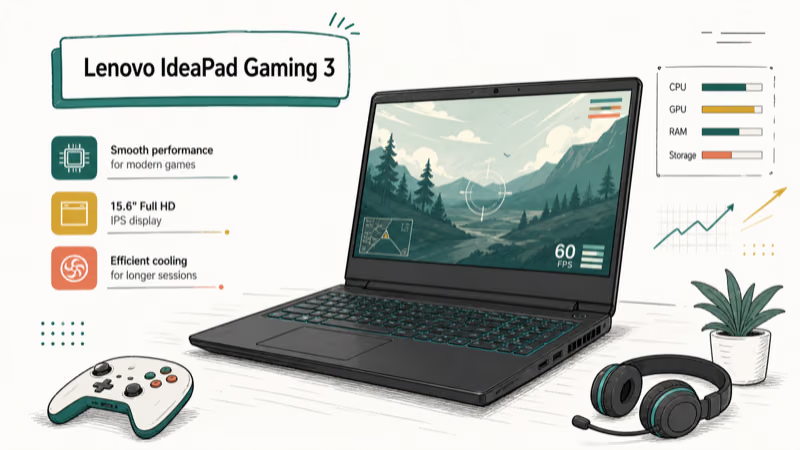
A weak battery or missing original charger changes the real cost immediately. If the seller won’t let you check the serial number or boot into Windows, walk away.
#3. HP Pavilion Gaming: historical context only
HP used the Pavilion Gaming name across different processors, displays, and graphics options. Don’t infer the configuration from the green-accent chassis or a copied retailer title.

Request the full HP product number. Test the hinge, keyboard, webcam, headphone jack, every USB port, and Wi-Fi before treating the machine as usable.
#4. ASUS TUF F15 FX506LH-AS51: used listing only
The FX506LH-AS51 is a specific discontinued TUF F15 configuration. A listing that says only “TUF F15” may describe a different generation, so don’t use photos or family branding as proof of the internals.

Look for stripped bottom screws, cracked vent plastic, and intermittent charging. Those signs often matter more than a clean benchmark screenshot because they reveal how the laptop was opened and handled.
#5. Dell G15 5511: used listing only
Use Dell’s service tag to identify the original configuration and support history before meeting the seller. Then confirm the installed parts in Windows because memory and storage may have changed after purchase.

Check that the BIOS isn’t password-locked. A locked BIOS can prevent boot and security changes, and it’s a poor starting point for a secondhand gaming machine.
#Current Alternatives to Use as a Price Check
Use current manufacturer pages to understand what replaced these old families. They’re comparison points, not promises that a current configuration will cost less than $600.
According to Acer’s current Nitro V 16 AI page, the family is designed for gamers and students, and specifications and availability vary by model and region. Check the exact store configuration rather than transferring any specification from the old Nitro 5.
Lenovo’s current LOQ 15AHP10 page states that the LOQ is a 15-inch AMD gaming laptop. Use the live page to compare warranty, memory, storage, graphics, and final checkout price with the used IdeaPad Gaming 3 in front of you.
Neither official page supports a fixed under-$600 claim. If the current alternative is outside your budget, save the configuration and wait for a sale rather than treating an old marketplace title as equivalent.
#Set a Total Budget, Not Just a Listing Price
Add every immediate cost before deciding whether the old laptop fits a $600 ceiling:
- Replacement charger or battery
- Memory or storage needed on day one
- Shipping, sales tax, and return shipping
- Cleaning or repair work
- The value of a short or missing warranty
A $520 laptop that immediately needs a charger, battery, and SSD can cost more than a better-supported alternative. Don’t price your own repair time at zero.
If the fans are already loud or temperatures spike, use the laptop overheating while gaming checklist before the return window closes. Dust and worn thermal material are fixable; damaged heat pipes and fan headers are a different purchase decision.
#Used-Laptop Inspection Checklist
Privacy law varies by location. Only inspect a laptop you own or test it with explicit authorization from the seller.
Never request or use the seller’s credentials, open personal files, or copy personal data. Ask the seller to remove their accounts before the transfer.
After purchase, follow Microsoft’s Reset your PC guidance to reinstall Windows and remove prior personal files.
Meet in a safe place with power and Wi-Fi, or buy only from a seller with a written return policy. Complete these checks before paying:
- Match the chassis label, BIOS model, and Windows model information
- Generate a Windows battery report and compare full-charge capacity with design capacity
- Check Device Manager for missing hardware and warning icons
- Test the display at low and high brightness on solid black, white, red, green, and blue backgrounds
- Test the keyboard, trackpad, webcam, speakers, microphone, Wi-Fi, Bluetooth, and every port
- Run a game or benchmark long enough for both fans to ramp up
- Check SSD health and confirm the advertised capacity
- Confirm Windows activates after a reset and the BIOS has no unknown password
- Photograph the condition and record the return deadline; keep serial numbers and reports private and only as long as needed for the transaction
According to Microsoft’s Windows battery guidance, powercfg /batteryreport creates an HTML report with battery usage and estimated-capacity details. Use its installed-battery and usage sections to check the seller’s battery claim.
Students should also compare battery and weight against our laptops for computer science and laptops for nursing students guides. A used gaming chassis can meet the frame-rate goal while still being the wrong laptop to carry all day.
#Performance Expectations for GTX 1650 Listings
Treat a GTX 1650 laptop as legacy 1080p hardware. Exact performance depends on the laptop’s power limit, cooling, memory layout, drivers, and the game build, so a desktop GTX 1650 result or a different laptop’s video isn’t proof of what your unit will deliver.
Test the games you actually play during the return window. Record frame rate, temperatures, clock behavior, and fan noise. If you need CAD or BIM for work, a consumer GTX configuration also isn’t a substitute for checking the software vendor’s current requirements; start with our best laptop for Revit guide.
Battery gaming is a poor acceptance test because laptops commonly reduce performance away from the charger. Test once on the correct charger, then test battery runtime separately.
#Bottom Line
Don’t buy the Acer Nitro 5 AN515-55, Lenovo IdeaPad Gaming 3, ASUS TUF F15 FX506LH-AS51, or Dell G15 5511 because an old roundup calls it a 2026 winner. All four are discontinued in our product catalog and belong only in a used or clearance evaluation.
Compare the exact unit with current Acer Nitro V and Lenovo LOQ listings, add the cost of missing parts and repairs, and keep a written return path. If the seller hides the serial number, blocks a full test, or rushes the handoff, skip the deal.
#Frequently Asked Questions
Is the Acer Nitro 5 still the best gaming laptop under $600?
No. The AN515-55 configuration formerly featured here is discontinued, so it isn’t a current 2026 best pick. Evaluate a specific used unit on condition, exact configuration, warranty, and total cost.
Is the Lenovo IdeaPad Gaming 3 still a current model?
The 15.6-inch IdeaPad Gaming 3 configuration formerly linked here is discontinued. Lenovo now uses the LOQ family for this part of its gaming range, but live price and availability depend on the exact configuration.
Should I buy a discontinued gaming laptop on clearance?
Only if the discount compensates for the older hardware, battery age, and shorter support window. Get the exact model number and a return policy before paying; “new in box” doesn’t turn an old configuration into a current one.
How can I check a used gaming laptop’s battery?
Run powercfg /batteryreport in Windows Terminal, then open the generated report and compare full-charge capacity with design capacity. A low figure isn’t automatically fatal, but replacement cost belongs in the total budget.
Can I upgrade the GPU later?
Usually not. The dedicated GPU in these laptops is soldered to the motherboard, so practical upgrades are normally limited to memory and storage.
Is 8GB of RAM enough for a used gaming laptop?
Eight gigabytes may boot older games, but it leaves little room for a browser, voice chat, and modern game assets. Confirm the slot layout and price a move to 16GB before you compare two listings.
What if I need long battery life for class?
Prioritize a lighter productivity laptop if all-day battery life matters more than gaming. Our best laptop for note-taking guide focuses on that trade-off.

Best Laptop for Running LLMs in 2026: Memory Comes First
The best laptop for running LLMs is a memory purchase first. Compare MacBook unified memory against NVIDIA laptop VRAM, and see what each tier really runs.

How to Run a Local LLM on Windows: A 2026 Setup Guide
Run a local LLM on Windows with LM Studio or Ollama. Pick a model that fits your GPU memory, keep every prompt offline, and skip the monthly bill.

Bluetooth Not Working on Snapdragon X? Fixes for 2026
Bluetooth not working on your Snapdragon X Copilot+ PC? Generic audio, mice, and keyboards work, but vendor apps often lack an ARM build. Fixes inside.

Docker Desktop and WSL2 Not Working on Snapdragon X? Fix It
WSL2 runs fine on Snapdragon X, but Docker Desktop ARM is Early Access and throws WSL errors. Use WSL2 plus native ARM64 Ubuntu and Docker Engine.