Games Like Spore: 10 Evolution Sims Worth Playing in 2026
Best games like Spore for 2026. Thrive, Species, No Man's Sky, and 7 more evolution sims, ranked by stage match across Windows and Steam Deck.

Quick AnswerThrive is the closest Spore alternative for evolution fans, while No Man's Sky delivers the space-stage scale Spore promised but never finished.
Games like Spore exist in pieces rather than one tidy package. Spore tried to cover five gameplay stages in one title and ended up thin on every one. The best replacements each nail a single stage. The ten titles below cover Windows and Steam Deck, ranked by which ones still hold up in 2026 and which ones only read well on a store page.
- Thrive is the closest open-source spiritual successor, with nine planned evolutionary stages; only the first two, Microbe and Multicellular, are currently playable.
- No Man’s Sky is the go-to for Spore’s space stage, with more than 30 hours of story and multiplayer sessions of up to 32 players.
- Species: Artificial Life, Real Evolution is an observation-first sim; you set climate and food, then watch clades form over in-game millennia.
- Spore’s five stages each map to a separate genre, so pairing Thrive with Stellaris gets you closer to the full Spore arc than any single title.
- Elysian Eclipse is an upcoming Spore-like from Seven Ducks Studios with seven planned stages, still without a release date as of April 2026.
#What Makes a Game Feel Like Spore in 2026?
Spore’s pull was never its polish. It was the fantasy of one species you built yourself, pushed from tide pool to starship. Three ingredients decide whether a rival sandbox scratches the same itch: a real editor, visible progression across stages, and a gameplay loop per stage you actually want to play.
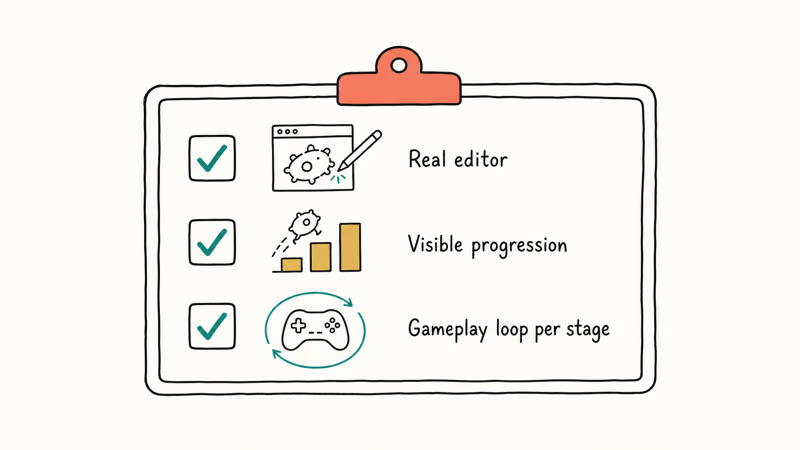
Most “Spore-like” lists skip that third test and mash in any sci-fi sandbox. This list filters harder. The ten games below each win at least one of Spore’s five stages — microbial, creature, tribal, civilization, or space — instead of faking all five.
The Wikipedia entry for Spore (2008 video game) confirms that Maxis designed Spore around exactly these five stages, so scoring replacements against them is not arbitrary.
#Top Evolution Sims Closest to Spore’s Core
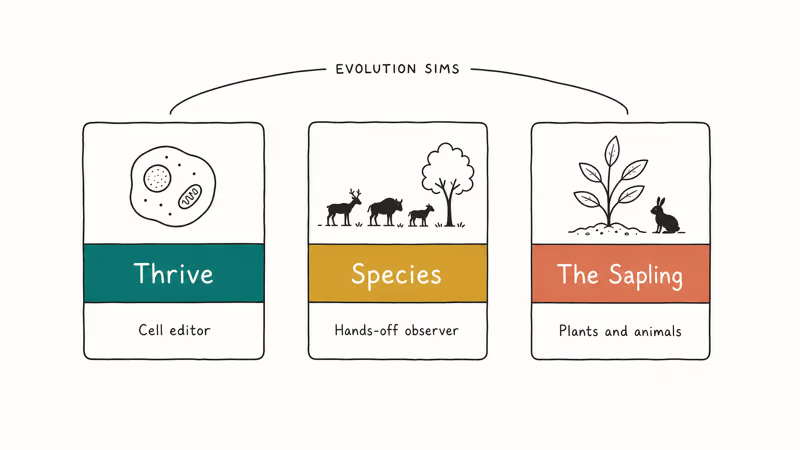
These three pick up where Spore’s microbe and creature stages left off. If you loved building wobbly creatures and watching them eat each other, start here.
#Thrive
Thrive is the most direct Spore successor available. It’s a free, open-source project from the Thrive team with a planned arc that runs Microbe, Multicellular, Macroscopic, Aware, Awakening, Society, Industrial, Space, and Ascension. According to the official Thrive site, 2 of the 9 planned stages are playable today, with Microbe fully complete and Multicellular in progress.
What Thrive does well:
- Cell editor with real organelle trade-offs (ATP cost, osmoregulation, toxin output)
- Ecosystem simulation with competing AI species evolving alongside you
- Permanent free access; optional Steam or Patreon support goes back into development
Thrive runs on the Steam Deck. Expect the same slow, research-paper pacing that Spore’s Cell stage had, minus the cartoon edges.
Download: Thrive Official Website
#Species: Artificial Life, Real Evolution
Species is a hands-off observation sim. It’s the most scientifically honest game on this list. You set climate, food, and terrain, drop in a founder species, then step back while mutation and selection do the work. The Steam page for Species states that the game launched into Early Access on September 28, 2018 at $19.99, with a Mostly Positive review profile.
Drop a single herbivore founder into a savanna biome and the population branches into distinct body plans over in-game millennia: a smaller, faster runner, a larger grazer, and climbing variants that die out if the tree cover shrinks. That kind of visible divergence is what the Spore creature editor hinted at but never actually delivered.
Download: Species on Steam
#The Sapling
The Sapling goes wide where Spore went shallow. You design plants, animals, and entire ecosystems, then let procedural planets run them. Based on the developer’s Steam page, The Sapling is a solo project from Wessel Stoop, released December 12, 2019 at $17.99. The store page shows it sits at 89% positive across roughly 1,792 reviews.
Highlights worth knowing:
- Plant design with root depth, photosynthesis type, and seed dispersal rules
- Animal design tied to diet, reproduction mode, and social behaviour
- Sandbox mode with real-time ecosystem tuning (weather, seasons, continents)
There is no space stage here. If you loved Spore for terrestrial life design, Sapling is the sharpest tool on the market.
Download: The Sapling on Steam
#Best Picks for Spore’s Space Stage
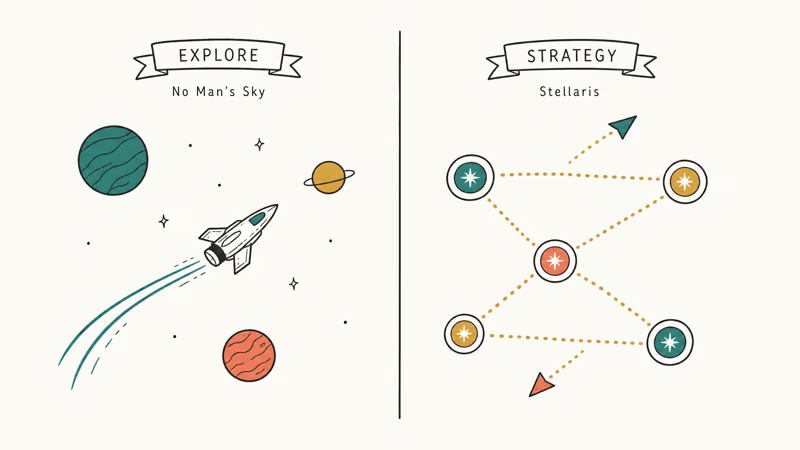
Spore’s space stage was the one a lot of players actually finished, even though it shipped under-cooked. Two modern titles split that ambition. One for exploration, one for galactic strategy.
#No Man’s Sky
No Man’s Sky is what Spore’s space stage should have been. Hello Games kept shipping free updates for nearly a decade. The No Man’s Sky official site states that the game has more than 30 hours of story and supports multiplayer sessions of up to 32 players. The universe is procedurally generated, so each planet, plant, and alien you log is new to the database when you find it.
No Man’s Sky runs on the Steam Deck. For the Spore “build a ship, explore, tag life, trade” loop, this is the closest match available in 2026.
For players who like this style of wide-open fantasy world instead, our list of games like Skyrim covers single-player open-world RPGs that run on a similar time budget.
Download: No Man’s Sky Official Website
#Stellaris
Stellaris is the strategy sibling to Spore’s space stage. Paradox Interactive’s Steam page lists Stellaris as a Paradox Development Studio title released May 9, 2016, with thousands of randomly generated planet types and a strong customization layer for species traits and ethics. A custom species like a fungoid hive-mind still has a deep late game hundreds of hours in.
Pair Thrive’s cell and creature work with a Stellaris campaign and you get closer to the complete Spore arc than any single title on this list.
Download: Stellaris on Steam
#Other Games That Feel Like Spore Without Being Spore
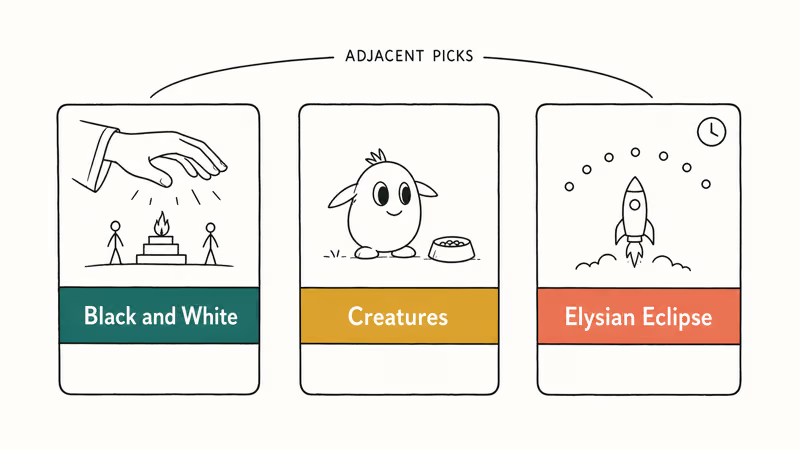
Three more titles cover the middle stages Spore tried to blend: tribal, civilization, and god-game management.
#Black and White
Black and White is the god game Spore borrowed its tribal-stage hand from. You shape belief, feed a creature companion, and swat the terrain to bully villagers into worship. The Steam re-release on the Black and White Steam page is the simplest way to run it on modern hardware.
If you want more divine-power action than strategy, our games like God of War list pairs better with a combat appetite.
#Creatures (The Albian Years)
The original Creatures series was teaching digital pets to learn before anyone else tried. GOG’s Creatures: The Albian Years bundle runs on modern Windows and keeps the Norn-breeding loop intact. The genetic model is crude by today’s standards, but the fact that your Norn will learn to fear a grendel you never scripted is still impressive.
Download: Creatures on GOG
#Elysian Eclipse
Elysian Eclipse is the “Spore 2” that’s still on the horizon. According to the Elysian Eclipse Steam page, the game is in development at Seven Ducks Studios with 7 planned stages: Cell, Aquatic, Creature, Tribal, Medieval, Industrial, and Space. No release date has been set as of April 2026.
There is nothing playable yet. Wishlist and wait. If the editors ship in the state the demos show, this could push Thrive for the spiritual-successor crown.
Download: Elysian Eclipse on Steam
#Spore Stages Mapped to Genre Equivalents
Spore’s five stages are worth treating as five different games. Here is how they pair with a matching genre pick.
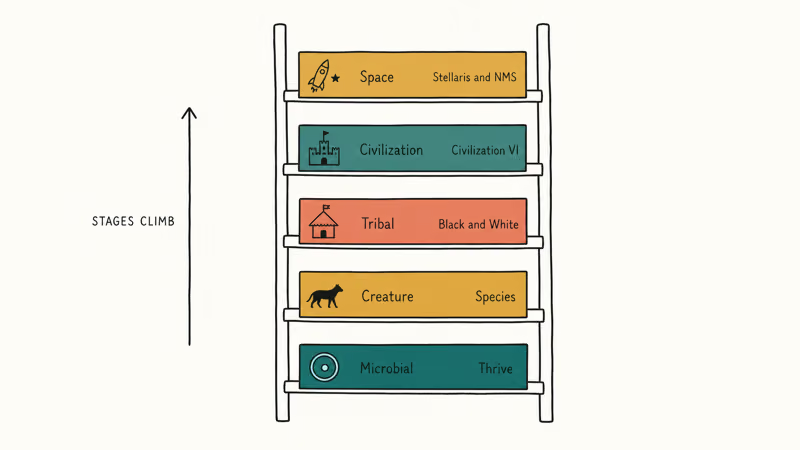
- Microbial stage: Thrive’s Microbe mode is the strict match. flOw is the gentler, zen-mode alternative.
- Creature stage: Species or The Sapling. Early-game MMOs like games like World of Warcraft also scratch the “grow and evolve a character” itch if you prefer progression via gear.
- Tribal stage: Populous or Black and White. Both are village god games that reward reading the terrain.
- Civilization stage: Sid Meier’s Civilization VI is the obvious pick. For players who want richer narrative layered on strategy, games like Baldur’s Gate offer that RPG-on-a-map flavour.
- Space stage: Stellaris for strategy depth, No Man’s Sky for exploration. Pick by whether you want spreadsheets or screenshots.
#Where Is the Evolution Game Genre Heading Next?
The next wave of Spore-likes is leaning on community development and scientific rigour instead of publisher budgets. Thrive’s open-source model shows a small team can keep shipping for a decade on Patreon. Species and Sapling are both solo or micro-team projects that outlasted their Kickstarter-era rivals because they narrowed scope. Community forums cluster around Discord servers and subreddits rather than publisher-run fan sites, which is a healthy sign for the genre.

Three bets we are watching for the 2026-2027 window:
- VR creature editors from small studios that treat Spore’s cell-stage as a proof of concept, not a throwback
- Biology-accurate campaigns adopted by schools, following the educational push the Thrive team has signalled
- Modded offshoots of big sandboxes like RimWorld or Stellaris that bolt on Spore-style species design
For a different kind of narrative branching that rewards the same pattern-spotting muscle, games like Danganronpa is a good palate cleanser between evolution sessions.
#Bottom Line
Install Thrive first if you miss Spore’s early stages. Install No Man’s Sky if you miss the space stage. Keep Species and The Sapling on your wishlist for the long, quiet evenings when you want to tweak a climate and watch ten million years tick past. Elysian Eclipse is worth wishlisting but not worth waiting for with your calendar held hostage.
If you like darker, atmosphere-heavy worlds more than sandbox design, our gothic games list is a better fit for your next slot.
#Frequently Asked Questions
Is Spore still worth playing in 2026?
Yes, if you want the editors. Spore sells on Steam and GOG, and the creature and vehicle editors are still the best-feeling toys in the genre. The campaign feels thin once you push past the Creature stage, so most returning players finish it in a weekend. After that the natural next move is Thrive for the simulation depth, or Stellaris if you want the space stage to have real consequences.
What is the best free alternative to Spore?
Thrive, no contest.
Does No Man’s Sky really feel like Spore’s space stage?
Yes. You warp between systems, scan planets, tag lifeforms, trade, and build bases. That’s the Spore space-stage loop. The combat is sharper and the procedural life is more varied than Spore ever managed, especially after the updates through 2024 and 2025.
Can you play these Spore alternatives on Steam Deck?
Thrive, No Man’s Sky, and Stellaris all run on the Steam Deck. Species and The Sapling technically launch, but the dense UI and small text wreck readability on the Deck’s 7-inch screen, so a desktop monitor suits them better where the clade diagrams and ecosystem panels have room to breathe. Elysian Eclipse has no Deck verification yet because the game is still in development.
How many stages does Thrive actually have playable?
Thrive has 9 planned stages. Only Microbe is fully playable, with Multicellular partially working; the remaining 7 stages, including Space and Ascension, are still in design and programming.
Is there a mobile game like Spore?
Not a first-party one. Evolution and Life Simulator clones on Android and iOS mimic the idle genre rather than Spore’s editors, so the feel is closer to incremental clickers than the Spore creature stage. If you want a phone-sized creature-breeder, Creatures remasters and Tamagotchi-style apps get closer than anything marketed as a Spore-like on the app stores today.
What’s the difference between Thrive and Species?
Thrive is a playable progression from microbe to civilization, where you control and evolve your species directly through each editor. Species is an observation simulator where you set the starting conditions and watch evolution run on its own, with no direct control over individual organisms. Thrive is closer to Spore in spirit; Species is closer to a biology lab.
Will Elysian Eclipse actually release?
Seven Ducks Studios has not announced a release date as of April 2026, and indie Spore-likes have a shaky track record for shipping on schedule.

Fortnite Stuck on the Loading Screen? Fix It in 2026
Fortnite stuck on the loading screen? Check server status, fix the Windows N Media Pack and DirectX 11 on PC, clear the console cache, and verify files.
Minecraft Keeps Crashing? Java and Bedrock Fixes (2026)
Minecraft keeps crashing on startup or mid-game? Update your GPU driver, remove mods on Java, and reinstall Gaming Services on Bedrock. Fixes for both.

Pokemon GO Not Loading? Fix the Loading Screen 2026
Pokemon GO not loading or stuck on the Pokeball? Check server status, fix automatic date and time, grant location permission, clear the cache, and update.

PS5 Controller Not Charging? 9 Fixes That Work (2026)
DualSense not charging? Swap the cable, use a rear port in Rest Mode, clean the USB-C port, and check power settings. 9 fixes for a dead PS5 controller.