eBay vs. Poshmark: Which Platform Should You Use in 2026?
eBay vs. Poshmark compared by fees, shipping, audience, and ease of use. Find out which platform fits your selling style and what each one does best.
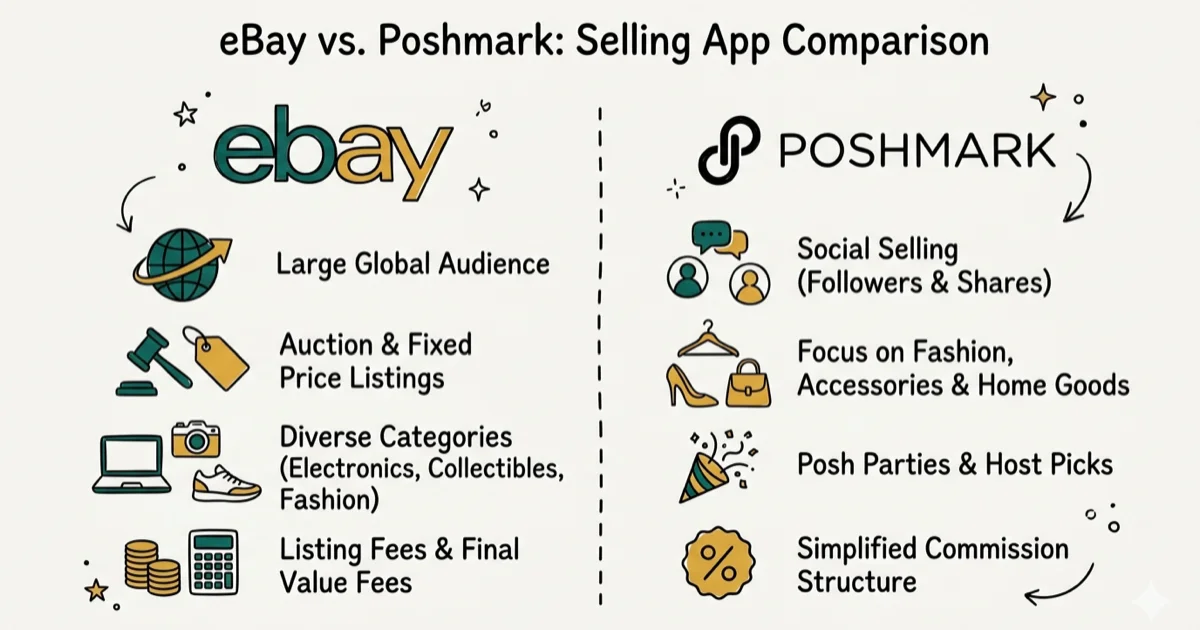
Quick AnswerUse eBay if you sell a variety of items or want global buyers. Use Poshmark if you sell fashion items and want a social, community-focused platform with built-in shipping labels. eBay charges 13% total fees; Poshmark charges 20% for items over $15.
Choosing between eBay and Poshmark depends on what you’re selling and how much time you want to spend. This comparison breaks down the two platforms by fees, listing time, shipping, audience, and return policies so you can see which one fits your selling style.
- eBay charges 10-13% in fees; Poshmark charges $2.95 flat under $15 and 20% above that
- Poshmark provides a prepaid USPS label with every sale; eBay requires you to handle shipping yourself
- eBay has a global buyer base in the tens of millions; Poshmark focuses on US fashion shoppers
- Poshmark listings are unlimited and free; eBay gives 250 free monthly then charges $0.35 each
- Poshmark’s no-return policy is strictly enforced; eBay’s can be overridden through buyer protection
Both platforms have different strengths. Poshmark excels at fashion in the US market, while eBay dominates for breadth and international reach. Our roundup of sites like Mercari and our ThredUp vs. Poshmark breakdown cover other resale options if you want to broaden the comparison.
#Fee Structure: eBay vs. Poshmark
Fees are the first thing most sellers check, and the difference is significant depending on your sale price.
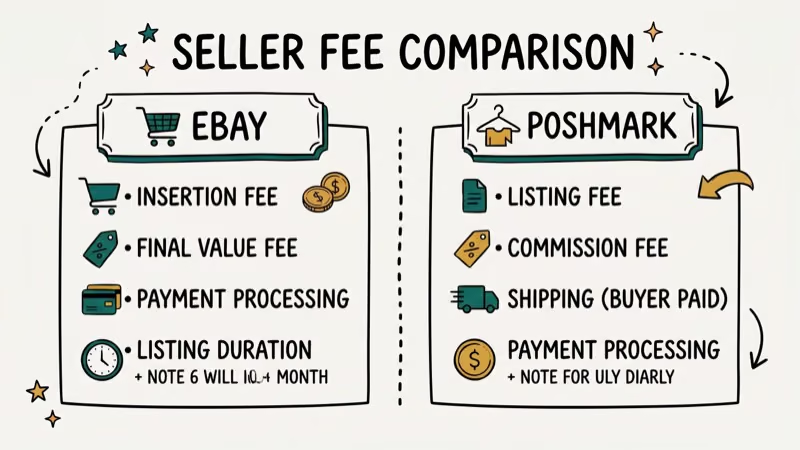
Poshmark fees: A flat $2.95 for sales under $15. For sales at $15 or above, Poshmark takes 20% and you keep 80%. According to Poshmark’s official fee schedule, these rates haven’t changed since the platform launched its current structure.
eBay fees: A 12.9% final value fee on most categories (capped at $750), plus $0.30 per order. eBay’s fee schedule page confirms that fashion categories have a lower 15% rate cap. For a mid-priced item at the same sale price, Poshmark’s 20% cut takes noticeably more than eBay’s roughly 13%.
For lower-priced items under $15, Poshmark’s flat $2.95 often beats eBay’s percentage-based fee. Above $30, eBay is almost always cheaper.
#Which Platform Is Easier for Beginners?
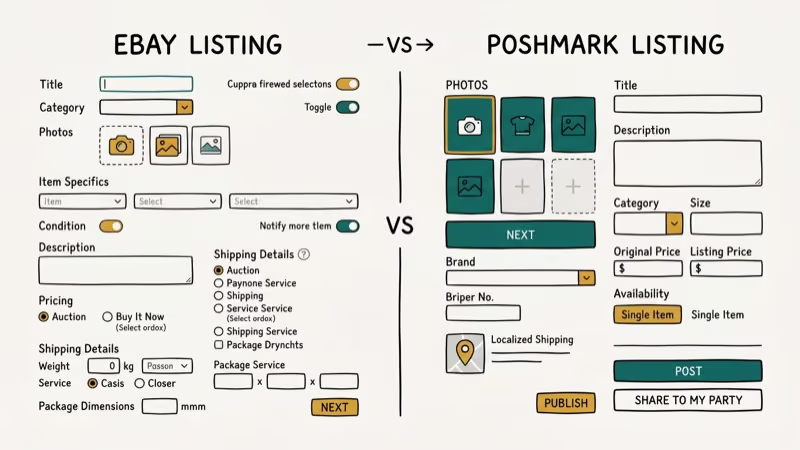
Poshmark is generally more beginner-friendly. Listing takes about 3 minutes using the mobile app: snap photos, write a description, set a price, and you’re done. The shipping label is provided automatically when a sale happens.
eBay listing takes 5 to 10 minutes because you choose shipping options, set return policies, and pick a listing format (auction or fixed price). Across the same kind of listing, Poshmark’s streamlined flow is noticeably faster than eBay’s.
eBay’s broader category structure makes the extra setup time worth it for non-fashion items. See the Mercari vs. Poshmark comparison if you’re exploring other options.
#Shipping Protocols
Poshmark: Provides a prepaid USPS Priority Mail label with every sale. You print it, package the item, and drop it at any post office or USPS mailbox. No weight calculations, no carrier decisions.
eBay: Offers full flexibility, which is more complex. You choose the carrier (USPS, UPS, FedEx), set the shipping price (free or paid), and decide whether you absorb the cost. For a heavier item, a cheaper option like USPS Parcel Select can come in under Poshmark’s flat Priority Mail label, which protects more of your final profit.
For high-value or heavy items, eBay’s shipping flexibility saves money. For quick, simple transactions, Poshmark’s fixed approach removes all friction.
#Audience and Category Scope
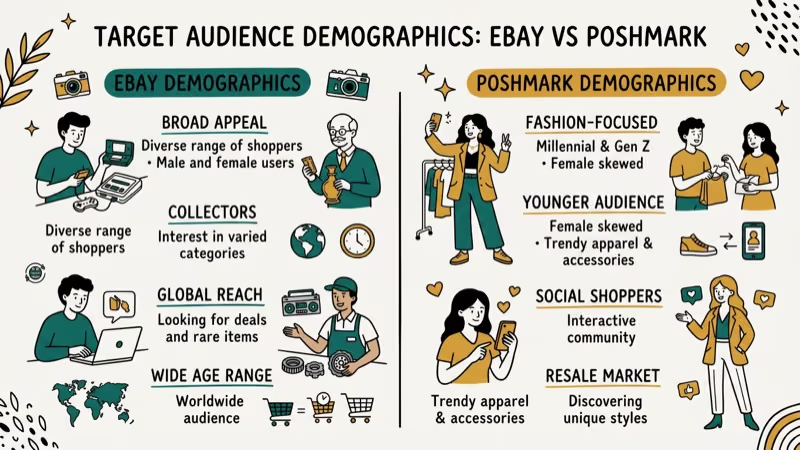
eBay has a global buyer base in the tens of millions and operates in markets worldwide, as its investor relations page details. Wikipedia’s eBay article confirms that the platform handles virtually every category: electronics, collectibles, automotive parts, fashion, and more.
Poshmark focuses on fashion, including clothing, shoes, accessories, and home goods. Its community is primarily women aged 18 to 35 in the US, and its social features (following, sharing, “Posh Parties”) are designed specifically for fashion discovery. Poshmark reports that the top-selling categories are women’s clothing and handbags.
For a used laptop, eBay is correct. For a designer handbag, Poshmark’s fashion audience converts faster, so fashion items often sell quicker there than on eBay, a meaningful difference when cash flow matters.
#Return Policies
Poshmark: No returns accepted by default unless the item is misrepresented. Buyers have 3 days after delivery to file a case. No case filed means the sale is final, automatically. This structure protects sellers from buyer’s remorse returns more effectively than eBay’s policy does.
eBay: Sellers can set their own return policy, but eBay’s buyer protection can override it. Even if you list “no returns,” buyers can open a case through eBay’s Money Back Guarantee and often win. According to eBay’s buyer protection policy, buyers have 30 days from delivery to return items.
If protecting yourself from returns is a priority, Poshmark’s enforced no-return policy gives sellers more control.
#Customer Support
Poshmark: Email-based support, typically responding within 24 to 48 hours. No phone support.
eBay: Phone support available for urgent issues, plus chat and email. Response time for phone is typically under 10 minutes during business hours. For sellers with high-volume disputes, eBay’s live support is a meaningful advantage.
#Which Platform Should You Choose?
Choose eBay if:
- You sell a mix of categories beyond fashion
- You want international buyers
- You’re selling items over $30 (lower fees)
- You want flexible shipping options
Choose Poshmark if:
- You sell fashion, shoes, or accessories
- You’re a beginner who wants a simple selling process
- You want community features and social discovery
- You prefer fixed, predictable shipping
Many sellers list on both platforms simultaneously. The same item gets exposure to different buyer pools, and the incremental effort is minimal once you’ve built the listing habit. See also how to cancel a Poshmark order and how to delete your Poshmark account if you want to manage your presence on the platform.
#Bottom Line
For fashion sellers in the US, Poshmark offers a cleaner experience and stronger community, despite the higher 20% fee. For anything outside fashion, or if you want international buyers and lower fees on higher-priced items, eBay wins. The fee difference is real: on a $45 sale, Poshmark costs $9 versus eBay’s $6.16, a gap that compounds across many transactions. Run your own math before committing to one platform.
#Frequently Asked Questions
Is Poshmark or eBay better for beginners?
Poshmark is better for absolute beginners. The listing process takes about 3 minutes, shipping is handled with a prepaid label, and the community helps new sellers get visibility through shares and Posh Parties. eBay requires more setup decisions but offers more flexibility for experienced sellers.
What are Poshmark’s fees compared to eBay’s?
Poshmark charges a flat $2.95 for sales under $15 and 20% for sales at or above $15. eBay charges approximately 12.9% plus $0.30 per transaction, with category-specific rates. For items priced above $30, eBay is almost always cheaper for the seller.
Can I sell anything on Poshmark?
No. Poshmark is limited to fashion, home goods, and beauty. Electronics, vehicles, and most non-fashion items belong on eBay.
How does shipping work on each platform?
Poshmark provides a prepaid USPS Priority Mail label automatically when you make a sale. eBay lets you choose your carrier, set shipping prices, and offer free or paid shipping — more control but more decisions.
Which platform pays out faster?
Both are similar. Poshmark releases funds 3 days after delivery. eBay releases within 2 business days. Neither is significantly faster for typical sellers.
Are there platforms similar to eBay and Poshmark?
Yes. Mercari offers a 10% selling fee and accepts a wide range of categories similar to eBay, making it a useful eBay alternative for low-priced household items, used electronics, and casual home goods that don’t fit Poshmark’s fashion niche but feel too small for an eBay auction listing.
Depop is fashion-focused like Poshmark but skews toward vintage and streetwear, with a younger Gen Z audience. Our roundup of sites like Poshmark also covers ThredUp and Vestiaire Collective for higher-end fashion.
Can I sell on both platforms at the same time?
Yes, and many sellers do. The main challenge is inventory management: you must remove a listing quickly once it sells on one platform to avoid double-selling and negative feedback. Most sellers who cross-list use a spreadsheet or a multi-channel tool like List Perfectly to stay organized.
Google Messages Error 3100: Why RCS Is Broken on Galaxy
Google Messages RCS error 3100 hits Galaxy owners after phone or carrier switches. Google told 9to5Google a fix is coming. Here's what actually helps.

Is This Bank App Real? Spot a Fake App on Your Home Screen
A bank app can land on your home screen from a web page with no install warning. Learn the checks that tell a real banking app from a phishing web app.
Apps Crashing After iOS 27 Update? Fix Order (2026)
Apps crashing after the iOS 27 update? Update the app in the App Store first, then offload and reinstall to clear stale cache, then restart. The fix order.
Do AI Translation Earbuds Work Offline? What to Know
Do AI translation earbuds work offline? A few do with downloaded language packs, but most need the cloud. Here's what works offline and what you give up.