How to Combine GIFs Online and on Desktop (5 Free Tools)
Combine GIFs online for free using EZGIF, Kapwing, and VEED.IO. Step-by-step instructions for merging GIFs sequentially or side by side with tips.
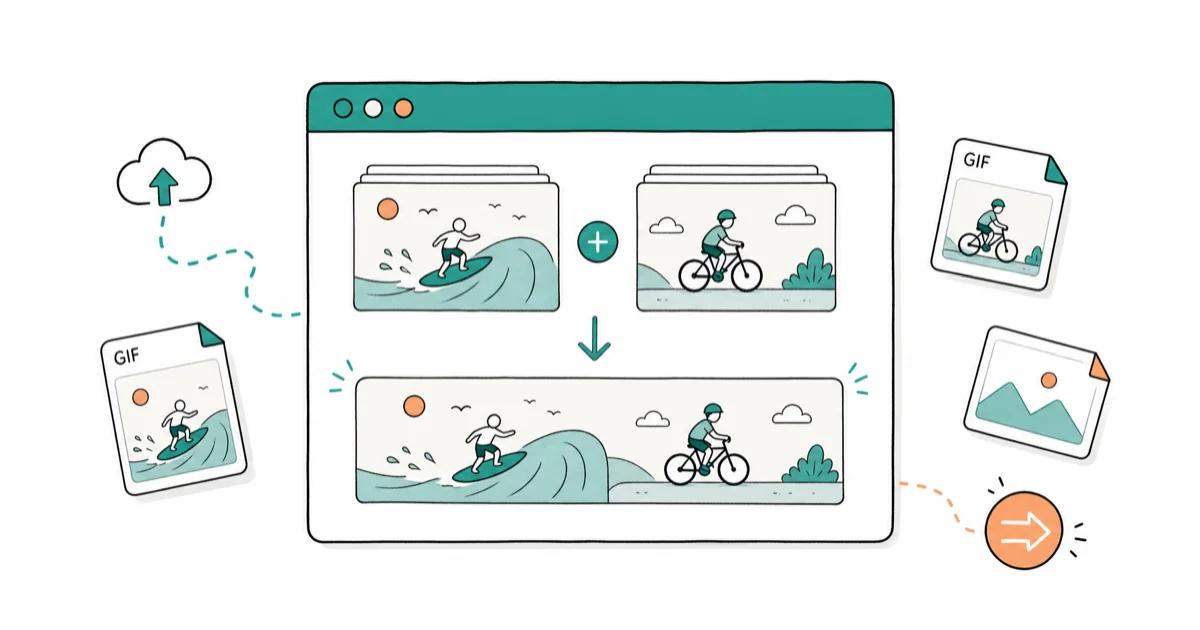
Quick AnswerYou can combine GIFs using free online tools like EZGIF or Kapwing. Simply upload your GIF files, arrange them sequentially or side by side, adjust frame delays if needed, and export the merged animation.
GIF animations are everywhere online, and combining multiple GIFs into a single file is easier than most people realize. The tools below cover common merge needs, from quick sequential joins to timeline-based edits with captions, layouts, and export controls.
- EZGIF is the best free online tool for combining GIFs, offering frame arrangement, adjustable delays, and no registration required.
- Kapwing provides a timeline-based interface with options to add text, effects, and audio before exporting as GIF or MP4.
- Adobe Photoshop’s Timeline panel gives frame-level control for combining GIFs but requires more technical skill than online tools.
- Keep final combined GIF files under 5MB for fast loading on most platforms without sacrificing noticeable quality.
- Match the frame rates and color palettes of source GIFs before combining to avoid jarring visual inconsistencies in the output.
#What Is GIF Combining and Why Do It?
GIF combining, also known as GIF merging, takes multiple animated GIF files and joins them into a single animation. This technique lets creators tell more complex stories, create longer animations, and juxtapose different scenes side by side.
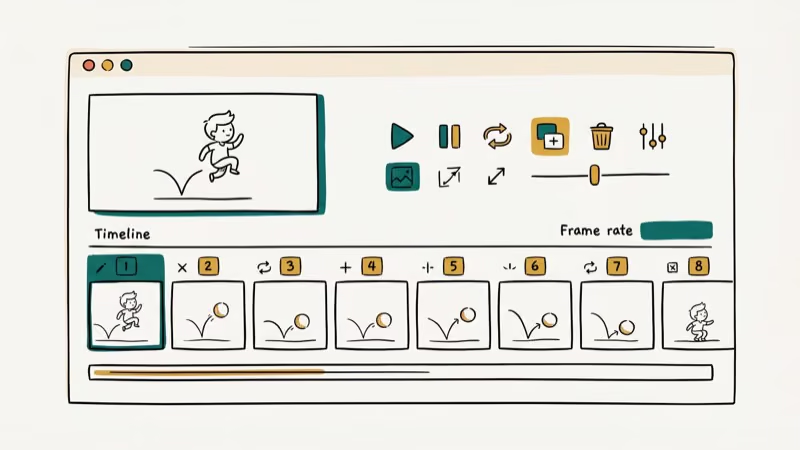
EZGIF is a strong choice for clean sequential output, while Kapwing handles side-by-side layouts well thanks to its timeline interface. According to Wikipedia, the GIF format was developed at CompuServe in 1987 and supports up to 256 colors per frame, which is exactly why combining GIFs that use mismatched palettes often produces banding artifacts unless you normalize the palette first. See Wikipedia’s GIF entry for the full format specification and color-table mechanics.
#Which Online GIF Combiner Tools Work Best?
Several browser-based combiners cover most everyday merges without forcing you to install desktop software.
#1. EZGIF
Best for sequential merges. EZGIF is a free online tool that specializes in GIF editing and combining. It supports quick browser-based combines with no watermark and no account prompt. Key features include:
- Adjustable frame delays
- Option to rearrange frames
- Additional tools for cutting and optimizing GIFs
#2. Kapwing
Best for timeline editing. Kapwing handles text overlays, audio tracks, and frame-by-frame trims inside a browser tab:
- A timeline interface for arranging GIFs
- Options to add text, effects, and even audio
- Ability to export as GIF or MP4 format
#3. VEED.IO
Best for converting GIFs to MP4. VEED.IO is a comprehensive video and GIF editor that excels at side-by-side layouts and exports to MP4 when you want smaller files than GIF allows. The free tier adds a small watermark, but the editor itself is generous enough to upload several short clips without sign-up, then arrange them on the timeline before exporting:
- Easy uploading and arranging of multiple GIFs
- Advanced editing tools for trimming and effects
- Option to add audio and create video from GIFs
#4. Flixier
Best for social sharing. Flixier merges GIFs with transitions and pushes results to social platforms:
- Support for transitions between GIFs
- Tools for adding sound effects
- Easy sharing to social media platforms
#5. Online Video Cutter
Best for batch merges. For a no-frills option, Online Video Cutter handles up to 10 GIFs at once through a simple drag-and-drop interface with no registration required:
- Combine up to 10 GIFs at once
- Simple drag-and-drop interface
- No registration required
#Step-by-Step Guide to Combining GIFs
Now that we’ve covered the available tools, let’s walk through the general process of combining GIFs:
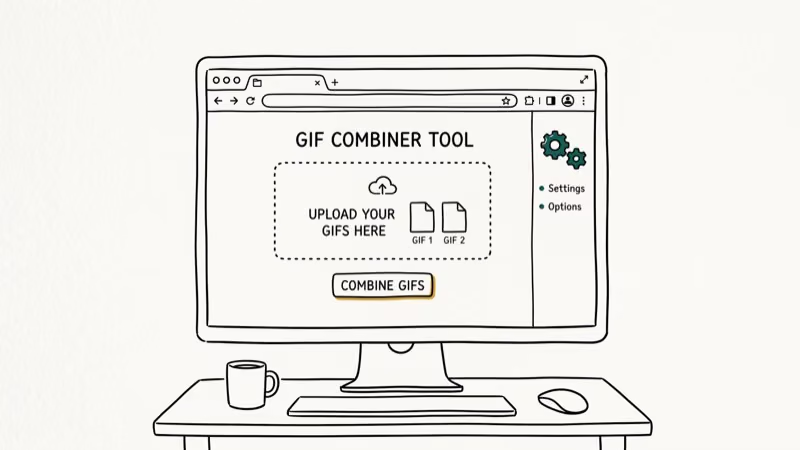
- Choose your tool: Select one of the online GIF combiners mentioned above based on your needs and preferences.
- Upload your GIFs: Most tools allow you to drag and drop your GIF files directly into the browser window. Alternatively, you can use the “Upload” button to select files from your device.
- Arrange and edit: Once your GIFs are uploaded, arrange them in the desired order. Many tools offer a timeline or storyboard view for easy organization.
- Add effects and transitions (optional): Depending on the tool you’re using, you may have options to add text, adjust timing, or apply transitions between GIFs.
- Preview your creation: Before finalizing, make sure to preview your combined GIF to ensure smooth playback and desired effect.
- Export and download: Once you’re satisfied with your creation, export the combined GIF. Pay attention to file size and quality options to optimize for your intended use.
#Advanced Techniques for Combining GIFs
For those who need more control, desktop tools and Photoshop offer frame-level precision that browser tools can’t easily match, especially for tight timing tweaks.
#Using Photoshop to Combine GIFs
Adobe Photoshop gives frame-level control that browser tools simply can’t match once your merges get complex. According to Wikipedia’s Photoshop entry, the Timeline panel handles frame-by-frame animation, supports animated GIF export, and includes onion-skinning so you can preview neighbouring frames while adjusting delays. Power users typically import each source GIF as a separate Smart Object, then sequence the layers manually on the Timeline before tweaking per-frame delays. To combine GIFs in Photoshop:
- Open your first GIF in Photoshop
- Import additional GIFs as separate layers
- Use the Timeline panel to arrange frames
- Adjust timing and transitions as needed
- Export as an animated GIF
If you’re working with RAW image files and need to convert them before creating GIFs, check this guide on converting RAW to JPEG.
#Adding Text and Captions
Text overlays make combined GIFs more shareable. Common uses include:
- Adding context or explanations
- Creating memes
- Emphasizing key moments in the animation
When adding text, ensure it’s legible and doesn’t distract from the main content of the GIF.
#Adjusting Timing and Frame Rates
Fine-tuning timing matters most when source GIFs were exported at different frame rates. The GIF spec stores delay in 1/100-second units, and Wikipedia’s LZW article states that LZW compression operates losslessly, so timing tweaks don’t introduce extra encoding artifacts. Consider:
- Matching frame rates between different GIFs for smoother transitions
- Adjusting the duration of specific frames to emphasize certain moments
- Using loop counts to control how many times the GIF plays before stopping
#Tips for Creating High-Quality Combined GIFs
To ensure your merged GIFs look their best, keep these tips in mind:
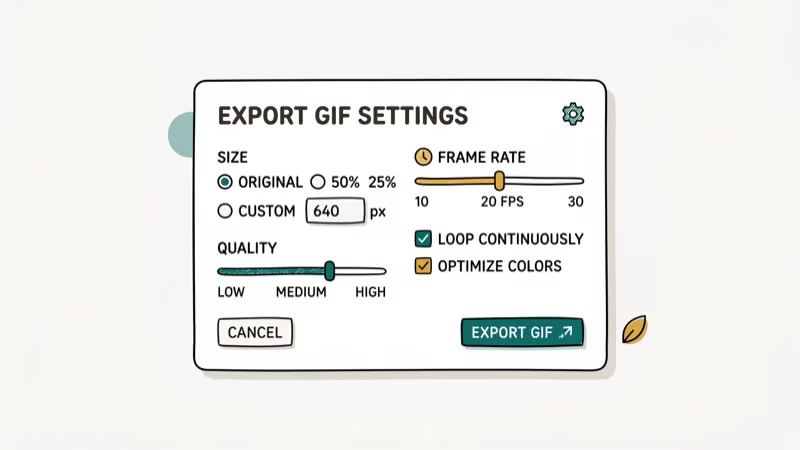
- Optimize file sizes: Large GIFs can be slow to load. Aim to keep your final file under 5MB for optimal performance on most platforms.
- Maintain visual consistency: When combining GIFs from different sources, try to match color palettes and visual styles for a cohesive look.
- Consider aspect ratios: Choose GIFs with similar dimensions to avoid awkward cropping or resizing.
- Test across devices: Preview your combined GIF on different screens and devices to ensure it looks good everywhere.
- Use compression wisely: While compressing your GIF can reduce file size, be careful not to sacrifice too much quality in the process.
Corrupted source clips break GIF exports too. If your source video misbehaves, this article on MP4 video repair tools covers recovery workflows that salvage frames before you re-encode them into a merged animation.
#Creative Applications of Combined GIFs
Once you’ve mastered the art of combining GIFs, you can explore various creative applications:
- Multi-screen presentations: Similar to how you can put multiple videos on one screen in iMovie, you can create GIFs that show multiple scenes simultaneously.
- Before and after comparisons: Combine GIFs to show transformations or progress over time.
- Storytelling sequences: Create a narrative by combining GIFs that represent different parts of a story.
- Reaction compilations: Merge multiple reaction GIFs to express complex emotions or responses.
If you want quick adjustments to your output, the GIF cropper tool guide walks through trimming the canvas after a merge. Speed mismatches between clips are another common issue, and the GIF speed changer guide explains how to normalize playback before re-exporting.
#Bottom Line
EZGIF is the best starting point for combining GIFs because it’s free, needs no sign-up, and handles most common use cases in under 30 seconds. Use Kapwing when you need to add text or sync multiple animations on a timeline. For frame-by-frame control, Photoshop’s Timeline panel remains the most precise option. Keep your final output under 5MB by matching frame rates and running EZGIF’s optimization step after combining.
#Frequently Asked Questions
How many GIFs can I combine at once?
This depends on the tool. EZGIF accepts hundreds of frames per combined GIF in its merger, while Kapwing imposes a project-wide upload cap measured in hundreds of megabytes per workspace. Combining more than five or six large GIFs usually pushes the output past the 10 MB mark, which loads slowly on mobile data and bumps against several common CDN size limits.
Can I combine GIFs of different sizes?
Yes, most tools allow it. EZGIF scales the smaller GIF to match the larger one by default, so matching aspect ratios first gives the cleanest result.
Is it possible to add music to a combined GIF?
GIFs don’t support audio as a format. VEED.IO and Kapwing let you add music and export the result as an MP4 video file. This is often a better choice anyway since MP4 at similar quality is about 5 times smaller than an equivalent GIF.
Are there copyright issues when combining GIFs?
Yes, and it’s the area that trips up creators the most often. GIFs sourced from movies, TV shows, music videos, or other copyrighted footage carry the same restrictions as the originals, and reusing them commercially without permission can trigger DMCA takedowns on most platforms within hours. Use GIFs you’ve created yourself or those released under Creative Commons licenses whenever possible. Giphy’s content policy states that any GIF using copyrighted footage requires permission from the rights holder before redistribution at scale.
Can I combine GIFs on my phone?
Yes. EZGIF, Kapwing, and VEED.IO all run in mobile browsers without app installs.
Why does my combined GIF look choppy?
Mismatched frame rates between source GIFs cause choppy playback. Check each source GIF’s frame delay in EZGIF’s editor before combining. Set all frames to the same delay value, typically 8-10 ms for smooth 25fps playback, to eliminate the jitter. A short test export at low resolution helps confirm the timing before you commit to the final render.
Google Messages Error 3100: Why RCS Is Broken on Galaxy
Google Messages RCS error 3100 hits Galaxy owners after phone or carrier switches. Google told 9to5Google a fix is coming. Here's what actually helps.

Is This Bank App Real? Spot a Fake App on Your Home Screen
A bank app can land on your home screen from a web page with no install warning. Learn the checks that tell a real banking app from a phishing web app.
Apps Crashing After iOS 27 Update? Fix Order (2026)
Apps crashing after the iOS 27 update? Update the app in the App Store first, then offload and reinstall to clear stale cache, then restart. The fix order.
Do AI Translation Earbuds Work Offline? What to Know
Do AI translation earbuds work offline? A few do with downloaded language packs, but most need the cloud. Here's what works offline and what you give up.