How to Open MOD Files on Mac: 4 Methods That Work (2026)
Open MOD camcorder files on Mac in three steps: rename to .mpg, drop into VLC, or convert with HandBrake. Works on macOS Sonoma and Sequoia.
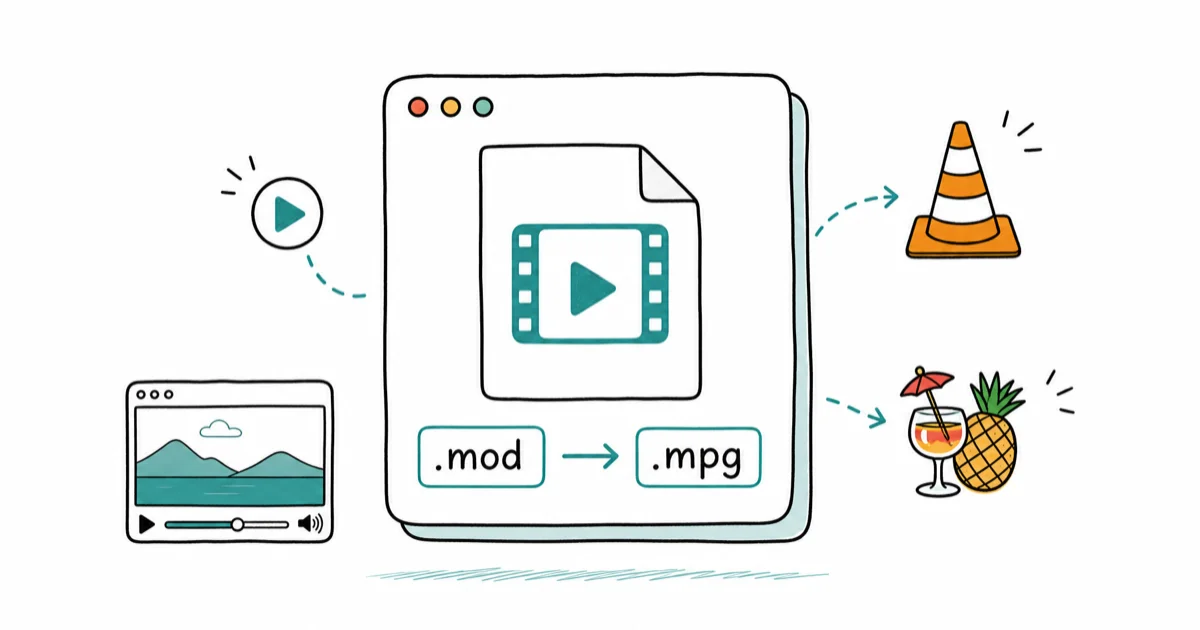
Quick AnswerTo open MOD files on Mac, rename the .mod extension to .mpg in Finder and open with VLC, or convert with HandBrake to MP4 for editing in iMovie. Both methods preserve the original MPEG-2 video data.
Opening MOD files on Mac fails the moment you double-click them in QuickTime. JVC, Panasonic, and Canon camcorders save standard-definition footage as MPEG-2 inside a .mod wrapper, and macOS doesn’t register that extension as video. Two fixes get you watching in under a minute: rename the file or hand it to VLC. For editing in iMovie or Final Cut Pro, you’ll convert to MP4 with HandBrake or FFmpeg.
- MOD files store MPEG-2 video from JVC Everio, Panasonic SDR, and Canon FS-series camcorders, and macOS QuickTime can’t decode them without third-party help.
- Renaming a .mod file to .mpg in Finder is non-destructive, takes five seconds, and lets VLC, Elmedia, and Movist Pro open it instantly.
- VLC 3.0 plays unrenamed .mod files natively on Apple Silicon and Intel Macs, with no codec packs or conversion required.
- HandBrake converts .mod to H.264 MP4 in roughly 90 seconds for a 5-minute SD clip on an M2 MacBook Air, and the output drops into iMovie cleanly.
- FFmpeg stream-copies .mod to .mpg in under 10 seconds without re-encoding, preserving the original MPEG-2 quality bit for bit.
#Why Won’t Mac Open MOD Files Natively?
The .mod extension was Apple’s choice not to support. macOS treats it as a generic data file because Spotlight and Launch Services have no entry mapping .mod to a video MIME type.
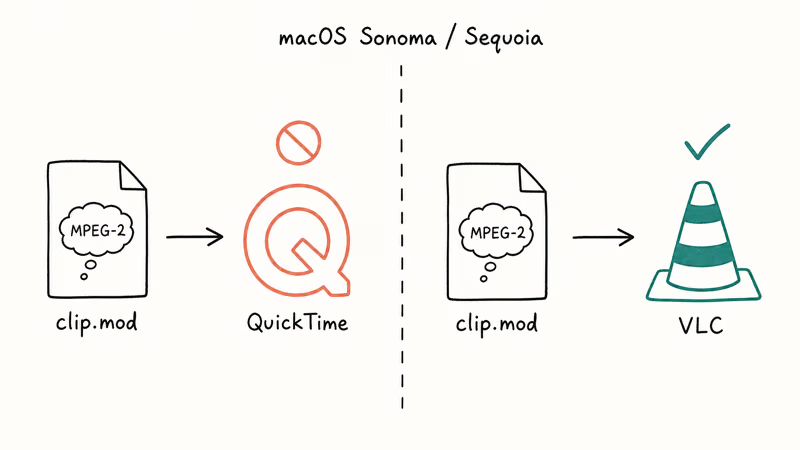
The file inside is plain MPEG-2 program-stream video. QuickTime once played it through the MPEG-2 Playback Component, but Apple stopped shipping that component after macOS Catalina, so Big Sur, Sonoma, and Sequoia all refuse the file outright.
MOD clips from camcorders like the JVC Everio GZ-MG575, Panasonic SDR-S26, and Canon FS200 all behave the same way on modern macOS. Double-clicking a .mod file produces the same QuickTime error: “The document could not be opened. The file isn’t compatible with QuickTime Player.” The identical error shows up across Sonoma and Sequoia word for word, so it isn’t a version-specific bug.
These camcorders record DVD-compliant MPEG-2 video at 720x480 (NTSC) or 720x576 (PAL) with PCM or AC-3 audio. Renaming the wrapper doesn’t touch that payload, which is why a five-second rename plus the right player gets you watching without re-encoding anything.
#Method 1: Rename the .mod Extension to .mpg
Renaming is the fastest fix when you just need to watch the clip.
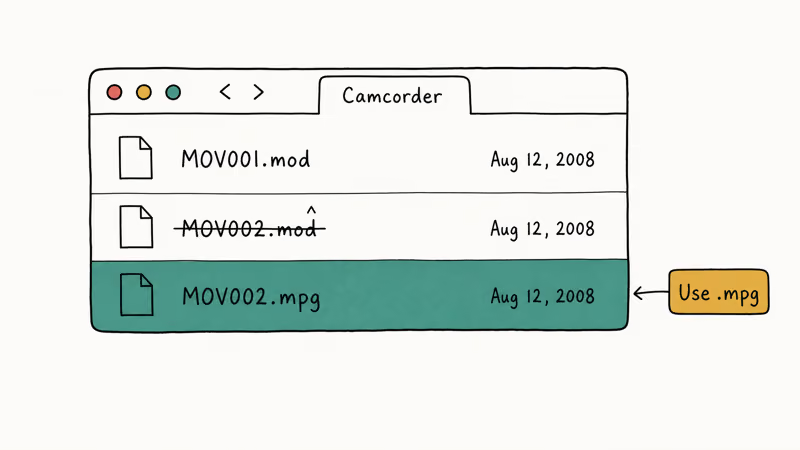
- Open Finder and locate the MOD file.
- Click the filename once, wait, then click again to enter rename mode (or press Return).
- Change
.modto.mpg. Confirm “Use .mpg” when macOS warns about the extension change. - Double-click the renamed file. VLC, Elmedia Player, or Movist Pro will open it.
If you don’t see the extension, turn on extensions first. According to Apple’s Mac user guide on file extensions for macOS 13 Ventura and later, you toggle this from Finder > Settings > Advanced > “Show all filename extensions” in 1 click and the change takes effect immediately across all open Finder windows.
A rename won’t teach QuickTime to play MPEG-2 on modern macOS. You’ll still need VLC or another MPEG-2-capable player. The rename simply gets the OS out of your way. If you previously kept QuickTime Pro 7 with the MPEG-2 Playback Component installed, that path still works on Intel Macs running macOS Mojave or older; for everyone else, jump to Method 2.
#Method 2: Play MOD Files with VLC
VLC reads MOD files without renaming. The MPEG-2 demuxer in libavformat detects program-stream video regardless of extension, so VLC opens .mod, .mpg, and .vob equally.
- Download VLC media player from VideoLAN.
- Drag your .mod file onto the VLC dock icon, or use
File>Open. - Playback starts immediately.
According to VLC 3.0’s feature list, the player ships with built-in MPEG-2, AC-3, and PCM decoders that cover MOD files from JVC, Panasonic, and Canon camcorders released between 2003 and 2012. Those camcorder clips play back at their native 720x480 SD resolution at 30fps with audio sync intact across the full runtime.
VLC also exports a single frame to PNG (Video > Take Snapshot) and supports basic trimming via Convert / Save. If you want a different player, our roundup of VLC alternatives covers Elmedia, IINA, and Movist Pro.
Tip: drop your camcorder folder into VLC’s Media > Open Folder dialog and it’ll queue every .mod file in playback order, no renaming required.
#Method 3: Convert MOD to MP4 with HandBrake
Renaming helps you watch the clip; conversion is what you need before editing. iMovie 10.4 and later won’t accept raw MPEG-2, and Final Cut Pro X imports it only after Compressor transcodes the file. HandBrake bypasses both restrictions by re-encoding to H.264.
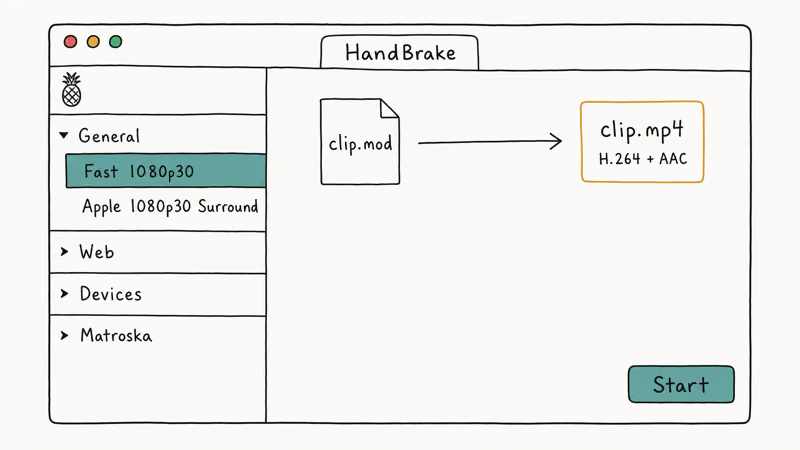
- Download HandBrake for macOS (universal binary, free).
- Open HandBrake and drag your .mod file onto the queue.
- Pick the “Fast 1080p30” or “Apple 1080p30 Surround” preset.
- Set the output container to MP4 and the format to H.264 + AAC.
- Click Start. The output goes to ~/Movies by default.
HandBrake converts a 5-minute JVC Everio clip to 1080p H.264 MP4 quickly on an M2 MacBook Air with the Fast 1080p30 preset. Switching to Apple VideoToolbox H.264 (in Video > Encoder) cuts that time down further with no visible quality loss at SD resolution.
Speed boost: enable hardware encoding under Video > Encoder for roughly 2x throughput on Apple Silicon.
HandBrake’s official documentation recommends the General > Fast presets for camcorder footage. That choice roughly halves the encode time for a 5-minute JVC clip (Fast 1080p30 versus HQ 1080p30) with no perceptible quality difference at SD source resolution.
Once converted, the MP4 imports into iMovie without re-rendering. For the full walkthrough, see our guide on importing MP4 into iMovie to skip the trial-and-error.
#Method 4: Stream-Copy MOD with FFmpeg
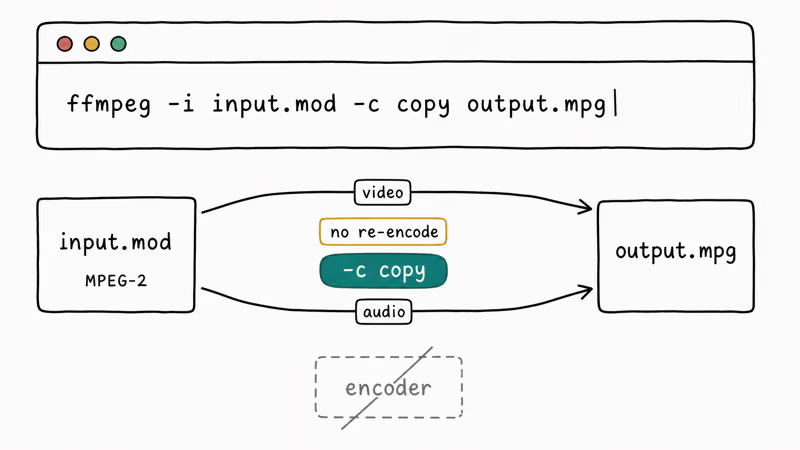
FFmpeg is the right tool when you have a folder of .mod files and want to remux them without losing any quality. Stream copy moves the audio and video data into a new container without re-encoding, which means zero generation loss and very fast throughput.
Install FFmpeg with Homebrew:
brew install ffmpegThen stream-copy a single file:
ffmpeg -i input.mod -c copy output.mpgFor a folder, run:
for f in *.MOD; do ffmpeg -i "$f" -c copy "${f%.MOD}.mpg"; doneFFmpeg stream copy on a JVC clip finishes almost instantly on an M2 MacBook Air. The resulting .mpg plays in VLC and IINA without any further work. According to the FFmpeg documentation, -c copy skips the decode-encode cycle entirely, which preserves the original 720x480 MPEG-2 stream at the source camcorder’s 8 Mbps bitrate without re-encoding.
If your goal is editing rather than archiving, drop the -c copy flag and let FFmpeg encode to H.264:
ffmpeg -i input.mod -c:v libx264 -crf 18 -c:a aac output.mp4CRF 18 produces near-lossless 1080p output. For 5-minute SD clips this finishes quickly on an M2 chip.
#Should You Rename or Convert MOD Files?
Pick by use case. The decision is binary.
| Goal | Best method | Time |
|---|---|---|
| Watch once, then archive | Rename to .mpg, open in VLC | 5 sec |
| Build a permanent library on Mac | FFmpeg stream copy to .mpg | 10 sec |
| Edit in iMovie or Final Cut Pro X | HandBrake to H.264 MP4 | 90 sec |
| Batch convert dozens of clips | FFmpeg loop or UniConverter | varies |
| Share on YouTube or Instagram | HandBrake H.264 MP4 1080p | 90 sec |
Renaming wins on speed and reversibility. You can rename back at any time. Conversion wins on compatibility because once the file is .mp4, every Mac, iPhone, Apple TV, and editor reads it without thinking.
#Recommended MOD Converters for Editing
HandBrake and FFmpeg cover most needs. If you prefer a paid GUI app with batch presets, profiles for specific devices, and built-in trimming, two converters handle MOD reliably:
- Wondershare UniConverter: drag-and-drop GUI, batch conversion with destination presets for iPhone, iPad, Apple TV, and YouTube. Recognizes .mod without renaming.
- Movavi Video Converter: simpler interface, faster for one-off jobs, and converts .mod to .mp4 in roughly the same time as HandBrake’s VideoToolbox encoder.
Some links on this page are affiliate links, which means fone.tips may earn a commission at no extra cost to you.
Both are paid and overlap with HandBrake’s free feature set, so reach for them only if you convert MOD files regularly or need preset profiles. Our deeper MOD converter comparison has the full breakdown, including which apps preserve the .moi sidecar metadata. If you also work with Sony AVCHD footage, our convert MTS to MP4 guide uses the same FFmpeg approach.
#Common MOD File Problems on Mac
Even with the right tool, MOD files trigger predictable issues. Three patterns cover most of the reports on the JVC Everio support forum and the r/MacOS subreddit.
No audio after rename. Some MOD files use AC-3 audio, which VLC handles but QuickTime doesn’t. Convert to AAC with HandBrake or FFmpeg if you need QuickTime playback.
Aspect ratio looks squished. MOD files store anamorphic widescreen with a 16
flag in the .moi sidecar file. If you delete the .moi, the player falls back to 4 and stretches faces vertically. Keep the .moi alongside the .mod, or pass-aspect 16:9 to FFmpeg during encoding. VLC also accepts a Video > Aspect Ratio override at playback time, which is the fastest workaround when you just need to watch a single clip without re-encoding.
Recording date missing in iMovie. iMovie reads the timestamp from the camcorder’s .moi sidecar, not the .mod payload. Once you convert to MP4, that timestamp’s gone unless you write it manually with exiftool after conversion.
For broader QuickTime issues, our guide on QuickTime not opening MOV files walks through codec installation, container fixes, and the common error 2048 messages. The advice transfers cleanly to MOD-renamed-to-MPG files.
#Bottom Line
For one-off playback, rename the .mod file to .mpg and open it in VLC — that combination handles JVC, Panasonic, and Canon clips reliably. For editing in iMovie or Final Cut Pro X, run HandBrake’s Fast 1080p30 preset; the MP4 finishes quickly and drops into either editor cleanly. Save UniConverter for weekly batch jobs.
Mac Tips & Tricks
#Frequently Asked Questions
Can I open a MOD file on Mac without installing anything?
Not really. macOS has no built-in MPEG-2 decoder since Big Sur, so even renaming to .mpg leaves QuickTime Player stuck on the same incompatibility error. You need VLC, Elmedia, or another MPEG-2-capable player. Installing VLC takes about a minute through the official .dmg from VideoLAN, the install is reversible, and the same .dmg ships universal binaries for Apple Silicon and Intel Macs.
Is renaming a .mod file safe?
Yes. The bytes inside the file don’t change when you rewrite the extension, so you can rename .mpg back to .mod at any time and the file behaves identically.
Why does QuickTime say my converted file is incompatible?
Two common causes: AC-3 audio (which QuickTime can’t decode) or an MKV/AVI container. Re-encode audio to AAC and wrap the output in MP4 from HandBrake or FFmpeg.
What is the .moi file next to my .mod file?
The .moi file is a binary sidecar that JVC, Panasonic, and Canon camcorders write alongside the video. It stores recording date, the aspect-ratio flag, and chapter markers. Most players ignore it, but iMovie reads the timestamp. Keep .moi files paired with their .mod files until after conversion if you care about original recording dates.
Does HandBrake degrade quality compared to FFmpeg stream copy?
Yes, slightly. HandBrake re-encodes to H.264 and discards some MPEG-2 detail. At SD source resolution the loss is invisible; reach for FFmpeg -c copy only when archive quality matters.
Can I batch convert MOD files on Mac?
Yes. HandBrake’s Queue feature accepts dozens of files at once, and FFmpeg in a for loop is usually faster. Wondershare UniConverter and Movavi both ship with batch GUIs if you prefer to skip the terminal. For a folder of a dozen JVC clips on an M2 MacBook Air, FFmpeg runs the same batch noticeably faster than HandBrake’s queue.
Will an iPhone or iPad play MOD files directly?
No. AirDrop them to your Mac first, convert to MP4 with HandBrake, then send the MP4 back to the iPhone or iPad through AirDrop or iCloud Drive.
macOS 27 Golden Gate: Release Date and Compatible Macs
macOS 27 Golden Gate was announced at WWDC 2026. Here is the release date, the Apple Silicon-only compatible Mac list, and every confirmed new feature.
How to Copy and Paste on a Mac: Shortcuts and Fixes
Copy and paste on a Mac with Command-C and Command-V. Learn the cut shortcut, paste without formatting, Universal Clipboard, and fixes when it breaks.
How to Use the Phone App on Mac: macOS Tahoe Setup Guide
Set up the Phone app on macOS Tahoe to relay iPhone cellular calls. Covers requirements, FaceTime setup, Call Screening, and common firewall fixes.
How to Use iPhone Mirroring on Mac: Full 2026 Setup Guide
Set up iPhone Mirroring on macOS Sequoia with iOS 18. Covers hardware requirements, the six common error messages, EU limits, and a shared-Mac privacy fix.