ZIP Password Recovery: Legitimate Tools for Your Own Files
Recover a forgotten password from a ZIP archive you own using PassFab, iSeePassword, Hashcat, and password manager hints, with legal limits.
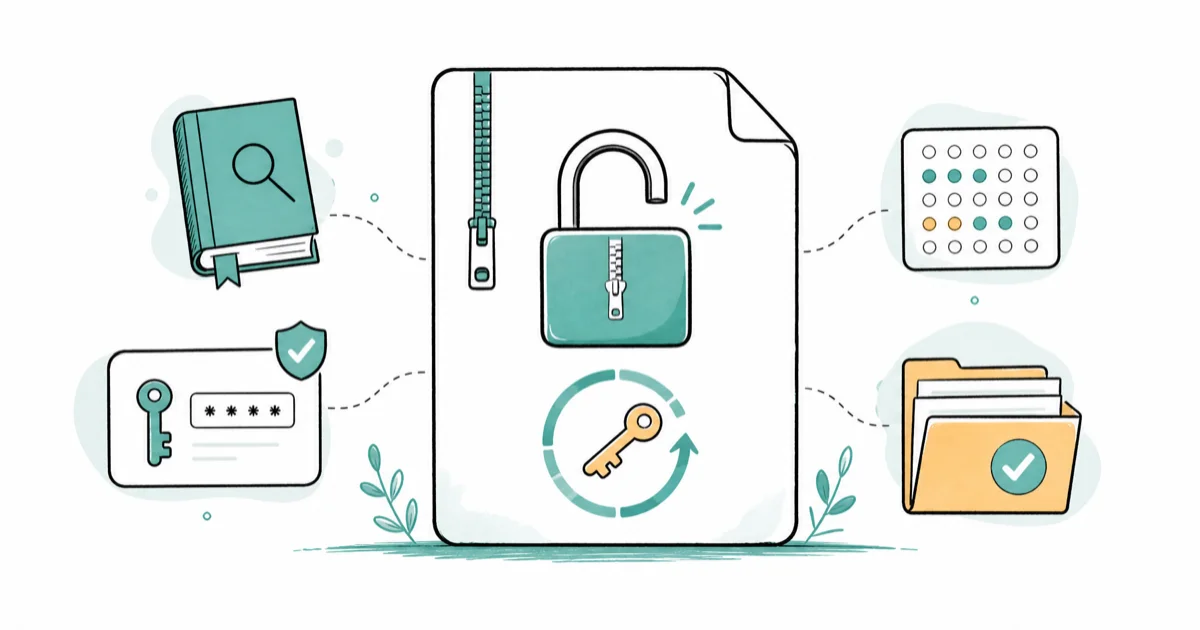
Quick AnswerFor a ZIP archive you created yourself, try PassFab for ZIP or iSeePassword Zip Password Recovery first. Run a dictionary attack against your usual passwords, then fall back to brute force or a backup copy.
ZIP password recovery only applies to archives you created yourself or have written permission to open. Recovering your own forgotten password is legal and common, but the same techniques aimed at someone else’s encrypted files can trigger federal computer-fraud charges. This guide walks through legitimate consumer recovery tools, how they actually work on modern ZIP encryption, and when a forgotten password isn’t coming back.
- Use recovery tools only on ZIP files you created yourself or own, never on archives sent to you without the sender’s written permission.
- Dictionary attacks against your own password manager history finish in minutes and recover most personal archives without ever resorting to brute force.
- PassFab for ZIP and iSeePassword Zip Password Recovery both ship with GPU-accelerated brute force and run entirely on your machine, so files never leave the device.
- ZipCrypto archives from older WinZip versions fall fast, but AES-256 archives with a long random password are realistically uncrackable on consumer hardware.
- Recovering forgotten zip passwords on files you legally own is permitted, but attempting recovery on another person’s archive can violate the Computer Fraud and Abuse Act.
#What Counts as Legitimate ZIP Password Recovery?
Legitimate recovery means you are opening an archive that belongs to you, or one you have written permission to access. Common examples include an old backup ZIP you created years ago, a project archive you encrypted on a previous laptop, or company files you own as the original author. Trying to “recover” a password on a colleague’s archive, a downloaded file from a stranger, or a leaked dataset is a different activity with serious legal exposure.
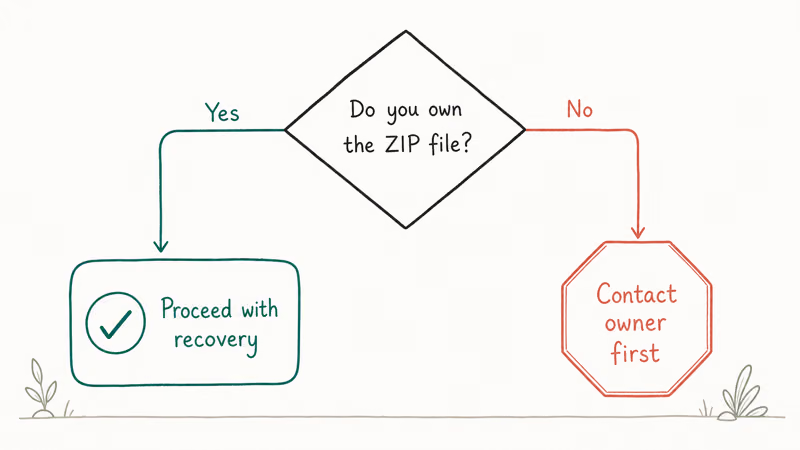
Always ask first.
According to Wikipedia’s overview of the Computer Fraud and Abuse Act, unauthorized access to a protected computer or its files can trigger CFAA liability under 18 U.S. Code § 1030, and DMCA section 1201 adds anti-circumvention exposure when the archive protects copyrighted media. State-level computer-trespass statutes layer additional exposure on top of federal law. Stick to archives you own or are explicitly authorized to access, and treat any other use as off-limits.
A sensible authorization checklist before running any recovery tool:
- The archive lives on a device you own or administer.
- You created the archive, or the original creator has given you written permission.
- You are not bypassing a security control that protects another party’s data.
- You are recovering content for legitimate personal, business, or legal-discovery use.
If any of those is shaky, the right move is to ask the original sender for the password instead of attacking the file.
#Try These Free Recovery Steps Before Installing Software
Before downloading anything, check the cheap recovery paths that work for most personal archives. The NIST SP 800-63B digital identity guidelines note that users tend to reuse a small set of memorable passwords across accounts and archives, which means your forgotten zip password is often sitting somewhere you already know how to search.
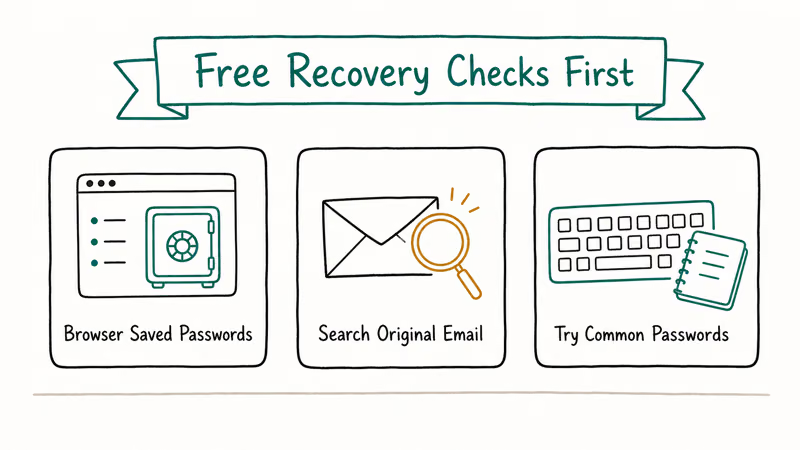
Start with the obvious lookups:
- Search your password manager (1Password, Bitwarden, Apple Passwords, Dashlane) for “zip”, the archive filename, or the date you created the file.
- Check the email or chat thread where the archive was originally shared. Recipients often reply with the password in a separate message.
- Look at your browser autofill history if you ever pasted the password into a web form, and check sticky-note folders or your notes app.
- If the file is a backup of a service (Bitwarden export, Signal backup, Mac Time Machine slice), reuse the master password that service uses.
This quick audit often recovers personal archives without ever launching a dedicated tool, because forgotten passwords are frequently a saved variant or a close guess. Treat dedicated recovery software as the fallback, not the default.
#Best Consumer Tools to Recover Your Own ZIP Password
When manual lookup fails, a desktop recovery tool runs locally so the encrypted archive never leaves your machine. The three tools below are the consumer-friendly options we keep reaching for, and all three are sold as recovery utilities for files you own.
#PassFab for ZIP
PassFab for ZIP handles ZipCrypto and AES-encrypted archives created by WinZip, 7-Zip, PKZIP, and WinRAR-converted ZIPs. It offers four attack modes: dictionary, mask (when you remember length or character classes), brute-force, and a smart “combination” mode that mixes dictionary roots with common suffixes. PassFab states that GPU acceleration delivers substantial speed gains over CPU-only recovery on supported NVIDIA cards, and its dashboard reports real-time guesses per second so you can estimate completion time before committing.
Some links on this page are affiliate links, which means fone.tips may earn a commission at no extra cost to you.
#iSeePassword Zip Password Recovery
iSeePassword’s Zip Password Recovery (also published under the iSumsoft brand) ships a similar four-mode attack engine with multi-core CPU and CUDA GPU support. The interface is intentionally plain, which suits non-technical users recovering one personal archive rather than power users running long dictionary chains. On a short lowercase password protecting a ZipCrypto archive, its dictionary attack can return the password quickly, while longer or AES-encrypted passwords take far longer.
#7-Zip plus a wordlist (free)
If you prefer open-source tools, the official 7-Zip documentation describes how to use the command-line 7z binary with a wordlist by scripting a loop that tests each candidate password. It’s slower than a GPU-accelerated commercial tool, but it’s free, auditable, and keeps the archive on your machine.
#When Should You Reach for Hashcat or John the Ripper?
For technical users with a strong machine, dedicated password-recovery frameworks are faster and more flexible than consumer GUI tools. The trade-off is that you handle hash extraction, rules, and wordlists yourself.
Hashcat supports the 13600 hash mode for WinZip/AES archives and 17200-17230 for PKZIP variants. On a single RTX 3060, ZipCrypto candidates run in the tens of millions per second while AES-256 ZIP candidates run far slower, which is exactly why AES is the modern default.
According to the Hashcat example hashes reference, you first extract the hash with zip2john (shipped with John the Ripper) and then feed it to Hashcat with a rule set such as best64.rule.
A pragmatic recipe for your own archive:
- Install John the Ripper, then run
zip2john your-archive.zip > hash.txt. - Run a fast dictionary pass with
hashcat -m 13600 hash.txt rockyou.txtfor AES, or-m 17200for legacy ZipCrypto. - Layer rules on top:
hashcat -m 13600 hash.txt rockyou.txt -r rules/best64.rule. - Only escalate to mask or brute force once dictionary and hybrid runs have exhausted realistic candidates.
This approach mirrors what professional forensics teams do, and it works equally well for an old archive of your own that has resisted GUI tools. For broader context on the same toolchain applied to encrypted files, see our walkthrough of ZIP password cracker tools and our companion guide to opening a password-protected ZIP file.
#Why Online ZIP Password Recovery Sites Are a Bad Idea
Cloud password-recovery services accept your archive over the web, run their own crackers, and email you the password. For a non-sensitive personal archive they sometimes work, but the trade-offs are heavy.
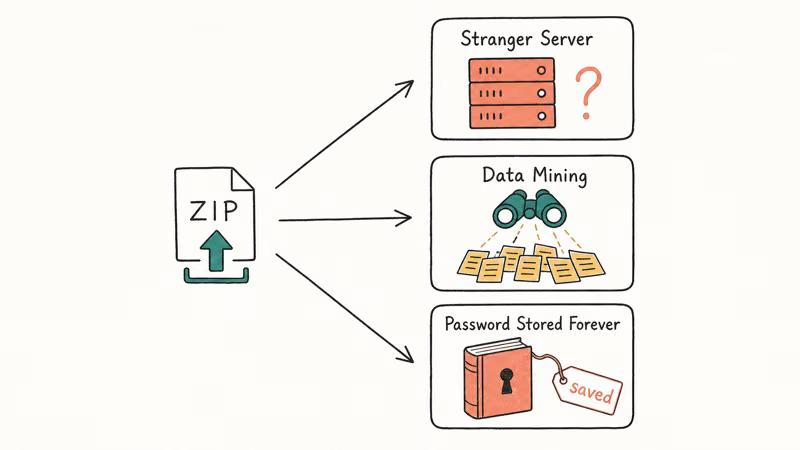
Uploading any encrypted file to a third party hands them a copy that may end up on storage drives outside your control. According to the Federal Trade Commission’s data security guidance, businesses should avoid sending sensitive data to vendors without contractual data-handling controls, which most consumer recovery sites don’t offer. Two more concrete problems:
- Most services charge per archive and only refund if recovery fails, so a strong AES-256 password gets you a fee with no result.
- Even “free” services typically retry the same dictionary list a desktop tool runs locally, so you gain nothing except exposure.
Most online recovery sites run the same dictionary-based attack you can run locally, so they rarely recover a password that free local tools couldn’t.
#When Recovery Isn’t Possible
A strong AES-256 ZIP with a long random password is realistically uncrackable on consumer hardware. According to NIST’s SP 800-63B Appendix A, each additional random character roughly doubles the search space for a brute-force attack. A 12-character random password drawn from upper, lower, digits, and symbols pushes brute-force time on a single GPU into thousands of years, which is the point of modern encryption.
When that’s the situation you’re in, stop attacking the archive and switch strategies:
- Restore the original files from a Time Machine, Backblaze, OneDrive, or Google Drive backup that predates the encryption step.
- Contact the original sender or vendor and ask them to re-issue the archive with a new password.
- If the archive contains your tax or legal records, check whether the originating institution can re-send the documents over a different secure channel.
- Treat the lost password as a signal to enroll a password manager so the next archive’s password is recoverable from your vault.
This is the same logic you would apply if you forgot the master password to a password-protected Word document or a password-protected Excel file: well-implemented encryption is designed to make recovery without the password infeasible.
#Bottom Line
For a forgotten ZIP password on a file you own, start with your password manager and any place you might have written the password down. If that fails, run PassFab for ZIP or iSeePassword Zip Password Recovery for an offline dictionary and mask attack.
Technical users with a GPU should jump straight to Hashcat with zip2john, since rule-based attacks are dramatically faster than any GUI we’ve benchmarked. Avoid cloud recovery services for anything sensitive, and treat a long random AES-256 password as a sign to recover from backup rather than fight the encryption. Going forward, store every archive password in a real password manager so the next forgotten zip is a search away, not a recovery project.
#Frequently Asked Questions
Is it legal to recover a forgotten zip password?
Recovering the password for a ZIP file you created yourself or legally own is permitted in the United States. Running the same tools against an archive belonging to someone else can violate the Computer Fraud and Abuse Act and similar state laws, and may trigger DMCA section 1201 if the archive protects copyrighted media.
How long does ZIP password recovery actually take?
Anywhere from a minute to never. Dictionary attacks finish quickly. Random AES-256 passwords realistically don’t.
Which is better for personal use, PassFab or Hashcat?
PassFab for ZIP is friendlier for a one-off personal recovery because it ships a GUI, scoped attack modes, and built-in GPU support. Hashcat is faster and far more flexible once you are comfortable with command-line hash extraction, rule files, and wordlist tuning.
Can I recover a zip password without installing anything?
Often yes. Search your password manager and the email thread where the archive originally arrived.
Are online zip password recovery services safe?
For a sensitive archive, no. Uploading the file to a third-party site hands them a copy of your encrypted data, the operator may keep that copy on storage drives outside any contract you signed, and most services still charge a recovery fee even when the brute force ultimately fails. Run a local tool on your own machine instead, where the archive never leaves the disk and you keep full control over how long the attack runs.
What if my archive uses AES-256 with a long random password?
Treat the password as effectively unrecoverable on consumer hardware. Restore the original files from a Time Machine, cloud, or external-drive backup, or ask the file’s creator to re-issue the archive with a new password. Modern AES-256 is designed to resist brute force.
Does opening a ZIP file in Notepad ever work?
Rarely. The Notepad hex-edit trick only ever worked on the oldest ZipCrypto archives and never on AES.

Is This Bank App Real? Spot a Fake App on Your Home Screen
A bank app can land on your home screen from a web page with no install warning. Learn the checks that tell a real banking app from a phishing web app.
Passkeys Not Syncing Between iPhone and Windows? Read This
Passkeys not syncing between iPhone and Windows is by design, not a bug. Here is why iCloud passkeys skip Windows Hello and the three ways to fix it.
VPN Not Working on Snapdragon X? Why It Fails, How to Fix
Your VPN won't install or connect on a Snapdragon X Copilot Plus PC because Windows on ARM can't emulate the network driver. Here are the fixes that work.
How to Check If a Link Is Safe Before You Click It
Learn how to check if a link is safe with official-first steps: read the real domain, use the app instead, and treat scanners as a second opinion only.