Who Blocked Me on Instagram? Confirm It Without Spy Apps
Confirm if someone blocked you on Instagram using profile search, logged-out browser checks, and DM behavior. No spy apps, no TOS violations.
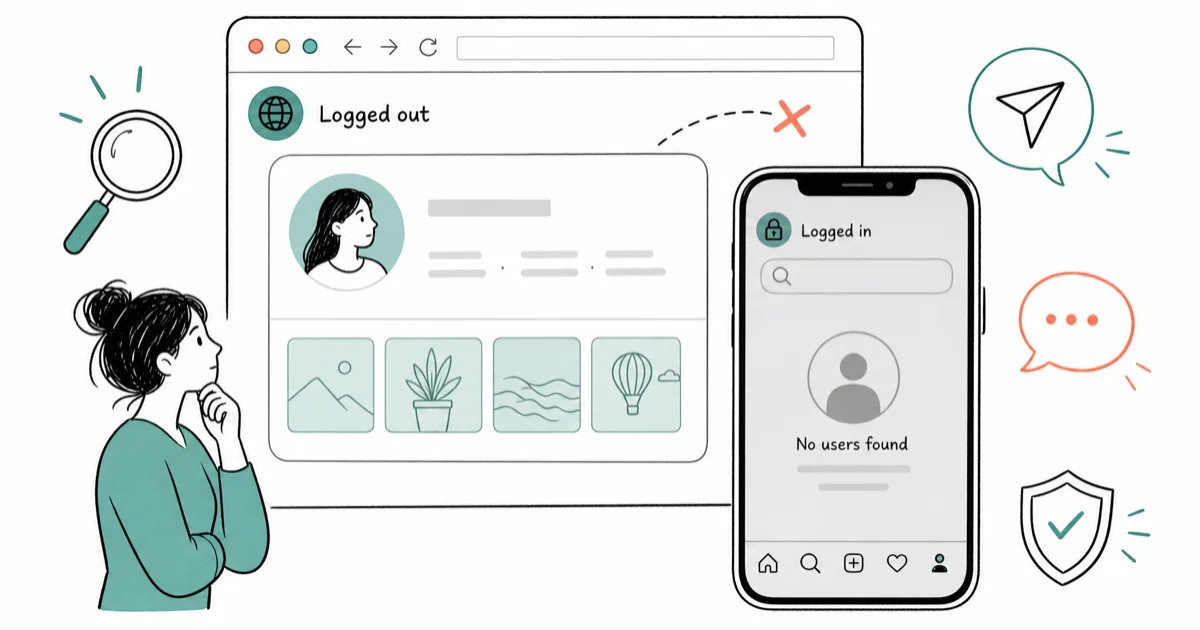
Quick AnswerInstagram never tells you when somebody blocks you, but you can confirm it by searching their handle from your account, then loading their profile in a logged-out browser. If the profile appears while logged out but vanishes when you sign in, that account on your own profile has blocked you.
If you’re trying to figure out who blocked you on Instagram, the only reliable signals come from your own account. Instagram doesn’t push a notification and doesn’t expose a blocked-by list. The platform also forbids third-party “who blocked me” apps that pretend to do either.
- Instagram offers no “who blocked me” feature, so confirmation requires combining a logged-in search, a logged-out browser check, and your existing DM thread
- A block hides the account from your search results, swaps the DM header to “Instagram User,” and removes all previous likes and comments from the blocker
- If the profile loads in a private browser window but disappears when you sign in, you’re blocked on that specific account rather than the user deactivating
- Meta’s Help Center is the official channel for verifying account status, and there is no support pathway to reverse another user’s block
- Third-party “blocker tracker” apps demand your password, violate Instagram’s Terms of Use, and frequently trigger Challenge Required lockouts
Every check below relies only on the official Instagram app and a standard web browser, with no third-party tools.
#Why Doesn’t Instagram Tell You Who Blocked You?
Instagram treats blocking as a private safety tool, so the platform deliberately hides the action from the person who got blocked. According to Instagram’s Help Center article on blocking, a blocked user can’t see the blocker’s profile, posts, Stories, Reels, or activity, and the platform doesn’t notify either side when the block goes into effect.
That design decision means every “are they blocking me?” check has to come from indirect signals on your own account.
Ambiguity also means a missing profile isn’t always a block. The account might be deactivated, deleted, suspended, or renamed. The methods below work by stacking three or four signals together so you can rule out the alternatives before concluding it’s actually a block. No single check is conclusive on its own.
Meta’s Terms of Use prohibit any third-party tool that scrapes account relationships or uses unofficial APIs, which covers every “who blocked me” app out there.
Sticking to the in-app checks below keeps your account on the right side of Meta’s automation rules and avoids handing your password to a stranger. According to the Wikipedia entry on Instagram, the platform crossed 2 billion monthly active users in 2021, which makes account-relationship data a popular scraping target and explains why Meta polices automation so aggressively.
#Step 1: Search Their Handle From Your Logged-In Account
The first signal is the in-app search. Open Instagram on your own account, tap the magnifying glass, and type the suspected blocker’s exact username. If you’ve recently interacted with the profile and it suddenly returns no result, that’s signal number one.
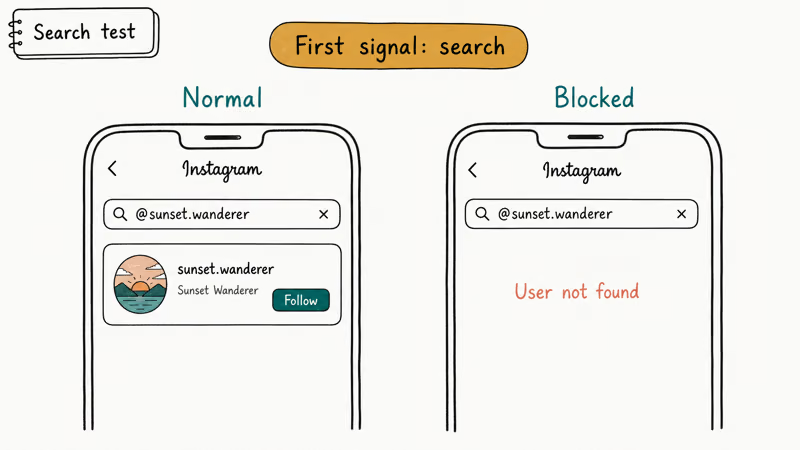
What to watch for:
- An exact-username search returns nothing while a partial search returns unrelated accounts
- The profile briefly flickers in autocomplete then disappears
- Your previous DM thread with the user no longer surfaces a tappable profile picture
After a block is applied, an exact-handle search usually returns zero results almost immediately. Double-check spelling against your DM history before drawing any conclusion, because a username typo can produce the same outcome.
A missing search result alone isn’t proof. Instagram also removes deactivated and disabled accounts from search, and any account flagged for community-guidelines violations is invisible to everyone, not just you. Stack this with Step 2 before you decide.
#Step 2: Load the Profile in a Logged-Out Browser
This is the highest-signal check because it separates a block from a deactivation. Open a private or incognito browser window so you’re fully signed out of Instagram, then visit instagram.com/their_username directly.
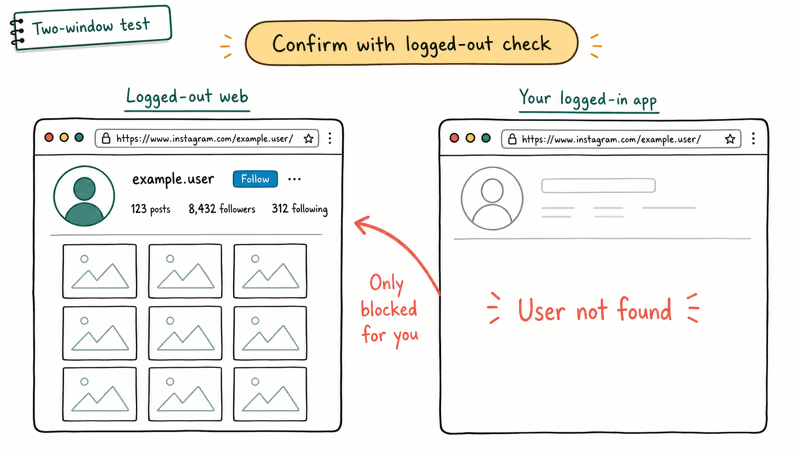
Three possible outcomes:
- Profile loads normally then the account is active and probably blocked you
- “Sorry, this page isn’t available” means the account is deactivated, deleted, or banned (not blocked)
- Profile loads with restricted view indicates the account is private but still active
When an account has blocked you, the profile renders cleanly in the logged-out window but throws the “isn’t available” string on your signed-in account. Meta’s Help Center confirms that deleted accounts disappear platform-wide within roughly 30 days of the request, so a profile that’s invisible everywhere is almost never a block.
If you don’t have access to a desktop, ask a friend who doesn’t follow the user to search for them. Same logic: if your friend sees the profile and you don’t, you’re blocked on your account.
#Step 3: Check Your Existing DM Thread for Block Signals
If you’ve ever exchanged messages with the suspected blocker, your DM history surfaces some of the cleanest confirmation signals. Open Instagram Direct, scroll to the thread, and tap the user’s name at the top.
Block-specific DM behavior:
- The avatar at the top of the chat goes blank or generic
- The display name changes to “Instagram User”
- Tapping the avatar opens a dead-end profile page or a “User not found” prompt
- New message sends fail silently with no read receipt and no delivery indicator
These four behaviors typically appear within minutes of a block. The pattern is consistent enough that DM signals alone get you most of the way to certainty, but Instagram occasionally lags on the avatar swap, so confirm with the logged-out browser check before deciding.
If the thread still shows the user’s real name and avatar, you probably aren’t blocked. They may have just unfollowed you, or you may be confusing them with a different account. The user not found prompt on Instagram sometimes appears for other reasons that have nothing to do with blocking.
#When the Account Is Invisible to Everyone, Not Just You
This is the most common false positive. Three non-block scenarios produce the same disappearance.
Possible non-block causes:
- Deactivation: the user temporarily hid the account, and it’ll come back when they reactivate
- Deletion: they permanently removed the account, and the handle may be reused later
- Disabled by Meta — Instagram flagged a Terms of Use violation and hid the account from everyone
Run the logged-out browser check first. If the profile loads when you’re signed out and disappears when you sign back in, it’s a block. If the profile is invisible from every angle (logged-out browser, friend’s account, search engines), the account itself is gone.
If the account is gone, there’s no path to recover the connection unless the user reactivates and reaches out to you. The forgot Instagram password recovery flow only works for accounts you own, not for finding someone else.
#What to Do (and Not Do) If You Confirm a Block
The right move is to respect the boundary. There’s no Meta-sanctioned way to dispute another user’s block, and Meta’s community guidelines explicitly forbid creating alternate accounts to bypass blocks or harass the blocker.
Five things to skip entirely:
- Creating a second Instagram account to view the blocker’s profile (community-guidelines violation that can disable both accounts)
- Asking mutual friends to relay messages on your behalf
- Posting public callouts demanding an explanation
- Installing any “who blocked me” tracker app (TOS violation plus credential theft risk)
- Reporting the account out of frustration without a real policy violation
Two reasonable next steps:
- Reflect on the last few interactions and let the block stand
- Focus on the relationships and accounts you do have access to, including communities like the Instagram tracker tools we covered for your own growth analytics
If the block came after a heated exchange or harassment from the other side, screenshot what you have and report through Instagram’s in-app report flow. Meta states that abuse reports are reviewed against community standards independently of the block status, so a report can still go through even after you’ve been blocked.
#Why Don’t Third-Party Block-Checker Apps Work?
Every app that claims to show you a list of accounts that blocked you uses one of two tricks, both broken.
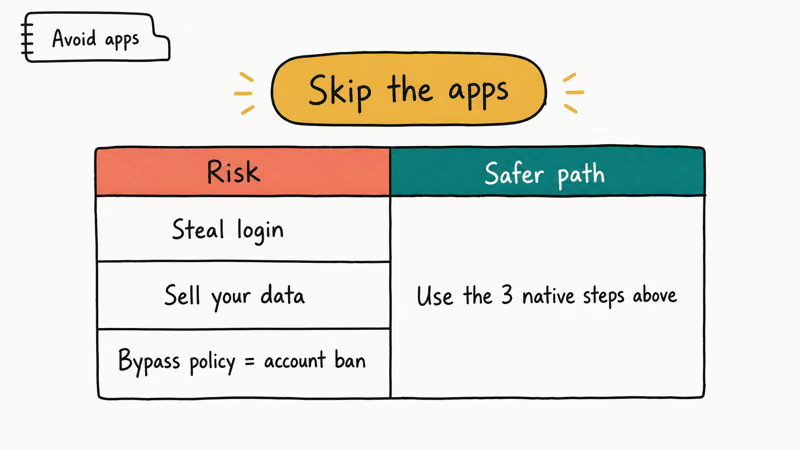
The first trick asks for your Instagram username and password directly, then logs in as you and scrapes your follower delta over time. The second compares your follower list against a public scrape and infers blocks from removals. Neither method matches what Instagram actually exposes through its real API.
Both approaches fail for the same reasons explained in the Instagram tracker piece:
- Instagram’s official API doesn’t expose blocked-by data to anyone except the blocker
- Direct password handoff bypasses OAuth, which is why these apps trigger Instagram’s Challenge Required prompt and temporary account locks
- Follower-delta inference can’t tell a block from an unfollow, a deactivation, or a deletion
- Meta’s automation prohibitions make any third-party tool that performs login-based scraping a Terms of Use violation
These apps frequently trigger the “Challenge Required” lockout within hours of installation, and some accounts end up suspicious login attempt flagged for weeks afterward. The risk-to-reward math doesn’t work; the apps don’t actually tell you anything useful, and the side effects can cost you the account.
Stick to the three legitimate signals above. They’re free, they don’t violate Meta’s rules, and they’re more accurate than anything a third-party app can pretend to surface.
#Bottom Line
The most reliable answer to “did this person block me on Instagram” comes from stacking three signals on your own account. An empty search result for their exact handle is signal one. A logged-out browser session that shows the profile loading normally is signal two. A DM thread that swapped to “Instagram User” is signal three.
If all three line up, it’s a block. If only the first signal hits but the logged-out browser also returns “page isn’t available,” the account is deactivated or disabled rather than blocking you specifically. Don’t install a tracker app. Meta’s Help Center and a private browser window already give you everything those apps pretend to offer, without the credential theft or the lockout risk.
Instagram Tips & Tricks
#Frequently Asked Questions
Does Instagram notify you when someone blocks you?
No, Instagram never sends a notification or alert.
Can I see a list of accounts that have blocked me?
No, Instagram doesn’t offer a blocked-by list anywhere in the app, on the web, or through its official API. Any app or website that claims to show one is either guessing from follower-list changes or violating Meta’s Terms of Use by scraping your account.
What’s the difference between being blocked and someone deactivating their account?
A block hides the profile only from you while keeping it visible to everyone else, so a logged-out browser check still loads it. A deactivation or deletion hides the profile from everyone, so the account is invisible from any logged-out session, any friend’s account, and search engines.
Can I unblock myself on Instagram?
No. Only the person who applied the block can reverse it from their own Settings menu. Meta does not provide a support pathway for the blocked user to dispute or undo another user’s block, so the only options are to accept it or attempt to reconnect through a different channel the user agrees to.
Will using a different Instagram account to view a blocked profile get me in trouble?
Possibly. Meta’s community guidelines treat alternate accounts created specifically to bypass a block as harassment, and both accounts can be disabled when detected. If you already had a second account for legitimate reasons before the block, viewing public posts from it isn’t a violation, but DMing or following the blocker probably is.
How long does an Instagram block last?
Indefinitely. A block stays in place until the blocker manually removes it from their own Settings menu. Instagram has no automatic expiration, no time limit, no temporary-block option, and no support pathway for the blocked user to request a review. The only way out is for the blocker to take that action themselves, or for you to accept the block and move on.
Can I tell if someone blocked me on Instagram if we were never connected?
Probably not with high confidence. If you never followed the user and never exchanged DMs, the DM and “previous likes disappeared” signals don’t apply, and the search test alone can be misleading. The logged-out browser check is your best remaining option in that scenario.
What happens to old DMs if someone blocks me?
The existing DM thread stays in your inbox, and old messages remain readable on both sides, but you can’t send new messages and the blocker’s profile turns into the generic “Instagram User” header. If they unblock you later, the thread re-attaches to their real profile automatically and messaging resumes.
Instagram Parental Controls: Family Center Setup (2026)
Set up Instagram Family Center, privacy settings, Hidden Words, content filters, and time limits with your teen's consent on iPhone or Android.
Instagram Notifications Not Working? Quick Fixes (2026)
Instagram notifications not working? Fix push alerts, DMs, likes, and Stories on iPhone and Android in under 5 minutes with proven 2026 steps.
Instagram "We Limit How Often" Error: How to Fix It 2026
Instagram says "we limit how often you can do certain things"? Wait 24-48 hours, slow down likes and follows, then appeal through Help Center.
Instagram Name Checker: Find Available Usernames Fast
Check Instagram username availability instantly with free tools like Namechk and KnowEm. Find perfect handles and avoid the frustration of taken names.